The scoreboard told the story early, and it kept getting louder. What started as a competitive first quarter quickly turned into a one-sided night at Target Center, where the Timberwolves steamrolled the Heat 122-94 and never let them breathe. Minnesota led by as many as 31 and controlled every phase of the game, pace, physicality, and effort, long before the fourth quarter arrived.
Anthony Edwards was the engine, the accelerant, and the closer all in one. But this wasn’t a solo act. Minnesota won this game with depth, size, and a defensive edge that Miami never solved. The Heat shot just 35.7% from the floor, were crushed on the glass, and spent most of the night reacting instead of dictating. For a Wolves team finding its identity, this was as complete a performance as they’ve put together all season.
1. Anthony Edwards Set The Tone
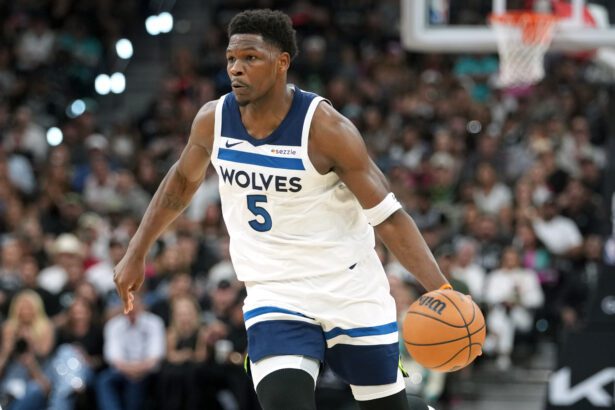
Edwards didn’t waste time feeling the game out. He attacked early, scored from all three levels, and forced Miami’s defense into constant rotation. He finished with 26 points on 8-of-18 shooting, drilled five of his eight attempts from deep, and added five rebounds, three assists, two blocks, and a steal in just 29 minutes. His plus-16 reflected how dramatically the floor tilted when he was out there.
What stood out most was how Edwards scored within the flow. He wasn’t hunting shots; he was taking what Miami gave him and punishing every mistake. When defenders sagged, he pulled. When they closed hard, he went downhill. Minnesota scored 62 points in the paint overall, and Edwards was the primary reason the Heat’s perimeter defense collapsed.
2. Minnesota’s Size Overwhelmed Miami From The Start
It is hard to put your finger on the game; look at the leaders in the categories. Minnesota owned the board (rebounding), 64-50, and Minnesota took advantage of their second chances as they created many of their many offensive rebounds into lots of points. Rudy Gobert was a very strong presence in the paint with 13 points, 17 rebounds (four offensive), and two blocks while being the anchor of Minnesota’s defense. Miami had issues trying to finish inside against Gobert. Miami shot only 35.7% overall, while taking a lot of difficult contested jumpers.
Besides Rudy Gobert, Julius Randle (15 points and 11 rebounds) and Naz Reid (14 points, 6 rebounds) both contributed points and rebounds off the bench. Minnesota’s 12 (offensive) rebounds led to Minnesota scoring 23 fastbreak points to Miami’s 11. It was impossible for Miami to match the physicality of Minnesota.
3. The Heat’s Offense Never Found A Rhythm
Miami’s struggles were constant. The Heat shot 35-of-98 from the field and just 12-of-37 from three, often missing clean looks early before forcing tougher shots late. Bam Adebayo was held to seven points on 3-of-11 shooting, and while he did grab 11 rebounds, he rarely found space to operate as a scorer.
Tyler Herro led the Heat with 17 points, but even that came inefficiently, and he finished a team-worst minus-25. Norman Powell had 21 points, but his scoring came in isolation bursts rather than sustained runs. As a team, Miami turned the ball over 18 times and allowed 21 points off those mistakes, fuel for a Wolves team eager to run.
4. Minnesota’s Role Players Made Winning Plays All Night
This wasn’t just an Edwards showcase. Jaden McDaniels delivered one of his most complete performances, scoring 19 points on 7-of-15 shooting while adding two steals and a block. Donte DiVincenzo knocked down four threes and spaced the floor perfectly, finishing with 12 points and a plus-18 in his 31 minutes.
Off the bench, Naz Reid’s energy changed the tempo when the starters sat. He scored 14 points on 6-of-12 shooting and added a block and a steal, helping Minnesota maintain pressure instead of letting the game stall. Even in limited minutes, Mike Conley and Bones Hyland steadied the offense and avoided mistakes, combining for zero turnovers.
5. Defense Was The Separator
Minnesota imposed themselves. The Wolves recorded eight blocks, seven steals, and held Miami to just 38 points in the paint. They contested nearly every shot without fouling excessively, forcing the Heat into 16 free-throw attempts while getting to the line 23 times themselves.
The most telling stat was effort-related: Minnesota committed just 12 turnovers while forcing 18. That six-possession gap turned into a 16-point advantage in points off turnovers. By the fourth quarter, Miami’s body language said everything. The Wolves didn’t let up, and the result was one of their most convincing wins of the season.