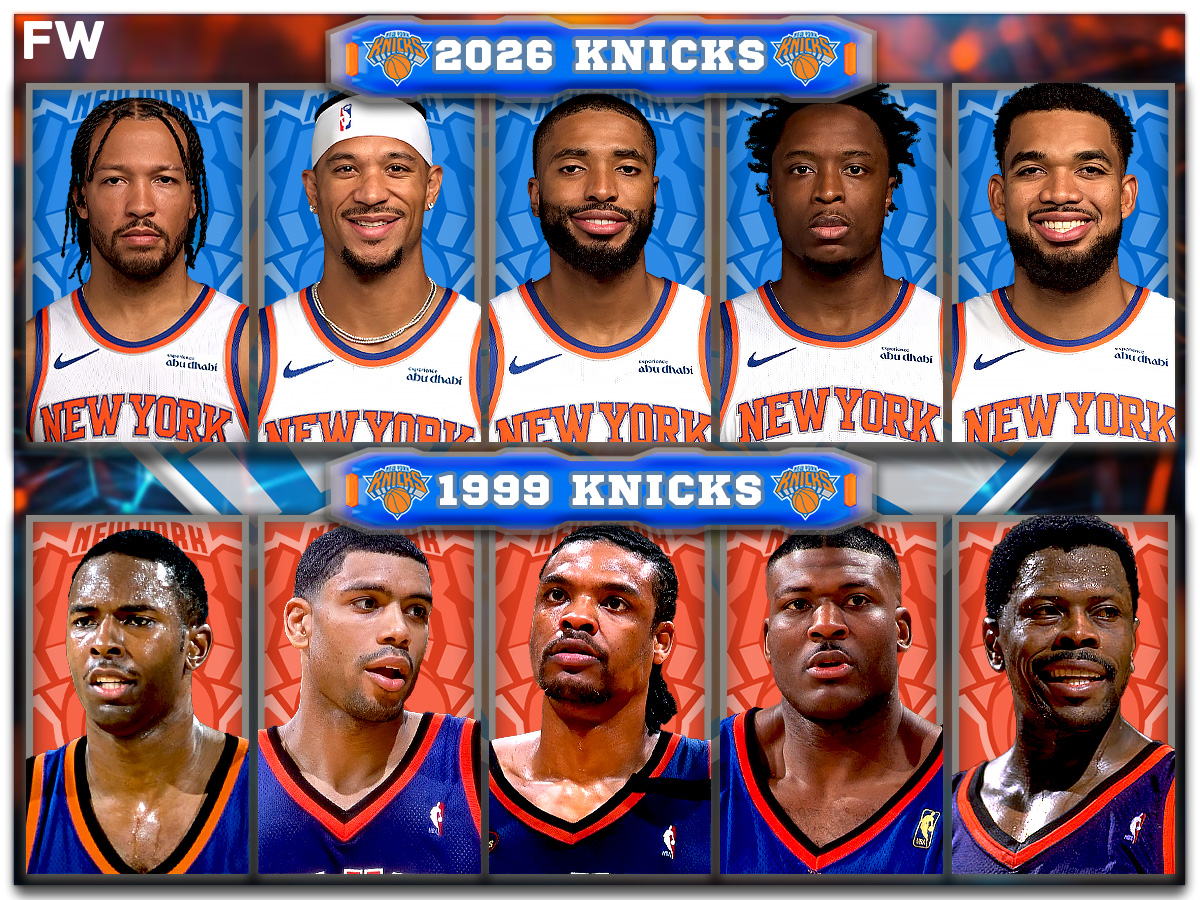
The Knicks are back in the NBA Finals for the first time since 1999, so this is the right moment to compare two very different versions of the same franchise. The 1999 Knicks were ugly, physical, slow, and defensive. They were an eighth seed in a lockout season, but they still made the Finals because they could survive playoff games that became a fight. The 2026 Knicks are different. They are deeper offensively, cleaner in spacing, and much more modern with five starters who can pass, shoot, cut, defend, or attack closeouts.
This matchup is not only about nostalgia. It is about style. The 1999 Knicks had Patrick Ewing, Allan Houston, Latrell Sprewell, Larry Johnson, and Charlie Ward. That team played at one of the slowest paces in the league and finished fourth in defensive rating. The 2026 Knicks finished 53-29, ranked third in offensive rating, seventh in defensive rating, and just swept the Cavaliers in the Eastern Conference Finals.
So, if these two Knicks teams met in a seven-game series, which one would win?
Starters
2026 Knicks Starters: Jalen Brunson, Josh Hart, Mikal Bridges, OG Anunoby, Karl-Anthony Towns
1999 Knicks Starters: Charlie Ward, Allan Houston, Latrell Sprewell, Larry Johnson, Patrick Ewing
The 2026 Knicks have the better modern lineup shape. Jalen Brunson gives them the best half-court creator in the series. He posted 26.0 points, 3.3 rebounds, and 6.8 assists while shooting 46.7% from the field. He is not big, but he controls pace, wins in the mid-range, gets into the paint, and punishes switches. Against a 1999 defense that lived on physicality, Brunson would still be hard to contain because he plays with strength, footwork, and timing.
Karl-Anthony Towns changes the matchup more than anyone. He averaged 20.1 points, 11.9 rebounds, and 3.0 assists on 50.1% shooting from the field this season. The 1999 Knicks had Patrick Ewing, but Ewing would be pulled into uncomfortable defensive spots. Towns can pop to three, play in delay actions, pass from the top, and punish slower bigs if they stay too low. That spacing is a major difference from anything the 1999 Knicks usually defended.
The wing group also helps the 2026 Knicks. Mikal Bridges put up 14.4 points, 3.8 rebounds, and 3.7 assists on 49.0% shooting from the field. OG Anunoby recorded 16.7 points, 5.3 rebounds, 2.2 assists, 1.6 steals, and 0.7 blocks. Josh Hart added 12.0 points, 7.4 rebounds, and 4.8 assists on 50.8% shooting from the field. That gives the 2026 Knicks more two-way balance around Brunson and Towns.
The 1999 Knicks win the physicality part. Patrick Ewing was still productive, with averages of 17.3 points, 9.9 rebounds, and 2.6 blocks. Allan Houston gave them 16.3 points per game while Latrell Sprewell added 16.4 points. Larry Johnson put up 12.0 points and 5.8 rebounds, and Charlie Ward added 7.6 points, 5.4 assists, and 2.1 steals. That lineup had toughness, shot-making, and defensive edge, but the spacing was tight.
The 1999 Knicks would try to drag the series into the mud. Houston and Sprewell could score from the mid-range, Johnson could punish smaller matchups, and Ewing could still protect the rim. But the 2026 Knicks have more ways to create efficient shots. They have Brunson as a true lead guard, Towns as a spacing center, and three wings who can defend without killing offense.
The starting lineup edge goes to the 2026 Knicks. The 1999 Knicks have the stronger old-school interior profile, but the 2026 Knicks have better spacing, better offensive variety, and more lineup flexibility.
Winner: 2026 Knicks
Bench
2026 Knicks Bench: Miles McBride, Landry Shamet, Jordan Clarkson, Jose Alvarado, Mitchell Robinson, Jeremy Sochan
1999 Knicks Bench: Chris Childs, Marcus Camby, Kurt Thomas, Chris Dudley, Herb Williams
The 2026 Knicks bench has more shooting and more modern role clarity. Miles McBride, Jose Alvarado, Landry Shamet, Mitchell Robinson, Jordan Clarkson, and Jeremy Sochan give them different looks. McBride can pressure the ball and hit open threes. Shamet gives movement shooting. Robinson gives offensive rebounding and rim protection. Clarkson gives extra creation. Sochan gives defensive size and switching.
That group has already been useful in the current playoff run. McBride is shooting 42.9% from three in the postseason, while Shamet gave the Knicks major bench shooting in the Eastern Conference Finals by going 11-12 from deep (91.7%). Robinson also gives the 2026 Knicks a way to play bigger if Towns gets attacked inside. That is important against Ewing, Johnson, and Marcus Camby.
The 1999 Knicks bench was also strong for that era. Marcus Camby was the best piece. He had 7.2 points, 5.5 rebounds, and 1.6 blocks in the regular season, then became more important in the playoffs because of his athletic rim protection. Chris Childs gave them 6.8 points and 4.0 assists. Kurt Thomas and Chris Dudley gave them more frontcourt fouls, strength, and rebounding.
The 1999 bench would make the series more physical. Camby could bother Towns as a help defender. Thomas would hit bodies and make every paint catch harder. Childs would pressure the ball and play with an edge. That bench was not pretty, but it fit the team’s identity.
Still, the 2026 bench fits better in a modern matchup. They can add shooting without losing all defense. They can use Robinson as a pure paint big, then go back to Towns for spacing. They can use Clarkson if the offense gets stuck. They can use Sochan if they need more size against Johnson or Sprewell.
The bench edge is close. The 1999 Knicks have better bruising frontcourt depth. The 2026 Knicks have better shooting and more flexible lineup tools. Over seven games, shooting and lineup variety matter more, so the 2026 bench gets a small edge.
Winner: 2026 Knicks
2026 Knicks Advantages
The first advantage is offense. The 2026 Knicks finished third in offensive rating at 119.8 points per 100 possessions. That is a massive gap from the 1999 Knicks, who ranked 26th in offensive rating at 98.6. Some of that is era, but not all of it. The 2026 Knicks have a real shot diet with Brunson, Towns, Bridges, Anunoby, and Hart. The 1999 Knicks relied much more on tough twos, post-ups, and late-clock isolation.
Brunson is the biggest offensive edge. The 1999 Knicks had good guards and wings, but nobody like this version of Brunson. He can run pick-and-roll with Towns, reject screens, draw help, and create efficient shots without needing a size advantage. Ward was tough and smart, but asking him to contain Brunson over seven games is a bad matchup.
The second advantage is spacing. Towns forces the 1999 Knicks to defend in a way they did not normally have to defend. If Ewing stays near the rim, Towns gets open threes. If Ewing comes out, Brunson, Hart, Bridges, and Anunoby have more room to drive. The 1999 Knicks could use Camby more, but then they lose some offensive structure.
The third advantage is wing defense without giving up offense. Bridges and Anunoby can take turns on Houston and Sprewell. Hart can rebound and guard bigger than his size. That matters because the 1999 Knicks needed Houston and Sprewell to score. If the 2026 Knicks make them work for everything, the 1999 offense gets slow fast.
The 2026 Knicks are also more balanced. They don’t need Brunson to score 40 every night. Towns can dominate a quarter. Anunoby can punish gaps. Bridges can hit mid-range shots, cut, and defend. Hart can create extra possessions. In a seven-game series, that balance is a major edge.
The final 2026 advantage is current playoff form. They swept the Cavaliers by winning Game 4 by 37 points, controlled the glass 60-33, and reached the Finals with an 11-game playoff winning streak. This is not only a good regular-season team. This is a team peaking at the right time.
1999 Knicks Advantages
The 1999 Knicks’ first advantage is physical defense. They ranked fourth in defensive rating and allowed only 85.4 points per game. The pace was slower, but the identity was real. They hit cutters. They used bodies in the paint. They made ball-handlers feel pressure. They were not built to win a track meet. They were built to turn games into half-court fights.
Ewing is the biggest difference for the 1999 Knicks. Towns is better offensively in this matchup, but Ewing gives the 1999 Knicks a real anchor. He can contest shots, punish smaller lineups, and make the 2026 Knicks think twice near the rim. Even in an injury-affected season, Ewing had 2.6 blocks per game. He still gave them structure.
Houston and Sprewell also give them shot-making. Houston was one of the better mid-range shooters of that era, and Sprewell was more aggressive downhill. Against a modern defense, they would not have the same spacing that today’s wings enjoy, but they could still attack one-on-one. Sprewell could test Bridges and Anunoby with strength, speed, and transition pressure.
Johnson is another matchup problem if the game becomes slow. He was no longer his peak version from the Charlotte Hornets, but he was strong, smart, and able to punish switches. If the 2026 Knicks put Hart or Bridges on him, Johnson could use his body in the post. If they put Towns on him, the 1999 Knicks could try to pull Towns into more physical defense.
The 1999 Knicks also have the emotional and playoff-survival edge. That team was an eighth seed that beat the Heat, Hawks, and Pacers to reach the Finals. They were not supposed to be there. They won ugly games. They handled pressure. They were not afraid of low-scoring chaos. For a fantasy series, they would not panic if the 2026 Knicks made the first run.
Who Would Win A Playoff Series?
The 1999 Knicks would make this uncomfortable. They would not get blown out easily. Their defense, size, and physical edge would travel in any era. Ewing, Camby, Johnson, and Thomas would make the paint hard. Houston and Sprewell would create enough offense to steal games if the 2026 Knicks got cold.
But the 2026 Knicks have the better full-series answers. Brunson is the best guard in the matchup. Towns is the hardest matchup piece because he changes the floor. Bridges and Anunoby give them the defensive bodies needed for Houston and Sprewell. Hart gives them rebounding from the guard spot. Their bench has more shooting and more lineup flexibility.
The 2026 Knicks also have the better endgame offense. In a close ending, Brunson can create a good shot against set defense. Towns can space or post a mismatch. Anunoby and Bridges can defend the other end without needing to be hidden. The 1999 Knicks would need Houston or Sprewell to have hard shot-making games, and that is a tougher way to survive four times.
Prediction: 2026 Knicks win 4-1