The 2016 Cleveland Cavaliers produced one of the greatest championship runs in NBA history, overcoming a 3-1 deficit against the 73-win Golden State Warriors behind the brilliance of LeBron James and Kyrie Irving. For many, they remain one of the defining champions of the modern era.
A decade later, the 2026 New York Knicks authored their own legendary postseason story. Led by Finals MVP Jalen Brunson, the Knicks stormed through the playoffs with a 16-3 record, erased multiple massive deficits, and delivered the franchise’s first championship in 53 years after an epic Game 5.
Their combination of star power, depth, defense, toughness, and clutch execution made them one of the most complete title teams of the century.
So what happens if these two champions collide in a seven-game series? NBA champion JR Smith made it clear that the 2016 Cavaliers would handle the 2026 Knicks in a 7-game series, but is he right? Let’s break it down.
Starting Lineups
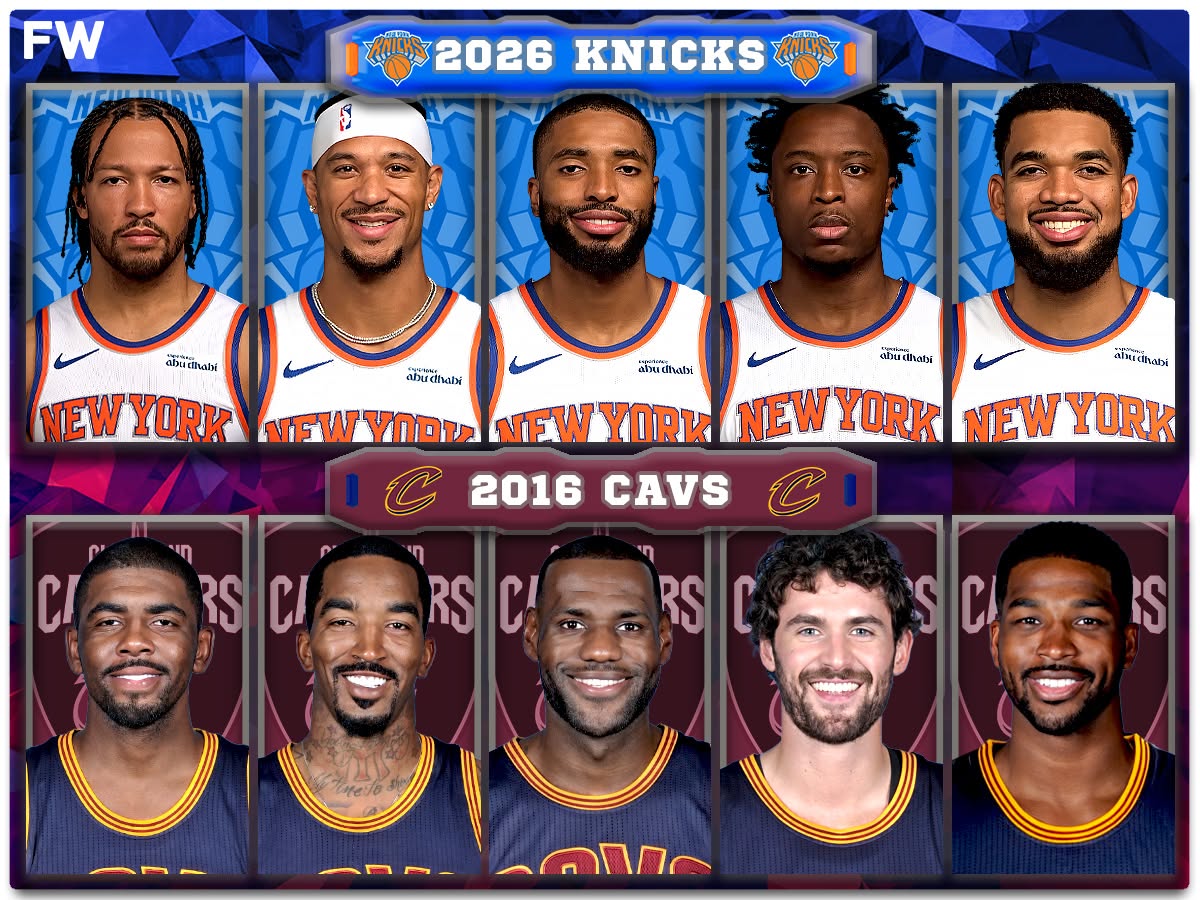
New York Knicks: Jalen Brunson, Josh Hart, Mikal Bridges, OG Anunoby, Karl-Anthony Towns
Cleveland Cavaliers: Kyrie Irving, J.R. Smith, LeBron James, Kevin Love, Tristan Thompson
The Knicks have one of the most balanced starting units in basketball history. Jalen Brunson averaged 28.4 points and 6.1 assists during the championship run while shooting 46.5% from the field. Unlike many superstar guards, Brunson has elite shot creation with efficient decision-making.
Alongside him, Mikal Bridges gives New York an elite two-way wing capable of guarding multiple positions while averaging 13.5 points per game. OG Anunoby brings All-Defensive Team caliber versatility and physicality, Karl-Anthony Towns supplies 15.9 points and 10.6 rebounds nightly while stretching the floor, and Josh Hart provides relentless rebounding, defense, hustle, and transition play.
The biggest advantage for New York is versatility. Every starter can defend, pass, rebound, or create offense. There are no weak links. Brunson may not be LeBron, but New York arguably possesses the stronger overall lineup from one through five.
For the Cavaliers, everything starts with LeBron James.
The 2016 version of LeBron was still near the peak of his powers, averaging 25.3 points, 7.4 rebounds, and 6.8 assists during the regular season before elevating his game to 26.3 points, 9.5 rebounds, 7.6 assists, 2.3 steals, and 1.3 blocks throughout the playoffs. He controlled every aspect of the game and remains the best player in this hypothetical matchup.
Kyrie Irving was equally devastating. During the Finals, he averaged 27.1 points and hit one of the most iconic shots in NBA history. Kevin Love added 14.7 points and 8.8 rebounds in the playoffs while providing floor spacing and rebounding, while Tristan Thompson dominated the glass, and J.R. Smith served as an elite floor spacer.
Cleveland’s top-end talent is extraordinary. The Cavaliers arguably possess the two best offensive players in the series with LeBron and Kyrie, giving them a slight star-power advantage despite New York’s superior balance.
Advantage: Cleveland Cavaliers
Bench
New York Knicks: Jose Alvarado, Landry Shamet, Jordan Clarkson, Miles McBride, Mitchell Robinson
Cleveland Cavaliers: Matthew Dellavadova, Mo Williams, Iman Shumpert, Richard Jefferson, Channing Frye
This is where the series begins to swing toward New York. The Knicks’ bench is loaded with playoff-proven contributors. Sixth Man of the Year candidate Miles McBride provides elite perimeter defense and knockdown three-point shooting. Mitchell Robinson offers rim protection, offensive rebounding, and physicality that can overwhelm opposing second units.
Landry Shamet’s shooting, Jordan Clarkson‘s scoring, and Jose Alvarado round out a deep rotation that allows Mike Brown to maintain intensity for 48 minutes.
The Knicks don’t simply survive non-Brunson minutes; they often win them. Their depth was a major reason they finished the playoffs with a dominant 16-3 record.
Cleveland’s bench was effective but not overwhelming. Richard Jefferson delivered crucial veteran leadership throughout the title run. Channing Frye stretched defenses with his three-point shooting while Matthew Dellavedova provided toughness and ball pressure.
The issue is overall depth. The Cavaliers relied heavily on LeBron and Kyrie for offensive creation. Once those stars rested, Cleveland’s margin for error shrank considerably.
Against most teams, Cleveland’s bench is sufficient. Against the deepest Knicks roster in decades, it becomes a noticeable weakness.
Advantage: New York Knicks
Mike Brown vs. Tyronn Lue
Mike Brown deserves tremendous credit for transforming the Knicks into champions. His defensive system and ability to maximize role players helped create one of the most resilient teams in recent memory. New York repeatedly overcame double-digit deficits because Brown instilled confidence and discipline throughout the roster.
However, Tyronn Lue’s championship pedigree is difficult to ignore. During the 2016 Finals, he consistently made adjustments against a 73-win Warriors team. His decision to stagger LeBron and Kyrie and trust role players in critical moments helped fuel one of basketball’s greatest comebacks.
Lue also possesses a unique understanding of superstar management. Getting the best out of LeBron James while navigating championship expectations is one of the most difficult coaching jobs imaginable.
Both coaches are elite, but Lue’s historic 2016 run gives him the narrow edge.
Advantage: Tyronn Lue
Who Wins A Best-Of-7 Series?
Game 1: Knicks 118, Cavaliers 111
The series opens in a deafening Madison Square Garden, and the Knicks immediately show why they steamrolled through the 2026 playoffs. Jalen Brunson controls the tempo from the opening tip, dissecting Cleveland’s defense. Brunson finishes with 34 points and 9 assists, while Karl-Anthony Towns adds 27 points, 12 rebounds, and 4 three-pointers.
LeBron James delivers a vintage performance with 28 points, 11 rebounds, and 8 assists, but Cleveland struggles to contain New York’s balanced attack. Mikal Bridges scores 21 points, OG Anunoby contributes elite defense on Kyrie Irving, and Josh Hart fills the box score with 14 rebounds. The Knicks’ bench outscores Cleveland’s reserves 38-19, exposing what could become a major theme throughout the series.
The Cavaliers keep things close entering the fourth quarter, but Brunson scores 11 points in the final six minutes to secure the victory. New York’s depth and defense are the difference in Game 1.
Game 2: Cavaliers 121, Knicks 115
LeBron reminds everyone why he is still considered one of the greatest players ever, posting 33 points, 12 rebounds, and 10 assists. Kyrie Irving follows with 31 points, repeatedly attacking switches and hitting difficult shots over Bridges and Anunoby. Cleveland’s stars combine for 64 points and control the game whenever it appears New York is ready to pull away.
Brunson is spectacular again with 32 points and 8 assists, while Towns contributes 24 points and 10 rebounds. However, Cleveland’s role players step up. J.R. Smith drills five three-pointers, Kevin Love records a double-double, and Tristan Thompson grabs six offensive rebounds that lead directly to second-chance points.
A late 10-2 Cavaliers run turns a tied game into a road victory. Cleveland steals home-court advantage and reminds everyone that championship DNA doesn’t disappear.
Game 3: Cavaliers 113, Knicks 108
Returning to Cleveland, the Cavaliers feed off their home crowd and receive perhaps the best offensive game of the series from Kyrie Irving.
The All-Star guard is nearly impossible to guard, finishing with 38 points, 7 assists, and 5 rebounds while shooting over 50 percent from the field. Every time New York cuts the deficit, Kyrie answers. LeBron adds 27 points, 9 assists, and 8 rebounds, controlling the game with his passing.
Brunson records 30 points and 7 assists, but the Knicks struggle to generate consistent offense outside of him and Towns. Mikal Bridges and OG Anunoby combine to shoot just 11-31, allowing Cleveland’s defense to focus heavily on Brunson in the fourth quarter.
The game remains within one possession during the final two minutes, but Kyrie hits back-to-back daggers to put the contest away. Cleveland suddenly looks like the more dangerous team.
Game 4: Knicks 119, Cavaliers 114
Facing a potential 3-1 deficit, the Knicks deliver the comeback that defined their 2026 championship run.
Cleveland leads by 14 midway through the third quarter behind another dominant performance from LeBron, who finishes with 30 points, 10 rebounds, and 9 assists. The Cavaliers appear firmly in control until Brunson completely changes the game.
The Finals MVP explodes for 36 points and 11 assists, scoring from every area of the court while relentlessly attacking Kyrie off the pick-and-roll. Bridges contributes 24 points, Towns adds 22 points and 11 rebounds, and Hart plays one of his trademark playoff games with 13 points, 14 rebounds, and 6 assists.
New York outscores Cleveland 36-22 in the fourth quarter. Their defense intensifies considerably. By the final buzzer, the momentum of the entire series has shifted.
Game 5: Knicks 112, Cavaliers 104
This becomes Karl-Anthony Towns’ signature game.
While much of the series revolves around Brunson and LeBron, Towns takes center stage with 29 points, 15 rebounds, and 5 assists. His ability to stretch the floor creates constant problems for Kevin Love and Tristan Thompson, forcing Cleveland into uncomfortable defensive rotations.
Brunson contributes 28 points and 10 assists, repeatedly finding Towns for open looks when double-teams arrive. Bridges and Anunoby combine to hold Kyrie to one of his least efficient games of the series, limiting him to 22 points on difficult shooting.
LeBron records 31 points, 9 rebounds, and 8 assists, but Cleveland’s supporting cast struggles. The Knicks’ superior depth becomes increasingly apparent as the series wears on, and New York takes its first series lead since Game 1.
Game 6: Cavaliers 117, Knicks 110
LeBron delivers one of the finest performances of the entire matchup. The Cavaliers’ superstar records 39 points, 13 rebounds, and 10 assists, controlling every possession and refusing to let Cleveland’s season end.
Kyrie contributes 29 points, including several impossible finishes around Mitchell Robinson and Towns.
Brunson fights valiantly with 31 points and 8 assists, while Towns records another double-double. However, Cleveland’s desperation is evident. Every loose ball belongs to the Cavaliers. Every critical rebound finds Tristan Thompson. Every big shot seems to come from either LeBron or Kyrie.
The duo combines for 68 points, forcing a winner-take-all Game 7 that feels worthy of the legendary teams involved.
Game 7: Knicks 116, Cavaliers 109
The greatest game in modern Knicks history. LeBron enters the contest determined to add another chapter to his legendary career.
He finishes with 31 points, 11 rebounds, and 9 assists, narrowly missing a triple-double while carrying Cleveland offensively. Kyrie adds 27 points, including several dazzling shot-making sequences that keep the Cavaliers within striking distance.
But New York’s depth shines. Brunson delivers a championship-level masterpiece with 33 points and 10 assists, repeatedly attacking Cleveland’s defense in crunch time.
Towns contributes 25 points and 13 rebounds, while Bridges scores 18 points and plays exceptional defense on Irving throughout the second half.
Josh Hart produces perhaps the most Josh Hart stat line imaginable: 11 points, 12 rebounds, 7 assists, and relentless hustle plays that energize the Garden crowd. Anunoby’s defense helps wear down Cleveland’s perimeter attack, and the Knicks’ bench once again provides valuable contributions.
The game is tied entering the final six minutes before New York unleashes one final run. Brunson scores eight consecutive points, Towns hits a massive three-pointer, and Madison Square Garden erupts as the Knicks pull away.
Final Series Result: 2026 New York Knicks vs. 2016 Cleveland Cavaliers 4-3
The 2016 Cavaliers have the best player in the series and arguably the second-best player as well. LeBron James and Kyrie Irving would be the two most dangerous offensive players on the floor.
But basketball is won by more than superstar talent. The 2026 Knicks possess more depth and switchable defenders.
Brunson’s leadership, Towns’ offensive skills, Bridges’ perimeter defense, Anunoby’s physicality, and Hart’s relentless energy create matchup problems that Cleveland cannot consistently solve over seven games.
LeBron would likely be the best individual performer in the series, but the Knicks would be the better team.