Trade value in the NBA is not only about who is the better player today. It is about age, contract control, positional value, playoff projection, and how many teams would change their entire plan to get one player. That is why the best trade assets under 25 are not always ranked the same way as the best young players in a normal basketball debate.
A 24-year-old All-Star scorer has huge value, but a 20-year-old franchise prospect on a rookie contract may be even more valuable. A two-way big man who can protect the rim and score efficiently can change a rebuild. A young guard who creates offense every night can become the face of a franchise. The price is not only based on production. It is based on how many prime years a team believes it can control.
Victor Wembanyama already averaged 25.0 points, 11.5 rebounds, and 3.1 blocks this season, while Cooper Flagg won Rookie of the Year after averaging 21.0 points, 6.7 rebounds, and 4.5 assists. That is the level of asset at the top of the list. The rest of the ranking is about which young stars carry the strongest mix of ceiling, current impact, and market power.
10. Amen Thompson, Rockets
Amen Thompson is not ranked here because of polish. He is ranked here because the physical profile is rare and the contract value is strong. Thompson is 23, already a high-level defender, and still on a rookie-scale deal. The Rockets exercised his $12.3 million team option for 2026-27, which gives any team one more cheap season before the next major contract decision. For a young player with this much two-way upside, that is valuable trade currency.
The production is already strong. Thompson averaged 18.3 points, 7.8 rebounds, 5.3 assists, 1.5 steals, and 0.6 blocks in 79 games. He shot 53.4% from the field with a 59.4% true shooting mark, and he finished the regular season at plus-368. That is not empty production on a bad team. The Rockets went 52-30, finished fifth in the West, and lost to the Lakers in the first round.
His trade value comes from the defensive range. Thompson can guard guards, wings, and some forwards. He rebounds like a forward, passes like a guard, and puts pressure on the rim without needing many set plays. In the playoffs, he averaged 19.2 points, 7.0 rebounds, 5.7 assists, 2.0 steals, and 1.2 blocks in 44.0 minutes. That workload showed how much the Rockets already trusted him in high-leverage games.
The reason he is not higher is clear. Thompson shot only 21.6% from three on 1.5 attempts per game. That limits playoff spacing and makes roster construction more difficult. If he becomes even a low-volume 33.0% three-point shooter, his value jumps fast. Without that, teams still have to build around his limitations.
Still, under-25 trade value is about ceiling and contract control. Thompson has both. He is already a rotation-shaping defender, already producing on a playoff team, and still not close to a finished player. That combination puts him inside the top 10.
9. Alperen Sengun, Rockets
Alperen Sengun is the safer offensive asset than Thompson, but also the more complicated one. He is already a two-time All-Star-level center, already paid, and already central to how the Rockets play. He signed a five-year, $185.0 million rookie extension with a $37.0 million average annual salary, and his 2026-27 salary is listed at $35.6 million. That contract is large, but it is still reasonable for a 23-year-old offensive hub under long-term control.
Sengun averaged 20.4 points, 8.9 rebounds, 6.2 assists, 1.2 steals, and 1.1 blocks in 72 games. He shot 51.9% from the field, 30.5% from three, and posted a 56.9% true shooting mark. The passing number is the central point. Very few centers can run offense from the elbows, hit cutters, punish switches, and create advantages without being a high-volume three-point shooter. Sengun also finished at plus-205 on a Rockets team that won 52 games and made the playoffs as the fifth seed.
The issue is postseason translation. Sengun’s value is not questioned because he lacks skill. It is questioned because a title team built around a non-vertical, non-shooting center needs very specific roster support. He does not stretch the floor at a high level. He is not an elite rim protector. His 30.5% from three keeps defenses comfortable in playoff coverage.
That is why his trade value is slightly below the cleaner wing and guard assets on this list. Sengun is better than some players ranked above him today, but trade value is not only current production. It is about how many teams can build a championship structure around the player.
Even with those concerns, his floor is high. He is 23, productive, skilled, and under contract for several seasons. A team trading for him gets an offensive identity on day one. The question is whether that identity can survive deep playoff rounds without perfect defensive and shooting pieces around it.
8. LaMelo Ball, Hornets
LaMelo Ball is still one of the most valuable under-25 trade assets because high-end offensive creation is hard to find. He is 24, 6-foot-7, under long-term contract, and already a proven high-volume passer and shooter. The concerns are also obvious: winning, efficiency, and availability history. That is why he is eighth, not top five.
Ball averaged 20.1 points, 4.8 rebounds, 7.1 assists, and 1.2 steals in 72 games this season. He shot 40.7% from the field, 36.8% from three, and 89.9% from the line, with a 54.6% true shooting mark. The field-goal percentage is low, but the passing and three-point volume still carry major value. He made 3.8 threes per game on 10.3 attempts, which changes how defenses guard the first action.
The Hornets also gave his value a better context this season. They finished 44-38, ninth in the East, after a 25-win improvement under Charles Lee. They also defeated the Heat in overtime during the play-in before being eliminated by the Magic. Ball had 30 points and 10 assists in the play-in win, then 23 points and five assists in the loss to the Magic.
His contract is not cheap. Ball is on a five-year, $203.9 million deal, with a $40.8 million salary in 2026-27. That lowers some trade flexibility, but it also gives the acquiring team control through his prime years.
The injury history still has to be part of the evaluation. Ball was shut down late last season with ankle and wrist issues, and his missed games before this year damaged his reputation as a dependable franchise guard. This season helped, because 72 games is a serious availability improvement.
Ball is not a perfect asset. He is expensive, not efficient enough inside the arc, and not a defensive anchor. But a 24-year-old lead guard who can pass at an elite level and shoot off the dribble is still extremely valuable. That profile keeps him above most young players, even with the risks.
7. Scottie Barnes, Raptors
Scottie Barnes is not a perfect offensive star, but his trade value is high because he solves several roster problems at once. He is 24, locked into a five-year, $224.2 million contract, and already works as a forward who can defend, rebound, pass, and play through contact. That contract is large, with a $38.7 million salary this season and a $41.8 million number in 2026-27, but it buys control through his prime years. For a team trading for a young franchise piece, that control carries major value.
Barnes averaged 18.1 points, 7.5 rebounds, 5.9 assists, 1.4 steals, and 1.5 blocks in 80 games. He shot 50.7% from the field, 30.4% from three, and 81.5% from the line, with a 57.7% true shooting mark. The Raptors were also competitive with him as their most important connector, finishing 46-36 and fifth in the East.
The three-point shooting keeps him at No. 7 instead of closer to the top five. Barnes made only 0.9 threes per game on 2.8 attempts. That number does not destroy his value, but it does limit how easily a team can use him as a primary half-court option. He is at his best when he can attack downhill, pass from the elbows, switch defensively, and punish smaller matchups. He is not yet the type of scorer who bends playoff defenses with shooting gravity.
Still, the asset profile is strong. Barnes gives a team a 6-foot-7 forward who can fill the box score without needing 25 shots. His passing is advanced for his position, and his defensive events are not fake production. A forward averaging nearly six assists with more than one steal and one block per game is a rare piece.
The main question is whether he becomes a true No. 1 scorer. If he does, he is a top-five asset. If he does not, he is still a high-level No. 2 or No. 3 piece with size, defense, playmaking, and long-term control. That keeps him above LaMelo Ball and the Rockets’ young core.
6. Chet Holmgren, Thunder
Chet Holmgren’s ranking is tied to one simple fact: efficient two-way bigs with shooting touch and rim protection do not become available. Even in a league full of skilled centers, very few can space the floor, protect the paint, finish above the rim, and play deep into the playoffs without needing the offense built only around them.
Holmgren averaged 17.1 points, 8.9 rebounds, 1.7 assists, and 1.9 blocks in 69 games. He shot 55.7% from the field, 36.2% from three, and 79.2% from the line, with a 65.3% true shooting mark. That efficiency is the reason his value is different from a normal young big. He does not need high usage to impact possessions. He can score from pick-and-pop actions, cuts, rim runs, short rolls, and spot-up threes.
The team context makes the case stronger. The Thunder went 64-18, finished first in the West, and are 8-0 in the playoffs after sweeping the Lakers in the second round. Holmgren has not been protected from postseason pressure. He had 24 points and 12 rebounds in Game 1 against the Lakers, then added 16 points and nine rebounds in the Game 4 closeout.
His playoff numbers also support the ranking. He’s at 18.6 points, 9.1 rebounds, 1.8 blocks, 1.5 threes, and 1.4 steals during the playoff run, while shooting 60.0% from the field. That is high-end production inside a contender, not inflated volume on a rebuilding team.
The contract is expensive, but expected. Holmgren signed a five-year, $239.3 million rookie-max extension, with a $41.3 million cap hit in 2026-27 and control through 2031.
The only reason he is not higher is physical durability and shot-creation level. Holmgren is not a primary offensive engine like Cade Cunningham or Paolo Banchero. He is also still thin for certain playoff matchups. But as a trade asset, his combination of defense, efficiency, shooting, playoff fit, and age is elite. A team can plug him into almost any serious roster and improve immediately.
5. Paolo Banchero, Magic
Paolo Banchero sits this high because he is already a playoff-level offensive engine at 24. His value is not built on projection alone. He has already been asked to carry a large scoring and creation burden for the Magic, and he has produced without playing in a perfect spacing environment.
Banchero averaged 22.2 points, 8.4 rebounds, and 5.2 assists in 72 games this season. He shot 45.9% from the field, 30.5% from three, and 77.5% from the line, with a 56.6% true shooting mark. The three-point percentage is still the weak point, but the rest of the profile is rare. A 6-foot-10 forward who can create shots, draw fouls, rebound, and pass over defenses has a different trade price than a normal volume scorer. He also attempted 8.2 free throws per game, which shows how much pressure he puts on the rim and on opposing frontcourts.
The Magic finished 45-37, eighth in the East, and Banchero remained the player defenses had to load toward. That context is important. This was not empty production on a team going nowhere. The Magic were a playoff team with a defensive identity, and Banchero gave them the half-court creation that most young rosters lack.
His playoff tape also gives both sides of the evaluation. He scored 45 points in Game 5 against the Pistons, then had a difficult shooting night in Game 6. That is the current Banchero experience: enough size and skill to dominate a playoff game, but not yet enough shooting stability to control a full series every night.
The contract is heavy, but it is also part of the appeal. Banchero signed a five-year, $239.3 million designated rookie extension with the Magic, with an average annual salary of $47.9 million and UFA status in 2031. That is expensive, but it gives a team long-term control of a young No. 1 option.
He is not above Cooper Flagg because Flagg is younger and cheaper. He is not above Cade Cunningham because guards who create offense with scoring and playmaking at such a high rate are very rare. Banchero is already expensive, but he is also already a franchise-level scorer.
4. Cade Cunningham, Pistons
Cade Cunningham is the first player on this list who can fully run an offense. That separates him from Barnes and Holmgren. Wings and bigs with two-way value are extremely important, but a 24-year-old lead creator who can score, pass, control tempo, and carry playoff usage has a different trade price.
Cunningham averaged 23.9 points, 5.5 rebounds, 9.9 assists, 1.4 steals, and 0.8 blocks in 64 games. He shot 46.1% from the field, 34.2% from three, and 81.2% from the line, with a 56.4% true shooting mark. The assist number is the main point. He finished second in the league in assists per game, and the Pistons finished 60-22, first in the East. That is a major jump from where the franchise was two years ago.
His playoff run has pushed his value even higher. Cunningham is averaging 29.2 points, 5.4 rebounds, and 7.5 assists in 11 playoff games. He scored 25 points with 10 assists in Game 2 against the Cavaliers, including 12 points in the fourth quarter, to give the Pistons a 2-0 lead in the second round. The series is now tied 2-2 after the Cavaliers answered, but Cunningham has already shown he can lead a top-seeded team through playoff offense.
The contract is heavy, but not a negative. Cunningham signed a five-year, $269.1 million designated rookie extension, with a $46.4 million salary this season and an average annual salary of $53.8 million. That is franchise-player money, but that is exactly how the Pistons use him.
The concerns are specific. Cunningham still turns the ball over a lot because his usage is massive. His 34.2% from three is acceptable, but not elite. He is not the defender that Holmgren or Barnes can be. Those factors stop him from moving higher.
But the league pays for creation. Cunningham gives a team a 6-foot-6 point guard who can organize offense, score in the mid-range, punish switches, and pass over smaller defenders. At 24, with playoff proof and a first-seed season on his resume, he is one of the strongest trade assets in the NBA.
3. Cooper Flagg, Mavericks
Cooper Flagg is the strongest contract-value asset on this list. That is why he is already No. 3 after one NBA season. He is not ranked here because he is already better than every player below him. He is ranked here because he gives a team star-level production, age advantage, and rookie-scale cost at the same time.
Flagg averaged 21.0 points, 6.7 rebounds, 4.5 assists, 1.2 steals, and 0.9 blocks in 70 games as a rookie. He shot 46.8% from the field, 29.5% from three, and 82.7% from the line, with a 54.8% true shooting mark. The shooting is not fully built yet, but the all-around production is serious for a first-year forward. He did not just score. He rebounded, created, defended, and handled different roles inside a broken Mavericks season.
The team context makes the asset even more obvious. The Mavericks went 26-56 and finished 12th in the West, but Flagg still won Rookie of the Year. He led the Mavericks in points, rebounds, assists, and steals across his 70 games. That is an extreme burden for a rookie, and he still produced enough to become the franchise’s new central piece.
His late-season stretch also changed the perception. He averaged 29.2 points, 7.3 rebounds, and 4.3 assists in April, including a 51-point game against the Magic and a 45-point game two days later. That run gave the Mavericks proof that his scoring ceiling is not theoretical.
The contract is the separator. Flagg signed a four-year, $62.7 million rookie deal, with $28.3 million guaranteed. His 2026-27 cap hit is listed at $14.5 million. For a player already producing like a lead option, that number is absurdly valuable.
The weaknesses are clear: 29.5% from three, no playoff sample, and a team situation that gave him more freedom than he would have on a contender. Still, a teenager with this production and this contract would require a franchise-changing offer. That is why he is above every non-Wembanyama and non-Edwards asset.
2. Anthony Edwards, Timberwolves
Anthony Edwards is the closest thing to an available-proof superstar asset, even though the Timberwolves would not seriously discuss him. His value is not built on mystery anymore. It is built on volume scoring, playoff history before age 25, physical force, and a contract that keeps him under control through the rest of the decade.
Edwards averaged 28.8 points, 5.0 rebounds, and 3.7 assists this season while shooting 48.9% from the field. That scoring number placed him third in the league, and it came on a Timberwolves team that still reached the playoffs as the sixth seed after a 49-33 season. The team context is not small. Edwards was not carrying usage for a dead team. He was the main offensive engine for a roster that upset the Nuggets in the first round and is now tied 2-2 with the Spurs in the second round.
The playoff case is the separator. Edwards already has 61 playoff games, which is a huge number for a 24-year-old guard. He is not learning postseason pressure from zero. He has already been trapped, switched against, forced into late-clock possessions, and asked to score when the first action dies. In Game 4 against the Spurs, he scored 36 points, including 16 in the fourth quarter, to level the series. That is the exact type of performance teams pay for when they trade half their future.
His contract is large, but not a problem for his tier. Edwards is on a five-year, $244.6 million designated rookie extension. He is owed $45.6 million this season and $48.9 million in 2026-27. That is expensive, but it is normal money for a 24-year-old No. 1 option who can score near 30.0 points per game and still has another athletic jump left.
He is not No. 1 because Victor Wembanyama is a different asset class. Edwards is still a guard with some playmaking limitations and not the same defensive singularity. But among normal young superstars, he is the highest-priced asset in the league. A team trading for him is not buying upside. It is buying a franchise face already strong enough to sell tickets, win playoff games, and carry a contender’s shot profile.
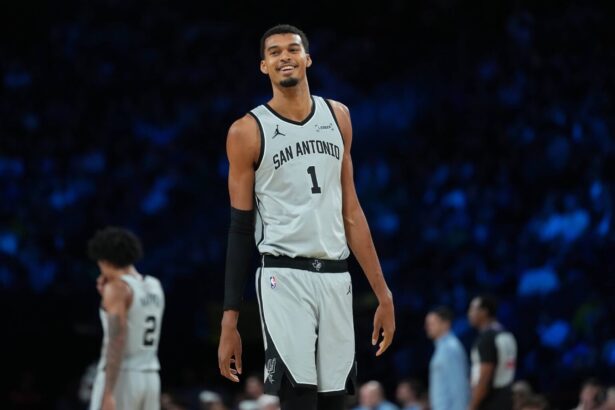
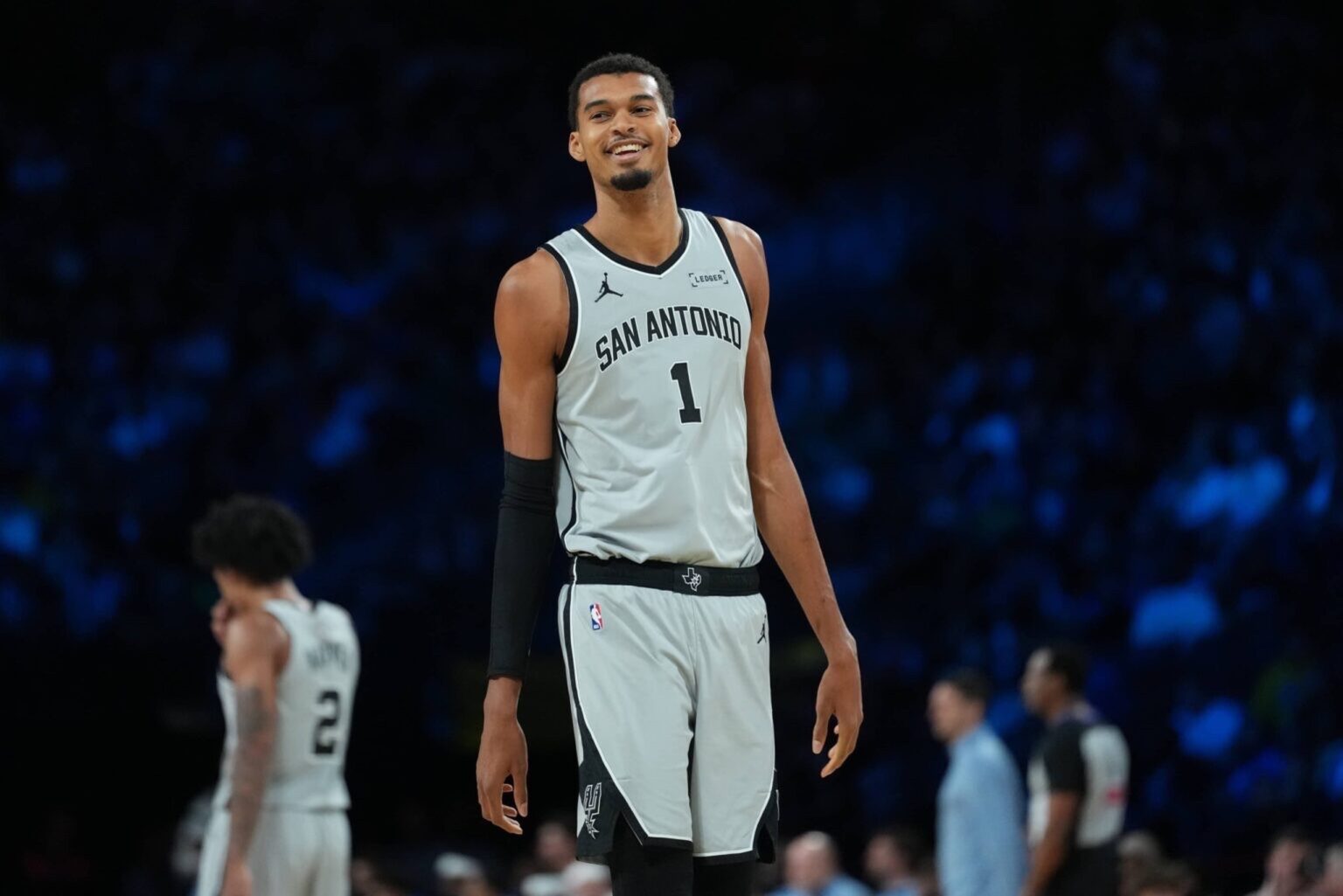
1. Victor Wembanyama, Spurs
Victor Wembanyama is not just the best under-25 trade asset. He is the only player on this list who should be treated as functionally unavailable. A normal offer does not apply. Picks, young players, and salary matching do not create a serious conversation unless the package is absurd enough to damage the other team for years.
The value starts with the contract. Wembanyama is still on a rookie-scale deal, with a $16.9 million salary in 2026-27. That number is ridiculous for his impact. Edwards, Cade Cunningham, Paolo Banchero, Chet Holmgren, and Scottie Barnes are already on or entering max-style salary structures. Wembanyama is giving the Spurs top-five asset value at a mid-rotation salary. That difference changes the entire cap sheet.
The production already matches the hype. Wembanyama averaged 25.0 points, 11.5 rebounds, and 3.1 assists in the regular season. His 197 blocks led the league, putting him with former Defensive Player of the Year winners Dikembe Mutombo and Marcus Camby in that type of season. Then he became the first unanimous Defensive Player of the Year and the youngest winner in the award’s history.
The playoff layer made the ranking even easier. Wembanyama is averaging 19.6 points, 10.5 rebounds, and 4.4 blocks in eight playoff games, with a 65.1% true shooting mark. In Game 1 against the Timberwolves, he had 11 points, 15 rebounds, five assists, and an NBA playoff-record 12 blocks. That is not normal rim protection. That is a player changing the geometry of every drive.
The Spurs went 62-20 and entered the playoffs as the No. 2 seed in the West. That is the strongest argument. Wembanyama is not a future monster on a bad team. He is already the center of a 62-win team before his rookie extension even begins.
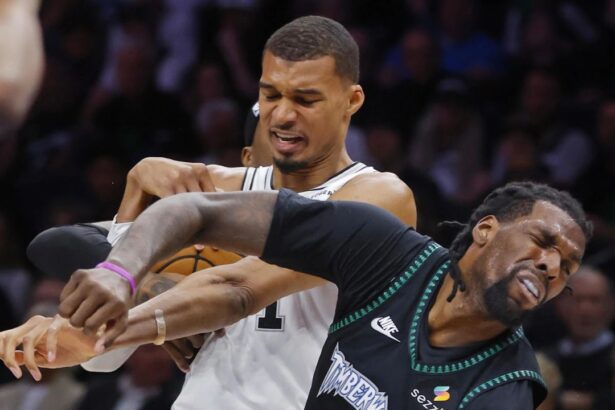
There are still weaknesses. He can be pushed physically. His shot selection can stretch too far from the rim. The Game 4 ejection against the Timberwolves showed he is still learning how teams will provoke him in playoff contact. But none of that changes the trade value. A 22-year-old, 7-foot-4 Defensive Player of the Year who scores 25.0 per game, leads the league in blocks, shoots threes, and costs $16.9 million next season is the strongest asset in the NBA.