The Knicks are 27-18, comfortably in the East mix on paper, but the last couple weeks have looked like a warning flare. They’ve gone 2-9 in a recent stretch, with two separate four-game losing streaks baked into that skid, the kind of stretch that changes the way a front office talks about “minor tweaks.”
The bigger issue is how un-Knicks the defense has felt. For the season, they’ve been a top 10 team in points allowed, but in January, they’ve been in the bottom half, which is already not where a serious contender wants to live.
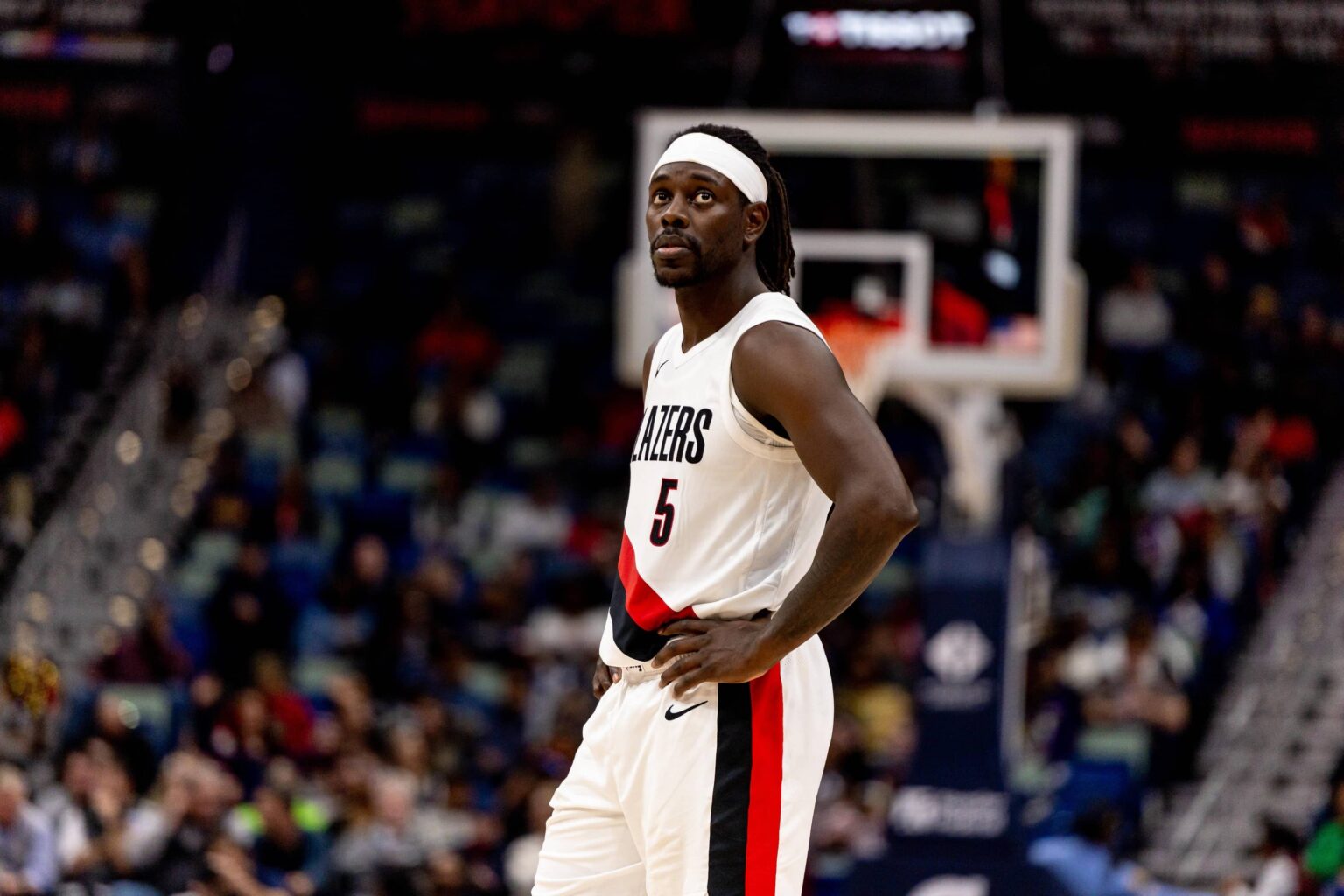
That’s where Jrue Holiday starts to make a lot of sense. He is averaging 15.3 points, 4.5 rebounds, and 6.9 assists in 28.6 minutes, shooting 45.0% from the field, 36.5% from three, and 79.4% from the line, with a 56.6% true shooting mark.
For the Knicks, the appeal is pretty straightforward: Holiday is the rare guard who can organize an offense without hijacking it, and set a defensive tone that actually holds up in playoff-style possessions.
Here at Fadeaway World, Siddhant Gupta already laid out that the Knicks could pursue Jrue Holiday, so now let’s expand the board and walk through three realistic scenarios where the Knicks could land him.
Scenario 1: The Mikal Bridges Heartbreaking Swing
New York Knicks Receive: Jrue Holiday
Portland Trail Blazers Receive: Mikal Bridges, Guerschon Yabusele, Pacome Dadiet, 2026 first-round pick (via Wizards)
This is the cleanest “math works, defense fixed” concept, and also the one that makes Knicks fans flinch, because it asks for Mikal Bridges, the exact archetype they’ve spent over five first-rounders to acquire.
Start with what you’re actually buying. Jrue Holiday is still producing: 15.3 points, 4.5 rebounds, 6.9 assists, and 1.4 steals per game in 19 games, shooting 45.0% from the field. That’s not just “nice veteran numbers”, that’s a real two-way organizer who can steady possessions and guard real people in big minutes.
Now, the part that makes this scenario feel “necessary” from a salary standpoint. Holiday is making $32.4 million in 2025-26. Mikal Bridges is at $24.9 million, Guerschon Yabusele is at $5.5 million, and Pacome Dadiet is at $2.8, for $33.2 million total outgoing. That’s why Bridges ends up in this specific framework. Without him, you’re stacking multiple rotation contracts or ripping the bench apart just to get to the number.
Guerschon Yabusele has also been in active trade-rumor territory, with reports framing the Knicks as exploring ways to move him after he fell out of the main rotation, which is exactly why he fits as salary ballast here.
The “why yes” for the Knicks is pretty straightforward: the perimeter defense and decision-making stabilize immediately. Holiday can play on-ball, peel switches, call coverages, and keep the offense from devolving into chaotic late-clock stuff. And you’re not guessing on fit, his whole NBA identity is plug-and-play.
The “why no” is even louder: Mikal Bridges is not a throw-in. He’s averaging 15.6 points, 4.4 rebounds, 4.2 assists, 1.6 steals, and 0.9 blocks, shooting 49.5% from the field and 38.9% from three (59.4% true shooting).
He’s also been an ironman, recently hitting 600 consecutive games, which matters when you’re trying to survive a long season and a brutal playoff run. If you’re sending that out plus a first, you’re basically saying Holiday is the missing piece that puts you over the top right now, and as good as he still is, that’s not the reality for the Knicks.
For the Blazers, the logic is: flip a 35-year-old guard on a $32.4 million salary into a prime-age two-way wing, a first-rounder, and two extra pieces. They are 23-24 and ninth in the West, competitive but not sitting in a clear contender lane.
That said, they’ve also been trending up lately, including a strong January run and defensive improvement. If they believe they’re building something real this season, they might prefer keeping Holiday’s leadership and two-way impact instead of cashing out early.
Scenario 2: The Rotation Shave For A Real Closer
New York Knicks Receive: Jrue Holiday
Portland Trail Blazers Receive: Josh Hart, Miles McBride, Guerschon Yabusele, 2026 first-round pick (via Wizards)
This is the version that feels like an actual negotiation instead of a thought experiment. It doesn’t force the Knicks into the heartbreak of losing their premium wing, and it gives the Blazers two guards who can play right now, plus the pick that turns “we’ll think about it” into “let’s talk.”
Start with what you’re actually sending out. Josh Hart is averaging 11.9 points, 7.8 rebounds, and 5.2 assists in 34 games, shooting 49.7% from the field and 39.8% from three. He’s not a throw-in, he’s a tone-setter, the kind of glue piece every team pretends is replaceable until they lose him.
Now, the part that makes this package feel real for the Blazers. Miles McBride is averaging 13.0 points, 2.6 rebounds, and 2.7 assists in 34 games, shooting 43.6% from the field and 42.6% from three. That’s a legit rotation guard profile, especially if the Blazers want someone who can defend up the floor and still make teams pay as a spacer.
Here’s the salary logic, since this is where Scenario 2 either works or needs one extra tweak. Jrue Holiday is at $32.4 million in 2025-26. Josh Hart is $19.4 million, Miles McBride is $4.3 million, and Guerschon Yabusele is $5.5 million, which comes out to $29.3 million outgoing. It’s close, but if the Blazers shave some salary to make space, this is the one that can realistically go through for both teams.
The positive side for the Knicks is simple: it’s the cleanest way to get the defensive organizer without gutting the roster’s highest-value wing piece. You consolidate multiple rotation players into one stabilizer, and you attach the 2026 first (via Wizards) to make it a real offer.
But the downside is also clear. Hart matters more than his stat line for the Knicks, and McBride is exactly the kind of cheap, two-way guard depth teams hate giving away. From the Blazers’ side, it’s the classic question of leverage. If they think another team will put a cleaner pick package on the table without sending back as many bodies, they’ll push for more.
Scenario 3: The Center Sacrifice For Control Deal
New York Knicks Receive: Jrue Holiday, Duop Reath
Portland Trail Blazers Receive: Josh Hart, Mitchell Robinson, Guerschon Yabusele
This is the “keep the pick, pay with a center” version, and it’s the one that can look like the best basketball deal for the Blazers if they’re prioritizing actual roster structure over draft capital.
Start with the real swing piece. Mitchell Robinson is averaging 4.9 points, 9.2 rebounds, and 1.2 blocks in 32 games, playing 19.5 minutes and shooting 68.0% from the field. That’s not pretty offense, but it is a real interior identity, the kind of big who changes possessions with rim deterrence and second-chance control.
Now, the part that makes the Knicks’ side feel less exposed. Duop Reath is a small-minutes big (8.1 MPG) averaging 2.9 points and 1.2 rebounds, shooting 44.6% from the field and 41.8% from three. He’s not the point of the deal, he’s the practical “you can survive some minutes” add if you’re moving a specialist center.
Salary-wise, this is the cleanest of the two. Josh Hart ($19.4 million) + Mitchell Robinson ($12.9 million) + Guerschon Yabusele ($5.5 million) is $37.9 million outgoing. Coming back is Jrue Holiday ($32.4 million) + Duop Reath ($2.2million), a total of $34.6 million incoming. This is the one where the spreadsheet looks the least messy.
The reasoning for the Knicks is the asset angle: you get Holiday, and you keep the 2026 first in your pocket. If the Knicks are trying to upgrade without burning the last “move later” bullet, that matters.
The risk is also on sight. Robinson is a real defensive piece, but his value is tied to availability and long-term commitment questions, and that’s where the Blazers could hesitate without a first attached. And on the Knicks side, you’re giving up one of the few true specialist bigs you have, which can show up loudly in playoff possessions.
Final Thoughts
Scenario 3 is the best one, because it’s the only framework that doesn’t rely on pretending a first-round pick magically appears. It’s a real basketball trade. The Knicks get the perimeter organizer they’re hunting, and the Blazers get a position-changing piece in the middle.
The entire swing is Mitchell Robinson. He’s on an expiring $12.9 million deal in 2025-26, and that contract timing is exactly why his name keeps floating around in trade chatter, even when the messaging publicly leans “we like him here.”
He also has the health context hanging over everything, he spent the year working back from an ankle issue that wiped out most of last season, and there have been recent injury-report notes about his ankle status. That combination, expiring money plus health questions, is why Robinson is always one of those “if they make a bigger move, he’s the pivot” guys.
But here’s why I still like it. For the Blazers, Scenario 3 gives them something that’s hard to buy: a true rim presence who rebounds, blocks shots, and changes what opponents even attempt at the rim.
And for the Knicks, it keeps the 2026 first off the table, which matters if you’re trying to keep ammo for a second swing later. Also, the Duop Reath add makes the rotation math at least survivable, it’s not a replacement, but it’s a functional minutes sponge who can stretch the floor in small bursts.
If you’re ranking them by realism and upside, I’d go Scenario 3 first, Scenario 2 second, Scenario 1 as the dramatic “it works on paper, it hurts in real life” option.