March Madness has always had a different standard for greatness. In the NCAA tournament, one night can become a career, and one weekend can turn a star into part of the sport’s permanent history. That is what makes ranking the greatest individual performances so difficult.
Some belong here because of pure scoring violence, like Austin Carr’s 61-point explosion in 1970, still the men’s NCAA tournament single-game record. Others are remembered for carrying an entire title run, like Glen Rice scoring a tournament-record 184 points for Michigan in 1989, or Kemba Walker dragging UConn through one of the best postseason runs the sport has seen.
That is also why this list cannot be only about raw numbers. March Madness history is built on context. The best performances are not just huge stat lines. They come with pressure, elimination stakes, stronger opponents, and moments that still hold up decades later. A 40-point game matters. A 40-point game that saves a season, breaks a powerhouse, or seals a championship means more. That is the line this ranking has to follow.
Here are the 10 greatest individual performances in NCAA March Madness history, combining production, stage, pressure, and the lasting weight of the moment.
10. Glen Rice, Michigan vs. Seton Hall – 1989
Game Stats: 31 PTS, 11 REB, 0 AST, 0 STL, 0 BLK, 48.0% FG, 41.7% 3P
Glen Rice’s title-game explosion was the perfect finish to the greatest scoring run March Madness has ever seen. In Michigan’s 80-79 overtime win over Seton Hall in the 1989 national championship game, Rice put up 31 points and 11 rebounds in 42 minutes, hitting 12 of 25 shots and 5 of 12 from deep. On a night when every possession tightened late, he still gave Michigan the one thing it could trust: a star who could keep producing under championship pressure.
What makes the performance stronger is the context around it. This was not a random heater from a great shooter. Rice entered the game already shredding the tournament and left it as the Most Outstanding Player after leading Michigan to its first national title. His 31 points in the final capped a six-game run that ended at 184 total points, still the NCAA men’s tournament record. So even though this list is about one game, the Seton Hall performance carries extra weight because it came on the biggest stage and sealed a historic tournament legacy in the same moment.
There have been louder box scores in March. There have also been flashier endings. But a 31-point, 11-rebound title-game performance that closes out a record-setting tournament run belongs in this conversation every time.
9. Ja Morant, Murray State vs. Marquette – 2019
Game Stats: 17 PTS, 11 REB, 16 AST, 0 STL, 0 BLK, 50.0% FG, 0.0% 3P%
Ja Morant gets this spot, as his NCAA tournament debut felt like a full takeover without needing a huge scoring number. In Murray State’s 83-64 win over Marquette, Morant finished with 17 points, 11 rebounds, and 16 assists, recording the first NCAA tournament triple-double since 2012. The scoring was efficient enough, but the real weight of the performance came from how completely he controlled the game. He dictated pace, created clean looks over and over, and turned a supposed upset matchup into a comfortable win.
The 16 assists are what make the performance stand out historically. March Madness usually remembers scorers first, but Morant dominated the entire game with playmaking. Every time Marquette tried to settle in, he broke the defense down again. It was one of the most dominant and controlled performances in recent tournament history, and that is exactly what it looked like on tape. He did not just post a rare stat line. He made a No. 12 seed look like the better, calmer, and more talented team from start to finish.
That is why this game belongs on the list. It was not the highest-scoring March Madness masterpiece, but it was one of the clearest examples of one player owning every part of a tournament game on a big stage. Morant announced himself to the whole sport that night.
8. Buddy Hield, Oklahoma vs. Oregon – 2016
Game Stats: 37 PTS, 4 REB, 0 AST, 0 STL, 0 BLK, 65.0% FG, 61.5% 3P%
The Elite Eight is supposed to tighten everything. Possessions get heavier, defenses get sharper, and stars usually have to grind for every basket. Buddy Hield made it look easy anyway.
Against a No. 1 seed with a Final Four spot on the line, Hield exploded for 37 points and completely bent the game around his shot-making. He hit 13 of 20 from the field, and 8 of 13 from deep, but the bigger thing was how helpless Oregon looked trying to slow him down. This was not one hot stretch. It was a full-game scoring clinic from a guard who never let the pressure change his rhythm.
Hield scored 22 in the first half and immediately put Oregon on the back foot. From there, every push felt like it ran into the same wall: another jumper, another three, another possession ending with Hield dictating the terms. That is what made the performance feel so overwhelming. He was not just scoring a lot. He was controlling the emotional shape of the game.
That matters in a ranking like this. Big numbers alone are never enough in March. The performance has to feel bigger than the box score. Hield’s did. On one of the biggest stages in college basketball, against one of the best teams in the country, he delivered the kind of shot-making avalanche that sends a team to the Final Four and stays attached to the tournament forever.
7. Carmelo Anthony, Syracuse vs. Texas – 2003
Game Stats: 33 PTS, 14 REB, 1 AST, 3 STL, 0 BLK, 63.2% FG, 75.0% 3P%
Carmelo Anthony hit the Final Four with Syracuse like the pressure was not even there. As a freshman on the biggest stage, he absolutely delivered right before the NBA Draft.
Against a No. 1 seed and with a title-game trip on the line, Anthony delivered 33 points and 14 rebounds in Syracuse’s 95-84 win over Texas. He shot 12-for-19 from the field, knocked down 3 of 4 from deep, and added three steals in one of the most complete semifinal performances the tournament has seen. The official box score has him at 37 minutes, and the game never really felt bigger than him.
What makes this one stand out is how much pressure it carried. Texas was the last No. 1 seed left, and Anthony still looked like the best player on the floor by a wide margin. Syracuse needed star power to get over the line, and he gave it everything at once: efficient scoring, rebounding, transition force, and total control of the moment. It was a career-high 33 points in college for him, and the best game of his tournament run.
That is why this game belongs here. It was not just a huge night. It was a freshman taking over the Final Four against elite competition and making it look normal.
6. Kemba Walker, UConn vs. San Diego State – 2011
Game Stats: 36 PTS, 3 REB, 3 AST, 2 STL, 0 BLK, 48.0% FG, 50.0% 3P%
Some March Madness performances feel explosive. This one felt inevitable. Kemba Walker walked into the Sweet 16 against a 34-3 San Diego State team and played like the best player in the country, dropping 36 points in UConn’s 74-67 win. He shot 12-for-25 from the field, 4-for-8 from deep, and 8-for-10 at the line, while adding three rebounds, three assists, and two steals in 40 minutes.
What made the game special was the timing of every bucket. UConn did not blow San Diego State out. They had to survive a real fight, and Walker kept answering. He scored 22 of his 36 in the second half and then delivered 12 straight points late as the game tightened. That is what separates this from a normal 30-point tournament game. The stage was big, the opponent was elite, and the pressure only seemed to sharpen him.
There is also the larger March context. This came in the middle of Walker’s famous postseason run, but even inside that stretch, this was the night where his scoring felt most overwhelming. San Diego State had size, toughness, and Kawhi Leonard. None of it changed the game’s main truth. When UConn needed control, Walker took it. That is why this one belongs here.
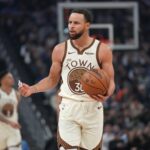
5. Stephen Curry, Davidson vs. Gonzaga – 2008
Game Stats: 40 PTS, 3 REB, 2 AST, 5 STL, 0 BLK, 63.6% FG, 66.7% 3P%
This was the game that changed Stephen Curry from a great college scorer into a national story. Davidson walked into the tournament as a No. 10 seed. Gonzaga had more size, more pedigree, and the safer profile. None of that mattered once Curry got loose.
He finished with 40 points on 14-of-22 shooting, hit 8 of 12 from deep, and added five steals in Davidson’s 82-76 win. The most important part was when it happened. Curry scored 30 of those 40 in the second half, then hit the go-ahead three with 1:04 left before sealing the game at the line. It was not just volume. It was total momentum control. Gonzaga never really recovered once the game tilted his way.
That is what makes this performance an easy top-five pick. March Madness is full of big scoring nights, but very few feel like a player rewriting the event around himself in real time. Curry did that here. He was not just making shots. He was turning a first-round game into the opening chapter of one of the most memorable tournament runs of the modern era. The game tape still points to this as the night Davidson’s run truly announced itself, and that feels right. The bracket changed after this game, but so did Curry’s basketball future.
4. Ed O’Bannon, UCLA vs. Arkansas – 1995
Game Stats: 30 PTS, 17 REB, 3 AST, 3 STL, 0 BLK, 47.6% FG, 25.0% 3P%
Championship games are usually remembered for one shot or one late sequence. Ed O’Bannon owned the entire night. Against the defending champions, with UCLA chasing its first national title in 20 years, O’Bannon finished with 30 points and 17 rebounds in an 89-78 win over Arkansas. The scoring was huge, but the rebounding made the performance feel even bigger. He did not just lead the game. He controlled it. Every loose ball, every extra possession, every stretch where UCLA needed someone to settle the game seemed to run through him.
What pushes this performance near the very top is the stage and the completeness of it. This was not a future NBA superstar catching fire in an early-round matchup. This was the title game against a battle-tested Arkansas team that had survived overtime games and was trying to repeat as champion. O’Bannon still put together 30 points, 17 boards, three assists, and three steals, then walked away as the Final Four’s Most Outstanding Player. His 17 rebounds still sit among the best championship-game marks, and UCLA still frames that night around one fact: when the title was there to be won, O’Bannon was the best player on the floor by a clear margin.
3. Danny Manning, Kansas vs. Oklahoma – 1988
Game Stats: 31 PTS, 18 REB, 2 AST, 5 STL, 2 BLK, 54.2% FG, 0.0% 3P%
Some championship performances feel like a star playing well at the right time. Danny Manning felt bigger than that. It felt like one player dragging an underdog through the last door. Against a heavily favored Oklahoma team, Manning finished with 31 points, 18 rebounds, two assists, five steals, and two blocks in Kansas’ 83-79 title-game win. He shot 13-for-24 from the field, played 36 minutes, and did damage in every area.
What makes the game special is how complete it was. This was not a scorer in his element. Manning controlled the glass, created extra possessions with five steals, protected the rim, and carried the offense against one of the best teams in the country. He remains the only player in title-game history with at least 30 points, 10 rebounds, and five steals. That says enough about how unusual this performance was.
The larger tournament context only makes it stronger. Kansas entered the NCAA tournament with 11 losses and was considered the typical “Cinderella Run”, largely because Manning’s run made the whole thing possible. His 31-point, 18-rebound title game was the centerpiece of that championship. On the biggest stage in college basketball, he did not just lead Kansas. He carried one of the sport’s most famous underdog runs all the way to the end.
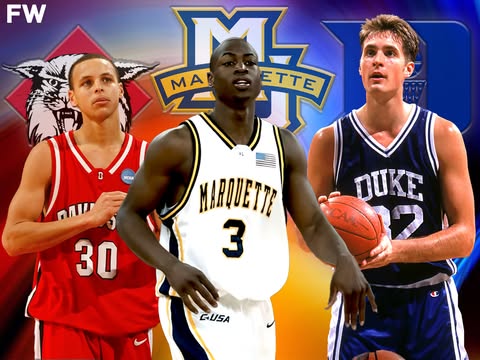
2. Dwyane Wade, Marquette vs. Kentucky – 2003
Game Stats: 29 PTS, 11 REB, 11 AST, 1 STL, 4 BLK, 68.8% FG, 100.0% 3P%
This was the night Dwyane Wade stopped looking like a rising star and started looking inevitable. Against a No. 1 seed with a Final Four berth on the line, he put up 29 points, 11 rebounds, and 11 assists in Marquette’s 83-69 win, while shooting 11-for-16 from the field and hitting both of his attempts from deep. For a guard to post that line in an Elite Eight game is absurd on its own. The four blocks made it even more ridiculous.
What separates this performance is how complete it was. Wade did not just score. He ran the offense, finished possessions on the glass, and protected the rim like a big man. Kentucky never got control of the game because Wade kept owning too many parts of it at once. That is rare in March. Most legendary tournament games come from shot-making avalanches. This one came from total command.
What happened right after is the bigger story. Wade sent Marquette to the Final Four for the first time since 1977, and the game still stands as the defining performance of his college career. On a stage that usually exposes every weakness, he looked like he had none.
1. Christian Laettner, Duke vs. Kentucky – 1992
Game Stats: 31 PTS, 7 REB, 3 AST, 2 STL, 0 BLK, 100.0% FG, 100.0% 3P%
No March Madness performance has ever blended perfection, pressure, and consequence better than this one. In a 104-103 overtime win over Kentucky in the 1992 East Regional final, Christian Laettner scored 31 points, grabbed seven rebounds, handed out three assists, and added two steals. The numbers are already absurd. The shooting makes it historic. He went 10-for-10 from the field, 10-for-10 at the line, and hit the turnaround buzzer-beater that sent Duke to the Final Four.
What separates this game from every other monster March line is that nothing was wasted. Every possession felt enormous. Kentucky kept answering, the game kept stretching, and Laettner never cracked. This was the high-water mark of his NCAA tournament career, and that feels right because the performance was bigger than the famous final shot. The shot made it immortal. The rest of the night made it possible.
That is why this has to be No. 1. Other players scored more. Other stars had huge title-game moments. Nobody matched this combination of flawless execution, elite opponent, winner-take-all stakes, and one of the most iconic endings the tournament has ever produced. If the list is about the greatest single March Madness performance, this is the standard that everything else is chasing.