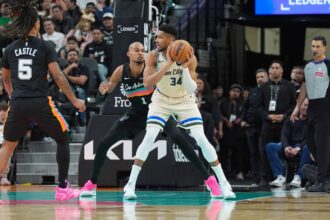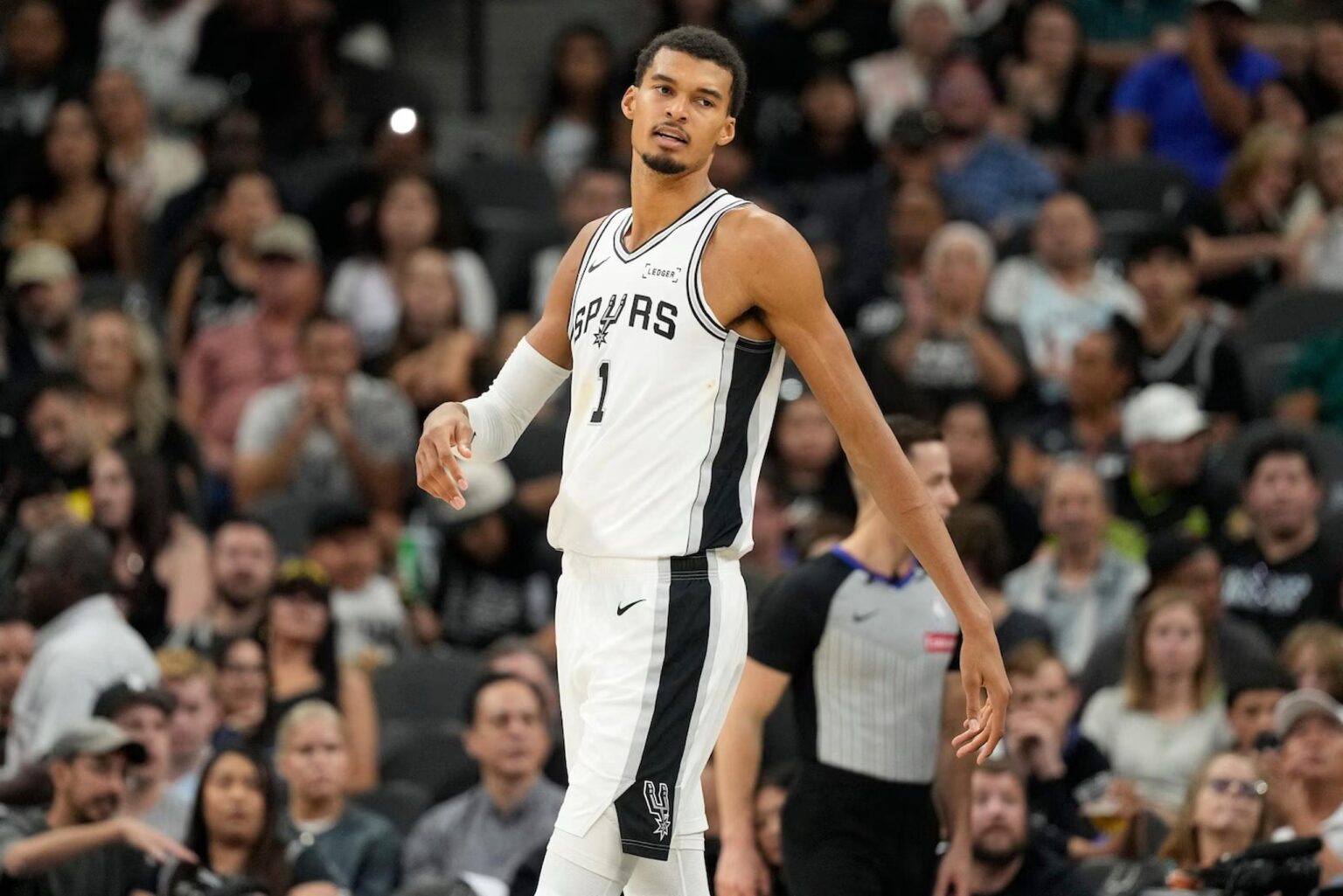
This was a statement wrapped in dominance. The San Antonio Spurs overwhelmed the Chicago Bulls with size, pace, and relentless interior pressure, turning the game into a one-sided showcase of control.
And at the center of it all was Victor Wembanyama, who delivered the fastest double-double in NBA history (8 minutes and 31 seconds). Chicago had scoring bursts, but they never had answers. San Antonio dictated where the game was played, and more importantly, how it was played, from the opening minutes.
This wasn’t just a win – it was a statement wrapped in dominance. The San Antonio Spurs overwhelmed the Chicago Bulls with size, pace, and relentless interior pressure, turning the game into a one-sided showcase of control.
1. Victor Wembanyama Took Over The Game Completely
There are big games, and then there are nights like this. Wembanyama erupted for 41 points on 17-27 shooting, adding 16 rebounds, four assists, and three blocks. He wasn’t just productive – he was everywhere. Efficient in the post, confident from deep (3-6), and dominant on the glass with six offensive rebounds, he controlled both ends without forcing the issue.
What stood out most was how easy he made it look. Chicago threw different looks at him, but nothing stuck. Whether it was single coverage or help, Wembanyama read it instantly. San Antonio scored 66 points in the paint, and a huge portion of that came from his ability to collapse the defense. When a player is that efficient and collects the fastest double-double in history, a win is guaranteed.
2. The Spurs Owned The Glass And It Changed Everything
San Antonio didn’t just win the rebounding battle – they dominated it. A 55-35 advantage overall and 16 offensive rebounds created a steady stream of second-chance opportunities. That’s how you build separation without needing a hot shooting night.
Those extra possessions added up quickly. Even when Chicago got stops, they often couldn’t finish the possession. Wembanyama (16 rebounds) and Stephon Castle (8 rebounds) led the effort, but it was a full-team commitment. When you combine that with San Antonio’s 51.0% shooting, it becomes overwhelming – you’re defending longer, running more, and constantly playing from behind.
3. Stephon Castle Controlled The Flow
Castle’s stat line deserves more attention: 21 points, 10 assists, eight rebounds. That’s near triple-double production, and it came with control rather than chaos. He picked his spots, scoring (6-12 shooting) while consistently creating for others.
His playmaking was key to San Antonio’s 31 assists as a team. The ball moved, the spacing held, and Chicago’s defense never got comfortable. Castle didn’t need to dominate the ball to impact the game – he just made the right read over and over again. That kind of steady orchestration is what turns a talented roster into a cohesive one.
4. Chicago Had Offense… But No Resistance
The Bulls weren’t awful offensively. They shot 46.2% from the field and had four players score at least 15 points, including Tre Jones (23 points on 9-13) and Collin Sexton (20 points off the bench). On paper, that’s enough to stay competitive.
But defense told the real story. Chicago allowed 51.0% shooting, 41.2% from three, and got crushed inside (66 points in the paint). Add in the rebounding deficit and fast-break gap (23-10), and it becomes clear why this game slipped away. The offense gave them a chance – the defense erased it.
5. San Antonio’s Depth Kept The Pressure Constant
What made this performance even more impressive was how little drop-off there was when the bench checked in. Keldon Johnson added 15 points, Dylan Harper chipped in 13, and Luke Kornet provided efficient minutes with 10 points on 4-5 shooting.
The Spurs didn’t rely on one run – they stacked them. Every rotation brought energy, size, and purpose. Even with 12 turnovers, they maintained control because of their rebounding, ball movement, and shot quality. It felt like Chicago was constantly trying to stabilize, but San Antonio never let them.