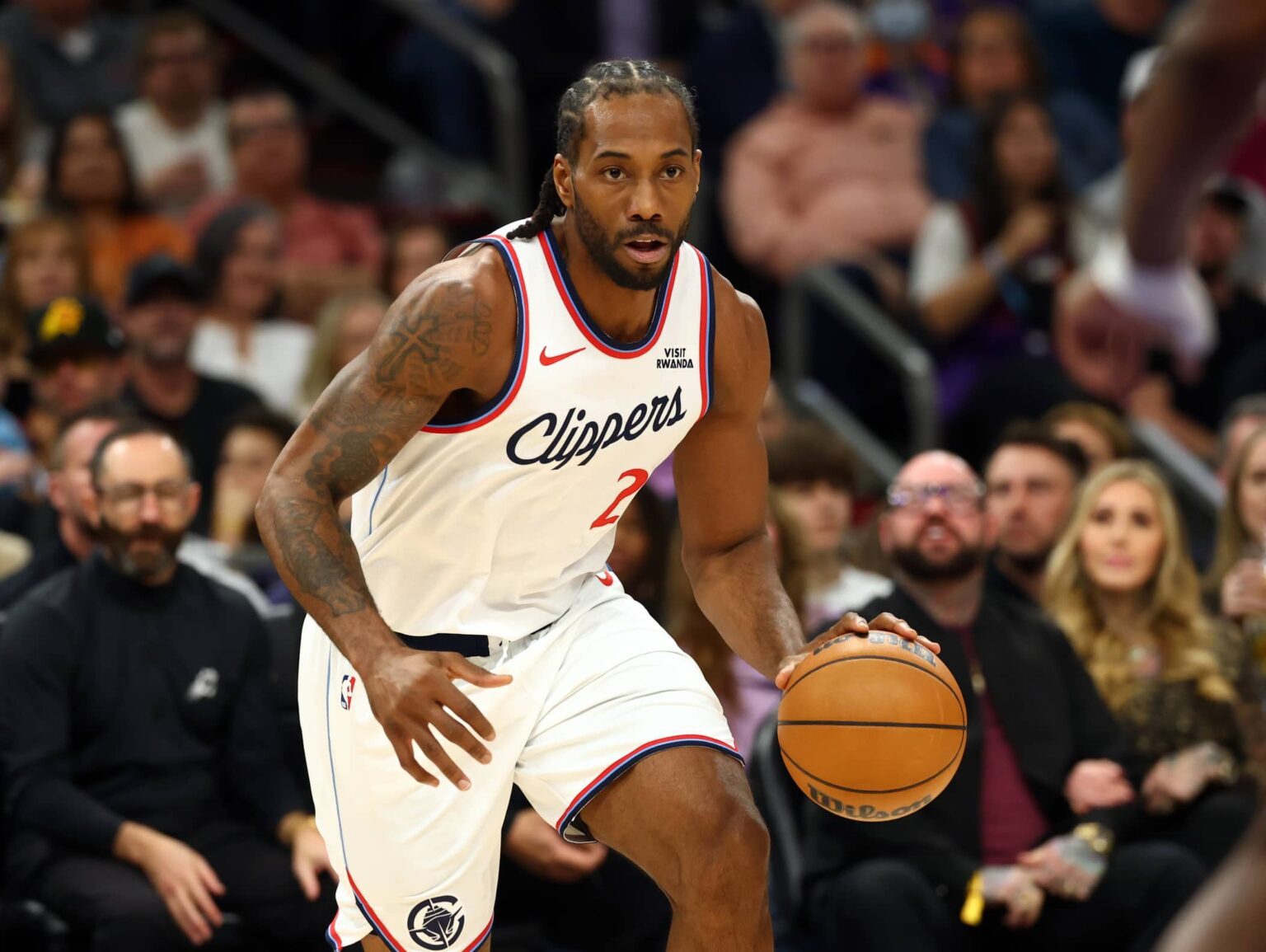
Kawhi Leonard is still a star. That part is not hard to prove. He finished the season with 27.9 points, 6.4 rebounds, 3.6 assists, and 1.9 steals per game while shooting 50.5% from the field, 38.7% from three, and 89.2% from the line. He also posted a 62.9% true shooting mark, played 65 games, finished seventh in MVP voting, and made the All-NBA Second Team.
The problem is not the player. The problem is the trade cost, the contract, the age curve, and the roster he would join.
Leonard is owed $50.3 million in 2026-27. He is 35 next season and can become an unrestricted free agent in 2027. Any team trading for him is taking a one-year expensive bet, unless it already knows it can keep him longer. That makes the destination very important. Leonard needs a team that can give him spacing, defensive help, low-mistake guard play, and enough depth left after the trade.
Some teams look strong because they have names. That is not enough. A bad Kawhi trade destination is not only a bad team. It can also be a win-now team with too much salary, too much injury risk, or too much overlap with his game.
These four teams would create more problems than solutions.
4. Phoenix Suns
The Suns have enough star power to make the idea feel big, but Leonard should be careful with this type of roster. They went 45-37, finished seventh in the West, and lost in the first round against the Thunder. That is not terrible, but it is not a stable title base either. A team trading for Leonard at $50.3 million should already be very close.
The team profile was solid but not special. The Suns had a 115.4 offensive rating, a 113.9 defensive rating, and a +1.5 net rating. That is around the middle of the playoff picture, not the top. They also got swept in the first round, which shows the gap between having good names and having a real postseason structure.
Leonard, with Devin Booker, would score. Booker had 26.1 points and 6.0 assists this season, and his shot creation would take pressure off Leonard in the regular season. The issue is everything around that. Jalen Green had 17.8 points in 32 games, but he shot 42.2% from the field and 31.3% from three. Mark Williams gave them 11.7 points and 8.0 rebounds while shooting 64.4% from the field, but his injury history is a real concern for a team that would be going all-in.
The salary matching is the next issue. Leonard’s $50.3 million number almost forces the Suns to build the package around Green’s $36.3 million salary, then add more money and value with Williams. That would remove one of the few younger perimeter athletes on the roster. If the Clippers ask for more, the Suns would have to include rotation pieces or picks, which makes the depth worse.
The Suns already have enough problems with depth, rim pressure, and point-of-attack defense. Leonard fixes some wing issues, but he does not fix the roster’s age, cost, or lack of clean two-way balance. He would have to defend elite wings, score late, help organize halfcourt possessions, and cover for a team that still may not have enough playoff speed.
This would be a loud move, but not the right one. Leonard should not want to join a team that already looks expensive and thin before the trade.
3. Milwaukee Bucks
The Bucks are a dangerous idea because the ceiling sounds good if Giannis Antetokounmpo stays. Leonard, next to Antetokounmpo and Myles Turner, would give them huge size, elite forward defense, and enough star power to make the East nervous. The problem is that the roster situation is not stable enough.
The Bucks went 32-50 and missed the playoffs for the first time since 2015-16. That is the first warning. They were not a contender this season. They were a lottery team with a superstar. Any Leonard trade would have to be treated as a total reset around Antetokounmpo, not just a normal star addition.
Antetokounmpo still produced at an elite level with 27.6 points, 9.8 rebounds, and 5.4 assists. But the rest of the roster did not hold up. Turner was supposed to be the big frontcourt addition after the Bucks waived and stretched Damian Lillard to create space. He gave them 11.9 points, 5.3 rebounds, and 1.6 blocks in 26.9 minutes per game. That is useful, but not enough for the cost and expectation.
The money makes this very hard. Antetokounmpo is already on a supermax track. Turner is on a large deal. Lillard’s stretched salary is still on the books. Leonard’s $50.3 million would add another major number to a roster that already has limited upgrade paths. If the Bucks trade for Leonard, they would have three huge salary commitments, but not enough proven guard creation or depth.
The basketball fit also has real issues. Leonard and Antetokounmpo can both dominate inside the arc, but the Bucks would still need high-level shooting and a real table-setter. Leonard is not a full-time guard creator. Antetokounmpo is not a half-court point guard. Turner spaces the floor for a center, but he is not enough to fix a full offense.
The other problem is the current Antetokounmpo noise. If he is fully committed, the Bucks can justify aggressive moves. If not, Leonard should not want to be the expensive veteran added to a team that may be one trade request away from a reset. He would be walking into uncertainty, not a clean title plan.
Leonard should want stability at this stage. The Bucks offer name value, but the numbers and roster direction are too messy.
2. Philadelphia 76ers
The 76ers make sense at first because they already have high-end talent. Tyrese Maxey made All-NBA Third Team after putting up 28.3 points, 6.6 assists, 4.1 rebounds, and 1.9 steals with 46.2% shooting from the field, 36.7% from three, and 89.2% from the line. Joel Embiid still had 26.9 points, 7.7 rebounds, and 3.9 assists. Paul George added 17.3 points, 5.3 rebounds, and 3.6 assists.
That is enough talent to be interesting. It is also exactly why Leonard should avoid it.
The injury and age risk would be too much. Leonard is 35 next season. Embiid played 38 regular-season games. George is also an older star with his own availability history. A Leonard-Embiid-George core would have a huge name value, but it would be very difficult to trust over 82 games and four playoff rounds.
Embiid’s playoff line was good on paper at 24.0 points, 7.3 rebounds, and 5.4 assists in seven games, but he shot only 46.0% from the field and 17.9% from three. He also missed time with right hip and ankle injuries in the Knicks series. If Leonard joins that roster, the postseason plan still depends on Embiid being healthy and efficient when the game slows down.
The salary structure is also brutal. Embiid is owed about $120.0 million over the next two seasons. George is set to make around $54.0 million next season. Maxey is over $40.0 million and is already on track for more money if he keeps making All-NBA. Add Leonard at $50.3 million, and the roster becomes almost impossible to deepen.
The fit is not bad in a vacuum. Leonard would give the 76ers another wing scorer, another playoff defender, and a stable option next to Maxey. But the trade cost would likely remove younger pieces, salary depth, or picks. Then the whole roster would depend on three older or injury-risk stars staying healthy.
Leonard should not want that. He needs less physical burden, not another situation where availability can decide the season before the series even starts.
1. Houston Rockets
The Rockets are the best team on this list. That is why this is the hardest one. They went 52-30, finished fifth in the West, and had a +5.4 net rating with an offensive rating of 118.6 and a defensive rating of 113.2. That is contender-level team quality. They also have real size, defense, and young talent.
That still does not make Leonard the right target.
The Rockets already made their older-star move with Kevin Durant. Durant was excellent individually. He had 26.0 points, 5.5 rebounds, and 4.8 assists while shooting 52.0% from the field, 41.3% from three, and 87.4% from the line. He also played 78 games and made the All-NBA Second Team. The production was real.
But the playoffs showed the problem. The Rockets lost to the Lakers in six games and averaged only 98.6 points per game in the series. Durant’s presence raised the ceiling, but his absence in the playoffs showed more issues. The offense still needed more guard creation, more shooting balance, and more late-clock structure. Adding Leonard gives them another great scorer, but it also doubles down on older wing isolation.
That is a dangerous path. Leonard and Durant are both elite midrange scorers, but both are also older forwards who need smart workload management. Durant is 37. Leonard is 35 next season. A Durant-Leonard core would have huge shot-making, but the Rockets would be shifting away from the younger two-way structure that made them good.
Amen Thompson had 18.3 points, 7.8 rebounds, and 5.3 assists while shooting 53.4% from the field. Alperen Sengun had 20.4 points, 8.9 rebounds, and 6.2 assists. Tari Eason remains a restricted free agent after giving them 10.5 points and 6.3 rebounds. Jabari Smith Jr. still fits the forward timeline. The Rockets have a group that can defend, rebound, run, and grow. A Leonard trade would probably cost some of that.
The salary also becomes a serious problem. Leonard at $50.3 million next to Durant’s money and future extensions for Thompson and Eason would put the Rockets into a very tight cap position with Smith and Sengun already on big salaries. They would not only be paying for talent. They would be paying to shorten the timeline.
From Leonard’s side, the role also may not be ideal. He would be joining a team that already has Durant as the top scoring forward, Sengun as a high-touch hub, and Thompson as a growing on-ball force. Leonard would still get touches, but the fit is not as clean as it looks. The Rockets need more quick guard pressure and shooting volume, not another expensive forward who likes the same areas of the floor as Durant.
The Rockets are good. That is exactly why Leonard should avoid this trade. He should not want to be the player who forces them to trade away the younger depth that makes them dangerous.
Final Thoughts
Leonard should not just look at records. He should look at the structure. At this point in his career, he needs spacing, health support, defensive help, and a roster that does not lose too much in the trade.
The Suns have star power, but not enough stability. The Bucks have Antetokounmpo, but too much uncertainty. The 76ers have elite talent, but the injury risk is too high. The Rockets are the best team here, but the fit would be too expensive, and the window would be short.
Leonard is still a championship-level player. That is why the wrong trade would be so damaging. He does not need the loudest team. He needs the one that can protect his body, keep the floor spaced, and still have enough depth left after paying the price.