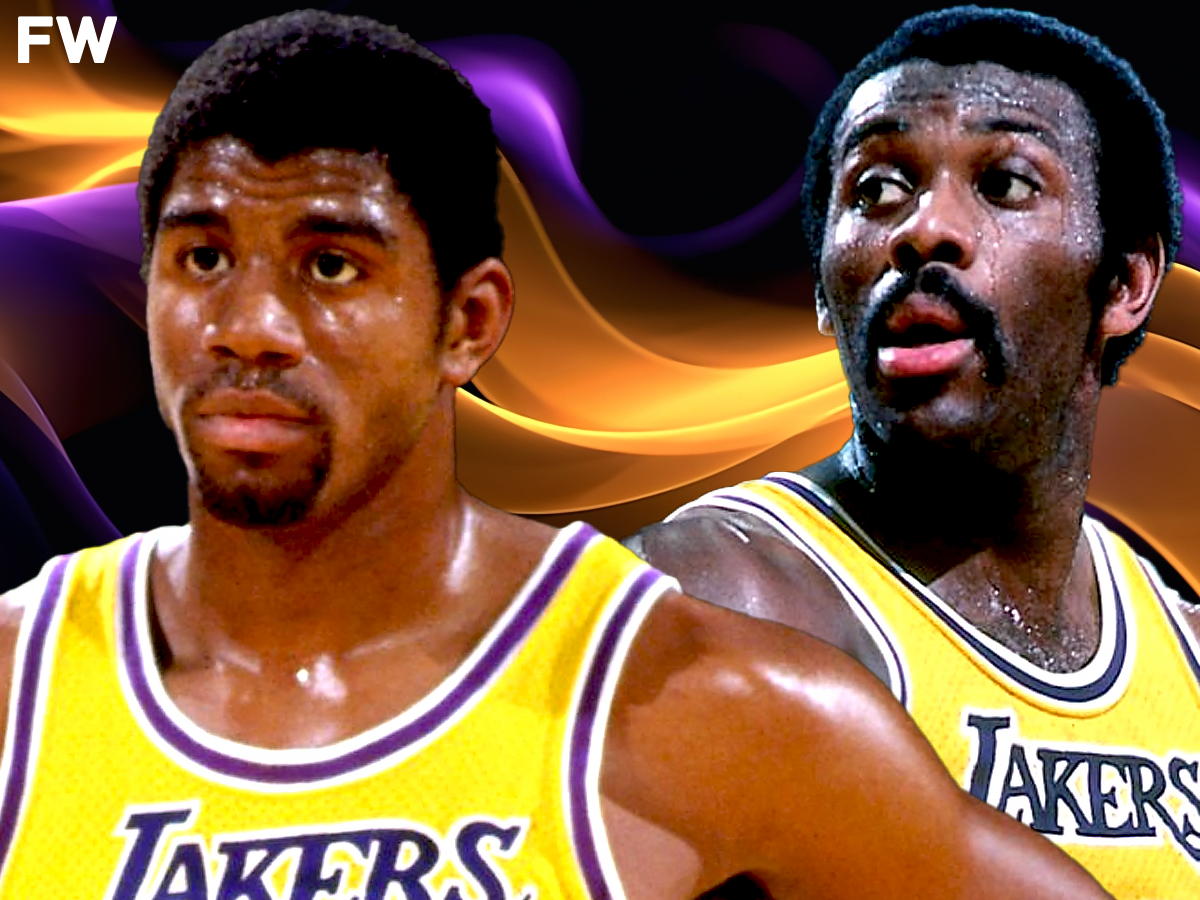
Bob McAdoo never lacked confidence, and when Magic Johnson entered the NBA in 1979, he made sure the rookie understood exactly who came before him.
Former Lakers trainer Gary Vitti shared a story that captured McAdoo’s mindset perfectly when he was on Byron Scott’s Fast Break podcast:
“Bob McAdoo was Michael Jordan before Michael Jordan was Michael Jordan. Rookie of the Year, scoring leader, MVP. Now Magic Johnson comes along, 6’9 point guard, right? Here’s Bob talking to Magic, dead serious.”
“‘I don’t know why they make such a big deal about you. I was the first big motherf***er to take the ball up the floor. I paved the way for motherf***ers like you.'”
That line captures McAdoo’s mindset. He saw himself as the original blueprint. A big man who handled the ball, scored from anywhere, and dominated offensively long before Magic became a superstar.
McAdoo’s resume backs that confidence. He won Rookie of the Year in 1973, MVP in 1975, and led the league in scoring three straight seasons from 1974 to 1976. During that stretch with the Buffalo Braves, he averaged 30.6, 34.5, and 31.1 points per game. His 1974-75 MVP season stands out. He averaged 34.5 points, 14.1 rebounds, and 2.2 blocks while shooting over 51.2% from the field. Those numbers put him among the most dominant offensive bigs ever.
For his career, McAdoo averaged 22.1 points, 9.4 rebounds, and 2.3 assists. He was a five-time All-Star, two-time All-NBA First Team selection, and later won two championships with the Lakers in the 1980s. His skill set was rare for his era. He had a smooth mid-range jumper, could face up, and handled the ball far better than most big men at the time.
That is why his comment to Magic was not random trash talk. McAdoo believed he had already done what made Magic special, just without the spotlight or team success, early in his career.
Byron Scott shared a similar experience that shows McAdoo’s personality.
“When I was in like the seventh grade, when he was at his prime in Buffalo, I switched from number seven to number 11 because I had never seen a big dude shoot the ball like that. So I was a huge McAdoo fan. Wore the number in high school, wore the number in college.”
“I get traded to the Lakers. Jack Kearns said, ‘What number you want?’ Damn, I wore 11. Can’t wear that number. Bob McAdoo’s here. That’s his number. I said, well, give me four. I was the fourth player picked. Give me four.”
“So I waited like half the year before I told him that I used to wear 11. I used to love you, man. I idolized you. The way you shot the ball back in the day. He looked me straight in the eye and said, ‘Of course you did, motherf***er. I was a bad motherf***er on a bad team. That’s right. I carried their ass. I was MVP.’”
“He just kept going. I was like, I’m sorry I ever told your ass.”
That attitude defined McAdoo. He knew his value and never downplayed it. At the same time, history shows the contrast between him and Magic.
Magic turned the Lakers into a dynasty. He won five championships, three MVP awards, and became the face of the league alongside Larry Bird. His style reshaped the point guard position and elevated team basketball to another level.
McAdoo, on the other hand, dominated individually but spent much of his prime on weaker teams. His later years in Los Angeles gave him titles, but not the same legacy impact. Still, that does not erase his influence. Before Magic, before point forwards became common, McAdoo showed what a skilled big man could do with the ball.