The series changed in one night. The Celtics opened with a 123-91 win in Game 1 and looked like the better team by a wide margin. Two days later, the 76ers answered with a 111-97 win in Game 2, tied the series 1-1, and took home-court advantage away from a Celtics team that went 30-11 at home in the regular season. The next two games are now on the 76ers’ floor.
That does not make the 76ers the favorite. The Celtics were the No. 2 seed at 56-26, finished with a 120.8 offensive rating and a 112.7 defensive rating, and were one of the league’s highest-volume and highest-efficiency three-point teams. The 76ers were the No. 7 seed at 45-37, finished much closer to league average on both ends at 115.4 offensive rating and 115.5 defensive rating, and are still playing without Joel Embiid, who remains out indefinitely after an appendectomy on April 9.
But the upset is no longer a fake underdog argument. The 76ers already showed one winning script against this matchup. They can get downhill with Tyrese Maxey, they now have enough perimeter scoring around him to keep the floor open, and they can drag the Celtics into a game that depends too heavily on jump shooting. The regular-season series was also 2-2, so this was never a matchup where the Celtics consistently solved everything.
Here are four reasons why the Philadelphia 76ers can make this series against the Boston Celtics a real first-round upset.
Tyrese Maxey Can Bend The Series With Scoring
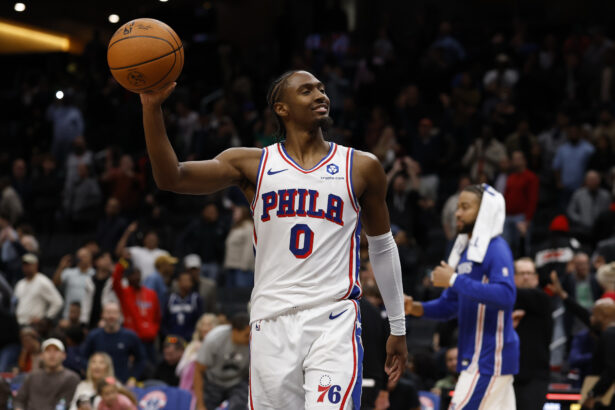
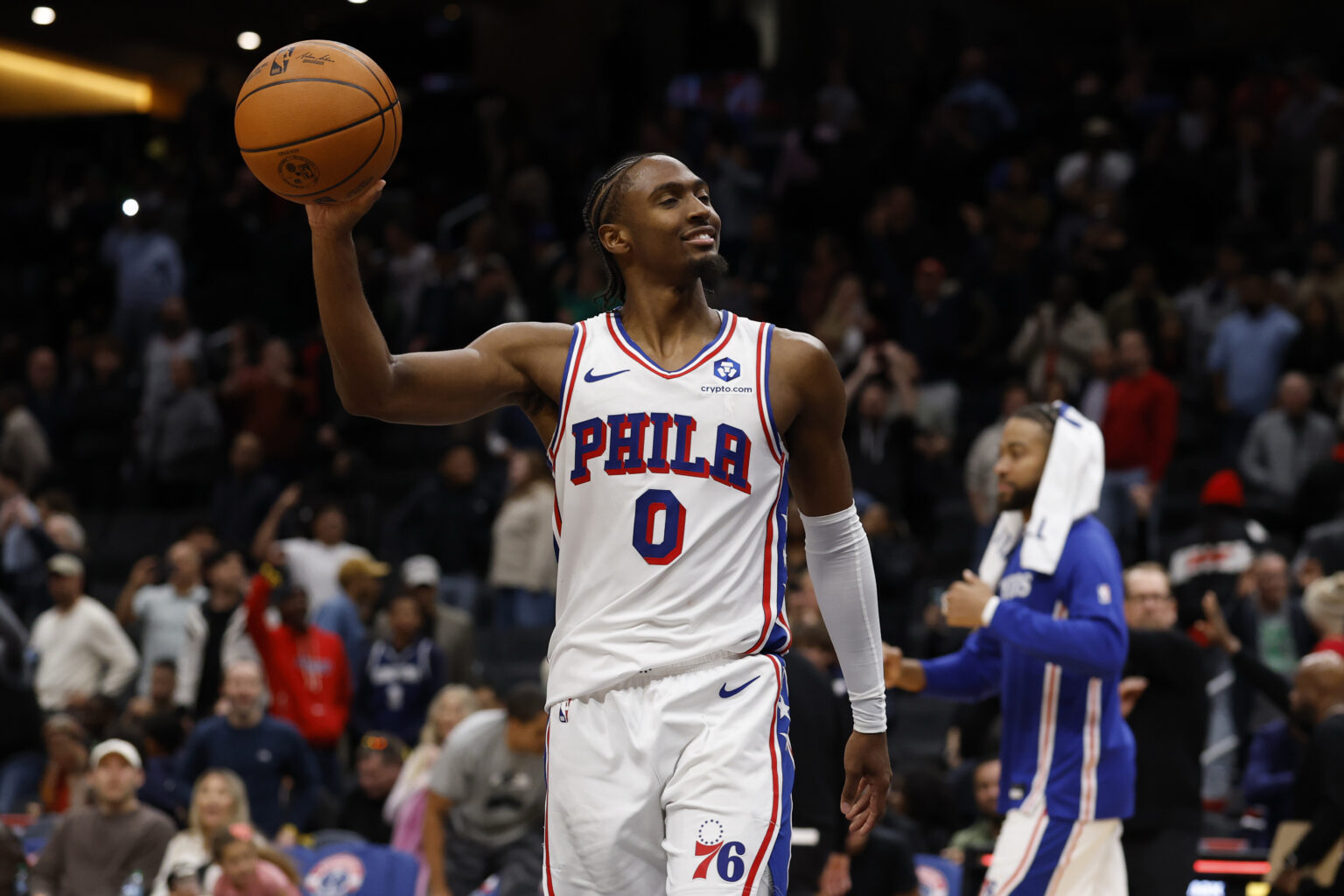
This starts with Tyrese Maxey because he is the biggest source of pressure left in the series. Maxey averaged 28.3 points, 6.6 assists, and 4.1 rebounds in the regular season. He is not just a scorer. He is the player who forces the Celtics to defend actions at full speed, defend the first drive, and then defend the second pass after the help rotates. That matters more now because without Embiid, the 76ers are not built around post offense. They are built around pace, drive-and-kick reads, and Maxey forcing the defense to move.
Game 1 showed what happens when the Celtics control him. They contested 12 of his first 14 shots in the first half, held him to 8-for-20 shooting, and pushed the 76ers into a dead half-court game. That was the version of the series the Celtics wanted. Maxey still finished with 21 points and eight assists, but those numbers came in a game where the 76ers shot just 4-for-23 from three and never got comfortable. The Celtics defended him high, crowded his handle, and made every advantage short-lived.
Game 2 was the correction. Maxey had 29 points and nine assists, and the more important detail is how the game looked around him. The floor was wider. The 76ers made 19 threes. The Celtics could not sit in the gaps the same way. When Maxey turned the corner, the help was later and the kick-out pass had more value. That is the difference between his scoring being survivable and his scoring warping the whole game.
This is why the upset path is real. The Celtics still have size and defensive structure, but Maxey is the one player in the series who can change the game possession by possession. If he gets the Celtics into rotation, the 76ers do not need to run great offensive schemes. They just need one cracked matchup, one late closeout, one wrong tag. Against a team that wants to control the floor with length and spacing, that kind of guard pressure is the quickest way to make the game unstable.
The Celtics do not mind seeing stars score if the rest of the offense stays cold. What they do not want is a lead guard who keeps forcing the defense to make decisions every time. Maxey did that in Game 2. He scored, he created, and he kept the Celtics from settling into the same defensive rhythm that buried the 76ers in Game 1. In a short series, that kind of control from one guard is enough to flip a matchup from “too much to handle” to “one possession away.”
Finding Enough Shot Creation Around The Star Guard
The biggest reason this upset is plausible is that Maxey no longer has to do all of it alone.
Game 2 was the clearest example. V.J. Edgecombe finished with 30 points and 10 rebounds, hit 6 of 10 from three, and became the first rookie since Tim Duncan in 1998 to post at least 30 points and 10 rebounds in a playoff game. Paul George added 19 points. Kelly Oubre Jr. had 12. Andre Drummond gave the 76ers 10 points and eight rebounds off the bench. That is not a one-man formula. That is enough offense to punish a defense for loading up on one creator.
Edgecombe is the piece that changes the series. He averaged 16.0 points, 5.6 rebounds, and 4.2 assists in the regular season, so his Game 2 breakout was bigger than expected, but not completely disconnected from what he has been all year. He gives the 76ers another downhill guard, another live dribble, and another pull-up threat. The Celtics usually break opponents by shrinking the floor around the first action. Edgecombe gives the 76ers a second action that can still score.
George is just as important, even if his box-score numbers are smaller. He averaged 17.3 points, 5.3 rebounds, and 3.6 assists this season while shooting 39.2% from three. More important, the 76ers were 22-15 with him, scored 117.8 points per game in those games, and shot 35.9% from three when he played. Those are not superstar-carry numbers, but they are exactly the kind of stabilizing numbers that matter in a series like this. George gives the 76ers a real wing shot-maker, a second-side passer, and a defender big enough to survive cross-matches.
This is where the seventh seed gets misleading. A normal No. 7 seed often looks top-heavy against a No. 2 seed. This 76ers version does not, at least not when the perimeter group is intact. Maxey can attack first. Edgecombe can attack second. George can settle possessions when they get late. That is enough to keep the Celtics from blitzing one matchup and living with the consequences. The Celtics still have better overall numbers, but series are often decided by whether the defense can narrow the opponent to one creator. The 76ers have already shown the Celtics they cannot do that every time.
That is why Game 2 felt different from a simple shooting spike. The 76ers did make 19 threes, and that number will naturally get attention. But the real signal was the source of those shots. The Celtics were not just giving up random makes. They were getting hit by multiple creators, multiple attack points, and multiple players who were comfortable taking big shots off the catch or off the dribble. That is much harder to erase over a series than one player having one hot night.
The 76ers Can Push The Celtics Into Bad Offense
The Celtics are still one of the best offensive teams in the league. That is not changing. But the 76ers do not need to shut them down to win this series. They need to move them toward the wrong version of their offense.
The Celtics posted a 120.8 offensive rating this season, attempted 42.1 threes per game, and shot 36.7% from deep. That combination is what makes them dangerous. They are not just a jump-shooting team. They are a jump-shooting team that usually creates enough quality to make those shots efficient over time. But Game 2 showed the vulnerability inside that profile. If the 76ers can stay attached first and force the next pass to happen later, the Celtics can drift from efficient into forced threes.
That is exactly what happened in Game 2. The Celtics shot 39.3% from the field and 13-for-47 from three. Jaylen Brown had 36 points. Jayson Tatum had 19 points, 14 rebounds, and nine assists. And it still did not matter because the 76ers held the rest of the offense down. That is the formula. Brown and Tatum can still get numbers. The upset path opens only if the 76ers keep everyone else from turning those drives and kick-outs into efficient support offense.
The turnover piece is also key. The Celtics averaged 12.4 turnovers per game in the regular season, but with 13 in Game 2, those became 16 points for the 76ers. That is not a huge raw number, but in a playoff game between two teams that both want to play in the half-court, those extra possessions count. The 76ers averaged 9.1 steals per game this season. They are not a passive defensive team. They have enough length and activity on the perimeter to turn rushed decisions into points the other way.
This is the basketball choice the 76ers have to keep making. Do not overhelp early. Do not hand the Celtics automatic corner threes. Stay in front of the first action as long as possible, then rotate late and hard. If that means Brown has to score through traffic and Tatum has to settle for contested pull-ups or delayed passes, that is fine. The 76ers do not have to win every one-on-one. They have to force the Celtics into more self-created offense and fewer clean chain-reaction possessions. Game 2 proved that is possible.
There is no way to remove the Celtics’ three-point volume from the series. They are going to keep taking them. The point is to change the type of three. The Celtics are at their best when the ball moves side to side and the weakside help arrives one beat late. They are more beatable when the offense turns into Brown or Tatum drawing two and everyone else standing. The 76ers got that version in Game 2. If they get it three more times, the upset happens.
They Already Found An Embiid-Less Blueprint
This may be the biggest point of all. The 76ers do not need Joel Embiid back for this series to stay dangerous. They already found an Embiid-less version that can beat the Celtics.
Embiid is out indefinitely after his appendectomy, and losing a player who averaged 26.9 points, 7.7 rebounds, and 3.9 assists is usually enough to end a first-round upset discussion before it starts. That is why Game 1 looked so final. The Celtics hit them early, took away the paint, forced them into 4-for-23 shooting from three, and made the whole series look too big for the 76ers’ current roster.
Game 2 changed that because it simplified the question. Without Embiid, the 76ers are not trying to split possessions between post offense and spread offense. They are fully committed to guard-driven pressure, quick decisions and five-man shooting windows whenever Drummond is off the floor. That gives them less margin for error, but it also makes them faster and more direct. Against a defense like the Celtics’, that’s needed. There is less time for the Celtics to load the paint, less reason for the 76ers to hold the ball, and more possessions that begin with Maxey or Edgecombe already in attack mode.
The shooting split between the first two games tells the story. In Game 1, the 76ers made four threes. In Game 2, they made 19. That does not mean they need to hit 19 every night to win the series. It means the version of the 76ers that can survive without Embiid is obvious now. They need spread offense. They need volume from three. They need Maxey and Edgecombe getting downhill, and they need George to punish the second layer when the Celtics shift. That is a real playoff identity, even if it is not the same one the 76ers expected to use.
The bracket now gives that blueprint room to breathe. The series is 1-1. Games 3 and 4 are on the 76ers’ floor. The Celtics were excellent on the road in the regular season at 26-15, so this is not a case where the building alone will decide everything. But the 76ers do not need the building to win the series for them. They need two more chances to play the same style that won Game 2, in a setting where the pressure has shifted back to the higher seed.
That is why the upset is in the cards. Not because the Celtics stopped being better on paper. They are still better on paper. Not because Embiid is suddenly coming back. He is not. But because the 76ers already answered the biggest question in the series. They found a version of themselves that can win this matchup as currently built. If Maxey stays in control, if Edgecombe and George keep the floor open, and if the 76ers keep the Celtics in a jump-shot-heavy game, this can go a long way. After Game 2, that is no longer a reach. It is the series.