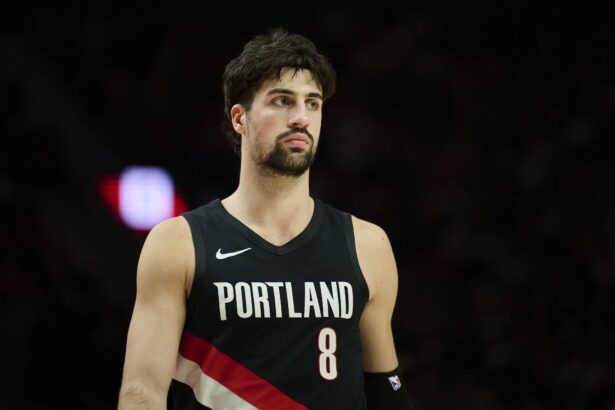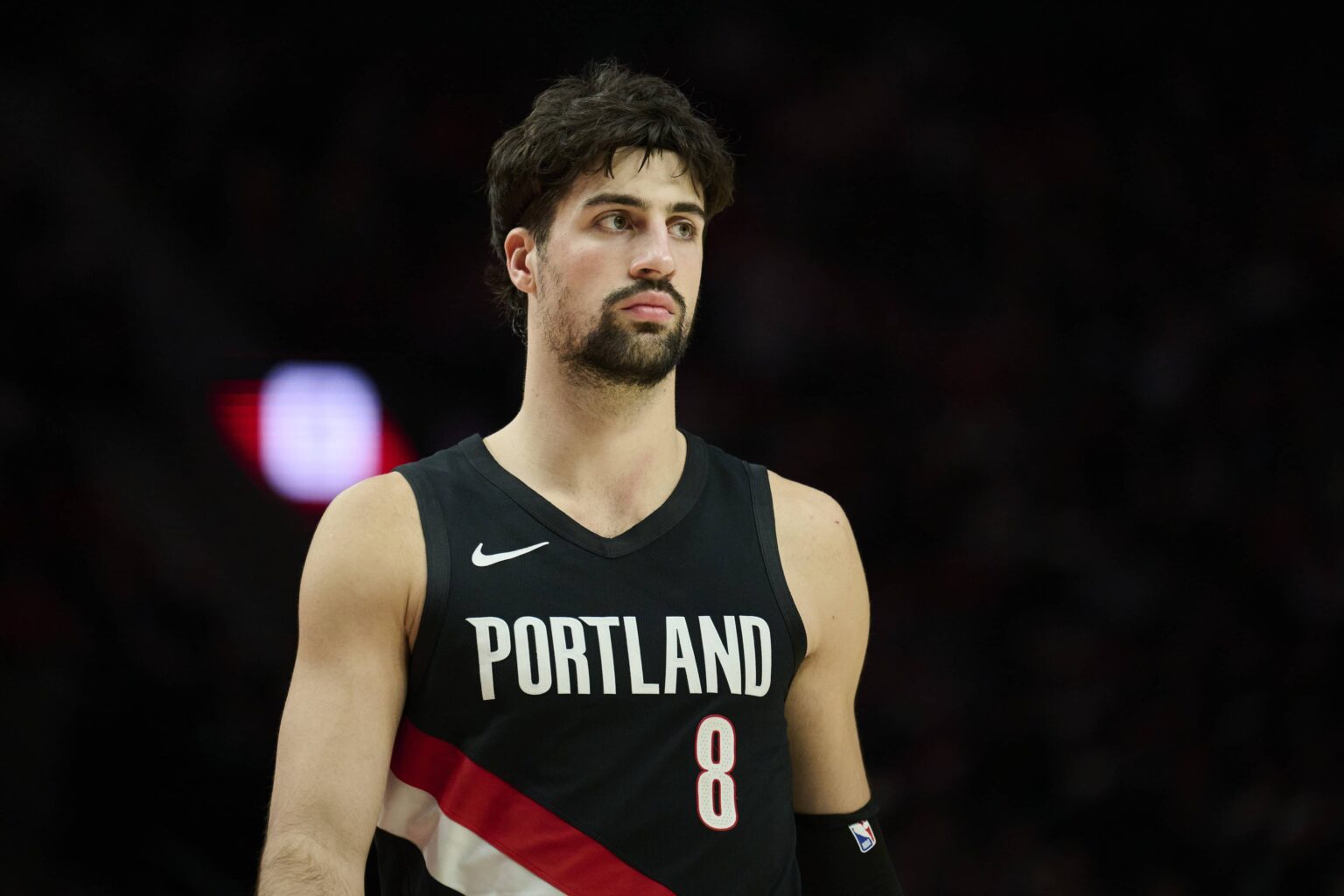
The Trail Blazers are no longer just holding prospects and waiting for lottery luck. The roster has moved into a more serious team-building stage. They finished 42-40, earned the No. 8 spot in the Western Conference standings, won their way into the playoff field, and lost to the Spurs in the first round. That is not contender status yet, but it is also not the same rebuild that spent years drifting near the bottom of the West.
The 2026-27 contract sheet shows that shift. The Trail Blazers already have major salary tied to Jrue Holiday and Jerami Grant, new extension money starting for Shaedon Sharpe and Toumani Camara, rookie-scale control over Scoot Henderson and Donovan Clingan, and one of the best value contracts in the league with Deni Avdija. They also have Damian Lillard on the books as he works back from a torn left Achilles tendon.
The Trail Blazers are not positioned to build through a major free-agent signing. The real path is trades, exceptions, extensions, and internal development. 10 of the 15 standard-roster players who finished the season have guaranteed salaries for 2026-27, with Vit Krejci and Sidy Cissoko also carrying non-guaranteed minimum deals.
The question is not whether the Trail Blazers have enough players. They do. The question is whether the money is attached to the right roles. Their next jump depends on whether Avdija is a true top option, whether Sharpe can defend enough to stay in closing lineups, whether Henderson becomes a reliable lead guard, whether Camara’s shooting holds, and whether Clingan can anchor a playoff defense for 30 minutes a night.
Trail Blazers Players Already Under Contract For 2026-27
1. Jrue Holiday: $34.8 million
2. Jerami Grant: $34.2 million
3. Shaedon Sharpe: $20.1 million
4. Toumani Camara: $18.1 million
5. Scoot Henderson: $13.6 million
6. Damian Lillard: $13.4 million
7. Deni Avdija: $13.1 million
8. Donovan Clingan: $7.5 million
9. Kris Murray: $5.3 million
10. Yang Hansen: $4.6 million
11. Vit Krejci: $2.7 million
12. Sidy Cissoko: $2.5 million
The Veteran Money Is Still Driving The Trade Board
Jrue Holiday and Jerami Grant are the two biggest salary slots on the books. That is the first thing that stands out. Holiday at $34.8 million and Grant at $34.2 million are not small veteran contracts around a young core. They are major matching salaries. That does not mean either player has to be moved, but it does mean every serious trade framework starts with one of them.
Holiday’s fit made basketball sense this season. He gave the Trail Blazers a real point-of-attack defender, secondary organizer, and late-clock guard who did not need touches to stay useful. He averaged 16.3 points, 4.6 rebounds, and 6.1 assists in 53 games while shooting 45.1% from the field and 37.8% from three. For a team trying to move away from bad defensive habits and loose guard play, that profile had value.
The problem is timeline. Holiday is 36 for the 2026-27 season and has a $37.2 million player option for 2027-28. That is expensive for a guard who is still useful but no longer a primary offensive engine. If the Trail Blazers want to keep pushing toward the playoffs, Holiday can help. If they want to chase a higher-ceiling star trade, his salary becomes one of the easiest ways to get into the right matching range.
Grant is a similar case with a different skill set. He averaged 18.6 points, 3.5 rebounds, and 2.1 assists in 57 games while shooting 45.3% from the field and 38.9% from three. That is real scoring efficiency from a forward who can space, attack closeouts, and defend enough size in a playoff rotation. The Trail Blazers needed that shot-making because their half-court offense still had long dry stretches.
Grant’s contract is still heavy. He has $34.2 million in 2026-27 and a $36.4 million player option in 2027-28. Jake Fischer has already connected the Trail Blazers to bigger trade ambitions, including Giannis Antetokounmpo as a target and Anthony Davis as an alternative, with reporting that a Grant-centric salary framework could be part of that kind of pursuit. That is not a guarantee of anything, but it explains why Grant’s contract is more than just a veteran deal on the books. It is a potential trade mechanism.
Damian Lillard is the emotional piece, but the contract is not destructive. At $13.4 million in 2026-27, his deal is manageable if he returns as a high-level shooter, pick-and-roll guard, and late-clock option. The Trail Blazers signed him to a three-year deal reportedly worth $42.0 million after he became a free agent, and the key variable is health after the torn left Achilles tendon.
The issue with Lillard is role allocation. If Scoot Henderson needs on-ball reps, Shaedon Sharpe needs scoring possessions, Deni Avdija has become a frontcourt initiator, and Holiday is still in the backcourt, the Trail Blazers cannot just add Lillard and expect a balanced usage distribution. They need a defined guard hierarchy. Otherwise, they risk crowding the ball-handling reps that should determine whether Henderson is a starter-level guard or just a change-of-pace scorer.
Deni Avdija Is The Best Contract On The Roster
Deni Avdija at $13.1 million is the best value on the Trail Blazers’ books. That is not close. He became the team’s best player this season, averaging 24.2 points, 6.9 rebounds, and 6.7 assists in 66 games while shooting 46.2% from the field, 31.8% from three, and 80.2% from the line. He also ranked 14th in scoring and 12th in assists per game, becoming an All-Star for the first time.
That production changes the timeline. If Avdija is a real top option, the Trail Blazers do not need to overpay for a traditional No. 1 scorer just to raise the offensive ceiling. They need to build better spacing, give him more half-court counters, and protect him from carrying every advantage-creation possession. His rim pressure and passing are already good enough to bend defenses. The next step is making defenses pay when they go under screens or load up early in the clock.
The three-point number is the swing point. Avdija got to the line 9.2 times per game and hit 80.2% of his free throws, which is top-option foul pressure. But at 31.8% from three, defenses still have a playoff coverage answer. The Spurs showed that in the first round by shrinking the floor and forcing tougher decisions. If Avdija gets closer to league average from deep on real volume, his contract becomes absurd value. If the shot stays shaky, the Trail Blazers need elite shooting around him.
The important part is that Avdija is not paid like a franchise centerpiece. He is paid like a mid-tier starter. That gives the Trail Blazers a major roster-building edge for one more season. His next deal will be much more expensive, but for 2026-27, Avdija is the player who lets them spend elsewhere and still keep a top-end offensive hub.
Sharpe And Camara Are Now Paid Like Core Players
Shaedon Sharpe’s $20.1 million number starts his four-year, $90.0 million extension. That deal is fair, but it also changes the standard. Sharpe is no longer just a high-upside scorer on a rookie deal. He is paid like a long-term starting wing. His regular season was strong: 20.8 points, 4.3 rebounds, and 2.6 assists in 50 games on 45.2% from the field, 33.7% from three, and 78.7% from the line.
The scoring is not the question. Sharpe can create separation, finish above the rim, punish bad matchups, and generate points without a perfect offensive structure. The question is whether he can defend at a playoff level and stay on the floor when possessions slow down. The Trail Blazers are building a more physical identity. If Sharpe is a weak link in screen navigation, off-ball awareness, and transition defense, his scoring will not be enough in a postseason rotation.
That is why 2026-27 is a pressure year for him. He does not need to become Camara defensively. He needs to become solid enough that opponents cannot hunt him for five straight possessions in a fourth quarter. If that happens, his contract becomes a positive asset. If it does not, the extension still works as trade salary because young scorers with athletic tools always carry market value.
Toumani Camara’s $18.1 million salary starts a four-year extension reported at $82.0 million. That is a major leap from his old second-round deal, but it is also a bet on one of the most valuable player types in the league: a durable two-way wing who defends stars, runs the floor, hits spot-up threes, and does not need plays called for him.
Camara averaged 13.4 points, 5.1 rebounds, and 2.5 assists in 82 games while shooting 44.0% from the field and 37.0% from three. He also made 219 threes, started every game, and drew an NBA-record 106 offensive fouls. That is not just role-player production. That is a full-season workload from a defender who takes difficult assignments and still gives enough shooting volume to stay on the floor.
The Trail Blazers’ post-All-Star defense also supports the Camara investment. In 26 regular-season games after the break, they posted a 109.3 defensive rating, third best in the NBA over that span. Camara was central to that identity. He is not just a stopper. He is the player who lets the scheme pressure the ball, switch more actions, and survive without hiding weak defenders.
Henderson And Clingan Are Still The Rookie-Scale Pieces
Scoot Henderson at $13.6 million is not cheap for a player still proving his long-term role, but rookie-scale deals are still working in the Trail Blazers’ favor. The important part is that Henderson has one more controlled season before restricted free agency and a potential extension decision. That gives the team another year to find out whether he is a starting point guard, a combo guard, or a bench scorer.
Henderson averaged 14.2 points, 2.7 rebounds, and 3.7 assists in 30 games while shooting 41.8% from the field, 35.2% from three, and 84.0% from the line. The injury concern is there, as he missed the first 51 games with a left hamstring tear, but the late-season shooting indicators were better than his early-career reputation.
The assist number dropped because the Trail Blazers used him more off the ball and because Avdija became a major initiation source. That is not automatically bad. Henderson’s best pathway might be as a pressure guard who attacks tilted defenses, pushes pace, gets downhill, and defends harder at the point of attack. But if the Trail Blazers still view him as the long-term lead guard, they have to give him enough reps to run offense through mistakes.
Donovan Clingan at $7.5 million is one of the best roster pieces on the books. He averaged 12.1 points, 11.6 rebounds, 2.1 assists, and 1.7 blocks in 77 games while shooting 52.0% from the field and 34.1% from three. More importantly, he led the NBA in offensive rebounds per game at 4.5 and contested shots per game at 13.4, while ranking third in rebounds and fifth in blocks.
Clingan gives the Trail Blazers a real defensive floor. He is huge, rebounds out of area, protects the rim without chasing blocks, and creates extra possessions on the glass. The three-point volume is still more theoretical than dangerous, but 34.1% from three on 3.2 attempts per game is enough to keep developing. If he becomes even a low-volume stretch five while maintaining his offensive rebounding, the Trail Blazers can play bigger without killing spacing.
The playoff issue is mobility. Clingan has to prove he can defend in space, survive against five-out lineups, and finish through elite length. But at his salary, the risk is low. Starting-caliber centers on rookie deals are roster-building weapons. The Trail Blazers have one.
The Lower-Salary Contracts Are Rotation Tests
Kris Murray at $5.3 million is a useful contract if he becomes a dependable eighth or ninth man. He averaged 5.8 points, 3.6 rebounds, and 1.4 assists in 57 games while shooting 46.7% from the field, but only 27.9% from three. That last number is the issue. For a forward who is not a high-usage scorer or elite defender, the jumper has to be more stable.
Yang Hansen at $4.6 million is a development bet. He averaged only 2.2 points, 1.5 rebounds, and 0.5 assists in 43 games, shooting 31.0% from the field and 11.9% from three. That is not rotation production yet. It is a first-round contract attached to size, passing flashes, and long-term skill development.
The Trail Blazers have to be careful with Hansen because the roster already has Clingan. Carrying two young centers is fine, but both need defined development plans. Hansen cannot just sit as the third big and play empty minutes. He needs G League reps, strength work, defensive coverage reps, and a role that does not overlap completely with Clingan.
Vit Krejci at $2.7 million is a backend guard/wing piece with some playmaking. In 19 games with the Trail Blazers, he averaged 7.2 points, 2.7 rebounds, and 1.7 assists while shooting 40.5% from the field and 30.3% from three. The contract is non-guaranteed, so this is a roster flexibility slot more than a fixed rotation spot.
Sidy Cissoko at $2.5 million is also non-guaranteed, but he gives the Trail Blazers a different type of decision. He averaged 5.1 points, 2.2 rebounds, and 1.5 assists while shooting 39.8% from the field. His defensive activity stood out, and he was also fifth in the NBA in offensive fouls drawn with 50. That gives him a possible lane as a physical defensive guard/wing if the offense gets to replacement level.
Final Thoughts: The Blazers’ Next Move Has To Be Precise
The Trail Blazers have enough structure to be taken seriously. Avdija is a top-option forward on a bargain deal. Camara is a defensive wing with real shooting volume. Clingan is a starting center with elite rebounding and rim protection. Sharpe is a 20-point scorer with athletic upside. Henderson still has a pathway to become a high-pressure guard. That is a solid young core.
The issue is the payroll around it. Holiday and Grant are useful players, but their salaries are too big to treat as background money. They either need to be part of a playoff rotation that pushes the Trail Blazers into the top six, or they need to become trade salary for a higher-level player. Holding both without a clear jump from the young core would leave the roster expensive, crowded, and short of true contender upside.
The next decision is not about adding more bodies. The Trail Blazers already have bodies. It is about role definition. Avdija should be treated like the offensive hub. Camara should remain the defensive matchup piece. Clingan should be the defensive anchor. Sharpe needs a two-way standard. Henderson needs a clearer guard role. Lillard’s return has to raise shooting and late-clock offense without cutting into developmental possessions.
That is why the 2026-27 contract sheet is so important. It shows a team with talent, salary slots, and trade tools, but not unlimited time. The Trail Blazers are past the asset-collection stage. The next version of this roster has to be built like a playoff team, not like a rebuild waiting for another answer.