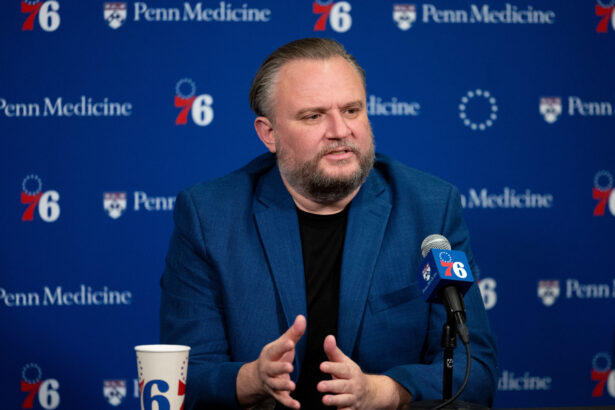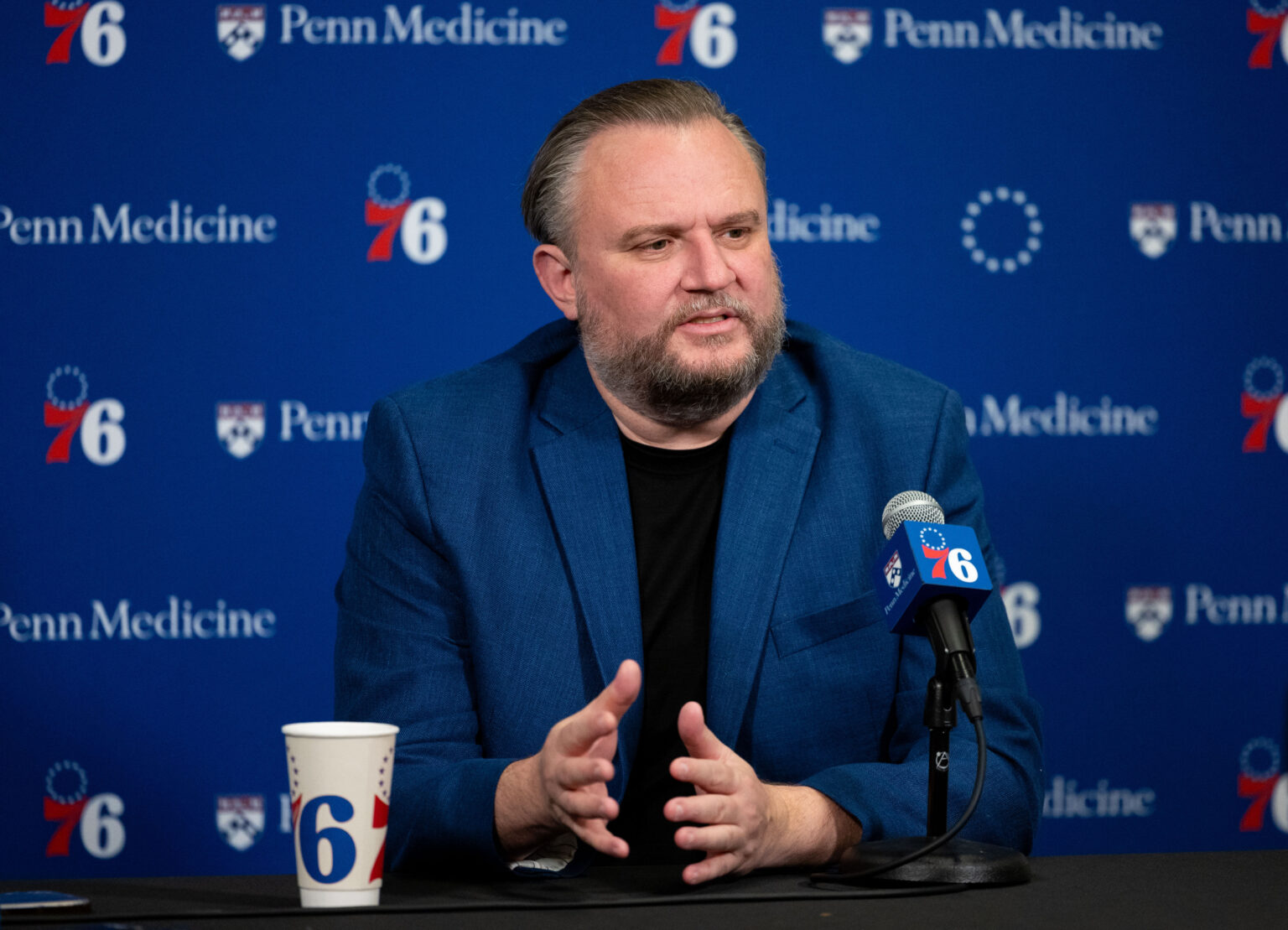
Daryl Morey is out as Philadelphia 76ers President of Basketball Operations following his immediate firing. Following the Sixers’ embarrassing second-round exit to the New York Knicks, via a sweep, changes were coming, and Morey’s name was the first to drop.
This result didn’t happen suddenly; it has been building. Reports came out earlier this month that Morey’s job was on “life support”, and following another failed playoff run, he had no chance at surviving his role.
So where did Morey go wrong? We have highlighted the biggest mistakes the analytics-driven executive has made since taking the 76ers job in late 2020, and needless to say, the organization has likely made the correct decision.
1. Giving Paul George A Max Contract At The Worst Possible Time
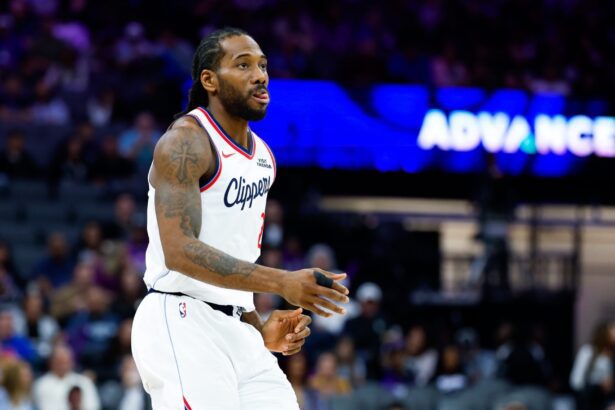
The moment that ultimately defined Daryl Morey’s downfall was handing Paul George a four-year max contract in the summer of 2024. Philadelphia committed roughly $212 million to a 34-year-old wing with a lengthy injury history, declining athleticism, and an inconsistent playoff resume.
Morey believed George would be the final championship piece next to Joel Embiid and Tyrese Maxey. Instead, the deal quickly became one of the league’s worst contracts.
The timing made it worse. The new CBA brutally punishes teams above the second apron, and Morey essentially locked the Sixers into a financially inflexible core before proving it could survive physically in the playoffs.
Philadelphia suddenly had over $140 million annually tied into Embiid, George, and Maxey alone. That destroyed roster depth, limited flexibility at the trade deadline, and forced the organization to rely on minimum contracts.
Then came the postseason disaster. George struggled badly against the New York Knicks (14.5 PPG, 3.8 RPG, 3.0 APG on 40.7% from the field) during the 2026 second-round sweep, looking a step slow defensively and unable to consistently create offense. The Sixers were blown out repeatedly, losing the series by an average margin of over 20 points.
No doubt, the George deal was always going to be a disaster, and it has proven to be true. Paying a player max dollars to post numbers that he did is simply poor management.
2. Building Everything Around Joel Embiid Despite Playoff Failures
Morey doubled down on the Embiid era even after years of evidence suggested the Sixers were never built to survive deep playoff runs. Embiid’s regular-season dominance is undeniable, with an MVP and two scoring titles, but a concerning playoff resume.
Embiid, now 32 years old, played only 281 games over six seasons and 43 playoff games. It was no secret that Embiid entered almost every season with a broken-down body, and in the playoffs, he often hobbled up and down the court.
Embiid’s track record is a little concerning as well. The big man’s career averages in the first rounds are impressive, posting around 24.9 PPG, 10.9 RPG, and 3.1 APG. Still, his numbers seem to drop in the second round, averaging approximately 23.8 PPG, 10.5 RPG, and 3.0 APG on 43% from the field and only 29% from deep.
His efficiency seems to drop in big games, yet Morey continued to build the roster as though Embiid were a dependable playoff centerpiece. Even looking at his latest postseason, the big man only played seven games over two rounds, the “most” since the 2022-23 season.
Embiid averaged 24.0 PPG this postseason, but only posted 7.3 RPG and shot 17.6% from deep. There were simply too many ups and downs for Embiid in this year’s playoffs in terms of health and production.
Instead of building around Maxey, Morey pushed every remaining asset into going all-in for a player who might be the most overrated MVP performer in NBA history.
By the end of Morey’s tenure, the Sixers had still never advanced past the second round despite five playoff appearances under his leadership. Philadelphia went just 28-26 in postseason games during his tenure, a shocking number considering the amount of star talent and payroll invested into the roster.
So spending a ton of money only to make the second round was always going to lead to firings within the organization. Morey’s was coming by default.
3. Not Building A Proper Depth Chart
One of Morey’s biggest flaws was his obsession with stars at the expense of the rotation. We have to point out the organization’s inability to retain and develop role players like Jared McCain, Isaiah Joe, Julian Champagnie, and other younger pieces who eventually thrived in better systems.
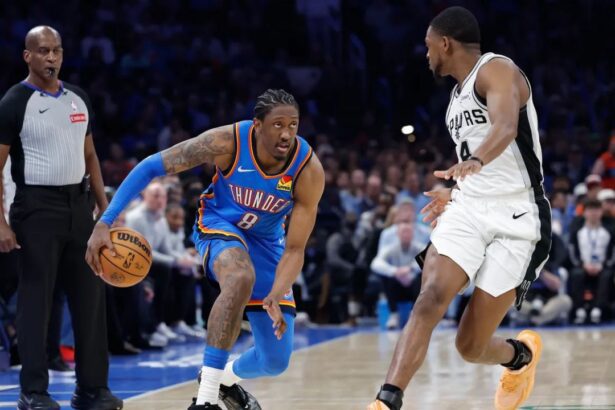
McCain is playing a huge role for the reigning NBA champion Oklahoma City Thunder this postseason, posting 7.3 PPG on 54.2% from three while nailing big shots when called upon. Similarly, Isaiah Joe played a role for the same champions last season and is averaging 6.6 PPG while playing elite on-ball defense.
Champagnie is starting for the San Antonio Spurs, posting 11.1 PPG and 5.8 RPG on 38.1% from deep in the regular season and 10.2 PPG and 5.6 RPG on 45.3% from deep in the playoffs. How could Morey trade McCain so freely and at the same time not recognize how valuable Joe and Champagnie can be?
Philadelphia never had elite role players or a bench that could be relied on. That problem became glaring against the Knicks in 2026. Only Quentin Grimes (6.0 PPG), Dominick Barlow (5.0 PPG), and Justin Edwards (5.3 PPG) played at least 10 MPG in the series, and none of them moved the needle.
On the flip side, the Knicks played five players at least 10 MPG, and their key contributors were Miles McBride (10.0 PPG), Landry Shamet (7.5 PPG), and Mitchell Robinson (5.3 RPG).
The Sixers’ bench provided little help, while the Knicks continuously attacked weak perimeter defenders and exploited the lack of lineup versatility. Morey spent years finding big names and not fixing a roster that wants to go deep into the playoffs.
4. Mishandling The James Harden Situation
The James Harden saga became one of the most embarrassing front-office disasters in recent NBA history. Initially, the trade for Harden looked brilliant.
Morey turned the toxic Ben Simmons situation into a former MVP and reunited with the superstar he helped build around in Houston. On paper, Harden solved Philadelphia’s biggest weakness: playmaking and ball-handling. The Beard averaged 21.0 PPG and 10.6 APG over his stint in Philly, with an average of 19.4 PPG and 8.4 APG in the postseason.
But Morey badly miscalculated Harden’s abilities. Harden expected long-term financial security after sacrificing money in 2022 to help Philadelphia improve the roster. When Morey refused to offer the full max extension Harden wanted, the relationship imploded publicly.
Harden famously called Morey “a liar” during a promotional tour in China, creating one of the ugliest executive-player feuds in NBA history. That is a terrible look for any franchise.
One can argue that Philadelphia lost leverage in trade negotiations, created massive locker-room tension entering training camp, and eventually settled for a trade package centered around draft assets and role players from the Los Angeles Clippers. Flipping Harden into Nicolas Batum, Robert Covington, Kenyon Martin Jr., Marcus Morris, and draft compensation, including a 2028 unprotected first-round pick, is not great.
5. Failing To Maximize Tyrese Maxey’s Talents
One of the cruel ironies of Morey’s tenure is that he actually drafted and developed the franchise’s most reliable playoff performer: Tyrese Maxey. Maxey evolved into an All-Star caliber guard who averaged 28.3 PPG, 4.1 RPG, and 6.6 APG while making his second All-Star appearance.
Yet instead of gradually transitioning the franchise toward Maxey, Morey continued prioritizing older stars around Embiid. The organization repeatedly placed Maxey into awkward developmental situations alongside Harden, Embiid, or George.
Rather than building a younger, faster roster around Maxey, Philadelphia kept trying to keep expensive veterans together.
By 2026, Maxey looked like the only Sixers star consistently capable of matching the Knicks’ pace and intensity during the second-round series. The point guard posted 18.3 PPG and 4.8 APG in the series although he had to come up against a staunch defensive team without the right help from his co-stars.
Morey should have seen what we all saw: Embiid is not the franchise player anymore, it’s Maxey.
6. Never Getting Past The Second Round
Ultimately, this is the mistake that got Morey fired: six seasons, massive spending, superstar acquisitions, constant roster changes, and the exact same result every year. Philadelphia never reached the Eastern Conference Finals under his leadership.
Morey’s supporters will argue injuries derailed several playoff runs, and there is truth to that. Embiid often entered the postseason hurt, Simmons collapsed mentally, and the East had some top-heavy teams, such as the Boston Celtics, Miami Heat, and the Indiana Pacers.
But elite executives are judged by results. Morey’s Sixers became trapped in a cycle of frustrating exits. Here are the results under Morey’s leadership:
- 2020-21: Lost Eastern Conference Semifinals (vs. Atlanta Hawks)
- 2021-22: Lost Eastern Conference Semifinals (vs. Miami Heat)
- 2022-23: Lost Eastern Conference Semifinals (vs. Boston Celtics)
- 2023-24: Missed playoffs (24-58 record, injuried-riddled season)
- 2024-25: Missed playoffs
- 2025-26: Lost Eastern Conference Semifinals (Swept 4-0 by New York Knicks)
The final humiliation came against the Knicks. Philadelphia was thoroughly outclassed on both ends of the floor with Morey’s roster on the floor. The sweep was proof that the Morey blueprint had failed.