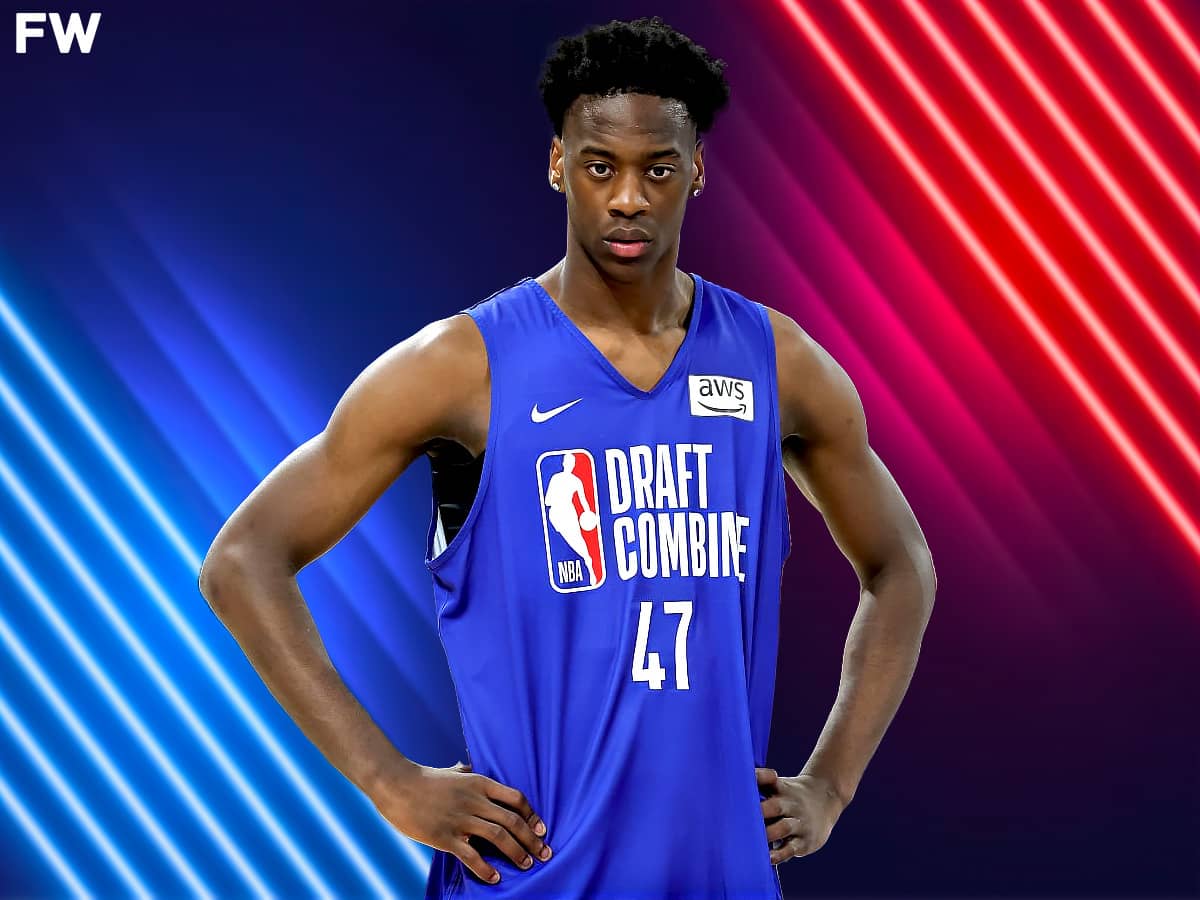
AJ Dybantsa is still the center of the 2026 NBA Draft conversation, but the situation is not as simple as the Wizards taking him at No. 1 and the Jazz staying at No. 2, as CBS Sports’ Adam Finkelstein reported from the NBA Draft Combine.
“One of the most repeated pieces of intel floating around Chicago this week: that Dybantsa was reportedly hoping to stay in Utah. He’s been in Utah now for two years (one season at Utah Prep and one season in Provo at BYU). His family is now with him in Utah, and they’ve grown to like the state and were hoping to stay.”
The Wizards won the lottery and hold the No. 1 pick, while the Jazz landed at No. 2. Dybantsa led the nation with 25.5 points per game at BYU, with 6.8 rebounds and 3.7 assists on 51.0% from the field and 33.1% from three-point range. He is clearly in position to be the top pick, but he is not viewed as an automatic lock. One lottery scout told Finkelstein, “Absolutely not,” when asked if Dybantsa to the Wizards was a certainty.
That is where the door opens. Jake Fischer reported that Wizards president Michael Winger will consider trading down from No. 1. Winger also said this is “not a savior moment,” because the Wizards have already added Trae Young and Anthony Davis while holding several recent lottery picks.
So if the Wizards are not fully locked on Dybantsa, and if the Jazz believe he is the right prospect for their new timeline, this is how a deal could look.
A Potential Trade Framework
Utah Jazz Receive: No. 1 Pick
Washington Wizards Receive: No. 2 Pick, 2027 first-round draft pick, Cody Williams
This is the type of trade that only makes sense if both teams have different boards. The Jazz would not be paying to move from No. 8 to No. 1. They would be paying to move one spot, from No. 2 to No. 1, and secure the player they actually want.
The recent Pelicans-Hawks Derik Queen trade is the easy comparison, even if this deal is safer. The Pelicans moved up from No. 23 to No. 13 in 2025 and gave the Hawks Asa Newell plus an unprotected 2026 first-round pick. The Hawks received the 2026 No. 8 pick from the Pelicans after the lottery.
This Jazz offer is not that aggressive because the move is only one slot. The Wizards still get a top-two pick and can take Cameron Boozer, Darryn Peterson, or another player they prefer. They also get a 2027 first-round pick and Cody Williams, a young wing who improved late in the season. Williams averaged 8.8 points, 3.0 rebounds, and 2.0 assists overall, but 15.4 points, 4.1 rebounds, and 4.4 assists in 21 March and April starts.
For the Jazz, it also opens a cleaner forward path. Williams becomes the movable piece. Dybantsa becomes the long-term upside play.
Dybantsa’s Fit With The Jazz
AJ Dybantsa makes sense for the Jazz because he gives them the one piece they still do not have: a high-end wing scorer who can bend the floor with size, pressure, and downhill shot creation.
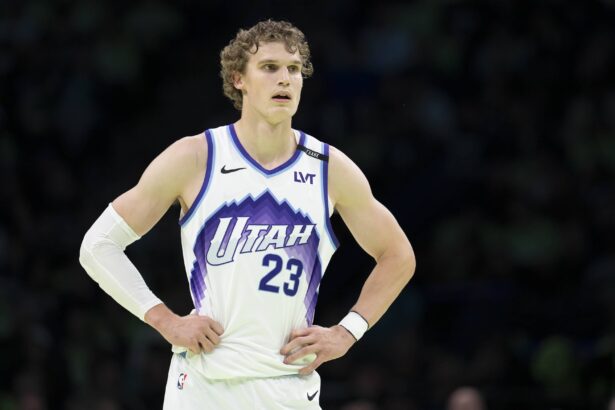
The Jazz already have real offensive talent. Lauri Markkanen averaged 26.7 points, 6.9 rebounds, and 2.1 assists while shooting 47.7% from the field and 35.5% from three. Keyonte George made the biggest leap on the roster, averaging 23.6 points, 3.7 rebounds, and 6.1 assists on 45.6% from the field and 37.1% from three. Those two were not empty numbers. George became a real advantage creator, and Markkanen returned to All-Star-level scoring efficiency after a weaker 2024-25 season.
Dybantsa would not need to become the first option on day one. That is important. A rookie wing can be hurt by being asked to solve every late-clock problem right away. With the Jazz, Dybantsa could play as a second-side attacker next to George, run the wing in transition, attack closeouts created by Markkanen, and punish smaller defenders when teams hide guards on him.
George is the key to the whole fit. He has become a high-usage guard with real scoring gravity, but he is still not a pure traditional point guard. That is fine if the Jazz build with multiple creators. Dybantsa helps there. At BYU, he was not just a scorer. He averaged 3.7 assists, and the tape showed a forward who can pass after drawing help. He is not a jumbo point guard yet, but he sees the weak side enough to fit next to George instead of taking the ball away from him.
The Markkanen fit is even easier. Markkanen is one of the cleanest frontcourt scorers in the league because he does not need to dominate the ball. He can run off screens, trail into threes, punish switches, and attack tilted defenses. Dybantsa’s rim pressure would make Markkanen’s life easier. Markkanen’s shooting would also give Dybantsa the spacing he needs to attack from the slot and the wing.
Jaren Jackson Jr. changes the defensive scheme. The Jazz acquired Jackson from the Grizzlies during the season, as he averaged 22.3 points and 4.3 rebounds in three games with the Jazz before a left knee procedure ended his season.
Dybantsa’s biggest early weakness is not offensive talent. It is defensive consistency. He has the tools to guard wings and switch across matchups, but his college defensive production was not elite. With Jackson behind him, the Jazz could live with some rookie mistakes. Jackson can clean up drives, protect the rim, and give the Jazz a real defensive anchor in smaller lineups.
Walker Kessler also has to be part of this discussion. Kessler is a restricted free agent, and the Jazz should bring him back unless the offer sheet becomes unreasonable. He played only five games this season, but he averaged 14.4 points, 10.8 rebounds, and 1.8 blocks on 70.3% from the field when available.
A frontcourt rotation with Jackson and Kessler gives the Jazz size, rim protection, and flexibility. Jackson can play the four next to Kessler in bigger lineups. He can also play the five when the Jazz want more shooting and speed around Dybantsa, Markkanen, George, and Brice Sensabaugh.
Sensabaugh is another important piece because he gives the Jazz a bench scorer who does not need a clear play call to exploit defenses. He averaged 14.9 points, 3.1 rebounds, and 1.9 assists in 75 games while shooting 46.0% from the field and 36.7% from three. That is useful next to a rookie star because the Jazz would not have to force Dybantsa to carry every second unit.
The fit is not perfect. Dybantsa shot 33.1% from three at BYU, so defenders will test him early. The Jazz would need him to become a league-average shooter quickly. They also would need George to keep improving as a decision-maker. But the roster logic is strong. George creates. Markkanen spaces and scores. Jackson protects. Kessler cleans the glass. Sensabaugh gives bench scoring. Dybantsa adds the top-end wing ceiling.
That is a real basketball plan.
Would The Wizards Make This Deal?
The Wizards should consider this deal if they do not have Dybantsa in a separate tier. That is the entire question.
If the Wizards believe Dybantsa is clearly the best prospect in the draft, they should take him and stop the conversation. No team should trade away a true No. 1 player just to collect a good but not great asset package. But the reporting around this class says the gap is not that simple, as Jake Fischer put it in his reporting:
“Winger told me directly that the Wizards will at least consider trading down. He insisted that this is ‘not a savior moment’ for Washington, given that the franchise just traded for two former All-Stars in Trae Young and Anthony Davis.”
That changes the calculation. If the Wizards like Cameron Boozer or Darryn Peterson almost as much, moving from No. 1 to No. 2 becomes logical. They would still get one of the best players in the class. They would also add a 2027 first-round pick and Williams, who is still only a young wing with size and recent signs of progress.
The Wizards already have young frontcourt and wing pieces, but they do not have enough proven two-way wings. Kyshawn George averaged 14.8 points, 5.1 rebounds, and 4.5 assists. Bilal Coulibaly averaged 11.7 points, 4.3 rebounds, and 2.6 assists. Those are useful players, but the Wizards are still short on reliable wing depth, especially if they try to win sooner with Young and Davis.
Williams would not arrive as a savior. He would arrive as a rotation bet. That is different, and it is more realistic. He has length, can guard multiple positions, and showed better feel late in the season. If he becomes a seventh or eighth man, that has value.
The bigger prize is the extra first-round pick. The Wizards finished 17-65 and 15th in the Eastern Conference, so they still need asset volume. They can say they are not in a full rebuild anymore, but the roster is not close to finished.
My view: the Wizards should say yes only if their board has Dybantsa, Boozer, and Peterson close together. If they see Dybantsa as the only real franchise wing in the class, they should keep the pick. But if they do not, this deal is good value for moving down one spot.
Could The Jazz Actually Become Contenders?
The Jazz would not become contenders overnight just because they add Dybantsa. That would be too much. But they could become serious much faster than their 22-60 record suggests. They finished 15th in the Western Conference, with a 112.7 offensive rating ranked 22nd and a 120.8 defensive rating ranked 29th. That was a bad team, but also a team that spent the season injured, rebuilding, and waiting for the next move.
The NBA has already shown how quickly a top rookie can change a team’s level when the structure is ready. VJ Edgecombe helped the 76ers become a second-round playoff team as the No. 3 pick. He averaged 16.0 points, 5.6 rebounds, and 4.2 assists as a rookie, and the 76ers finished 45-37 as the No. 7 seed before beating the Celtics in the first round.
Dylan Harper gave the Spurs a different kind of lift. He was not their star, but he became a major bench piece. Harper averaged 11.8 points, 3.4 rebounds, and 3.9 assists in the regular season, then improved to 13.6 points, 5.1 rebounds, and 2.2 assists in the playoffs. The Spurs finished 62-20 and are still alive in the second round with Harper playing real minutes.
That is the model for the Jazz. Dybantsa would not be joining an empty roster. He would be joining two All-Star-level frontcourt players in Markkanen and Jackson, a rising guard in George, a defensive center in Kessler if he returns, and a scorer in Sensabaugh. That is not a 60-win base, but it is much better than a normal 22-win team.
The Western Conference is still hard. The Jazz would need health from Markkanen, Jackson, and Kessler. They would need George to prove his breakout was not just usage on a losing team. They would need Dybantsa to be efficient enough as a rookie. They would also need the defense to move from awful to average.
But average defense is possible with Jackson and Kessler. Better offense is possible with Dybantsa and a full season of George’s improved shot creation. That is enough to raise the floor.
The right expectation is not championship contention in year one. It is play-in contention. If Dybantsa is as good as advertised, the Jazz should be aiming for at least the No. 8 seed next season. If Jackson is healthy and George keeps rising, they can push higher.
The Jazz should be aggressive here, but not reckless. They should not include Ace Bailey. They should not include George. They should not include Markkanen or Jackson. But No. 2, one future first-round pick, and Williams is a serious offer without becoming desperate.
If the Wizards are truly open to moving down, that is the offer the Jazz should put on the table.