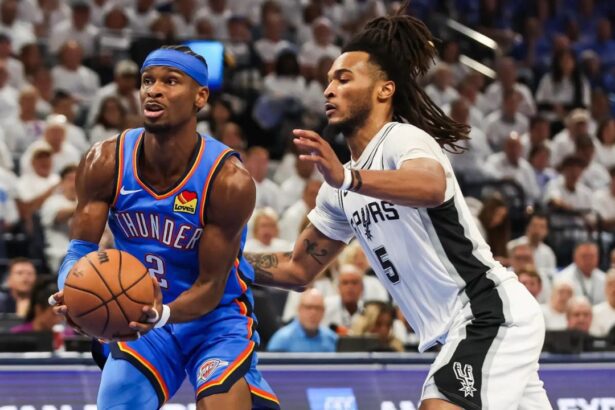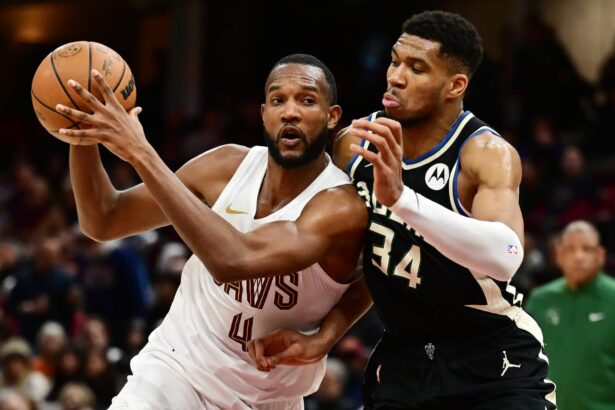
The Thunder are going into 2026-27 with one of the strongest rosters in the NBA, but also one of the most expensive sheets in the league. That is the whole point of this offseason. This is no longer the cheap version of the core.
The Thunder finished 64-18, had the No. 1 seed in the West, and still lost their title defense in Game 7 of the Western Conference Finals against the Spurs. Shai Gilgeous-Alexander had 35 points and nine assists in that final loss, but Jalen Williams was out with a hamstring injury, and the roster didn’t have enough second-shot creation to close the series.
Now the money comes. Chet Holmgren and Jalen Williams move into max-level salaries. Gilgeous-Alexander is still on the last year before his supermax extension starts. Isaiah Hartenstein, Luguentz Dort, and Kenrich Williams have team-option decisions. The Thunder still have depth, picks, and young players, but the simple version is gone.
Thunder Players Already Under Contract For 2026-27
The Thunder have $250.1 million in active roster salary on the 2026-27 sheet if every listed salary and option stays in place. That puts them $41.6 million above the first apron and $28.6 million above the second apron, so hard decisions might be necessary.
1. Chet Holmgren: $41.3 million
2. Jalen Williams: $41.3 million
3. Shai Gilgeous-Alexander: $40.8 million
4. Isaiah Hartenstein: $28.5 million (Team Option)
5. Alex Caruso: $19.6 million
6. Luguentz Dort: $18.2 million (Team Option)
7. Isaiah Joe: $11.3 million
8. Aaron Wiggins: $9.2 million
9. Jaylin Williams: $7.8 million
10. Cason Wallace: $7.4 million
11. Kenrich Williams: $7.2 million (Team Option)
12. Nikola Topic: $5.4 million
13. Thomas Sorber: $4.9 million
14. Jared McCain: $4.4 million
15. Ajay Mitchell: $2.9 million (Partially Guaranteed)
The Thunder can still make choices. They can keep the expensive veteran depth and pay a heavy tax bill. They can trim one or two options. They can use one of those contracts in a trade. But the main fact is already set: this is now a very expensive contender.
Shai Gilgeous-Alexander Is Still The Center Of The Sheet
Shai Gilgeous-Alexander is owed $40.8 million in 2026-27. That number is big, but it is still friendly for a player who just put up 31.1 points, 4.3 rebounds, and 6.6 assists on 55.3% from the field and 38.6% from three. He also won MVP again and made All-NBA First Team.
That is the best part of the Thunder’s cap structure for one more year. Gilgeous-Alexander is already paid like a superstar, but not yet like the full supermax version. His new four-year extension does not start until 2027-28, when the number jumps into a different tier.
For 2026-27, that gives the Thunder one more season where their best player is not their highest-paid player. Holmgren and Jalen Williams both sit above him by a little. That is funny on paper, but not a real issue. The real issue starts one year later, when Gilgeous-Alexander moves past $63.0 million and the second apron becomes a yearly problem instead of a one-year pressure point.
On the court, there is no debate. Gilgeous-Alexander is still the whole system. He bends the first defender, creates free throws, gets to the midrange, and gives the Thunder a half-court answer when their drive-and-kick offense gets slowed. The playoffs showed the cost when the secondary creation was hurt. If Williams is not right, everything becomes too dependent on Gilgeous-Alexander.
That is why the Thunder can’t just think in tax terms. They need enough salary around Gilgeous-Alexander to keep real playoff help. Cutting money just to cut money would be dangerous. The right move is trimming the least needed salary, not stripping the roster around the MVP.
Chet Holmgren And Jalen Williams Start An Expensive Era
Chet Holmgren and Jalen Williams both jump to $41.3 million in 2026-27. Together, they take $82.5 million of cap space. That is the new price of the Thunder’s core. It is also why the roster is now moving from “best young value in the league” to “expensive contender with hard decisions.”
Holmgren’s case is easy to understand. He posted 17.1 points, 8.9 rebounds, and 1.9 blocks while shooting 55.7% from the field and 36.2% from three. He gives the Thunder rim protection, spacing, transition speed, and a real vertical defensive presence.
That skill set is expensive because it is rare. Holmgren can play next to Hartenstein or function as the main big. He can guard the rim without killing spacing. He can punish smaller matchups without needing 20 post touches. Even if he is not a true No. 2 scorer yet, his two-way value fits exactly with Gilgeous-Alexander.
Jalen Williams is more complicated because of the injury. He was limited to 33 regular-season games and finished with 17.1 points, 4.6 rebounds, and 5.5 assists. He shot 48.4% from the field, but only 29.9% from three. In the playoffs, the left hamstring problem became a major series factor, and he missed Game 7 against the Spurs.
Still, the Thunder weren’t wrong to pay him. Williams is the connector who gives them size, playmaking, and late-clock creation from the wing. He is not just a scorer. He can defend across positions, run second-side offense, attack mismatches, and take pressure off Gilgeous-Alexander.
The concern is health and shooting. At $41.3 million, Williams has to be more than a good secondary player. He has to be a real playoff engine. The Thunder saw the other side of that problem against the Spurs. When he was unavailable, the offense became too narrow.
The Expensive Team Options Are The First Big Decision
The Thunder’s first major offseason question is not about the stars. It is about the options.
Isaiah Hartenstein is at $28.5 million. Luguentz Dort is at $18.2 million. Kenrich Williams is at $7.2 million. All three have team-option decisions due June 29, 2026. If the Thunder pick up all three, that is $53.9 million in salary. If they decline one or more, the sheet gets much lighter.
Hartenstein is the hardest call. Isaiah Hartenstein put up 9.2 points, 9.4 rebounds, and 3.5 assists while shooting 62.2% from the field. He also gave the Thunder real size, screening, short-roll passing, and defensive rebounding.
The problem is price, not usefulness. Paying $28.5 million for a center next to Holmgren can work if the team is winning the title. It gets harder after a conference finals exit. Hartenstein helps the regular-season floor a lot, but the Thunder must decide if that money is better used as a trade salary or removed from the sheet.
Dort is a different case. Luguentz Dort had 8.3 points, 3.6 rebounds, and 1.2 assists while shooting 38.5% from the field and 34.4% from three. His offensive value is limited, but his defensive job is real. He takes the biggest wing and guard assignments, plays physical at the point of attack, and lets Gilgeous-Alexander save energy.
The Thunder can survive Dort’s streaky shooting because they have shooting elsewhere. But at $18.2 million, he can’t be treated like a small role-player cost. That salary is now a real roster-building number.
Kenrich Williams is smaller money, but still part of the picture. He gave them 6.5 points, 3.3 rebounds, and 1.4 assists on 47.3% from the field and 38.8% from three. At $7.2 million, he is not the main cap issue. The question is roster slots and flexibility.
My read: Hartenstein is the biggest swing contract. Dort is harder to replace because of the defensive role. Kenrich is useful, but more movable. If the Thunder want to stay under the second apron or reduce the tax hit, the Hartenstein number is the first place to look.
The Veteran Middle Is Still Strong
Alex Caruso, Isaiah Joe, Aaron Wiggins, and Jaylin Williams are the kind of middle contracts that still keep the Thunder balanced. This is where the front office did good work before the max salaries hit.
Alex Caruso is owed $19.6 million. His regular-season offense was poor by his standards: 6.2 points, 2.8 rebounds, and 2.0 assists on 42.3% from the field and 29.3% from three. But the playoff version was much better, with 11.0 points in 23.5 minutes and 44.6% from three.
That is why Caruso is still worth the money. He defends guards, plays passing lanes, makes fast reads, and doesn’t need touches. In a playoff series, he can close games because he understands spacing and defensive coverages. The Thunder don’t need him to score 15 every night. They need him to defend without killing the offense.
Isaiah Joe is the simplest value on the sheet. Joe is at $11.3 million after a season with 11.1 points on 45.5% from the field and 42.3% from three. That is real movement shooting at a mid-level price.
Aaron Wiggins is at $9.2 million. He put up 9.4 points, 3.1 rebounds, and 1.7 assists while shooting 43.1% from the field and 35.6% from three. That is a fair number for a rotation wing.
Jaylin Williams is at $7.8 million, and he produced 7.2 points, 5.5 rebounds, and 2.4 assists while shooting 38.3% from three. That is useful because he gives them another passing big and a frontcourt option who can space the floor.
This group is not the problem. The Thunder’s middle salaries are mostly logical. The bigger question is whether they can keep all of them while also paying three max-level players and carrying Hartenstein’s option.
The Rookie-Scale Group Keeps The Roster Alive
The Thunder still have cheap help. That is the only reason this sheet is not completely locked.
Cason Wallace is owed $7.4 million. He had 8.6 points, 3.1 rebounds, 2.6 assists, and 2.0 steals in 26.6 minutes. He shot 43.2% from the field and 35.1% from three.
Wallace is one of the most important contracts on the team. He is a rotation guard on a rookie-scale number, and he can guard the ball, pressure passing lanes, and play next to Gilgeous-Alexander. He becomes extension eligible in July 2026, so the Thunder have another money decision coming fast.
Ajay Mitchell is at $2.9 million, with only $1.5 million guaranteed on the current sheet. That is a bargain if the Thunder keep him. Mitchell gave them 13.6 points, 3.3 rebounds, and 3.6 assists on 48.5% from the field and 34.7% from three. He also played real playoff minutes before a soleus strain ended his run.
Nikola Topic is owed $5.4 million. He only played 10 regular-season games, but he showed passing value with 4.4 assists in 16.0 minutes. The shot sample was small, but 40.0% from three in limited attempts at least gives the Thunder something to work with.
Jared McCain is at $4.4 million. He’s a bargain at 10.4 points in 18.0 minutes and 39.1% from three. That is exactly the kind of cheap scoring guard the Thunder need around a very expensive top three.
Thomas Sorber is at $4.9 million. He is more of a long-term depth piece on the sheet, but that salary is still important. The Thunder need low-cost frontcourt depth because Holmgren, Williams, and Gilgeous-Alexander take so much money.
This is the part that keeps the Thunder flexible. Wallace, Mitchell, Topic, McCain, and Sorber don’t need to all become stars. They just need two or three of them to be reliable rotation players. That is how expensive contenders survive the second apron.
The Real Tax Problem Starts Now
The Thunder’s 2026-27 sheet is already above the second apron if they keep the full roster. The first apron sits at $209.0 million and the second apron at $222.0 million.
That changes everything. Second-apron teams lose team-building tools. Trades get harder. Aggregating salaries gets harder. Flexibility drops. The Thunder can pay the bill, but the new CBA punishes expensive teams more than the old system did.
The timing is the key. In 2026-27, Gilgeous-Alexander is still at $40.8 million. In 2027-28, his new deal begins. That means the Thunder should treat 2026-27 like the transition season before the real squeeze. They still have enough movable salary and cheap young players to make one more major roster correction.
The best path is not a panic trade. The best path is choosing which expensive non-star salary is least needed. Hartenstein at $28.5 million is the obvious number. Dort at $18.2 million is also part of the discussion, but his defensive role is harder to replace. Caruso at $19.6 million is expensive, but his playoff value is too useful unless his shot fully disappears.
The Thunder don’t need to rebuild the roster. They need to avoid paying everyone just because they can.
Final Thoughts
The Thunder still have a championship roster. Gilgeous-Alexander is an MVP-level guard. Holmgren is a rare two-way big. Williams gives them wing creation when healthy. Wallace, Mitchell, Joe, Caruso, McCain, and Jaylin Williams keep the rotation deep.
But the cheap phase is finished.
The Thunder have $250.1 million on the 2026-27 active roster sheet if all options stay. That is not just expensive. It is second-apron territory. The front office can still move before it gets trapped, but the next decisions have to be precise.
My view is simple: keep the core, keep enough shooting, and don’t let sentiment decide the option calls. Hartenstein, Dort, and Kenrich Williams are useful players, but the Thunder can’t carry every useful player forever. The roster is too expensive now.
The Thunder are still built to win. They just aren’t built to delay the financial decisions anymore.