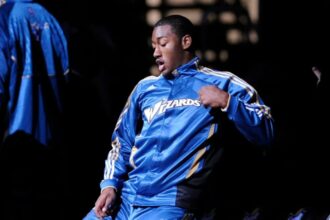
Michael Jordan stunned the basketball world in 2001 when he came out of retirement for the second time to play for the Washington Wizards at the age of 38. While there was incredible joy over getting to see Jordan play again, the man struggled with knee issues during his time with the Wizards.
Former Wizard Brendan Haywood got to see just how bad things were behind the scenes, and during an appearance on the TFU Podcast, he recounted asking Jordan why he wouldn’t sit out instead of playing through injury.
“I don’t know if you remember, down the stretch, Mike was getting his knee drained to play,” Haywood said. “… They probably weren’t telling y’all, but I was in the training room. I’m seeing this nasty liquid coming out of his knee. I remember asking him, I’m like, ‘Dog, why?’ I’m like, ‘Why you doing this, man?’… We’re coming down the stretch of the season. I’m like, ‘Yo, why don’t you just like stop playing? We’re not going to make the playoffs.’
“He was like, ‘Somebody paid for the Michael Jordan experience, and I at least got to go out there and give them a quarter or two,'” Haywood continued. “That’s just how he felt. He’s like, ‘There’s somebody that spent their last to get the Michael Jordan experience.’ And he wore that, he wore that as a badge of honor.
“There wasn’t no rest days for Mike,” Haywood added. “Wasn’t no load management. Like listen, ‘Somebody spent their hard-earned dollars to watch me play, I at least got to give them a quarter. I got to give them that. I owe them that.'”
That is commendable. This was an almost 40-year-old man who was willing to go to great lengths just so that he didn’t let some fans down.
As Haywood, a rookie on the Wizards in 2001-02, mentioned, load management wasn’t in Jordan’s dictionary. He even ripped the concept back in October 2025, making it clear that if people were coming to watch him play, he wasn’t going to miss that opportunity, as long as he was physically able to go.
Now, back in 2001, Jordan had been dealing with tendinitis in his right knee since he started working out for his second comeback. He needed fluid drained from his knee on multiple occasions, but kept playing.
The situation got worse, though, when Jordan banged knees with teammate Etan Thomas during a game against the Sacramento Kings on Feb. 7, 2002. At the end of that night, Jordan was averaging 25.1 points per game for the season, and the Wizards were 26-23.
Things had been going well, but Jordan just wasn’t the same afterward. A few weeks later, it was revealed he had torn lateral meniscus cartilage in his right knee and would need surgery. Despite the earlier knee issues, Jordan had only missed two games up to that point in the season. This would cause him to miss another 12, and he probably should have missed more.
The Wizards had dropped to 31-36 in Jordan’s absence, and he rushed back from injury to save the season. That proved to be a mistake. An ailing Jordan would only last another seven games before he was shut down for the season.
Jordan only played 60 games in 2001-02, and you’d imagine that didn’t sit well with him. He’d then play all 82 games for the Wizards in 2002-03, and then retired for the third and final time after the campaign.
Jordan finished his Wizards career with averages of 21.2 points, 5.9 rebounds, 4.4 assists, 1.5 steals, and 0.5 blocks per game. The team didn’t make the playoffs in either season, but, considering the circumstances, it was still incredible that he played so well.
Los Angeles Clippers head coach Tyronn Lue was playing for the Wizards at the time and said Jordan was averaging 20 points a night on one leg. Lue believes that showed just how great he was.