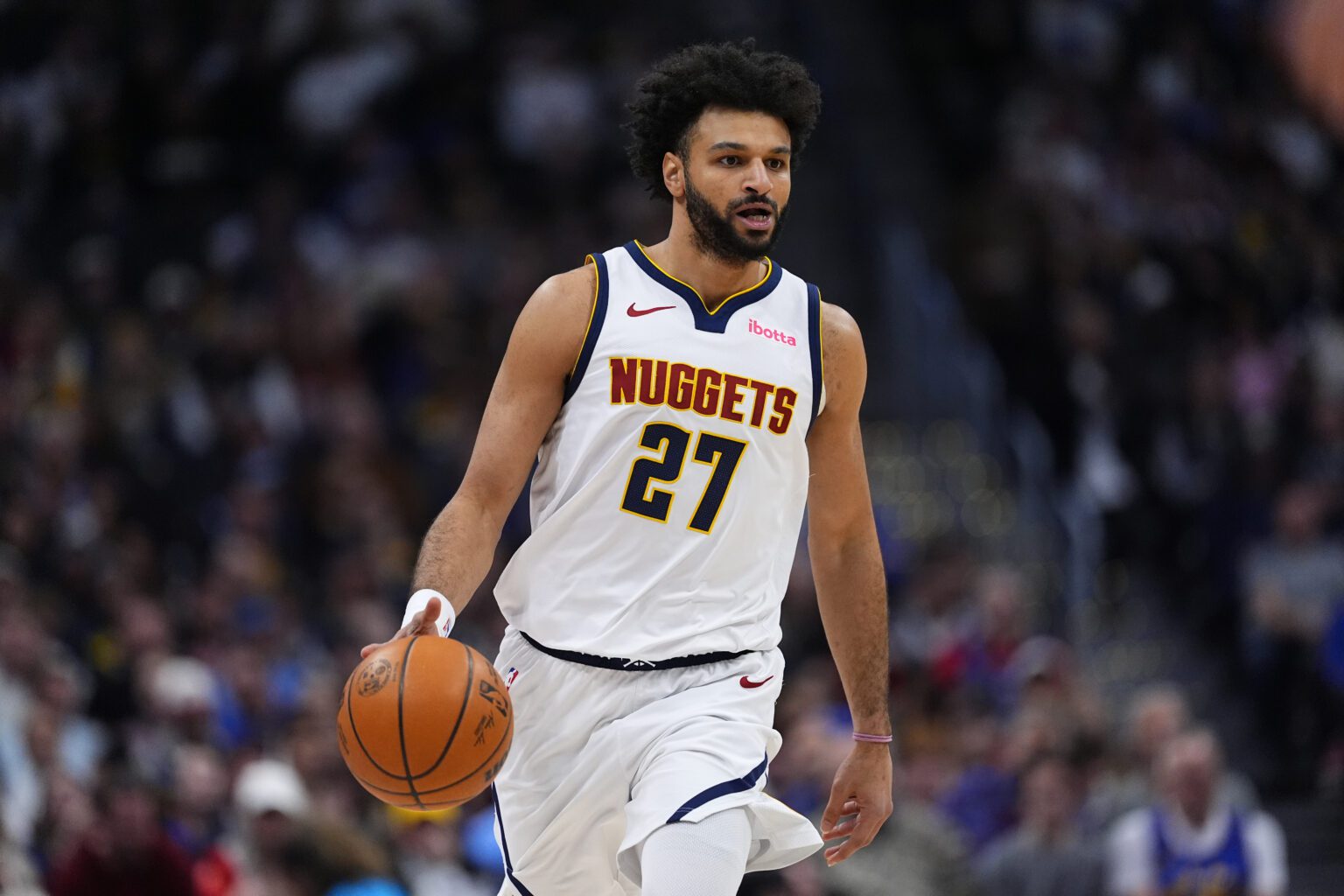
The Nuggets do not have to trade Jamal Murray. That part should be clear. He is still the guard who won a title next to Nikola Jokic, still has elite playoff history, and still averaged 23.7 points, 5.0 rebounds, and 5.7 assists in the first round.
But the ending was ugly enough to make the conversation real. The Nuggets lost 110-98 to the Timberwolves in Game 6, ending their season in the first round. Jokic had 28 points, 10 assists, and nine rebounds, but Murray finished with 12 points on 4-of-17 shooting as Jaden McDaniels locked him down the whole game. The Timberwolves were also missing Anthony Edwards, Donte DiVincenzo, and Ayo Dosunmu, and, with Terrance Shannon Jr. dominating on offense, the loss was harder to ignore.
The contract adds pressure. Murray is owed $50.1 million in 2026-27, then $53.8 million in 2027-28 and $57.5 million in 2028-29. That is superstar money for a guard who still has big highs, but also puts the Nuggets in a tight cap position around Jokic, Aaron Gordon, Cameron Johnson, Christian Braun, and a major Peyton Watson decision.
There is no firm report saying the Nuggets are shopping Murray. This is a logical trade watch after a bad playoff exit. If the Nuggets decide they need a different roster shape around Jokic, these four destinations make the most sense.
4. Miami Heat
Miami Heat Receive: Jamal Murray, Zeke Nnaji
Denver Nuggets Receive: Tyler Herro, Davion Mitchell, Jaime Jaquez Jr.
This is the Heat-style swing. They have needed a real half-court point guard for years, and Murray would give them one. He is not a pure point, but he can run pick-and-roll, get to pull-up jumpers, play off Bam Adebayo handoffs, and create late-clock shots. The Heat have used too many lineups where the offense turns into tough jumpers, stalled spacing, and Adebayo trying to create from the elbow without enough guard pressure.
The money can work if the Heat structure the deal before other moves push them into apron problems. Tyler Herro is listed at $31.0 million on the 2026-27 cap sheet, Davion Mitchell is at $12.4 million on the multi-year table, and Jaime Jaquez Jr. is at $5.9 million. That puts the Heat around $49.3 million in outgoing money for Murray and Zeke Nnaji, who combine for about $57.6 million. Under normal offseason matching rules, that can work if the Heat stay below the first apron hard-cap issue.
The basketball fit for the Heat is obvious. Murray would be their best guard creator right away. He averaged 25.4 points, 4.4 rebounds, and 7.1 assists in the regular season, then still gave the Nuggets 23.7 points per game in the playoffs despite poor shooting splits. That is the exact type of shot creation the Heat have lacked since their best Jimmy Butler playoff runs.
For the Nuggets, this is about splitting one huge contract into three useful pieces. Herro gives them shooting and movement scoring with 20.5 points, 4.8 rebounds, and 4.1 assists. Mitchell gives them creation and point-of-attack defense, which they badly need after McDaniels and the Timberwolves attacked their guards, and 9.3 points with 6.5 assists. Jaquez gives them a strong young wing with feel, size, and a cheap contract at 15.4 points, 5.0 rebounds, and 4.7 assists this season.
The concern is that Herro does not fix the defense. If the Nuggets trade Murray, they should probably want to become bigger and harder to score against. Herro helps the offense, but he is not a defensive answer. That is why Mitchell and Jaquez are important. Without both, the deal does not make enough sense.
This would be a bold Heat move and a practical Nuggets reset. It is not the best offer here, but it gives both teams a clear reason to talk.
3. Orlando Magic
Orlando Magic Receive: Jamal Murray, Zeke Nnaji
Denver Nuggets Receive: Jalen Suggs, Jonathan Isaac, Anthony Black
The Magic are the easiest basketball case. They need a guard who can organize offense, create shots, and calm them down when the game slows. That has been obvious in their first-round series against the Pistons. They have Paolo Banchero, Franz Wagner, Desmond Bane, size, defense, and depth. What they do not have is a top-level playoff guard who can control late-game possessions.
Murray would change that. He gives the Magic a half-court creator who can run actions with Banchero and Wagner instead of forcing both forwards to do everything. He can shoot off the dribble, work in two-man actions, punish switches, and give them a real answer when defenses pack the paint.
That is the main tactical point. The Magic already have enough big wings. They do not need more size. They need someone who can turn their size into better shots. Murray can run high pick-and-roll with Banchero, attack second-side actions with Wagner, and play off Bane’s spacing. Their offense would still not be perfect, but it would stop looking so limited in tight games.
The salary is close. Jalen Suggs is listed at $32.4 million for 2026-27, Jonathan Isaac at $14.5 million, and Anthony Black at about $10.1 million on the multi-year table. That is roughly $57.0 million going to the Nuggets for Murray and Nnaji at about $57.6 million. If the Magic need to clean up a small salary gap because of apron rules, this is the type of framework that can be adjusted with a minor roster piece or timing.
For the Nuggets, this is a defensive reset. Suggs averaged 13.8 points, 3.9 rebounds, and 5.5 assists this season, but his real value is pressure defense. He can fight over screens, pick up guards early, and bring a level of physicality the Nuggets did not have enough of in the Timberwolves series.
Isaac is the high-risk piece. When healthy, he is one of the best defensive forwards in the league. He can protect the rim, switch, cover mistakes, and play next to Jokic in lineups that need length. The problem is his health history. Black gives the Nuggets another big guard with passing and defensive upside, but he is still developing as a shooter.
This trade would hurt the Magic defensively, but it would finally give them a real guard scorer. For the Nuggets, it would be a bet that Jokic can lift a less explosive offense if the defense around him gets much better.
2. Los Angeles Clippers
Los Angeles Clippers Receive: Jamal Murray, Zeke Nnaji
Denver Nuggets Receive: Darius Garland, Derrick Jones Jr., Jordan Miller
This is the obvious star-for-star idea. It is not a full reset for the Nuggets. It is a reshaping of the backcourt. Murray becomes a bigger scoring guard for the Clippers, and Darius Garland becomes a more natural point guard for Jokic.
The Clippers have Garland at $42.2 million in 2026-27, Derrick Jones Jr. around $10.0 million, and Jordan Miller at $2.5 million. That package gets close to Murray and Nnaji’s combined $57.6 million. The Clippers would need to handle the final apron details carefully, but the Nuggets would be taking back less salary than they send, which is important for a team already under cap pressure.
Garland is not Murray as a playoff shot-maker. That is the trade-off. Murray has the better postseason track record, the bigger shot history, and more size. But Garland is younger, cheaper in 2026-27, and a more traditional organizer. He averaged 18.8 points, 2.4 rebounds, and 6.7 assists this season while shooting 46.0% from the field and 39.6% from three-point range.
That fit with Jokic is interesting. Garland can play faster in the middle of the floor, run more classic pick-and-roll, shoot off the catch, and let Jokic operate without always needing to create the first action. The Nuggets would lose some size and playoff toughness at guard, but they would gain more table-setting and a lower salary slot.
Jones is the key non-star piece. The Nuggets need more defensive wings, not fewer. Jones gives them athleticism, transition play, rim pressure, and the ability to guard bigger scorers. He is not a high-volume shooter, but he does not need the ball. That fits next to Jokic.
Miller is the type of cheap wing the Nuggets need to find more often. He is not the main piece, but this Nuggets roster has become expensive. Low-cost wings who can defend, cut, and maybe grow into bigger roles are not throw-ins for a team this expensive.
For the Clippers, the bet is that Murray’s playoff scoring gives them a better offensive ceiling than Garland. A Murray-Kawhi Leonard pairing would be more physical and more shot-based. It also gives them another guard who has already been deep in the playoffs and has made big shots in June.
The risk for the Nuggets is simple: if they trade Murray for Garland and Garland is not good enough defensively in the playoffs, they may have solved one issue and created another. Still, this is one of the few frameworks that gives them an All-Star point guard, a defensive wing, and salary relief without making them feel like they are rebuilding.
1. New Orleans Pelicans
New Orleans Pelicans Receive: Jamal Murray, Jalen Pickett
Denver Nuggets Receive: Dejounte Murray, Herb Jones, Jordan Hawkins
This is the best basketball trade for the Nuggets. It is not the biggest headline, but it gives them the most complete answer to what went wrong against the Timberwolves.
The Pelicans have Dejounte Murray at $30.8 million, Herb Jones at $13.9 million, and Jordan Hawkins around $7.0 million in 2026-27. That is about $51.7 million going to the Nuggets. Murray and Jalen Pickett combine for about $52.5 million going the other way. The numbers are close enough for a potential offseason framework, and the Nuggets would not be taking on more salary.
For the Pelicans, Jamal Murray gives them a better half-court shot-maker than Dejounte Murray. That is the argument. Zion Williamson needs spacing and a guard who can punish teams for loading up on the paint. Trey Murphy III needs someone who can create open threes. Jordan Poole can score, but Jamal Murray has a much stronger playoff record. If the Pelicans want to be more dangerous late in games, Jamal Murray is a serious upgrade as a scorer.
For the Nuggets, Dejounte Murray changes the physical profile. He averaged 16.7 points, 5.4 rebounds, and 6.4 assists while shooting 48.4% from the field this season. He is not the shooter Jamal Murray is, but he gives them size, defense, rebounding, and another playmaker next to Jokic.
The big prize is Herb Jones. He is one of the best perimeter defenders in the league, and he is exactly the type of player the Nuggets needed against the Timberwolves. He can take primary wing assignments, help off the ball, recover to shooters, and reduce the number of defensive problems Jokic has to solve behind the play.
That is the reason this deal works. The Nuggets would stop asking Murray and Jokic to carry the offense while the defense tries to survive. They would build a more balanced team: Dejounte Murray at guard, Herb Jones as the stopper, Aaron Gordon as the physical forward, and Jokic as the offensive system. That is not as explosive, but it is more stable.
Jordan Hawkins adds shooting, which is important because Dejounte and Jones do not fully replace Jamal Murray’s spacing. Hawkins is young, cheap, and useful as a movement shooter. If he becomes a constant rotation guard, the deal becomes even better for the Nuggets.
This is the hardest trade for the Pelicans to accept because Herb Jones is valuable. But that is also why it is the best trade for the Nuggets. They should not move Jamal Murray unless they get back a defensive piece who changes their playoff identity.
The Nuggets do not need to panic. Murray has earned more respect than that. But if they decide the Jokic era needs a different build, this is the kind of trade that makes sense. They would lose a championship guard, but they would gain defense, size, ball-handling, and a younger shooter.




![Knicks Fans Assault Police, Destroy Cab And Five Guys Restaurant In Violent Game 4 Aftermath [Video]](https://fadeawayworld.net/wp-content/uploads/2026/06/Knicks-Fans-riot-after-Game-4-615x410.jpg)