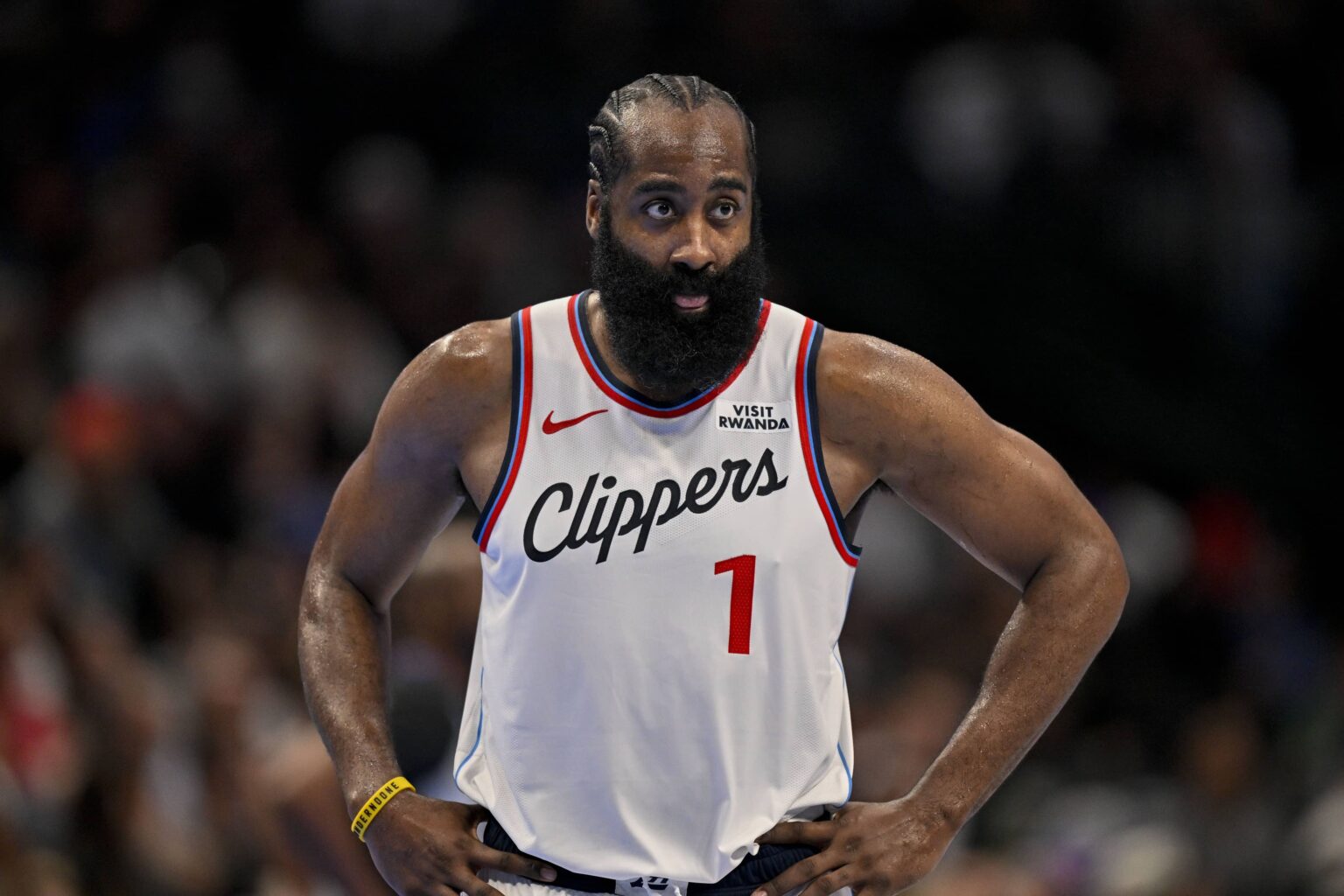
The league’s trade-deadline board flipped on February 2, 2026, when Shams Charania reported that the Clippers and James Harden are aligned on trying to find a trade before the February 5 deadline.
The timing has been loud, too. Harden has missed back-to-back games for personal reasons while trade noise swelled, and the absence instantly became part of the story around the locker room and the market.
On the court, James Harden has still looked like a top-end engine this season: 25.4 points, 4.8 rebounds, 8.1 assists, on 41.9% from the field, 34.7% from three, 90.1% from the line in 44 games. That’s not a “buy-low” résumé. That’s a team-building dare.
Why now? Multiple breadcrumbs point to the same thing: money and timeline. Per Kelly Iko, rival teams have connected Harden’s push to his contract structure, including a $42.3 million player option for 2026-27 with only $13.3 million guaranteed. And one league source told Marc Stein and Jake Fischer the motivation is “all about a contract extension” and the sides’ differing priorities into 2027 flexibility.
Right now, the Cavaliers have been painted as the clearest lane, and Chris Mannix has reported their side is even pushing for draft compensation in structures involving Darius Garland.
That’s the temperature check for the rest of this piece: the five “realistic” landing spots aren’t about fan fiction. They’re about who can stomach Harden’s price, his timeline, and the idea that this is a win-now swing, not a slow-burn rebuild.
5. Sacramento Kings
Sacramento Kings Receive: James Harden, Nicolas Batum,
Los Angeles Clippers Receive: DeMar DeRozan, Malik Monk, 2026 first-round pick
This is the rare Harden framework that reads like two front offices solving problems they actually have, not a headline chase. The Kings are sitting on a 110.3 offensive rating (29th), a 120.5 defensive rating (28th), and a -10.2 net rating (30th). That profile screams for an elite half-court organizer who can simplify possessions when the first action dies.
Harden does that immediately, but the real “why this is realistic” is the cost. The Clippers’ net rating is basically middle-of-the-pack at -0.2 (17th), with a 116.8 offensive rating and 117.0 defensive rating. They’re not tanking, so the return has to keep them playable right now. DeMar DeRozan and Malik Monk check that box with different flavors.
DeRozan gives the Clippers a late-clock bailout option who can live in the midrange and manufacture free throws. He’s at 19.0 points, 3.2 rebounds, and 3.9 assists this season. Monk adds the speed and spacing the Clippers need in non-Kawhi minutes: 12.2 points, 2.1 rebounds, 2.5 assists, and 41.5% from three.
If you’re the Clippers, that’s two rotation creators instead of one heliocentric hub, which matters when you’re trying to survive playoff scouting.
The DeRozan part also has real smoke. Sam Amick has previously reported the Clippers had interest in DeRozan, which is exactly why this construction isn’t coming out of nowhere. It’s basically a “circle back” target that becomes available only because Harden is pushing the market.
Batum is the quiet key for the Kings. If they are going to add Harden, they need someone who can soak up wing assignments and keep the defense from collapsing on switches. Batum’s line is modest (4.5 points, 2.7 rebounds, 0.8 assists), but his value is functional: spacing, connective passing, and not getting played off the floor.
The cap math is clean, too. In the framework, DeRozan and Monk combine to roughly match Harden’s $39.1 million, with Batum’s $5.6 million smoothing the edges. That’s why I like this as a “realistic” spot: it’s a basketball trade first, not a spreadsheet fantasy.
4. Toronto Raptors
Toronto Raptors Receive: James Harden
Los Angeles Clippers Receive: Immanuel Quickley, Gradey Dick
This one tracks with what’s actually been floating around the Raptors for weeks: they’re open to moving real money and real players if it gets them a true upgrade at the top. Per Michael Scotto, the Raptors have gauged the trade market on Quickley while looking for a point guard upgrade. And per Josh Lewenberg, they’ve shown willingness to part with some combination of Quickley, RJ Barrett, and Jakob Poeltl in the right swing.
If you’re the Raptors, Harden is the cleanest way to raise your offensive floor instantly. He’s still putting up star production at 36 years old. You’re not trading for the idea of Harden. You’re buying an offense that can generate a good shot late in the clock without needing everything to be perfect.
The “why the Clippers do it” case is about two things: age curve and lineup balance. Immanuel Quickley gives them a younger lead guard with real two-way pop and actual volume creation, not just a caretaker. He’s at 16.8 points, 4.5 rebounds, 6.1 assists this season, with solid efficiency (43.9% from the field, 37.0% from three). Gradey Dick is the second piece that makes this realistic: a cheap, playable shooter-connector archetype (6.7 points, 2.2 rebounds in 50 games) that can be developed instead of rented.
The money is at least plausible on paper, too: Harden’s $39.1 million slots against Quickley’s $32.5 million plus Dick’s $4.9 million, which is the kind of structure teams actually use at the deadline.
The Raptors should absolutely be on Harden’s short list if they’re serious about skipping the “one more year” phase. This is expensive, but it’s coherent. It turns their offense from “hope” into “plan,” and that’s usually what separates fake buyers from real ones.
3. Atlanta Hawks
Atlanta Hawks Receive: James Harden
Los Angeles Clippers Receive: Kristaps Porzingis, Luke Kennard, 2026 first-round pick (swap)
This one starts with the Hawks’ reality check: they already moved Trae Young, so the offense needs a new primary initiator, not another committee of “pretty good” handlers. Harden is still the cleanest plug-in version of that archetype, and Marc Stein framed the Hawks as a team “he has eyed” recently.
The Hawks are 24-27, which puts them in the uncomfortable middle where “development” and “winning” fight each other every night. Harden is the shortcut to coherence. He raises the floor of every half-court possession, and he instantly turns rim pressure into corner threes instead of late-clock pull-ups.
On the Clippers’ side, this is less about punting and more about staying playable while leaning into the organizational plan. Sam Amick’s reporting has framed the Clippers as a team that has prioritized salary-cap flexibility starting in the summer of 2027, which naturally makes them resistant to money that runs past that window. That’s the logic behind taking expiring-style pieces plus a draft lever rather than swapping Harden for another long-term contract.
Kristaps Porzingis gives them a frontcourt scoring outlet that doesn’t require the ball to be effective. He’s at 17.1 points, 5.1 rebounds, 2.7 assists on 45.7% from the field. Even if his role changes possession to possession, the spacing gravity is real, and it keeps the Clippers from being too perimeter-heavy.
Luke Kennard is the second piece that fits the “stay competitive” mandate. He’s averaging 7.8 points and is shooting 49.0% from three, the best mark in the league this season. That’s not a throw-in. That’s a rotation shooter who bends playoff scouting without needing touches.
The records make the incentive obvious. The Clippers are 23-26 and can’t afford dead roster spots if they move Harden. This return keeps the rotation functional, trims long-term risk relative to an extension fight, and still leaves a real asset on the board with the first-round pick. Meanwhile, the Hawks get the one thing they’ll feel every single night post-Trae: a true engine that can carry offense when the game gets ugly.
2. Houston Rockets
Houston Rockets Receive: James Harden
Los Angeles Clippers Receive: Fred VanVleet, Dorian Finney-Smith, Jae’Sean Tate, 2027 first-round pick (swap rights), 2028 first-round pick
This is the “stars fix problems fast” landing spot, and the Rockets’ problem is obvious right now: they’re winning games, but they’re doing it without a true late-clock organizer when the possession turns ugly. They’re 31-17 and riding real momentum. That’s exactly when front offices get dangerous.
The Fred VanVleet injury is the practical reason this works. VanVleet tore his ACL and is expected to miss most or all of the season, as the Rockets are reportedly not targeting a replacement. But if your lead guard spot is a rotating cast, a disgruntled Harden is the cleanest “one move, one solution” player on the board.
For the Clippers, the return is about staying functional and buying optionality, not pretending three role players replace a star. VanVleet’s $25.0 million is the salary spine of the deal, even if he doesn’t help this season. You can rehab him and treat him as next-year defense and pull-up shooting, or you can treat that contract as a future matching tool.
Finney-Smith and Tate are the rotation glue. Finney-Smith’s box score is tiny (2.9 points, 2.5 rebounds, 0.6 assists), but the minutes are the point: a low-usage defender who can be slotted around stars. Tate is similar in intent, with 2.5 points, 1.5 rebounds, and 0.5 assists in a limited run. If you’re the Clippers, those are the types you can play without needing to redesign the offense.
The real payoff is the pick package. If Harden is forcing the market, the Clippers need a clean way to justify moving an All-Star without taking back a worse long-term contract. Picks plus a swap is how you do that.
My take: this is the most “basketball makes sense” reunion option. The Rockets get a real offensive closer while they’re already good, and the Clippers turn a messy situation into assets and flexibility without torching the rotation. Harden trade talks are real, too: Charania reported Harden and the Clippers are exploring deals ahead of the deadline.
1. Cleveland Cavaliers
Cleveland Cavaliers Receive: James Harden
Los Angeles Clippers Receive: Darius Garland
This is the cleanest “real” Harden pathway because the reporting is already there: Chris Mannix reported the Cavaliers and Clippers have had advanced discussions on a deal built around James Harden for Darius Garland.
If you’re ranking landing spots by realism, nothing beats a framework that’s already being talked through at the league level.
The Cavaliers are 30-21, sitting fifth in the East, and the appeal is pretty obvious on paper: they’re good, but the offense still leans on Donovan Mitchell to do too much late in games. Harden is still a one-man possession solver with top-tier creation, and it’s exactly the type of skill that can turn a tight playoff game from a grind into free throws and corner threes.
The Garland side is why the Cavaliers can even talk themselves into it. Darius Garland is 26, and he’s been in and out: He missed the first seven games coming off offseason toe surgery and has been sidelined since January 16 with an ankle sprain. When he’s played, the production has still been solid: 18.0 points, 2.4 rebounds, 6.9 assists on 45.1% from the field, 36.0% from three, 86.1% from the line.
But if the Cavaliers are making this swing, it’s them choosing availability and late-clock shot creation over the smaller-guard pairing questions that never fully go away.
From the Clippers’ side, the fit is almost too clean. They’re 23-26, ninth in the West, and if Harden is forcing the timeline, a straight swap for a younger All-Star guard is the kind of pivot that lets them reset without bottoming out. Garland’s contract also keeps their “star guard” slot filled for multiple seasons, which matters if they don’t want to spin into a full teardown.
My take is simple: if the Cavaliers are willing to bet on Harden’s shot creation next to Mitchell, this is the one landing spot that reads less like theory and more like the actual endgame.