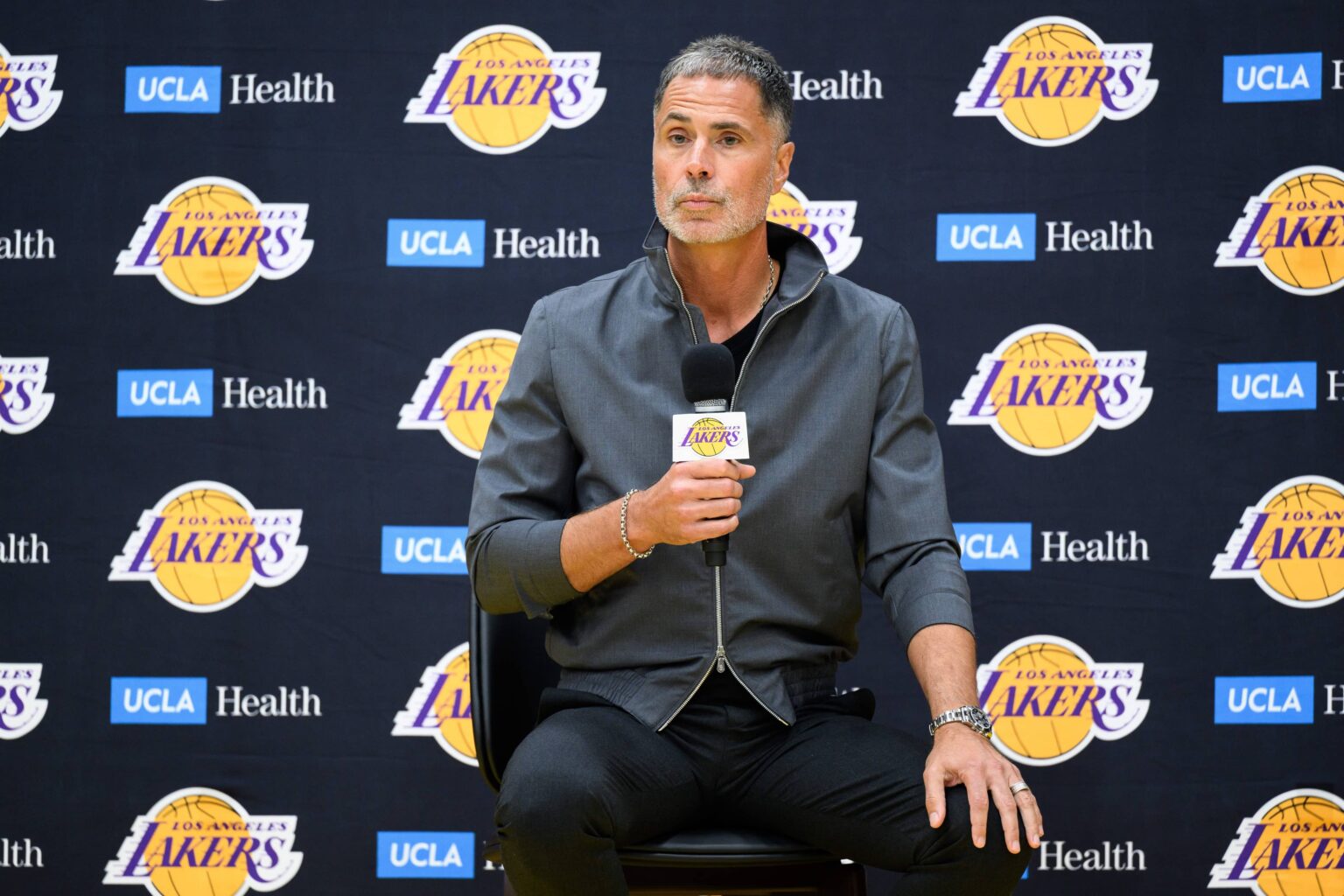
The Lakers were swept by the Thunder in the Western Conference semifinals. As Luka Doncic missed the postseason with a Grade 2 hamstring injury, the roster problems became apparent.
The Lakers are “not good enough right now,” as JJ Redick said after the elimination. The offseason has to reflect that. The roster needs changes if the Lakers want to compete with the best teams in the Western Conference.
LeBron James’ future remains uncertain, but the most likely outcome is that he stays for at least one more season. Austin Reaves is also expected to be part of the next roster, with a big contract coming in free agency.
The more important question is the rest of the group. Several players do not look secure. Some are free agents. Some have limited roles. Others could be used in trades if the Lakers try to add more size, defense, and playoff-level depth.
That puts a handful of names in a difficult position. Whether because of contract status, roster fit, or a completed cycle with the team, these five players may not be on the Lakers roster next season.
These are five players who are unlikely to be on the Lakers roster next season.
1. Maxi Kleber
Contract 2026-27: Unrestricted Free Agent
Maxi Kleber is the easiest decision.
He is 34 years old and entering unrestricted free agency. He had an annual salary of $11.0 million this season, and at this point is far from being a priority. The Lakers can bring him back if they want, but there is no strong reason to do it unless the contract is near the minimum.
Kleber’s production was too small. He averaged 2.0 points, 2.0 rebounds, and 0.6 assists in 43 games for the Lakers. He played only 10.7 minutes per game and shot 23.1% from three. That is the number that changes the evaluation. Kleber used to have value because he could defend in the frontcourt, move the ball, and space the floor. If the three-point shot is gone, his role becomes very narrow.
The Lakers need frontcourt players who can do at least one thing at a high level. They need real rim protection, strong rebounding, vertical finishing, or dependable shooting. Kleber did not give them enough in any of those areas.
His connection with Doncic is not enough. He knows how to play with him, but that is not the same as being a rotation player for a team trying to win the West. The Lakers already have too many players who need the stars to create all their value.
Kleber can still help a team in a small regular-season role. He should not be one of the Lakers’ answers next season.
2. Jaxson Hayes
Contract 2026-27: Unrestricted Free Agent
Jaxson Hayes had a useful season in basic numbers. He averaged 7.5 points, 4.1 rebounds, and 0.9 assists in 66 games while shooting 75.6% from the field. He is athletic, he runs the floor, and he can finish above the rim. Next to Doncic, that type of center will always produce some easy baskets.
That does not make him a player the Lakers should keep.
Hayes is also an unrestricted free agent as his $3.4 million deal expires. That is not a large number, but the question is not only price. It is role. The Lakers need a center who can survive playoff matchups with discipline, rebounding, and defensive reads. Hayes still has problems in those areas.
His best offensive value is as a lob threat. That is useful in the regular season. It is less useful if the other team can attack him in space, force rotations, and punish bad decisions. The Lakers cannot keep paying for theoretical tools. They need a more stable defensive profile.
Ayton also has an $8.1 million player option, that might get declined in search of a bigger payday. If Ayton stays, paying Hayes again becomes harder to justify. If Ayton leaves, the Lakers should aim higher than Hayes for the center rotation.
Hayes can return only if the market is weak and the contract is small. That is possible. But the better roster decision is to move on and find a center with more defensive trust.
3. Kobe Bufkin
Contract 2026-27: Unrestricted Free Agent
Kobe Bufkin is already the most direct case.
The Lakers signed him to a two-year contract in February after strong G League production. He was averaging 26.7 points in 26 games for South Bay, shooting 51.3% from the field and 43.0% from three. He had enough scoring production to deserve another NBA look.
But the Lakers ended the experiment before the playoffs. The Lakers placed him on waivers before the deadline to adjust the postseason roster.
That says enough. The Lakers did not see him as part of their playoff group. If a player is waived before the postseason, he is not part of the next roster plan unless something changes strongly in the summer.
Bufkin’s case is not about talent. He is still young. He was a first-round pick. He has shown he can score at the G League level. But the Lakers are not in a patient development window. They need guards who can defend, shoot, and play simple minutes next to Doncic, Reaves and James. Bufkin did not reach that level with the Lakers.
This one is not much of a projection. He is already out. The Lakers used the roster spot differently when the games became more important.
4. Nick Smith Jr.
Contract 2026-27: $2.5 million (Team Option / non-guaranteed)
Nick Smith Jr. is more interesting than Bufkin because he had better NBA production with the Lakers.
Smith averaged 6.2 points, 0.8 rebounds and 1.0 assists in 30 games. He shot 43.5% from the field and 39.5% from three. For a low-rotation guard, that shooting was useful. He also spent much of the season with South Bay before the Lakers signed him to a standard contract.
Still, this is a roster fit problem.
Smith is a small scoring guard. That profile is hard to keep on a team already built around Doncic, Reaves, and maybe Smart if he picks up his option. The Lakers don’t need more small guards who need touches to create value. They need players who can defend bigger matchups, rebound from the wing, and score the open shots without needing the ball in their hands the whole possession.
Smith remains with the Lakers on a potential team option for next season. That makes him easy to move on from if the Lakers need the roster spot.
There is a case to keep him as cheap shooting. That case is not crazy. But the Lakers cannot build the end of the roster only around guards who are playable in certain offensive lineups and vulnerable in other matchups.
Smith can score. He can shoot. He may have a longer NBA career. But for this specific roster, he is not a priority. The Lakers should use that spot on size, defense, or a more complete guard.
5. Dalton Knecht
Contract 2026-27: $4.2 million (Team Option)
Dalton Knecht is the biggest name on this list.
He is not a free agent, so this is not a simple contract decision. It is a trade decision. The Lakers already gave a signal. Dan Woike of The Athletic already reported that the Lakers “shopped aggressively” Knecht at the trade deadline, but no deal happened. The same report noted that the team had already picked up his 2026-27 option.
That is not a common thing for a recent first-round pick. It means the Lakers were already open to moving him.
Knecht’s season did not help his case. He averaged 4.2 points, 1.4 rebounds, and 0.4 assists in 54 games. He shot 45.5% from the field and 34.2% from three. For a player whose main NBA value is shooting and scoring, 34.2% from three is not enough.
The problem is role. Knecht is not a strong defender. He is not a secondary creator. He does not rebound enough to play as a bigger forward. If the shot is not elite, his minutes become difficult to defend.
The Lakers need athletic wings. They need two-way players. They need rotation pieces who can stay on the floor against the Thunder, Nuggets, Spurs, and Timberwolves. Knecht does not give them that right now.
His low salary still has trade value. Another team may see shooting upside and a better development situation. That may be the best outcome for both sides.
Knecht is the name that gives the article weight. He is not old. He is not finished. But the Lakers already tried to move him once. They should try again.