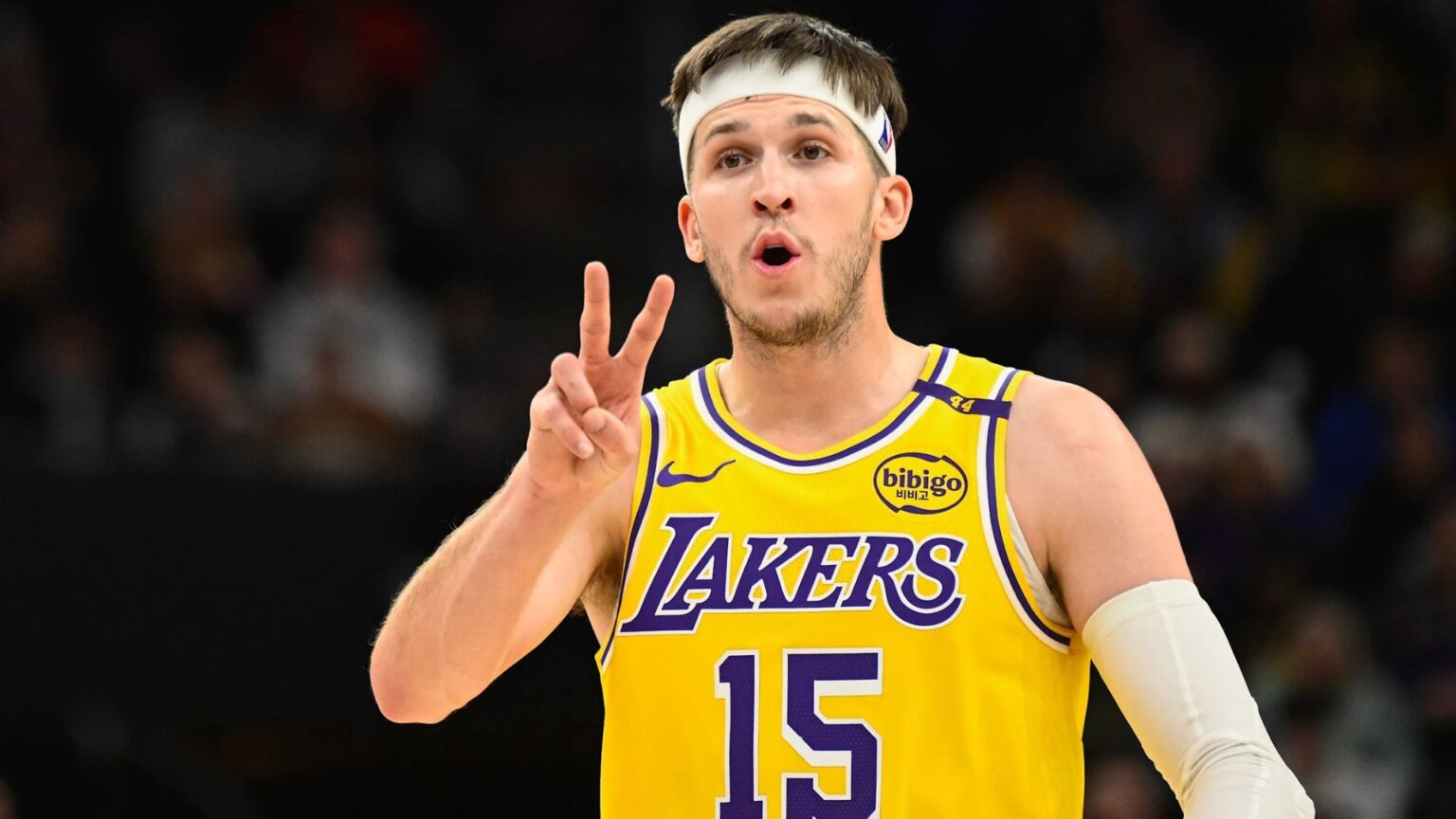
Austin Reaves is going into free agency as one of the biggest guards on the market.
He is expected to decline his $14.9 million player option for 2026-27 and become an unrestricted free agent. He has outplayed the contract. Reaves averaged 23.3 points, 4.7 rebounds, and 5.5 assists in 51 games this season, shooting 49.0% from the field, 36.0% from three, and 87.1% from the line. He is no longer a good role player. He is a high-level offensive guard.
That is why the price will be high. Dan Woike and Sam Amick of The Athletic reported that rival executives believe Reaves could command around $40.0 million per season because of his production, age, and a weak free-agent class. They also reported that the Bulls and Nets have the cap space to reach that type of number, while the Jazz and Hawks have known interest but would need to create more room.
The Lakers still have the strongest case. Rob Pelinka said Reaves has made it clear he wants to stay, and the Lakers want the same result. Luka Doncic has also told the franchise he wants to keep playing with Reaves. That gives the Lakers the biggest advantage before free agency even begins.
Still, unrestricted free agency always brings pressure. Reaves can get paid, choose a bigger role, or stay in the best basketball spot. These are the five best landing spots for him this summer.
5. Chicago Bulls
The Bulls are here because of money. They are projected to have $63.5 million in cap space, per Spotrac, the most among clear cap-space teams. ESPN’s Bobby Marks also projected them with up to $54.0 million. Either way, the point is the same. The Bulls can put a large offer on the table without needing a complicated trade first.
That is the main threat. Reaves is not leaving the Lakers for a small raise. It would take a number that forces him to think. A four-year offer starting near $40.0 million would do that. The Bulls can be aggressive because their roster is still open. They are not locked into an expensive veteran core. They can sell Reaves a major offensive role, heavy usage, and the chance to be one of the faces of the team.
The fit is simple on offense. Reaves would give the Bulls a guard who can score at all three levels, run pick-and-roll, get to the line, and make plays without needing to dominate every possession. He is not a pure point guard, but he is more than a spot-up scorer. His 5.5 assists per game show that he can carry real creation volume. That would help a Bulls team still trying to build a serious half-court identity.
The problem is the direction of the team. The Bulls are not close enough to winning to be the strongest basketball pitch. Woike and Amick reported that winning will be a significant factor in Reaves’ thinking, and that hurts this case. The Bulls can pay him. They can give him a bigger role. They can give him more control. But they cannot offer the same short-term title path as the Lakers or Hawks.
There is also a roster-building question. Paying Reaves near $40.0 million per year makes sense only if the Bulls see him as a real top-two offensive player. That is a big jump. Reaves is very good, but he has played next to elite stars. Asking him to become the main guard for a rebuilding roster would test his game in a different way.
The Bulls are a real financial threat. They are not the best basketball threat. That keeps them fifth.
4. Brooklyn Nets
The Nets are another major cap-space team with a clear need for offense. They are projected to have $46.9 million in cap space, and that is enough to chase Reaves with a major offer. It also gives the Nets flexibility to add more than one player if they want to speed up the rebuild.
The Nets were bad this season. They finished 20-62, 13th in the East, and had one of the weakest offenses in the league. That is exactly why Reaves would interest them. They need a real guard scorer, not another developmental piece who may need three years. Reaves would walk in as their most proven offensive player. He can score out of ball screens, create late-clock shots, and keep the offense organized.
The fit with the Nets’ young roster is better than it looks at first. They added several young players in the 2025 draft, including Egor Demin, Nolan Traore, Ben Saraf, and Danny Wolf. That gives them youth, but not certainty. Reaves would give the group an adult offensive guard who can raise the floor right away. He would also help young wings and bigs by creating better shots instead of forcing them into difficult self-creation.
There is a strong financial case, too. Reaves’ market could go near $40.0 million per year, and the Nets can reach that zone. The Lakers may not want to match a full max-type number if they have other roster needs. The Nets can pressure them by making the contract uncomfortable.
The issue is the same as with the Bulls, but even stronger. Reaves has said and shown that he likes his current situation. The Lakers want him back. Doncic wants him back. The Nets cannot match that kind of basketball security. They can offer money and a bigger role, but they cannot offer a strong chance to win right away.
That is why this would be more of a leverage spot than a likely destination. Reaves can use the Nets to raise his market. The Nets can make a serious offer because they need talent and have the space. But for Reaves to actually leave for a 20-win team, the money would probably need to be near the top of his market.
The Nets are dangerous because they can pay. They are not dangerous enough because the basketball case is weak today.
3. Utah Jazz
The Jazz are one of the more interesting teams because their interest has been reported, but the money is not simple.
Woike and Amick reported that the Jazz are among the teams with known interest in Reaves, but they would need to make roster moves to create the kind of cap space needed for a serious offer. That is the key difference between them and the Bulls or Nets. The interest is real enough to discuss, but the path is harder.
The basketball fit is easy to understand. The Jazz finished 22-60, but they have more frontcourt talent than a normal 22-win team. Lauri Markkanen averaged 26.7 points, 6.9 rebounds, and 2.1 assists, and the roster also includes Jaren Jackson Jr., Ace Bailey, Walker Kessler, Keyonte George, and other young pieces. That is not a tanking team anymore, and they can add the No. 2 overall pick in the Draft shortly.
Reaves would answer a direct need. The Jazz need a guard who can control possessions, score efficiently, and organize offense. Reaves is not a traditional floor general, but he is a strong secondary creator who has grown into a real on-ball scorer. His 23.3 points and 5.5 assists per game are not empty numbers. He did it on strong efficiency and inside a winning team structure.
Next to Markkanen and Jackson, Reaves would have space to work. Markkanen stretches defenses as a big forward. Jackson gives rim protection and frontcourt scoring. Reaves would give the Jazz a guard who can attack closeouts, run middle pick-and-roll, hit pull-up threes, and get to the line. That is a useful mix.
The problem is cost. The Jazz would be at just under $25.0 million in cap space before other moves and before dealing with their own free agents. That is not enough for the type of offer that could force Reaves away from the Lakers. To get there, the Jazz would need to shed salary or change the roster first.
That makes this less direct, but still serious. The Jazz have enough young players and movable contracts to create room if they decide Reaves is the guard they want. The question is whether they should move that aggressively after a 22-win season.
Reaves would help the Jazz. He would give them a real guard and make the offense much more organized. But this only becomes a true threat if the Jazz are ready to move from rebuild mode into a faster timeline. That is possible. It is not certain.
2. Atlanta Hawks
The Hawks are the most serious outside threat because they can offer a winning context.
They went 46-36 and finished sixth in the East. That already separates them from the Bulls, Nets, and Jazz. Reaves is expected to value winning, and the Hawks can offer a real playoff team with a real need at guard.
The need is clear. The Hawks have Jalen Johnson as an All-Star-level forward and a strong two-way core, but they need more lead-guard stability. Johnson averaged 22.5 points, 10.3 rebounds, and 7.9 assists this season, so the offense already has a forward who can pass, rebound, and create. Reaves would not need to be the only organizer. He could share the ball with Johnson while giving the Hawks more shooting and late-clock scoring.
That is the best part of the fit. Reaves does not have to become a heliocentric guard. He works better as a guard who can play on the ball and off the ball. He can run pick-and-roll, but he can also spot up, cut, attack closeouts, and punish weak defenders. Next to Johnson, Dyson Daniels, and Nickeil Alexander-Walker, Reaves would give the Hawks a different offensive shape without removing their defensive base.
The Hawks also have a better pitch than most teams. They can tell Reaves he would join a playoff team, get a large role, and still compete. That is very different from asking him to sign with a rebuilding team and lose for two years. Reaves is 27. This is probably the biggest contract of his career, but he is also in his prime. The basketball situation should be important.
The money is the issue. The Hawks could create up to $32.9 million in room, depending on their own decisions. That is not enough if Reaves’ market gets close to $40.0 million per year. To make a full push, the Hawks would need to create more space or use a sign-and-trade path.
That is why this is not simple. The Hawks can be the best outside basketball fit and still fail to reach the money. But they should be aggressive if the Lakers hesitate. Reaves is exactly the type of guard who can make a good team more stable. He is old enough to help now, young enough to keep value, and skilled enough to work with other creators.
The Hawks are not the favorite. But among teams outside the Lakers, they may have the best mix of role, winning, and need.
1. Los Angeles Lakers
The Lakers remain the best landing spot.
This is not only because they already have Reaves. It is because the contract path, the basketball fit, and the reporting all point in the same direction.
Pelinka said Reaves has made it clear that he wants to remain with the Lakers, and Pelinka said the team feels the same way. That is the strongest public signal. This does not sound like a player preparing to leave. It sounds like a player who wants to get paid properly by the team that developed him.
Doncic also wants him back. Woike reported that Doncic has made it clear to the Lakers that he wants to keep playing with Reaves, and that he views him as a long-term piece. The same report said Doncic would prefer a team construction that includes him and Reaves with another star if the Lakers can get one. That is not a small detail. The franchise player wants Reaves in the build.
The fit is easy. Reaves gives Doncic a second ball-handler who can score, pass, and play without needing every possession. He can run bench units. He can close next to Doncic. He can play off the ball when Doncic controls the floor. He can attack when teams overload the strong side. He is not a lockdown defender, and that is a real limitation, but his offensive value is high enough to keep him.
The Lakers also have a contract advantage. Reaves’ cap hold is projected around $20.9 million, which is much lower than his next salary. That gives the Lakers a strong order-of-operations play. They can use cap space first, then re-sign Reaves with Bird rights later.
That is why the Lakers can justify paying him. If Reaves starts around $35.0 million or even pushes closer to $40.0 million, the deal is expensive, but it does not stop them from using his low cap hold first. The danger comes later, when Doncic’s money rises and the roster gets more expensive. But that is a future cap problem. Losing Reaves for nothing would be a current roster problem.
The Lakers went 53-29, and Reaves was a major part of that. He became the second-leading scorer, had his best season, and proved he can handle more responsibility. He also stayed efficient despite a larger role. That is the argument for paying him.
The concern is price. Reaves is very good, but $40.0 million per year is not a normal role-player number. If the Lakers pay him that much, they must believe he is a real long-term guard next to Doncic, not only a useful third option. That is a fair debate.
Still, the best answer is to keep him. Reaves wants to stay. Doncic wants him. The Lakers can structure the offseason around his cap hold. Other teams can offer money, but they cannot offer the same mix of role, trust, winning, and continuity.
The Lakers should be the favorite unless another team forces the market into a number that becomes uncomfortable. Even then, the most likely ending is Reaves staying where he is, with a massive raise and a bigger place in the post-LeBron version of the roster.