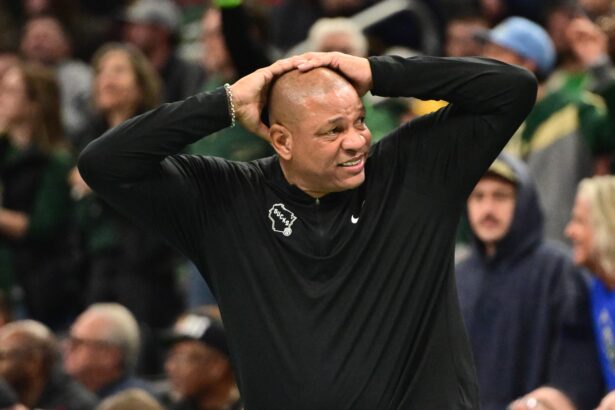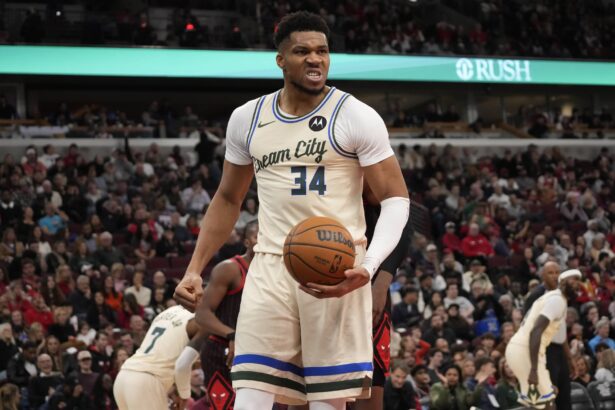
The Milwaukee Bucks are drifting into the danger zone. They sit 11-16, currently 10th in the East, and the February 5 trade deadline is starting to feel less like “optional roster tweaking” and more like a deadline for the entire Giannis Antetokounmpo era.
The recent Giannis noise hasn’t been subtle, either. ESPN’s Shams Charania reported that Giannis’ camp and the Bucks have been in talks about his future and whether the “best fit” is in Milwaukee or “elsewhere.”
Around the league, the message is that the Bucks want to shop like a buyer, with Jake Fischer describing the Bucks as “big-game hunting” to get Giannis more help.
That’s where Zach LaVine enters the chat. The Athletic’s Sam Amick reported the Bucks have “done recent due diligence” on the Sacramento Kings guard after showing “interest in the past.”
If the Bucks want a cleaner, simpler offensive jolt next to Giannis, a pure scorer like LaVine might be the most straightforward swing they can realistically talk themselves into. As Bleacher Report put it best in a recent mock trade, this idea could be a path to keep Giannis in Wisconsin.
The Trade Idea
Milwaukee Bucks Receive: Zach LaVine, Keon Ellis
Sacramento Kings Receive: Bobby Portis, Kyle Kuzma, Gary Harris, Cole Anthony, 2031 first-round pick
From a contract standpoint, this is the kind of “push the chips in” package you only consider if you believe it changes your ceiling.
LaVine is on a massive number: $45.9 million this season, with a $48.9 million player option for 2026-27. The sweetener for the Bucks is that Ellis comes cheap at $2.3 million.
On the outgoing side, the Bucks would be shipping real rotation money and real bodies: Bobby Portis ($13.4 million), Kyle Kuzma ($22.4 million), Gary Harris ($3.6 million), and Cole Anthony ($2.6 million), plus that 2031 first. It’s a lot, and it’s supposed to be. That’s the point.
Why The Bucks Do This
The Bucks need scoring that doesn’t require a 12-step instruction manual to unlock.
LaVine’s entire appeal is that he’s a plug-and-play bucket. This season with the Sacramento Kings, he’s at 20.2 points per game, shooting 48.7% from the field and 38.5% from three, with a 61.8 true shooting percentage.
That’s not “maybe he can help.” That’s “he instantly becomes your best perimeter shot creator.”
And the fit with Giannis is way more straightforward than people want to admit. The Bucks don’t need some perfect two-man symphony to justify this. They can run basic actions and still win possessions:
- Giannis draws two in the paint, LaVine gets the swing, and attacks a bent defense.
- LaVine runs secondary pick-and-roll while Giannis rests, so the offense doesn’t die the second Giannis sits.
- Late clock? LaVine can actually take the ball, create separation, and get a real shot without the possession turning into chaos.
The Bucks have also lived through the reality that name-value doesn’t automatically equal fit. Even after the Bucks waived Damian Lillard in the offseason, the core issue didn’t magically disappear: they still need reliable perimeter creation to keep teams from loading up on Giannis every single night. LaVine gives them that in the purest form.
Now add the under-the-radar part of this deal: Keon Ellis. He’s not a headliner, but he’s the type of backcourt defender every contender needs when the games tighten up. Ellis is only scoring 5.3 points per game, but he’s giving you 1.2 steals and hitting 37.0% from three in a smaller role.
That matters because if you’re trading for LaVine, you’re accepting you’ll need to cover for him defensively. Ellis helps patch that leak.
The real “why,” though, is bigger than any single stat line. The Bucks are getting linked to big targets for a reason. There’s been enough smoke around the organization’s urgency that it’s hard to ignore, including reporting framing them as deadline “buyers” trying to bolster the roster around Giannis. This is the kind of swing that says: we’re not wasting a year of prime Giannis, and we’re not praying internal development fixes everything.
Is LaVine a perfect star? No. But he’s a star scorer, and that’s the one thing the Bucks can’t fake when it matters.
Potential Troubles Awaiting
Now for the part Bucks fans won’t love: this trade could also blow up in their face.
First problem, defense. LaVine has never been a consistent difference-maker on that end, and “effort” has been the critique for years. You can win with a flawed defender at guard, but only if the rest of the lineup is built like a shield. If the Bucks give up multiple two-way bodies and bring in LaVine, they’re basically betting they can outscore problems that might get uglier in a playoff series.
And yes, Ellis helps, but one solid defensive guard doesn’t magically cancel out everything. Ellis can pressure the ball and make life annoying, but he’s not going to erase the reality that playoff teams will hunt matchups until something breaks.
Second problem, depth. The Bucks would be trading four playable guys. Portis alone is a real piece, giving the Bucks 11.9 points and 5.7 rebounds this season. Kuzma is sitting at 13.5 points on 51.5% from the field, and even if he’s not always pretty, he’s still another forward who can actually score.
Cole Anthony has been a useful secondary handler at 6.9 points and 4.0 assists, and Gary Harris, even in a limited role, is still a veteran defensive option.
You don’t move that many bodies without consequences. Injuries happen. Foul trouble happens. And playoff rotations always need a couple of “break glass in case of emergency” guys. This deal strips that away.
The third problem, money and flexibility. LaVine’s contract is enormous, and it doesn’t come with the safety valve you’d want. He can opt into nearly $49 million next season. If the fit isn’t clean, the Bucks could find themselves stuck with a max-level bill for a player who doesn’t solve the defense and doesn’t elevate others as a passer.
Which brings up problem four: playmaking. LaVine is a scorer first, second, and third. This season, he’s at 2.3 assists per game. If the Bucks need him to morph into some table-setter, that’s not the bet. The bet is that Giannis and the system create enough advantages that LaVine can just finish possessions. If opponents force LaVine to make complex reads under pressure, you might not love what you see.
Finally, availability. LaVine has already dealt with a thumb issue this season and is currently out for a week with an ankle issue. The Bucks already know how quickly a season can get derailed when key guys miss time.
So yeah, there’s a real downside here. You’re not trading for a flawless superstar. You’re trading for a high-level scorer and hoping the environment is strong enough to make the weaknesses manageable.
Is This In The Cards For The Bucks?
If we’re talking pure realism, the Bucks being tied to LaVine isn’t random fan fiction. There’s reporting that they’ve checked in, and the deadline context is obvious.
The bigger question is whether the Bucks have the appetite to send out this much depth plus a real future first for a scorer who isn’t universally viewed as a “winning player.”
But here’s the uncomfortable truth: the Bucks might not have the luxury of waiting for the perfect, no-risk star.
Giannis is still an MVP-level force, and the Bucks can’t waste that while hoping marginal moves fix everything. The league is too stacked, and the East is too competitive for half-measures. If the Bucks want to make a statement that they’re serious about maximizing Giannis’ prime, this is exactly what that looks like.
Would it help keep Giannis happy? It certainly signals the right things. It tells him the organization sees what he sees: he needs more help that actually changes the math in playoff games. And adding a legit 20-point scorer who shoots efficiently from deep does change the math.
But would it be a clean solution? Not automatically. The Bucks would have to commit to building the defense around the new reality, and they’d need to be comfortable living with the “LaVine experience”, meaning brilliant shot-making mixed with frustrating lapses. That’s the tradeoff.
If I’m the Bucks, I don’t love the cost, but I understand the desperation. At 11-16, “pretty good” moves aren’t enough. A swing like this is risky, but it’s also the kind of swing that can keep a season from quietly dying in February.