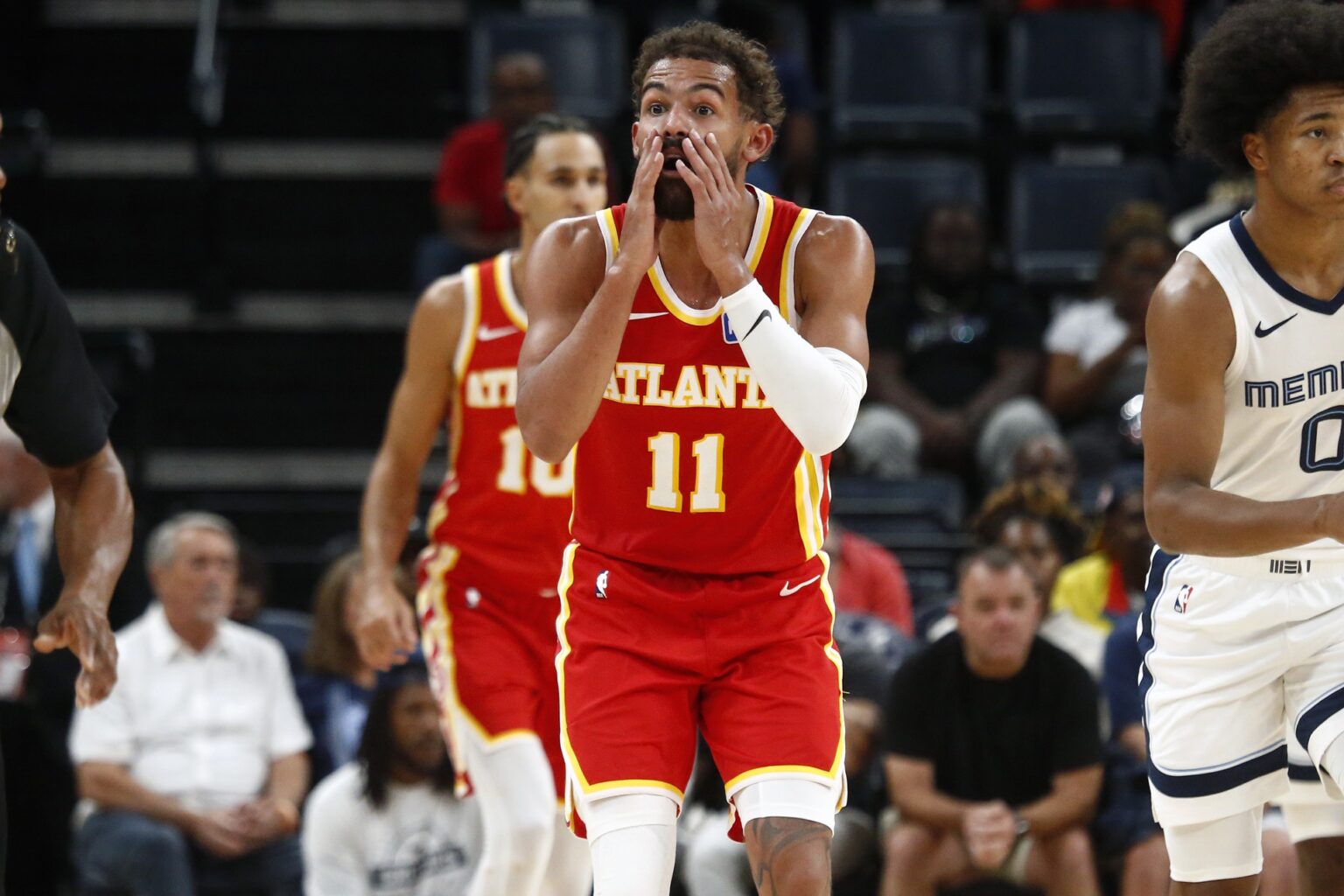
The Atlanta Hawks opened the season 2-3 with Trae Young in the lineup, and then lost him to a right MCL sprain on October 29 against the Brooklyn Nets. Since then, they’ve ripped off an 11–8 stretch without him and sit at 13–11 overall, ninth in the East with a +3.0 net rating. The eye test says they look bigger, more connected, and way nastier on defense. The numbers back that up.
With Young on the floor, Atlanta had a 119.0 defensive rating in his minutes, which is basically “bottom-five defense” territory. Without him, that number drops down into the 114.0 range, and the Hawks as a team now own a 113.1 defensive rating that ranks seventh in the entire league. For a franchise that lived in the 116–119 defensive range the last few seasons, that’s a massive leap.
At the same time, Young’s individual season was rough before the injury: 17.8 points and 7.8 assists on just 37.1 percent from the field and 19.2 percent from three in five games. This is a player whose career averages are 25.2 points and 9.8 assists, with a 35.1 percent three-point shooting percentage. So yeah, the “are they better without him?” conversation is loud for a reason.
But to really answer it, you have to look at what’s changed stylistically and who’s stepped into the void.
Defensive Identity
The biggest shift is on that end of the floor. It’s not just that Atlanta’s team defensive rating is down to 113.1; it’s that the split with and without Young is so stark. With him, they were giving up 119.0 points per 100 possessions. Without him, that’s around 113.6, a swing of roughly 5–6 points per 100. That’s the difference between being a fringe play-in defense and a legit top-10 unit.
Personnel-wise, this is exactly the kind of roster Quin Snyder wants to coach. Dyson Daniels, last season’s Defensive Player of the Year finalist and Most Improved Player, was already one of the best guard defenders in the league; he led the NBA in both total steals and deflections last year and averaged 3.0 steals per game. Now, with the ball in his hands more, he’s putting up 10.7 points, 6.2 rebounds, and 5.9 assists on 48.7 percent shooting, while still being a chaos merchant on the perimeter.
Next to him, Nickeil Alexander-Walker has gone from “nice role player” to full-on two-way scoring guard. He’s averaging 20.8 points per game on 46.8 percent from the field and 39.7 percent from three, plus 3.4 rebounds and 3.5 assists. His length and activity at the point of attack are a huge part of why Atlanta is suddenly forcing tougher shots and living in passing lanes instead of constantly putting out fires behind Young.
The front line is different, too. The Hawks just spent two years bleeding points in pick-and-roll coverage; they posted defensive ratings of 119.4 in 2023-24 and 115.7 last season, both bottom-10 marks. Kristaps Porzingis, when healthy, has changed the geometry of their defense. He’s giving them 19.2 points, 5.6 boards, and 3.1 assists on roughly 49.7 percent shooting, but the bigger story is the rim protection (1.6 BLK) and floor spacing (36.4 3P%) that lets them stay big without sacrificing offense.
Put Daniels, NAW, and Jalen Johnson around a 7-foot-3 shot-blocker, and you suddenly get a team that can switch, stunt, rotate, and still contest at the rim. That’s what the numbers are screaming. And it’s not a coincidence that those numbers look a whole lot better in the minutes where Young isn’t getting targeted in every action.
Jalen Johnson Is An All-Star
The other reason the Hawks haven’t fallen apart is that Jalen Johnson has basically turned into a point forward on steroids.
Since Young went down, Johnson has put up flat-out All-NBA numbers. He’s posting 23.7 points, 11.2 rebounds, and 8.5 assists per game in the Young-less stretch, while hitting over 43.4 percent from three. In his last 10 games, he jumped to 24.9 points, 11.3 rebounds, and 9.2 assists on 49/43/78 splits. That is bonkers production for a 23-year-old who was a bench piece two seasons ago.
Then he goes and drops a 21-18-16 line against the Denver Nuggets, becoming just the fifth player since 1997-98 to record a first-half triple-double in that wild one-point loss to Denver. That’s not “nice young player” stuff. That’s “this might be your franchise guy” stuff.
What Young’s absence has done is push Johnson into the center of everything. The offense flows through him as a grab-and-go creator, short-roll playmaker, and point forward in transition. Atlanta’s scoring hasn’t cratered at all; they’re still on 117.5 points per game this year, basically middle of the pack offensively. The difference is that it’s not coming from one heliocentric guard taking 25 shots and living at the logo.
Johnson’s size at 6-8, his ability to rebound and immediately ignite the break, and his improved shooting are what make the whole “better without Trae” thing even discussable. If he were just a finisher, Atlanta would be desperate for Young’s on-ball juice. But Johnson can run a lot of the same actions while also being a plus defender and rebounder. That’s a very different team identity.
Roster Cohesion
The last piece is fit. Everyone kind of makes more sense in this version of the Hawks.
Without Young, the usage spreads out. NAW’s at 20.8 points with efficient shooting and just 2.1 turnovers in more than 32 minutes a night. Daniels is a low-usage connective guard who averages six assists while rarely hunting his own shot. Johnson operates as the primary initiator but can slide off the ball when Porzingis is cooking in pick-and-pops or post-ups. Porzingis gives you stretch-five spacing that opens runways for Johnson and Daniels to attack the paint.
The on-off splits show the team playing faster, sharing the ball more, and shooting better when Young sits. Without him, the Hawks are scoring about 118.5 points per game while shooting close to 50 percent from the field and nearly 38 percent from three. With him, they’re at 113.8 points on 45.9 percent shooting and 34.5 percent from deep. The offense is less explosive in terms of individual shot-making, but it’s cleaner, more balanced, and harder to game plan for.
And then there’s the vibes part. Multiple national outlets have already floated the idea that the Hawks and Young could be heading toward a long-term crossroads, noting that Atlanta has gone 11-8 without him after that 2–3 start. It’s not crazy talk anymore to wonder if the roster, as currently constructed, is simply optimized for a bigger ball-moving, defense-first identity instead of a Trae-centric offense.
That said, this isn’t some obvious “trade him tomorrow” situation either.
Even in a down year, Young still brings elite pick-and-roll craft, deep-range gravity, and passing that you just can’t manufacture. His 17.8 points and 7.8 assists came with ugly shooting, but the career résumé is still 25 and almost 10 a night. In a playoff series, when possessions slow down and defenses know every play you run, having someone who can create something out of nothing still matters a ton.
Also worth noting: the Hawks’ offense with Young on the floor was still good in past seasons. The problem was always the other end. The version of this roster we’re seeing now, with Daniels as a terror at the point of attack, Johnson as a jumbo wing creator, and Porzingis roaming behind them, might actually be the best defensive infrastructure Young has ever had. If they can keep this defensive identity when he comes back, the ceiling jumps again.
So, are they actually better without Trae Young?
Right now, in the regular season, the answer is kind of yes. The defensive metrics, the record without him compared to 2–3 with him, and Johnson’s breakout all point to a group that looks more complete and more flexible when Young isn’t dominating the ball.
Long term, though, the real question isn’t “Trae or no Trae.” It’s whether Atlanta can bring him back into this version of the team without losing what’s made them so good over the last few weeks. If Young buys into more off-ball work, more defensive effort, and a little less control, the Hawks might end up with the best of both worlds: Johnson as a do-everything All-Star forward and Young as a supercharged closer.
If he doesn’t, then yeah, this current stretch is absolutely going to fuel some very real front-office conversations about where the Hawks go next.