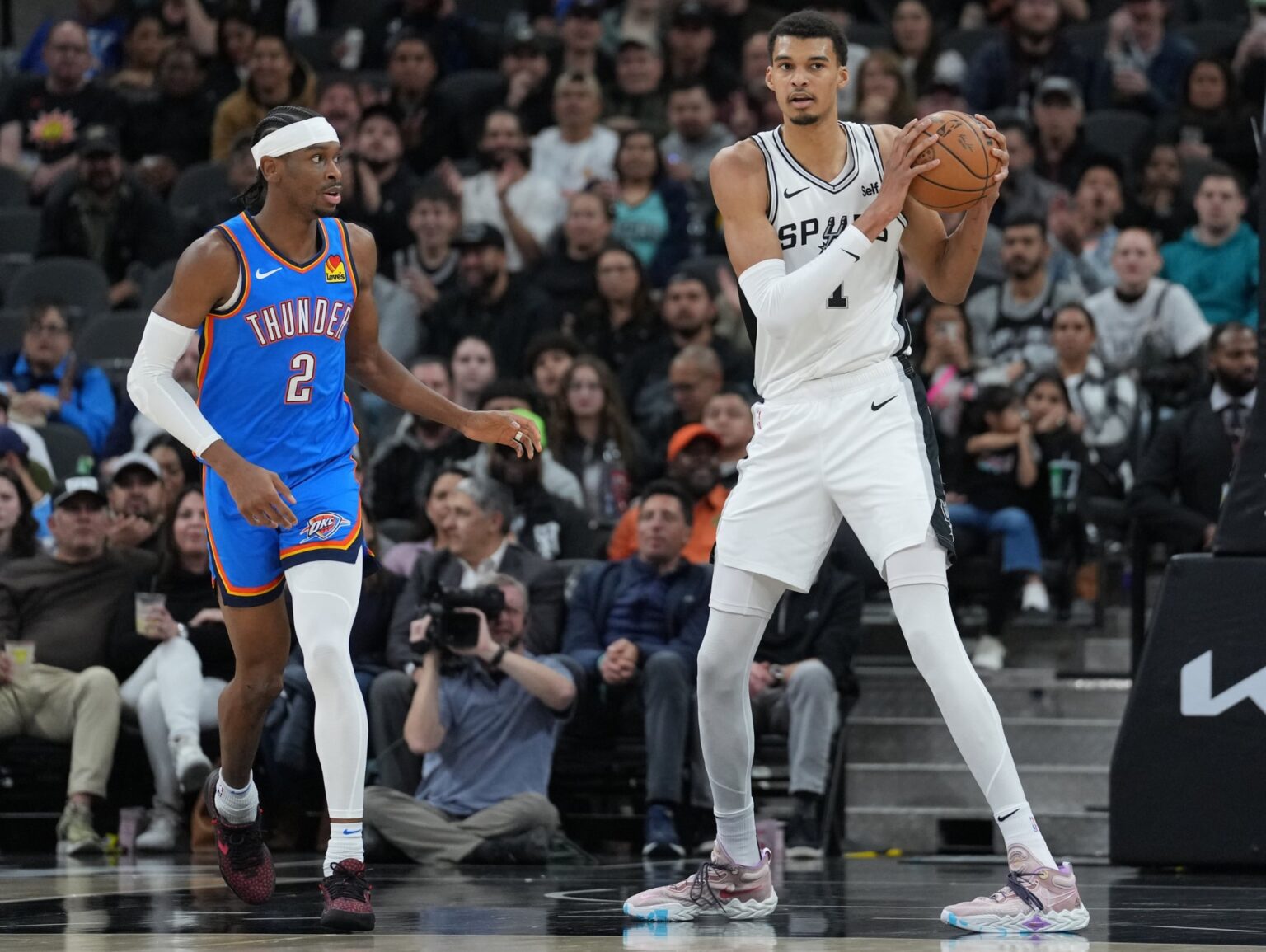
The Oklahoma City Thunder are still the scariest “process” team in the league. They play fast, they force mistakes, they stack stops, and they’ve got an MVP-level problem in Shai Gilgeous-Alexander, who’s putting up 32.1 points, 4.9 rebounds, and 6.5 assists on 55.1% from the field and 42.5% from three.
And yet… none of that has mattered against the San Antonio Spurs.
Three games this season, three Spurs wins. 111-109 in the NBA Cup semifinal on December 13, 130-110 on December 23, and then the Christmas Day gut-punch, 117-102 in OKC.
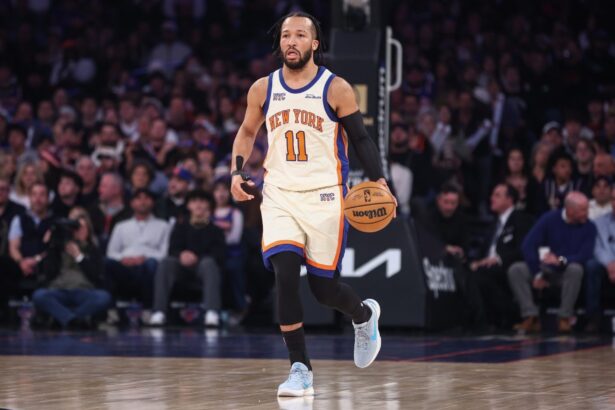
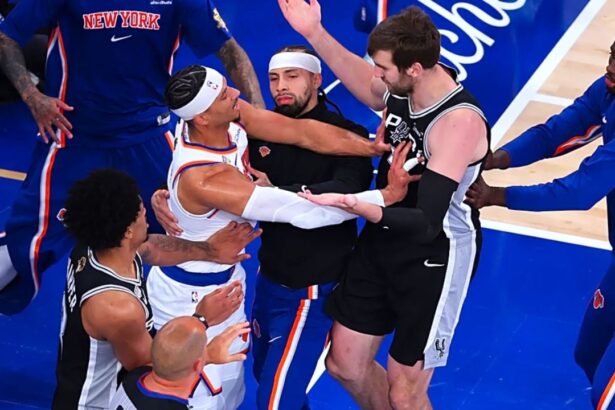
That Christmas win pushed the Spurs to 23-7 and made it eight straight wins (excluding the NBA Cup final loss to the Knicks), while handing the Thunder their first home loss of the season outside the Cup.
This is what makes the “kryptonite” label feel real: the Thunder aren’t losing because they suddenly forgot how to play. They’re losing because the Spurs are attacking the Thunder’s identity at the roots, possession by possession, decision by decision.
And the wild part? The numbers say both teams are legit. The Thunder sit No. 1 in net rating at 13.6 with the NBA’s best defensive rating at 104.6. The Spurs sit top-five in offense (118.9) and top-five in defense (112.0), with a 6.9 net rating that screams “real contender.”
So yeah, let’s call it what it is: this matchup is a problem.
Beating The Thunder’s Own Game
OKC wins by turning basketball into a turnover contest. They play clean on offense, they’re No. 1 in turnover percentage at 12.2, and they use that extra possession math to bury teams before the fourth quarter even starts.
The Spurs are one of the few teams that don’t get lured into that chaos.
In the Christmas win, they didn’t just outshoot the Thunder, they controlled the possession battle with poise. They shot 53.6% from the field, they kept their spacing organized, and they repeatedly answered Thunder runs with calm execution instead of “hero ball.” That matters because OKC thrives on emotional mistakes: rushed passes, panicked drives, early-clock pull-ups because the defense looks like it’s everywhere.
The Spurs basically say: “Cool, we’ll play fast too… but we’ll play fast with structure”.
That’s where De’Aaron Fox changes the matchup. He’s at 21.9 points and 6.1 assists on 48.2% from the field, and he turns Thunder pressure into backpedaling defense. The Thunder want to set their shell, load up early, and make you feel bodies at the nail. The Spurs don’t let them. Fox pushes the ball before OKC’s help can get organized, then the Spurs flow straight into early drag screens and quick-hitting pistol actions, forcing OKC’s defenders to communicate at full sprint.
And when the Spurs do end up in the half-court, they don’t play into OKC’s hands with slow, predictable sets. They keep the ball moving side-to-side, they cut behind ball-watching defenders, and they hunt the “second rotation,” not the first. That’s the key. OKC’s first rotation is elite. The second one is where even the best defenses bleed.
It’s not an accident that the Spurs have been humming lately. They’ve scored 616 total points over their last five games (123.2 on average), which is the kind of offensive rhythm that turns a tough matchup into a bully matchup.
Guiding Shai Into Rushed Offensive Decisions
Most teams defend Shai like they’re terrified of him. Hard doubles, early traps, “get the ball out of his hands,” and then Shai calmly picks them apart because he’s that good.
The Spurs don’t do the obvious thing. They do the smart thing.
They crowd Shai with bodies in his driving lanes without committing to full doubles that expose the corners. They show him a wall at the nail, they keep a second defender within arm’s length of the dotted line, and they make every drive feel like it ends in a forest. The goal isn’t to stop Shai from scoring entirely. It’s to make Shai work so hard that the rest of the Thunder offense becomes late-clock, low-rhythm basketball.
That’s exactly what Christmas looked like. Shai finished with 22 points, and the Thunder as a team shot 38.9% from the field and 25% from three. Those aren’t “missed open looks” numbers. Those are “we never got comfortable” numbers.
And this is where Stephon Castle has quietly become a matchup cheat code. He’s averaging 18.6 points, 5.2 rebounds, and 7.0 assists on 51.5% from the field, which already tells you he’s not some energy guy, he’s a real two-way connector. But against the Thunder, his value spikes because he can guard Shai without needing constant help.
Castle’s biggest win is at the start of possessions. He fights over the first screen. He denies clean angles. He forces Shai to reset. And when Shai has to reset, the Thunder lose the timing that makes their offense lethal. That’s how you get Shai possessions that start at 18 seconds instead of 22, and that’s how you get Thunder role players catching the ball a beat late, taking a contested three instead of a confident one.
Even when Shai has big scoring nights, like the 33-point game in the 130-110 loss on December 23, the Spurs still win because OKC’s overall offensive rhythm breaks. The Spurs basically praise Shai can get his, but the Thunder don’t get their style.
That’s not “stopping a star.” That’s breaking an ecosystem.
Turning The Paint Off With Wembanyama
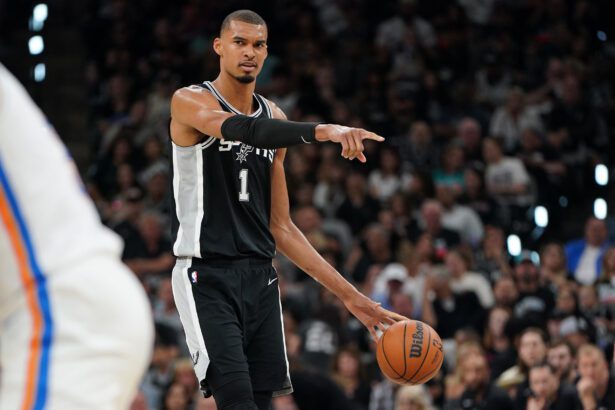
Victor Wembanyama’s stat line is already ridiculous: 23.4 points, 11.8 rebounds, and 3.6 assists on 51.4% from the field. But the real impact is what he does to your decision-making.
OKC’s offense relies on paint touches. Shai bends the defense, the ball swings, the closeout gets attacked, and suddenly you’re choosing between giving up a layup or giving up a corner three.
Wembanyama messes with that entire chain because he makes the paint feel closed even when it’s technically open.
You can see it in how the Thunder finish possessions against him. Drives turn into floaters. Layups turn into kickouts. Kickouts turn into late-clock threes because the first option never materializes. And the Spurs can keep shooters hugged because Wembanyama can cover mistakes like nobody else.
On Christmas, he came off the bench and still dropped 19 points and 11 rebounds. That “off the bench” detail matters because it shows this isn’t some fragile “we only win if Wemby plays 38 minutes” thing. The Spurs can structure the matchup around him in a bunch of different ways. They can use him in drop, they can use him as a roaming free safety, they can hide him on non-shooters and let him erase the rim.
And because he’s back from injury on a managed load, the Spurs are basically showing they can beat the Thunder even without going full throttle. That’s terrifying if you’re OKC. It means the matchup advantage isn’t tied to one specific rotation pattern.
The Thunder are elite because they’re efficient. Both teams sit top-five in eFG%, OKC at 56.6 and San Antonio at 56.4. But when Wembanyama is involved, OKC’s shot quality changes. The shots might still be threes, but they’re not the same threes. They’re later, they’re tighter, and they’re taken by players who didn’t want to be the one shooting it.
That’s how you end up with 25% from deep in the biggest game of the season.
Fox And Castle Force “Uncomfortable” Matchups
Here’s the part that feels unfair: the Spurs don’t just have one way to stress you. They have multiple ball-handlers who can get into the paint, and they have a seven-foot-four alien waiting behind the action like a looming consequence.
Fox’s speed creates the first crack. Castle’s size and composure widen it. Then Wembanyama makes it fatal.
That’s why the Spurs can survive different scripts against the Thunder. The Cup semifinal win came with Wembanyama returning and putting up 22 points and nine rebounds, while Fox and Castle each dropped 22, and the Spurs outlasted a Thunder team that came in 24-2.
Then the December 23 win looked completely different; Keldon Johnson had 25, Castle had 24, and the Spurs dropped 43 in the fourth quarter to blow it open. Then Christmas became the Fox show, 29 points, plus timely counters every time OKC tried to make it a game.
Different leading scorers. Same result. That’s not luck. That’s scheme plus roster versatility.
From an Xs-and-Os standpoint, the Spurs are constantly hunting the Thunder’s “help rules.” OKC wants to tag the roller from certain spots, stunt from the nail, and recover to shooters with clean closeouts. The Spurs make those closeouts messy by keeping the floor spaced and using quick re-screens and “empty corner” actions that force the low man into a brutal choice.
And when OKC tries to switch, the Spurs are comfortable playing against a switch because Fox can beat bigs with speed, Castle can punish smaller guards with size, and Wembanyama can turn a simple mismatch into instant free throws or a dunk. It’s pressure from multiple angles, and it’s exactly what you want in a playoff-style matchup.
This is also why the Spurs’ offensive rating being top-five isn’t a cute regular-season number. Their offense has counters. It’s not one action spammed 30 times. It’s reads.
The Blueprint That Scales In A Playoff Series
If you want the scary truth, it’s this: the Spurs’ “kryptonite” case scales better than most regular-season matchup quirks.
The Spurs aren’t winning because they hit 19 threes one night. They’re winning because they can control the parts of the game that OKC usually controls.
They can protect the ball enough to keep the Thunder from getting those nuclear transition avalanches. They can play a defender like Castle at the point of attack and keep Shai in front without selling out the entire defense.
They can play Wembanyama as a rim deterrent without abandoning the perimeter. They can score in multiple ways depending on how OKC guards them, and they’ve already proven it across three totally different games.
And the context matters too. The Thunder are still the top dog by metrics, No. 1 in net rating, No. 1 in defense. But the Spurs are one of the only teams with a profile that looks like a mirror, top-five offense, top-five defense, top-five net rating. That’s why this doesn’t feel like a “bad matchup” in the normal sense. It feels like an equal who happens to hit the Thunder right where it hurts.
So where do the Thunder go from here?
They have to find ways to create an easier offense when Shai’s driving lanes get walled off. That means more movement shooting, more off-ball screening to free up secondary creators, and more actions that force Wembanyama to make decisions away from the rim instead of letting him camp in that menace zone.
Because right now, the Spurs have a clean plan: turn the Thunder into a jump-shooting team, keep Shai human, and win the possession math by not panicking.
That’s why the Spurs are the Thunder’s kryptonite. Not because of one hot night. Because the Spurs can beat OKC at the exact things OKC usually uses to break everybody else.