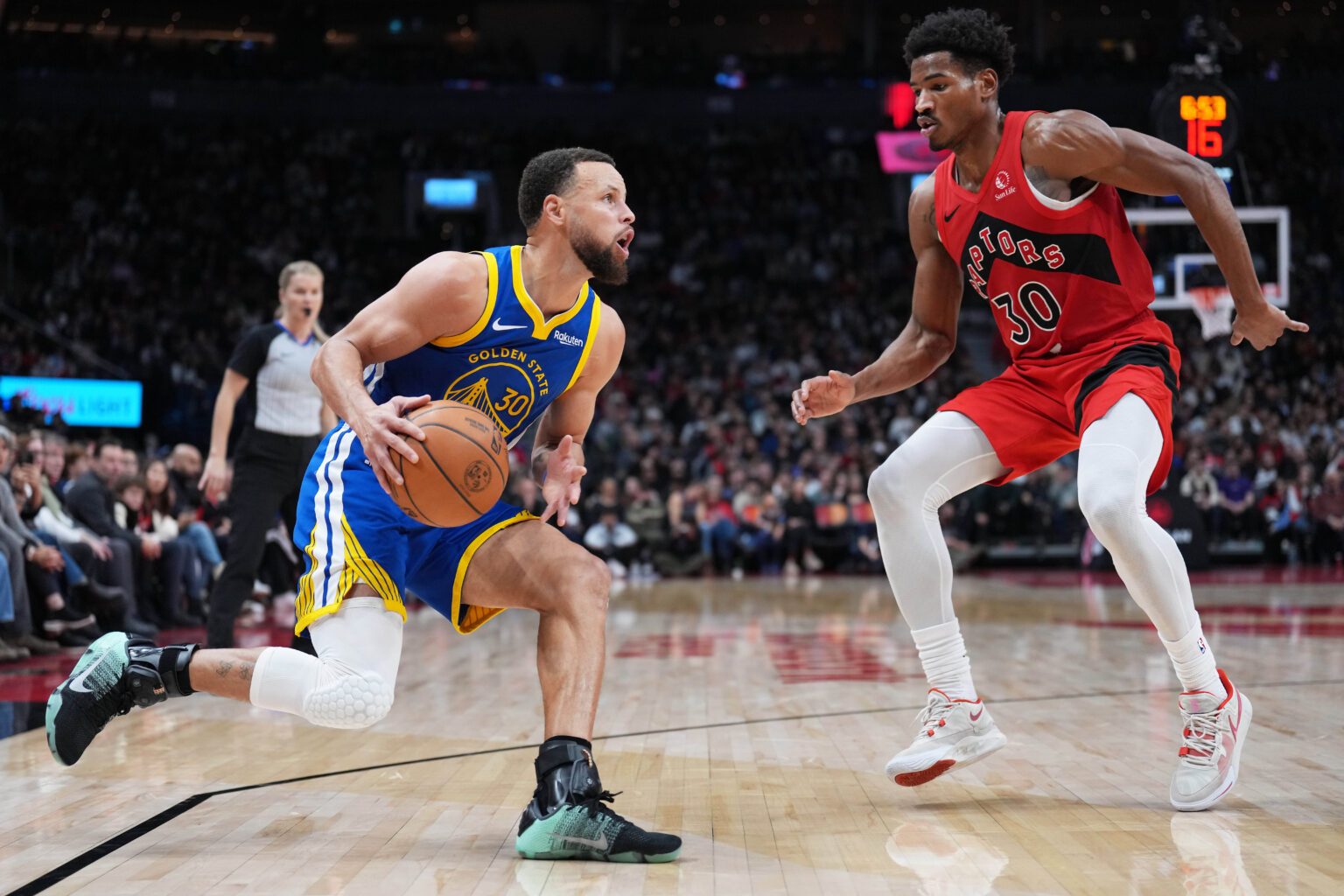
For the second straight game, the Warriors found a way to turn control into collapse. Golden State fell 127-141 in overtime to the Raptors on Sunday night, a loss that felt especially deflating given how firmly the game sat in their hands late. The Warriors led by double digits, dictated pace for much of the night, and appeared headed toward a routine road win before everything unraveled in the final minutes of regulation.
Toronto closed the fourth quarter on a stunning 9-2 run in the final 1:12 to force overtime, then completely overwhelmed Golden State once extra time began. Despite Stephen Curry’s 39 points and solid contributions from Draymond Green and Jimmy Butler, the Warriors were undone by turnovers, rebounding issues, and a complete lack of execution when the pressure peaked. It marked another missed opportunity for a team still searching for consistency away from Chase Center.
1. Turnovers Continue To Sink Golden State
This loss followed a painfully familiar script. Golden State committed 21 turnovers, which Toronto immediately turned into 35 points, the most the Warriors have allowed off turnovers this season. Those giveaways weren’t just careless; many came in live-ball situations that led directly to transition buckets, energizing the Raptors crowd and flipping momentum when Golden State desperately needed control.
The timing made it worse. Several turnovers came late in the fourth quarter as Toronto erased the deficit, including rushed passes and miscommunications in half-court sets. The Warriors also struggled to recover defensively after mistakes, allowing Toronto to score 19 fast-break points and dominate the paint 70-40. For a veteran-heavy team, the lack of poise in key moments remains a glaring red flag.
2. Stephen Curry Carried The Load – Until Overtime
Stephen Curry did everything possible to keep the Warriors afloat through regulation. He finished with 39 points on 12-of-30 shooting, knocked down four three-pointers, and went a perfect 11-for-11 from the free-throw line. Fourteen of those points came in the third quarter alone, where Curry single-handedly prevented Toronto from taking control of the game.
But once overtime arrived, Curry didn’t score. Toronto sent immediate double-teams, crowded his space, and forced the ball out of his hands – and Golden State had no counter. The Warriors scored just seven points in overtime while allowing 21, exposing a recurring issue: when Curry is neutralized late, there isn’t a reliable secondary offensive engine to stabilize the offense.
3. The Warriors Were Dominated On The Glass
Golden State had no answer for Toronto’s physicality inside, and the rebounding margin told the story. The Raptors out-rebounded the Warriors 55-42 overall, including an 18-14 edge on the offensive glass. Those extra possessions repeatedly punished Golden State, especially as fatigue set in late.
Scottie Barnes alone grabbed 25 rebounds, matching a Raptors franchise record, while also posting a triple-double with 23 points and 10 assists. Time and again, Warriors defenders forced misses only to surrender second-chance opportunities. That inability to finish defensive possessions allowed Toronto to stay within striking distance and ultimately take over when Golden State’s legs gave out.
4. Late-Game Execution Is A Major Problem
This loss dropped the Warriors to 6-12 on the road, reinforcing how drastically their performance dips away from home. Even with efficient shooting nights, 44.8% from the field and 36.4% from three, Golden State struggled to close quarters, manage tempo, and execute under pressure in a hostile environment.
Toronto won the game despite trailing after three quarters, improving to 3-0 this season in such situations. Golden State, meanwhile, was outscored 9-2 in the final 1:12 of regulation and completely overwhelmed in overtime. Until the Warriors clean up their late-game execution and stop bleeding points off mistakes, these types of losses will continue to pile up – regardless of how well Curry plays.




![Knicks Fans Assault Police, Destroy Cab And Five Guys Restaurant In Violent Game 4 Aftermath [Video]](https://fadeawayworld.net/wp-content/uploads/2026/06/Knicks-Fans-riot-after-Game-4-615x410.jpg)