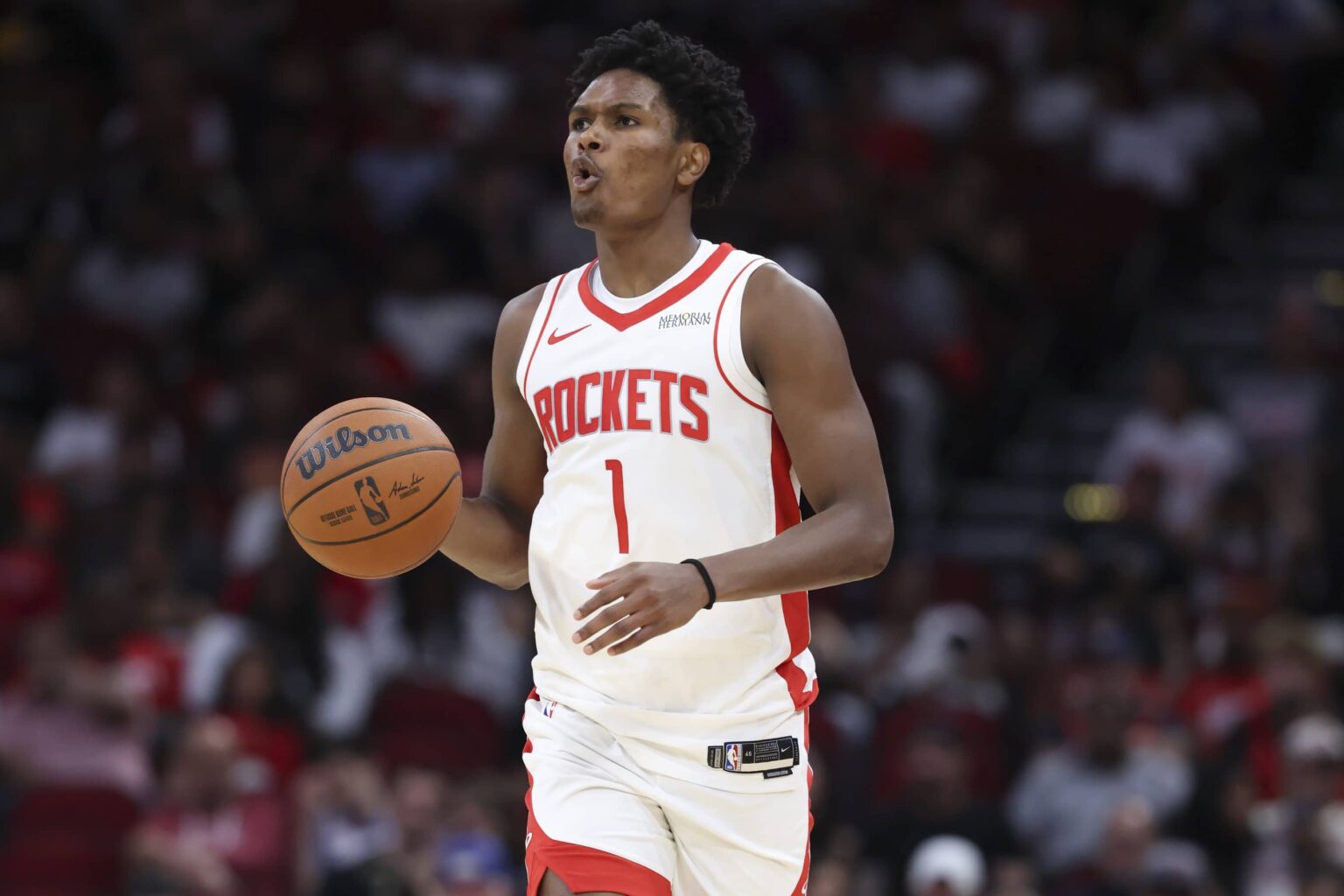
The Rockets will have a clean decision point with Amen Thompson this summer, because he’s eligible for a rookie-scale extension in July 2026 after the team exercised his 2026-27 option. Thompson is currently on a four-year, $40.0 million rookie deal, so an extension would be the first real “core money” commitment of his career.
That’s why the $252 million number keeps popping up in the discourse: if Thompson is treated as a full five-year rookie max, the total would land in the roughly $250 million range depending on the cap and any escalators tied to awards. The basketball case is obvious. In Year 3, Thompson is playing like a two-way engine, averaging 17.5 points, 7.6 rebounds, and 5.3 assists per game while shooting 50.4% from the field.
So in this article, we will explore whether the Rockets should commit to a near-max extension for Amen Thompson this summer, or keep flexibility and force the price to be proven over another season.
The Rockets’ Cap Outlook For The Future
The Rockets are not a cap-space team for 2026-27. They are a spend-over-the-cap roster with most of their flexibility coming through exceptions and internal mechanisms, not open room. The projected 2026-27 salary cap is $166.0 million, with the luxury tax at $201.6 million.
On the current books, the Rockets project around $184.9 million in total cash commitments for 2026-27. That puts them roughly $18.9 million over the cap, but still below the tax by about $16.8 million. From an apron standpoint, Spotrac’s 2026-27 tracker lists the first apron at $210.3 million and the second apron at $223.0 million.
At $184.9 million committed, the Rockets would sit about $25.4 million under the first apron and about $38.2 million under the second apron, before accounting for standard end-of-roster charges and any new money added in July.
The top of the sheet is already defined. Alperen Sengun’s five-year, $185.0 million extension is the anchor, with a 2026-27 salary in the mid-$35 million range. Jabari Smith Jr.’s extension (five years, $122.0 million) starts hitting in 2026-27, putting another $23.6 million on the books that season.
And Kevin Durant’s two-year, $90.0 million extension slots in at $45.0 million per year, with a second-year player option, which keeps the Rockets expensive at the top while still preserving a clear exit lane after one more season if needed.
The practical takeaway: 2026-27 looks like a “below-the-apron, above-the-cap” year if the Rockets keep the roster stable. That matters because once they drift into apron territory, the CBA restrictions start dictating roster-building. Staying $25 million-ish below the first apron gives them breathing room to extend a young core piece without instantly triggering the harshest constraints, but it is not a blank check either.
A Difficult Choice With Extra Players To Keep
The Rockets are not only weighing an Amen Thompson extension. They are also staring at a real retention problem with Tari Eason, who is trending into the most expensive kind of role player: a wing-sized defender who can play up a lineup, finish plays, and swing games without needing touches.
Eason is on pace for a clear breakout season production-wise at 12.2 points, 6.1 rebounds, and 1.5 assists per game. The bigger point for the Rockets is the timeline. Eason is lined up for restricted free agency, with a projected 2026-27 cap hold of $17.0 million and a qualifying offer of $8.0 million.
That cap hold sits on the books until the Rockets either re-sign him, let him walk, or renounce him. In other words, even before you get to a new deal, Eason is already “occupying” meaningful space on a roster that is trying to stay comfortably below the aprons.
What does Eason cost if this season holds? A reasonable working range is $20.0 million to $26.0 million per year. That band lines up with recent market markers for high-end defensive wings: Herb Jones is at about $22.5 million per year on his extension, while Jaden McDaniels is a $26.2 million per year player on his deal.
If Eason lands in the middle, say $23.0 million annually, the real cap impact versus the $17.0 million cap hold is closer to a $6.0 million increase for 2026-27, not a full $23.0 million jump. That is manageable, but it narrows the cushion that keeps the Rockets away from apron-triggered restrictions.
The downstream issue is sequencing. Reed Sheppard is on the rookie scale and will become extension-eligible on July 1, 2027. If the Rockets pay Eason at market and then give Thompson max-level money, they are effectively committing to a top-heavy ledger where future extensions become harder to “absorb” cleanly.
Keeping Eason is realistic because restricted free agency gives the Rockets matching rights. The question is whether they want that matching decision to happen in an offer-sheet environment, when the number is usually at its most aggressive.
Is Thompson A Rookie Max Player Already?
A rookie max extension is not “just paying your young guy.” It is a franchise-level declaration. The clean comparison point is Victor Wembanyama, because the Spurs are widely expected to hand him a five-year, $252.0 million rookie max extension this summer. And if Wembanyama hits the right triggers (All-NBA, MVP, Defensive Player of the Year) in 2026-27, that projection can climb to about $303.3 million.
That is the bar. Wembanyama is already a league-shaping player with a résumé that fits the max ecosystem: awards gravity, top-five impact, and an obvious “build the entire operation around him” profile. Thompson is excellent, but he is not in that tier yet. Paying Thompson at the same level means the Rockets would be pricing him as a perennial awards candidate, not as an elite complementary star. That is a materially different bet, especially when the math starts approaching $50.0 million per season.
The Rockets’ behavior at the 2026 deadline matters here. They did not make a deal, and GM Rafael Stone framed it as both strategic and financial, pointing to limited flexibility and the constraints of their cap situation.
That context cuts both ways. On one hand, it supports a continuity argument: keep the core together, avoid taking on bad money, and let the roster grow. On the other hand, it underscores that Houston has been cautious about absorbing big contracts. If they were reluctant to take on large money midseason, the question becomes obvious: how eager will they be to lock themselves into near-supermax annual numbers for Thompson before he is an All-NBA-level certainty?
Does Thompson deserve it right now? Not at that level. The Rockets can believe in him, and still treat the max as something you earn through the league’s top tier: elite creation, elite efficiency, and award-level impact. If Houston gives Thompson the full rookie max now, they are not paying for what he is. They are paying for what he must become, quickly, while the rest of the roster gets expensive around him.
What Should The Rockets Offer Him?
Amen Thompson has played like a core piece, but not like a no-questions rookie max. He’s at 17.5 points, 7.6 rebounds, and 5.3 assists per game on 50.4% from the field, adding 1.5 steals and 0.6 blocks as a defensive pest, which is real two-way volume for a 23-year-old who is still learning how to run an offense.
The advanced profile supports “big money,” just not “top-of-the-league money.” Thompson is sitting around a .568 true shooting percentage with a solid usage load (21.0% usage), strong playmaking indicators (20.2% assist rate), and disruptive defense markers (3.5% steal rate). That’s the resume of a high-impact starter trending toward All-Star conversations, not an automatic All-NBA bet.
So here’s the clean offer that fits both the player and the Rockets’ risk tolerance:
A five-year, $210.0 million extension (about $42.0 million per year), with standard 8.0% raises.
That breakdown would look roughly like: $35.8 million, $38.7 million, $41.8 million, $45.1 million, $48.7 million. (That is big, but it is not “max-no-matter-what” big.)
Why that range works: it prices Thompson above the elite role-player tier and closer to the “young near-star” tier, without forcing the Rockets to pretend he’s already in the Victor Wembanyama lane. Herb Jones is roughly a $22.5 million-per-year player. McDaniels is roughly a $26.2 million-per-year player. Thompson is clearly more central than that, because he creates offense and bends a defense with rim pressure, but he also hasn’t proven the shooting and late-game scoring consistency that usually comes with a true rookie max.
If Thompson wants the max, the Rockets’ counter should be incentives and escalators, not a flat “yes.” The league’s early 2026-27 cap projection has been around $166.0 million, and rookie max math can move fast if the cap rises, which is exactly why the Rockets should keep the ceiling tied to awards. Put the real max outcome behind All-NBA-type triggers, then you are paying for the player he becomes, not the player you hope he becomes.
My take: offer the $210.0 million framework, bake in escalators to the rookie max if he hits the award bar, and call it fair. If he’s truly a max guy, he’ll make it impossible to argue by February next season.