The Lakers are officially out after losing 115-110 to the Thunder on Monday night, ending their playoff run with a second-round sweep. That result does not need a dramatic reading. It simply leaves the franchise with a difficult offseason and no easy direction. The roster was not good enough to extend the series, and now the front office has to decide how much of this group should return.
LeBron James is the first decision. After completing his 23rd NBA season, he is set to enter unrestricted free agency, and his next step is still uncertain. Retirement, a return to the Lakers, or one more title chase somewhere else all change the franchise’s plan. The Lakers cannot build the summer without knowing where James stands.
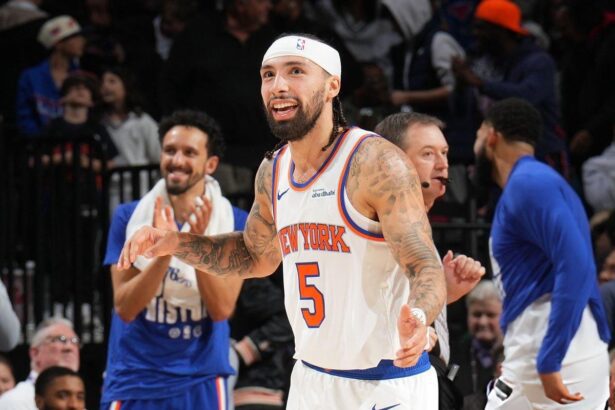
Austin Reaves is the second major question. He has a $14.9 million player option for next season, but all signs point to him declining it for a better deal. That puts the Lakers in a direct position: pay him as a long-term core piece, or consider whether his value is best used in a larger trade.
Beyond James and Reaves, the Lakers need a more aggressive offseason. They need another creator, a more athletic size, shooting, and a move that changes their ceiling instead of only protecting the current roster.
5. Re-Sign Rui Hachimura And Marcus Smart
The Lakers should start the offseason by keeping Rui Hachimura and Marcus Smart, but only at prices that protect the rest of the plan. This cannot be emotional. Hachimura and Smart help the roster in different ways, and both fit around Luka Doncic, Austin Reaves, and whatever happens with LeBron James. But neither player should block the Lakers from chasing a higher-level move.
Hachimura is the more important contract. He just finished the final season of a three-year, $51.0 million deal and is set to become an unrestricted free agent in 2026. His last cap hit was $18.3 million, so his next number will almost certainly start above that range. A fair offer from the Lakers should be three years, $60.0 million to $66.0 million. If the market gets aggressive, they can go to four years, $80.0 million, but that should be close to the ceiling. Anything much higher becomes dangerous for a player who is productive but not a high-usage creator.
The basketball case is clear. Hachimura averaged 11.5 points, 3.3 rebounds, and 0.8 assists this season. He shot 51.4% from the field and 44.3% from three, which is exactly the type of efficiency the Lakers need around higher-usage stars. He does not need many dribbles. He can punish weak-side help, hit corner threes, attack mismatches, and play as a strong forward in bigger lineups.
The issue is role size. Hachimura is not a top defensive stopper, and he does not solve the Lakers’ need for more athletic perimeter defense. That is why the number has to stay disciplined. At $20.0 million to $22.0 million per year, he is a useful starter or elite seventh man. At $25.0 million per year, the contract starts hurting flexibility.
Smart is a different decision. He signed a two-year, $10.5 million deal with the Lakers, including a $5.4 million player option for 2026-27. He is not a direct unrestricted free agent unless he declines that option. If he opts out, the Lakers should try to keep him on a short deal, ideally two years, $13.0 million to $15.0 million.
Smart averaged 9.3 points, 2.8 rebounds, 3.0 assists, and 1.4 steals while shooting 39.5% from the field and 33.1% from three. The shooting is limited, but his defense, communication, strength, and playoff edge still have value.
The Lakers should keep both, but with a clear line. Pay Hachimura like a strong rotation forward. Pay Smart like a veteran guard, not like a core piece.
4. Sign Walker Kessler In Free Agency
Walker Kessler should be one of the Lakers’ most aggressive targets, but this is not a normal free-agency chase. Kessler is a restricted free agent, which means the Jazz can match any offer sheet. The Lakers cannot just offer him a deal and assume they get him. They have to make the number high enough to force the Jazz into a hard decision.
The case for Kessler is simple. The Lakers need a real center who can protect the rim, rebound, finish without plays being called for him, and cover defensive mistakes behind Luka Doncic and Austin Reaves. Kessler fits that job better than most available bigs. He played only five games this season before a torn labrum in his left shoulder ended his year, but the production was strong: 14.4 points, 10.8 rebounds, 3.0 assists, 1.4 steals, and 1.8 blocks in 30.8 minutes, while shooting 70.3% from the field. The sample is small, but the skill set is not fake. He has averaged 9.5 points, 9.3 rebounds, and 2.4 blocks across 201 career games.
The contract situation is the opening. Kessler is finishing his rookie-scale deal and will enter restricted free agency in 2026. His qualifying offer is $7.1 million, but that number only keeps him under Jazz control. It does not represent his real market. Spotrac projected that something around four years and $112.0 million would make sense for his next deal, which would put him at $28.0 million per season.
That should be the Lakers’ target range. A four-year, $112.0 million offer is serious, but the Jazz may still match it. If the Lakers want to make the Jazz uncomfortable, they may need to go closer to four years, $120.0 million, with the final season structured as a player option if allowed under the offer-sheet rules. That would push Kessler to $30.0 million per year, which is expensive for a center who does not create his own offense, but it is the type of overpay required to steal a restricted free agent.
The Jazz also have a frontcourt question now. Lauri Markkanen is already a major piece, and the addition of Jaren Jackson Jr. gives them another high-level frontcourt player. Keeping all three is possible, but expensive and not perfectly clean long term.
The Lakers have also been connected to Kessler for a long time. Marc Stein reported last year that the Lakers were interested in acquiring him, but the Jazz had made him unavailable. That matters now because restricted free agency gives the Lakers a different route. They do not need the Jazz to accept a trade package first. They need Kessler to sign an offer sheet and then force the Jazz to decide if they want to match a large number after his shoulder injury and with Markkanen and Jackson already in place.
The risk is obvious. Paying Kessler $28.0 million to $30.0 million per year limits flexibility. But the Lakers need a defensive center more than they need another mid-level guard or another undersized forward. Kessler would not be a splash because of name value. He would be a splash because he fixes a real structural problem.
3. Trade For Herb Jones
Los Angeles Lakers Receive: Herb Jones
New Orleans Pelicans Receive: Jarred Vanderbilt, Dalton Knecht, 2031 first-round pick
Herb Jones is the type of trade target the Lakers should push for if they want to fix their defense without adding another high-usage player. This roster does not need another player who needs 18 shots. It needs a wing defender who can guard elite scorers, cover mistakes, cut, move the ball, and stay playable next to Luka Doncic and Austin Reaves in playoff lineups.
Jones is not a star, but he is a high-level defensive player on a contract that still has value. He agreed to a three-year, $68.0 million extension last summer after already having almost $29.0 million left on his previous deal. His salary is $14.9 million in 2026-27, then jumps to $20.9 million in 2027-28, $22.5 million in 2028-29, and $24.2 million in 2029-30. That is not cheap, but it is fair money for a top defensive wing if he stays healthy.
The Lakers’ offer would be simple: Jarred Vanderbilt, Dalton Knecht, and the 2031 first-round pick. Vanderbilt gives the Pelicans a cheaper defensive forward at $12.4 million in 2026-27 and $13.3 million in 2027-28. Knecht adds a low-cost shooting piece at $4.2 million next season, with team control after that. Together, their 2026-27 salaries come in around $16.6 million, so the framework works from a salary standpoint because the Lakers are sending out more money than they take back. The only key restriction is apron position. If the Lakers are not operating above the second apron, aggregating Vanderbilt and Knecht should not be the issue.
For the Pelicans, the reason to listen is their position. They finished 26-56 and 11th in the Western Conference, which means they are not one small move away from contention. They also already have expensive long-term salary tied to Zion Williamson, Dejounte Murray, Jordan Poole, Trey Murphy III, and Jones. Their 2026-27 active cap is already listed at $196.2 million, leaving only $4.8 million below the tax line and $6.3 million below the first apron.
Jones averaged 8.9 points, 3.4 rebounds, 2.8 assists, 1.6 steals, and 0.5 blocks this season, but the shooting dropped to 38.3% from the field and 30.9% from three. That is the concern for the Lakers. He cannot be treated like a complete offensive answer. Still, his defensive value is the selling point. He was All-Defensive First Team in 2023-24, and he had 105 steals and a career-high 62 blocks that season.
The Lakers should make this offer because Jones gives them something they do not have enough of: a serious perimeter stopper with size, discipline, and playoff defensive value. Vanderbilt is useful, but his offense is harder to trust. Knecht has shooting upside, but he is not central to a Doncic-Reaves timeline if the Lakers are trying to win now. The 2031 first-round pick is the expensive part, but that is the price for a wing who changes their defensive ceiling without demanding touches.
2. Re-Sign Austin Reaves With A Long-Term Deal
The Lakers should re-sign Austin Reaves, but they have to win the number. That is the whole decision. Reaves has become too productive to treat like a normal role player, but he is not the type of player who should reset the cap sheet at $40.0 million per year.
His contract situation is clear. Reaves has a $14.9 million player option for 2026-27, with a June 29 deadline. If he declines it, he becomes an unrestricted free agent with a projected $22.3 million cap hold. That gives the Lakers a path to use cap space first, then re-sign him with Bird rights after bigger moves are handled.
The basketball argument for keeping him is strong. Reaves averaged 23.3 points, 4.7 rebounds, and 5.5 assists in 51 games this season, shooting 49.0% from the field, 36.0% from three, and 87.1% from the line. His true shooting was 64.1%, which is very strong for a guard with that level of on-ball work.
That production is why his market is no longer simple. He already declined a four-year, $89.2 million extension, which was expected because the Lakers could not offer his full market value through that structure. The Lakers also have a basketball reason to keep him next to Luka Doncic. Dan Woike said on The Dan Patrick Show that the Lakers have shown no indication they want to trade Reaves, and added that Doncic believes in Reaves. That is important for any Giannis Antetokounmpo framework. If Doncic wants Reaves kept, the Lakers should not rush to put him in every star-trade package. Reaves gives Doncic a secondary creator, a shooter, and a guard who can attack tilted defenses.
The price is the hard part. The Athletic, through Woike’s reporting, spoke with team and league sources who expected Reaves to earn more than $35.0 million per year, with sources from two teams saying he could command more than $40.0 million annually.
That number is too high. At $40.0 million per year, Reaves stops being a strong contract and starts becoming a cap problem. The Lakers should push for something closer to four years, $112.0 million to $120.0 million, or five years, $145.0 million to $150.0 million if they want the extra season. That keeps him between $28.0 million and $30.0 million per year.
That is the right range. Reaves is a high-level third option, a strong secondary handler, and a serious offensive piece next to Doncic. He is not a max-level guard, and the Lakers should not pay him like one. Keeping him is the correct move. Paying him $40.0 million per year would be the wrong one.
1. Sign-And-Trade LeBron James
Los Angeles Lakers Receive: Sam Merrill, Jaylon Tyson, 2031 second-round pick
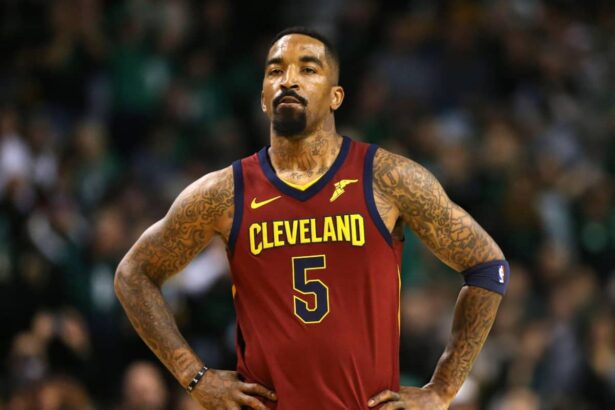
Cleveland Cavaliers Receive: LeBron James
The Lakers should not frame this as pushing LeBron James out because he can no longer play. That would be wrong. James just finished his 23rd NBA season averaging 20.9 points, 6.1 rebounds, and 7.2 assists, and he still averaged 23.2 points, 6.7 rebounds, and 7.3 assists in the playoffs. He remains useful at a high level. The problem is not production. The problem is structure. James is entering unrestricted free agency, and the Lakers have to decide if his next contract still fits the team they need to build around Luka Doncic.
Dan Woike and Sam Amick reported that there is still interest in a return, and the Lakers’ strong March run increased the chances of both sides continuing together. That should be included because it is the honest starting point. A reunion is possible. But possible does not mean it is the best team-building path. Once the Lakers commit major money to Austin Reaves, Rui Hachimura, Marcus Smart, and a potential Walker Kessler offer sheet, there is no practical room to pay James close to the salary he just had. He made $52.6 million this season. That type of number would block the entire offseason.
That is why the cleanest exit is a one-year sign-and-trade to the Cavaliers for $14.0 million to $16.0 million. It would only work if James accepts a major discount. The Cavaliers also do not have the cap room to sign him normally, and their salary sheet is already tight. They have expensive money tied into their core, with Jarrett Allen at $28.0 million in 2026-27, James Harden at $42.3 million, and several rotation contracts already on the books. Sam Merrill is at $9.2 million, while Jaylon Tyson is at $3.7 million.
For the Lakers, this is not about getting equal value for James. That is impossible. This is about removing the salary slot, avoiding a drawn-out negotiation, and starting the Doncic era without pretending the old timeline still controls the franchise. Merrill would give the Lakers a real shooter. Tyson would give them a young wing on a cheap deal. The 2031 second-round pick is small in value, but the main return is flexibility.
For the Cavaliers, the logic is also clear. James gets a final chapter with the franchise where he started. The Cavaliers get him without breaking their core. A one-year, $14.0 million to $16.0 million contract would not destroy their future books, and James could still help as a secondary creator, transition passer, and playoff organizer next to Donovan Mitchell and Evan Mobley.
The Lakers have to be honest. They cannot re-sign Reaves at $28.0 million to $30.0 million, keep Hachimura around $20.0 million, retain Smart around $7.0 million, chase Kessler around $30.0 million, and still give James the money and role he may want. Something has to leave the sheet. If James is not taking a deep discount to stay, the front office should help him get to the Cavaliers, take back limited salary, and begin the new era with a cleaner cap and a roster built for Doncic.