Point guards are supposed to run the offense, distribute the ball, and make the right decision late in games. But the best ones in NBA history also had to score, and nowhere is that more obvious than the Finals.
By that point, every team has watched hours of film, every action is expected, and the defense is already one step ahead. The point guards on this list are the ones who could still score 25, 30, even 35 points per game when none of that mattered anymore.
The list covers very different eras and very different styles. The ranking uses a specific point guard classification, so some numbers here might look slightly different from what you’d find in a general career Finals search.
Here are the 10 point guards with the highest NBA Finals scoring averages in history.
10. Jason Terry – 22.0 PPG
NBA Finals Stats: 22.0 PPG, 2.2 RPG, 3.5 APG, 1.8 SPG, 0.0 BPG, 47.8% FG, 31.7% 3P, 73.3% FT
Jason Terry’s number here comes only from the 2006 Finals, when he was still being listed primarily as a point guard. His 2011 run as a shooting guard sixth man is not included in that 22.0 figure, so this is purely about what he did against the Heat in that first series.
He opened the 2006 Finals with 32 points on 13-of-18 shooting, and the Mavericks went up 2-0, looking like a team that was about to win a title. Terry was playing like a legitimate second star next to Dirk Nowitzki, not like a secondary guard. The Mavericks actually looked really good in those first two games.
Game 5 was his best individual performance of the series. Terry scored 35 points with four threes and shot 13-of-23 from the field. The Mavericks still lost in overtime and went down 3-2, and from there, the series fell apart pretty fast.
He shot 7-of-25 in Game 6, and the Mavs lost the title after winning the first two games, which is still one of the more painful collapses in Finals history. Terry became too dependent on tough perimeter shots once the Heat adjusted and stopped giving him clean looks.
Even with that ending, shooting 47.8% from the field while taking nearly 19 shots a game across a full Finals is a real number.
Five years later, he won the title against the same Heat team, averaged 18.0 points, and scored 27 in the closeout. His full career Finals average across both appearances was 20.0 points, but the 2006 version of him was already playing at a level most people forget about.
9. Isiah Thomas – 22.6 PPG
NBA Finals Stats: 22.6 PPG, 4.2 RPG, 7.9 APG, 2.1 SPG, 0.3 BPG, 48.0% FG, 46.2% 3P, 78.6% FT
Isiah Thomas went to three straight Finals from 1988 to 1990 and played 16 total games, which gives this average a real sample to stand on. He lost the first one, won the next two, and got better every single year. That progression is part of what makes his Finals legacy so complete.
The 1988 Lakers series is the one everyone remembers because of Game 6. Thomas scored 25 points in the third quarter on an injured ankle and finished with 43, but the Pistons lost by one and had to go home without the title. That game became a huge part of the Bad Boys’ identity.
His role shifted in 1989 when Joe Dumars took over as the main scorer and won Finals MVP. Thomas still averaged 21.3 points and 7.3 assists as the Pistons swept the Lakers for their first championship.
The 1990 Finals against the Trail Blazers were his best individual series. Thomas averaged 27.6 points, 5.2 rebounds, and 7.0 assists while shooting 54.2% from the field and 68.8% from three on low volume. He scored 33 in Game 1, 32 in Game 4, and 29 in the closeout. The Pistons won 4-1, and Thomas took home Finals MVP.
What makes his full line so impressive is everything around the scoring. He averaged 7.9 assists and 2.1 steals per game across all 16 Finals games while shooting 48.0% from the field, and he did all of it in an era where defenders were allowed to be much more physical, and modern spacing simply didn’t exist. He wasn’t just scoring in the Finals. He was controlling them.
8. Anfernee Hardaway – 25.5 PPG
NBA Finals Stats: 25.5 PPG, 4.8 RPG, 8.0 APG, 1.0 SPG, 0.8 BPG, 50.0% FG, 45.8% 3P, 91.3% FT
The sample is only four games, and the Magic got swept, so this one is easy to overlook. But what Anfernee Hardaway actually did in the 1995 Finals against the defending champion Rockets was genuinely impressive for a 23-year-old in his second NBA season.
He opened with 26 points and two steals in Game 1, then came back with 32 points and eight assists in Game 2, shooting 12-of-21 from the field and finishing with a 69.0% true shooting mark. Game 3 was his best passing performance, putting up 19 points and 14 assists while turning it over only three times against a veteran Rockets defense that had Hakeem Olajuwon at the rim on basically everything.
He closed the series with 25 points on 8-of-14 shooting and made five of his eight threes. Across the four games, he shot 50.0% from the field, 45.8% from three, and 91.3% from the line. His 63.7% true shooting percentage would be elite for a high usage guard in any era, not just the mid-90s.
What makes it even more impressive is that he was sharing the offense with Shaquille O’Neal and still averaging eight assists per game. He wasn’t just attacking as a scorer. He was running the full offense against a championship defense while also being the second most important player on his team.
The Magic lost because they couldn’t finish close games, and the Rockets had more experience and the best player in the series. Injuries then derailed Hardaway’s career before he could get back. Those four games ended up being his only Finals, and they showed a player who was already performing at a genuinely elite level way earlier than most people realize.
7. Kyrie Irving – 25.5 PPG
NBA Finals Stats: 25.5 PPG, 3.8 RPG, 4.4 APG, 1.5 SPG, 0.4 BPG, 45.5% FG, 36.2% 3P, 93.7% FT
Kyrie Irving’s 25.5 average across 18 Finals games covers two very different versions of his career, and it’s important to separate them to understand what the number actually means.
With the Cavaliers, he was one of the best Finals scorers of his generation. He averaged 27.7 points in 13 games against the Warriors across three series, carrying huge offensive responsibility next to LeBron James and doing it efficiently. His first Finals appearance lasted only one game in 2015, but that game alone showed 23 points, seven rebounds, six assists, four steals, and two blocks.
The 2016 series was his defining moment. Irving averaged 27.1 points while shooting 46.8% from the field, 40.5% from three, and 93.9% from the line. He scored 41 in Game 5 to keep the Cavaliers alive down 3-1, and then in Game 7, he hit the go-ahead three over Stephen Curry to give the Cavaliers their first championship.
He was even better as a scorer in 2017, averaging 29.4 points on 47.2% from the field and 41.9% from three. The Warriors still won in five because Kevin Durant fundamentally changed the matchup, but Irving’s scoring that series was elite.
His 2024 Finals with the Mavericks were a different story entirely. He averaged 19.8 points and shot 41.4% from the field and 27.6% from three against the Celtics, struggling through the series and never really finding his rhythm.
That 2024 run pulled the career average down, but it doesn’t erase what he did in Cleveland. Across the full 18-game sample, he shot 93.7% from the line, created his own shot against elite defenses without needing the offense designed around him, and produced one of the most important baskets in Finals history.
The 2016 shot is the main image, but the larger sample proves he was more than a one-moment player.
6. Russell Westbrook – 27.0 PPG
NBA Finals Stats: 27.0 PPG, 6.4 RPG, 6.6 APG, 1.0 SPG, 0.4 BPG, 43.3% FG, 13.6% 3P, 82.4% FT
Russell Westbrook only reached the Finals once, in 2012, when the Thunder had one of the youngest star groups the league had ever seen. Westbrook was 23. Kevin Durant was 23. James Harden was 22. They beat the Mavericks, Lakers, and Spurs before running into LeBron James, Dwyane Wade, and Chris Bosh, which was a completely different problem.
The Thunder won Game 1 with Westbrook putting up 27 points, eight rebounds, and 11 assists, controlling the pace in a comfortable win. Then the Heat won four straight, and the series got away faster than anyone expected. Westbrook’s scoring stayed high throughout, averaging 27.0 points on 43.3% from the field, but the efficiency went up and down depending on the game.
His best night was Game 4, when he scored 43 points on 20-of-32 shooting with seven rebounds and 45 minutes played. He attacked the rim, hit pull-up jumpers, and basically kept the Thunder alive by himself in a loss.
Game 5 was the opposite. Westbrook went 4-of-20 from the field and scored 19 points as the Thunder lost by 15, and the series ended. The Heat had figured out how to load the paint, ignore him outside, and force difficult decisions. He made only three threes in 22 attempts all series, which gave the defense exactly what they wanted.
Even with all of that, 27.0 points per game at 23 years old in the NBA Finals is a serious number. He averaged 24 field goal attempts and 6.8 free throw attempts per game, gave the Thunder 6.4 rebounds and 6.6 assists, and never backed down from the moment.
5. Stephen Curry – 27.3 PPG
NBA Finals Stats: 27.3 PPG, 5.8 RPG, 6.0 APG, 1.6 SPG, 0.3 BPG, 43.2% FG, 39.5% 3P, 91.7% FT
Stephen Curry has the biggest modern sample on this entire list. He played 34 Finals games across six appearances from 2015 through 2022, won four championships, and averaged 27.3 points per game across all of it. That is sustained production over years of Finals basketball against teams that were specifically game planning to stop him.
He made 152 Finals threes, more than anyone in NBA history, averaging 4.5 made threes per game on 11.3 attempts at 39.5%.
His worst series was 2016, when he averaged 22.6 points and shot 40.3% from the field as the Warriors blew a 3-1 lead in Game 7. He recovered with strong series in 2017 and 2018, averaging 26.8 and 27.5 points respectively, though Durant won both Finals MVPs and Curry sometimes got overshadowed despite being just as important to how the offense functioned.
The 2019 Finals against the Raptors, without a healthy roster, might have been his most impressive individual showing up to that point. He averaged 30.5 points and scored a career Finals high of 47 in Game 3 while Klay Thompson and Durant were both out. He was basically carrying the offense alone and still making it work.
Then the 2022 Finals completed his story. He averaged 31.2 points, 6.0 rebounds, and 5.0 assists while shooting 48.2% from the field and 43.7% from three, won his first Finals MVP, and had a 43-point game in Boston that completely swung the series.
His 59.6% true shooting percentage across all 34 Finals games is the number that really captures it. That is elite efficiency over a massive sample against the best defenses in the world, and that is what separates him from almost everyone else on this list.
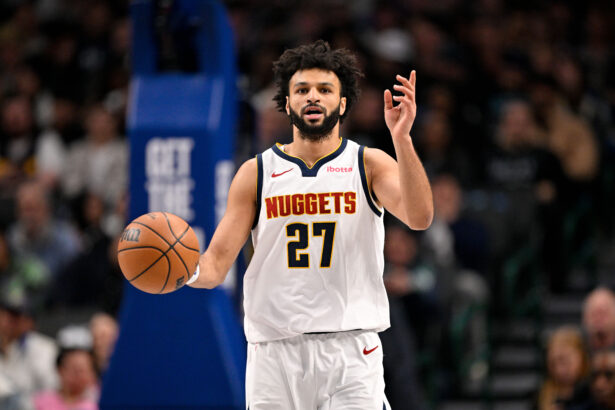
4. Luka Doncic – 29.2 PPG
NBA Finals Stats: 29.2 PPG, 8.8 RPG, 5.6 APG, 2.6 SPG, 0.0 BPG, 47.2% FG, 24.4% 3P, 58.6% FT
Luka Doncic reached his first Finals in 2024 after carrying the Mavericks through the West, and against the Celtics, he averaged 29.2 points, 8.8 rebounds, and 5.6 assists. Those are massive raw numbers for a first Finals appearance, but the series also exposed real problems that go beyond just winning and losing.
He scored at least 28 points in four of the five games, opened with 30 points and 10 rebounds, and followed that with 32 points, 11 rebounds, and 11 assists in Game 2. The Mavericks needed him to create almost every half-court possession, so he was playing 38.8 minutes and taking 25 field goal attempts per game. That kind of usage is unsustainable at high efficiency, and eventually the wear showed.
The efficiency was genuinely mixed. He shot 47.2% from the field, which is strong for that volume, but made only 24.4% from three and 58.6% from the free-throw line, finishing with a 53.0% true shooting mark. The Celtics defended him with big wings, didn’t send the aggressive help that other teams used, and trusted their individual defenders to make him work for everything. That reduced his passing openings and kept his assist numbers lower than his normal playoff level.
His 29.2 average ranks this high because the scoring floor was already elite in his very first Finals, and he also added 2.6 steals and nearly nine rebounds per game, which nobody really talks about. The ceiling is clearly higher, though. He proved he can create Finals-level offense. The next step is doing it on both ends.
3. Jerry West – 29.9 PPG
NBA Finals Stats: 29.9 PPG, 4.7 RPG, 5.6 APG, N/A SPG, N/A BPG, 44.6% FG, N/A 3P, 82.0% FT
Jerry West is the hardest player on this list to put into any kind of modern context. He played 55 Finals games across nine appearances between 1962 and 1973, lost eight of them, and still averaged 29.9 points per game.
Most of those Finals were against the Celtics dynasty, which means he was going up against Bill Russell, Sam Jones, and one of the greatest defensive teams ever assembled, repeatedly, for an entire decade.
He averaged 31.1 points in 1962, 29.5 in 1963, 33.8 in 1965, 33.9 in 1966, and 31.3 in 1968. He just consistently scored around 30 points in the Finals for the better part of ten years.
The 1969 series was his single greatest Finals performance. West averaged 37.9 points, 7.4 assists, and 4.7 rebounds against the Celtics, scored 53 points in Game 1, and still lost Game 7 by two points. He won the first-ever Finals MVP award and remains the only player in history to win it while playing for the losing team. That tells you something about how dominant he was, even in defeat.
His only championship came in 1972, when his scoring dropped to 19.8 points, but his playmaking rose to 8.8 assists, and Wilt Chamberlain won Finals MVP. Losing eight Finals is something that followed West for the rest of his career, but the production never wavered. He kept showing up, kept scoring over 30, and kept carrying the Lakers against the best teams of his era. Very few players in any sport have that kind of sustained excellence in losing efforts.
2. Shai Gilgeous-Alexander – 30.3 PPG
NBA Finals Stats: 30.3 PPG, 4.6 RPG, 5.6 APG, 1.9 SPG, 1.6 BPG, 44.3% FG, 24.2% 3P, 91.4% FT
Shai Gilgeous-Alexander came into the 2025 Finals as the league MVP with the best record in the NBA, and the Pacers pushed him all the way to seven games before the Thunder closed it out. He averaged 30.3 points, 4.6 rebounds, and 5.6 assists across those seven games, and the way he scored was genuinely different.
He made only 24.2% from three, hitting eight threes in seven games, but that almost didn’t matter because he was getting to the free-throw line ten times a game and making 91.4% of them. That gave him over nine points per game from the line alone, which kept his scoring consistent even on nights when the jumper wasn’t falling.
He started the series with 38 points in Game 1, followed with 34 points and eight assists in Game 2, and scored 35 in Game 4. The Pacers threw length, pressure, and multiple defenders at him throughout the series, and he still reached 30 points in four of the first five games. His lowest moment came in Game 6, when he had 21 points and eight turnovers as the Thunder missed a chance to close it out.
Game 7 was the answer to all of that. He shot only 8-of-27 from the field, but he put up 29 points, five rebounds, and 12 assists, made 11 free throws, and controlled the game as a passer when his shot wasn’t falling.
The defensive numbers made the whole package even more complete. He averaged 1.9 steals and 1.6 blocks per game, which is remarkable for a point guard, using his length to affect passing lanes and help at the rim.
A 56.1% true shooting mark over seven Finals games, while also being the best defensive player at his position in the series, and winning Finals MVP is a genuinely impressive debut on the biggest stage.
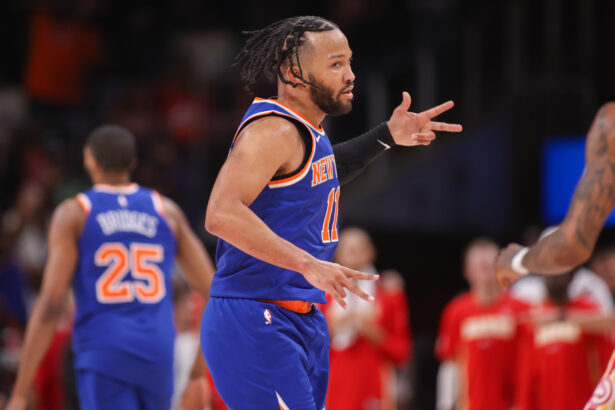
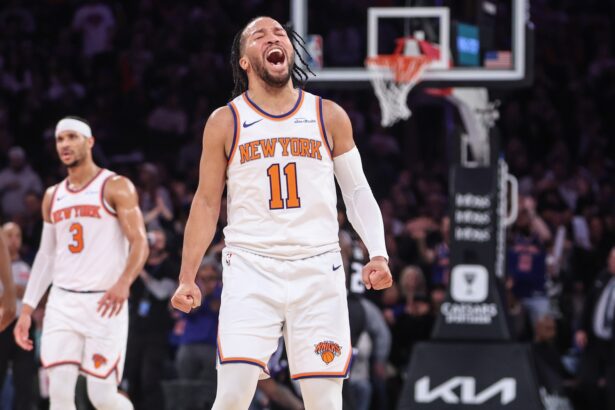
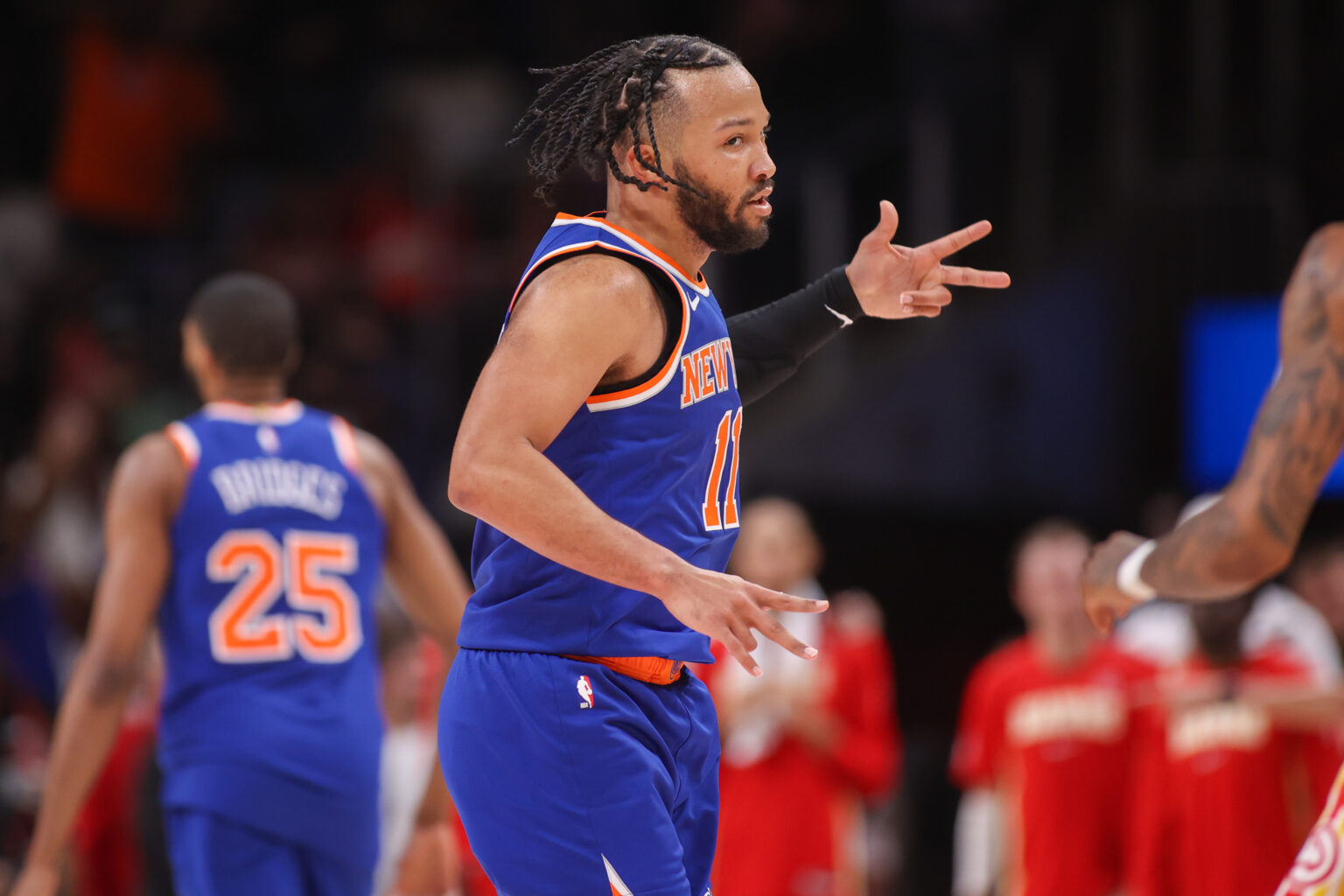
1. Jalen Brunson – 32.6 PPG
NBA Finals Stats: 32.6 PPG, 4.2 RPG, 4.6 APG, 2.0 SPG, 0.0 BPG, 42.1% FG, 38.9% 3P, 86.0% FT
Jalen Brunson just put up one of the best scoring Finals ever by a point guard, averaging 32.6 points across five games as the Knicks beat the Spurs 4-1 and won their first championship since 1973. The number sits at the top of this list right now, and the way the series unfolded made it even more impressive than the average suggests.
The first two games were not efficient. He scored 30 points in Game 1 but needed 31 shots, then had only 20 points on 7-of-25 shooting in Game 2. Through those first two games, he was shooting 33.9% from the field, and there were real questions about whether he could carry them against a young Spurs team with length and athleticism. Then he just completely changed the series.
Game 3 was 32 points, and Game 4 was 36 points with seven assists as the Knicks came back from 29 points down. Brunson kept attacking switches, getting to his left hand, and making plays in the fourth quarter when the game was actually on the line. The Knicks went up 3-1, and suddenly the Spurs were in trouble.
Game 5 was the performance that closed everything out. Brunson scored 45 points on 14-of-27 shooting, made four threes, went 13-of-15 from the line, and scored 29 points in the second half alone as the Knicks erased a 15-point deficit to win the championship. It was the kind of fourth-quarter performance that gets replayed for decades, and it made any Finals MVP conversation a very short one. Across the last three games of the series, he averaged 37.7 points, and the Knicks won all three.
The 42.1% field goal percentage for the full series was not elite, and the Spurs deserve credit for making him work. But he balanced that with 38.9% from three and 86.0% from the line, committed only 3.8 turnovers per game despite carrying massive usage and facing constant pressure, and scored 163 total points in five games with nobody else in the series coming close to his volume.
The sample is only five games, so this average could move around if he returns to the Finals. But right now it sits at the top, and the 45-point closeout game made sure there was no real argument about who the best scoring point guard in Finals history is at this moment.