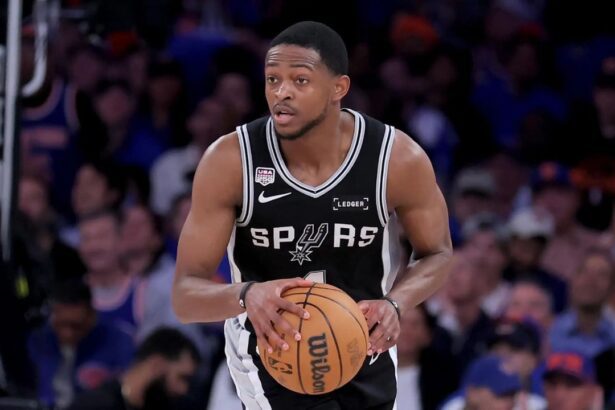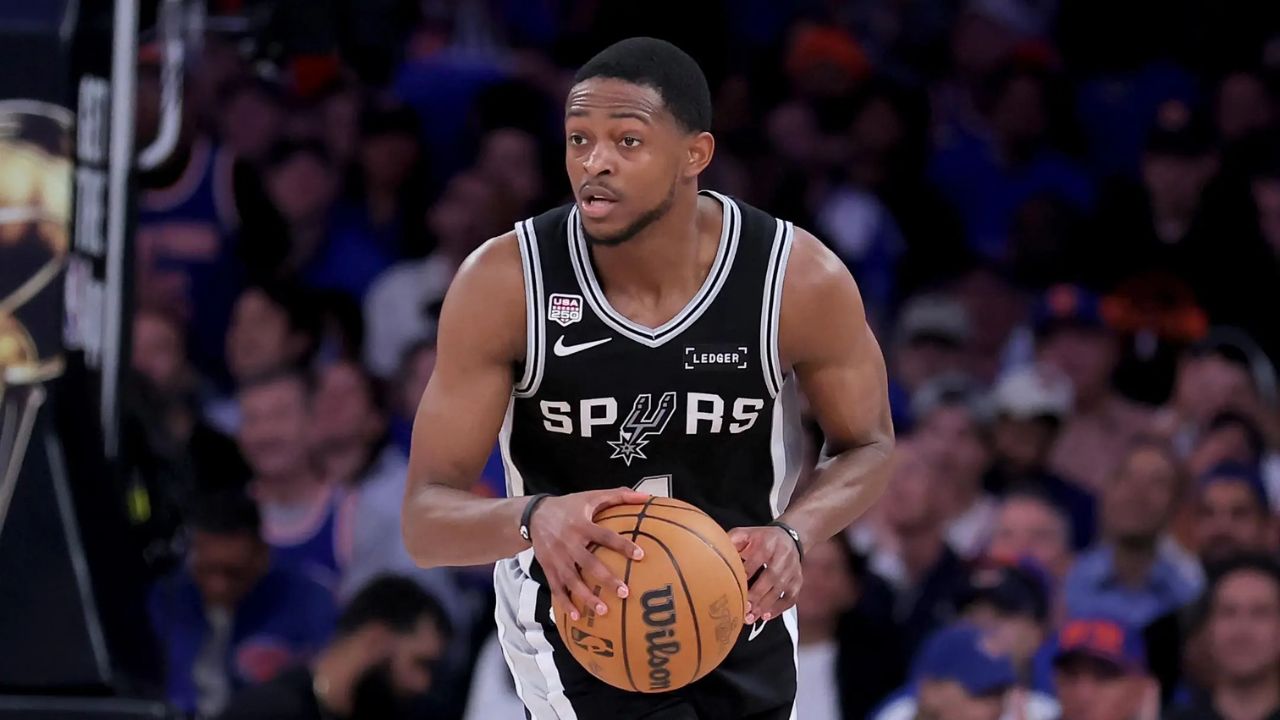
De’Aaron Fox picked the worst possible moment to have the worst series of his career.
Fox averaged only 12.8 points, 3.0 rebounds, and 6.0 assists in the NBA Finals. He shot 34.3% from the field and 25.0% from three as the Spurs lost to the Knicks in five games. He scored seven points in Game 1, made the terrible late decision that helped the Spurs blow Game 4, and then finished Game 5 with seven points on 3-of-15 shooting.
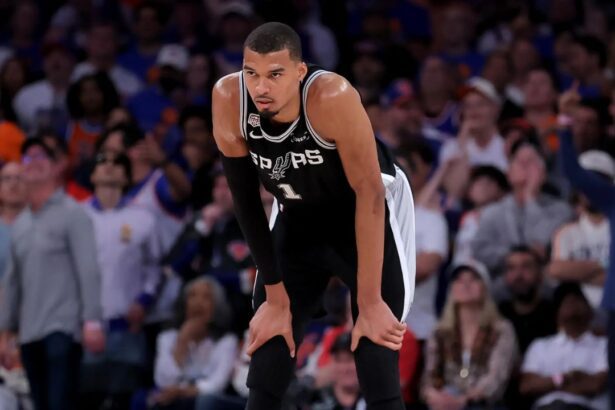
Those numbers were far below his regular-season production of 18.6 points, 3.8 rebounds, and 6.2 assists on 48.6% from the field. The Spurs still went 62-20 and reached the Finals, so Fox was clearly part of a great team. The problem is that the franchise now has to decide if he is still the right long-term guard next to Victor Wembanyama.
Fox’s four-year, $229.0 million extension begins in 2026-27 and runs through 2029-30. That is a huge commitment for a player who will be 29 next season and probably became the third guard at times behind Stephon Castle and Dylan Harper.
This is also not only an idea created after the Finals. Sam Amick reported in May that there was already league-wide chatter about Fox’s future because Harper may be too good to stay on the bench for long. That does not mean the Spurs are officially shopping Fox.
These are only three mock trades they could explore if they decide to build the backcourt around Castle and Harper.
3. Miami Heat
San Antonio Spurs Receive: Tyler Herro, Andrew Wiggins
Miami Heat Receive: De’Aaron Fox, Keldon Johnson
The Heat finished 43-39, took the No. 10 spot in the East, and lost their Play-In game against the Hornets. They still need a real point guard who can attack the rim, create easier shots for Bam Adebayo, and control the offense late in games. De’Aaron Fox would give them all three.
Fox is not a great three-point shooter, but his speed would change an offense that can become slow and predictable. A Fox-Adebayo pick-and-roll could force defenses to protect the rim, while Keldon Johnson would give the Heat another strong wing who plays with energy. Johnson won Sixth Man of the Year after averaging 13.2 points and 5.4 rebounds on 51.9% from the field.
The Spurs would receive two players who make more sense next to their young guards. Tyler Herro averaged 20.5 points, 4.8 rebounds, and 4.1 assists while shooting 48.0% from the field and 37.8% from three. He can score off the ball, run secondary actions, and give Castle and Harper more space to drive. He only played 33 games and needed a minor foot procedure after the season, so that is a real concern.
Andrew Wiggins averaged 15.4 points, 4.8 rebounds, and 2.7 assists. He also shot 41.4% from three and can defend the best opposing wing. That would remove some defensive pressure from Wembanyama, Castle, and Harper. Wiggins would first need to pick up his $30.2 million player option, while Herro is entering the final season of his deal at $33.0 million.
The main problem for the Spurs is the lack of a draft pick. Fox and Johnson are both under contract, and Johnson just won a major award. Still, Herro’s shooting and Wiggins’ wing defense would give the roster a better balance around Wembanyama. This is the safest trade of the three, but it also has the lowest long-term upside.
2. Toronto Raptors
San Antonio Spurs Receive: Brandon Ingram, Ja’Kobe Walter, No. 19 pick in the 2026 NBA Draft
Toronto Raptors Receive: De’Aaron Fox
The Raptors went 46-36, finished fifth in the East, and lost their first-round series in seven games. Their defense was strong enough to compete, but the offense did not have a reliable lead guard who could control a playoff series. Fox would give them a much faster and more aggressive option.
A starting group with Fox, Immanuel Quickley, RJ Barrett, Scottie Barnes, and Jakob Poeltl would have real size and creation. Quickley could spend more time away from the ball, while Barnes would remain the secondary playmaker. Fox would be the guard responsible for breaking down the first defender and getting into the paint.
The Spurs would be betting on Brandon Ingram recovering from a terrible postseason. Ingram averaged 21.5 points, 5.6 rebounds, and 3.7 assists during the regular season while shooting 47.7% from the field and 38.2% from three. In the playoffs, those numbers dropped to 12.0 points on 32.8% from the field.
That postseason performance is a major red flag, but Ingram would fill a direct need. The Spurs have several guards and Wembanyama at center, but they still need a tall forward who can create his own shot. Ingram can score from the mid-range, shoot over smaller defenders, and handle possessions when Castle or Harper sits. His $40.0 million salary in 2026-27 is also lower than the first season of Fox’s extension.
Ja’Kobe Walter averaged 7.5 points and 2.6 rebounds while shooting 44.6% from the field. He is still only 21 and gives the Spurs another young wing to develop. The No. 19 pick adds another asset in a draft with several guards and forwards expected to be available in that range.
This deal would only make sense if the Raptors believe Fox can be the final piece for a deeper playoff run. For the Spurs, it would turn one expensive guard into a starting forward, a young player, and a first-round pick. There is more risk than in the Heat trade, but also more future value.
1. Brooklyn Nets
San Antonio Spurs Receive: Michael Porter Jr., 2032 first-round pick (Nuggets)
Brooklyn Nets Receive: De’Aaron Fox
This would be the best return for the Spurs, even if it may be the hardest trade to complete.
Michael Porter Jr. averaged 24.2 points, 7.1 rebounds, and 3.0 assists in his first season with the Nets. He shot 46.3% from the field, 36.3% from three, and made 3.4 threes per game. His season ended early because of a left hamstring strain, but he still produced the best individual numbers of his career.
Porter is 6-foot-10 and does not need to control the ball to score. He can shoot over defenders, move without the ball, and punish teams that send extra help toward Wembanyama. A frontcourt with Porter and Wembanyama would create much more room for Castle and Harper to attack the paint.
The Spurs would also receive the unprotected 2032 first-round pick that the Nets acquired from the Nuggets. That pick is far away, but it could become very valuable by the time it arrives. The Spurs would get an immediate starter and another major future asset without giving up one of their young core players.
The Nets finished 20-62 and clearly need more talent. Fox would immediately become their lead guard and biggest established name. He is under contract through 2029-30, so they would have several seasons to build around him. He could also help their young players by creating easier shots instead of forcing them to run the full offense.
The difficult part is the first-round pick. The Nets may prefer to keep that asset and continue rebuilding instead of giving it up for a 29-year-old guard on a huge deal. Porter is also younger, cheaper next season, and coming off a career year.
Still, the Nets have a large collection of future picks and need to eventually turn some of those assets into a proven player. Michael Porter Jr. will make $40.8 million on an expiring contract, and the Nets have enough financial flexibility to take back Fox’s larger salary.
This is not the most likely trade, but it is the best one for the Spurs. Porter would fit directly next to Wembanyama, while the 2032 first-round pick would protect them if moving Fox becomes a mistake.