After a 22-60 season and a 14th-place finish in the West, the Kings entered the lottery with the fifth-best odds. They had an 11.5% chance to land the No. 1 pick and a 45.2% chance to jump into the top four, which would have put them within reach of the true top tier of the class. Instead, they slipped to No. 7, their most likely bad outcome at 25.5%. For a team coming off 60 losses, that is a rough break.
That drop changes the board in a big way. The Kings are probably out of range for the best franchise-level prospects, but they are still in a strong enough spot to find a long-term guard. Since the De’Aaron Fox trade, there still is no clear answer at point guard. There is also no obvious young cornerstone on the roster who can give the team a clear direction for the next phase.
That is why this pick matters so much. At No. 7, the Kings need more than a rotation player. They need someone who can create offense, shoot, and help give the roster a new identity. With that in mind, several guards with upside should be near the top of their board.
1. Darius Acuff Jr.
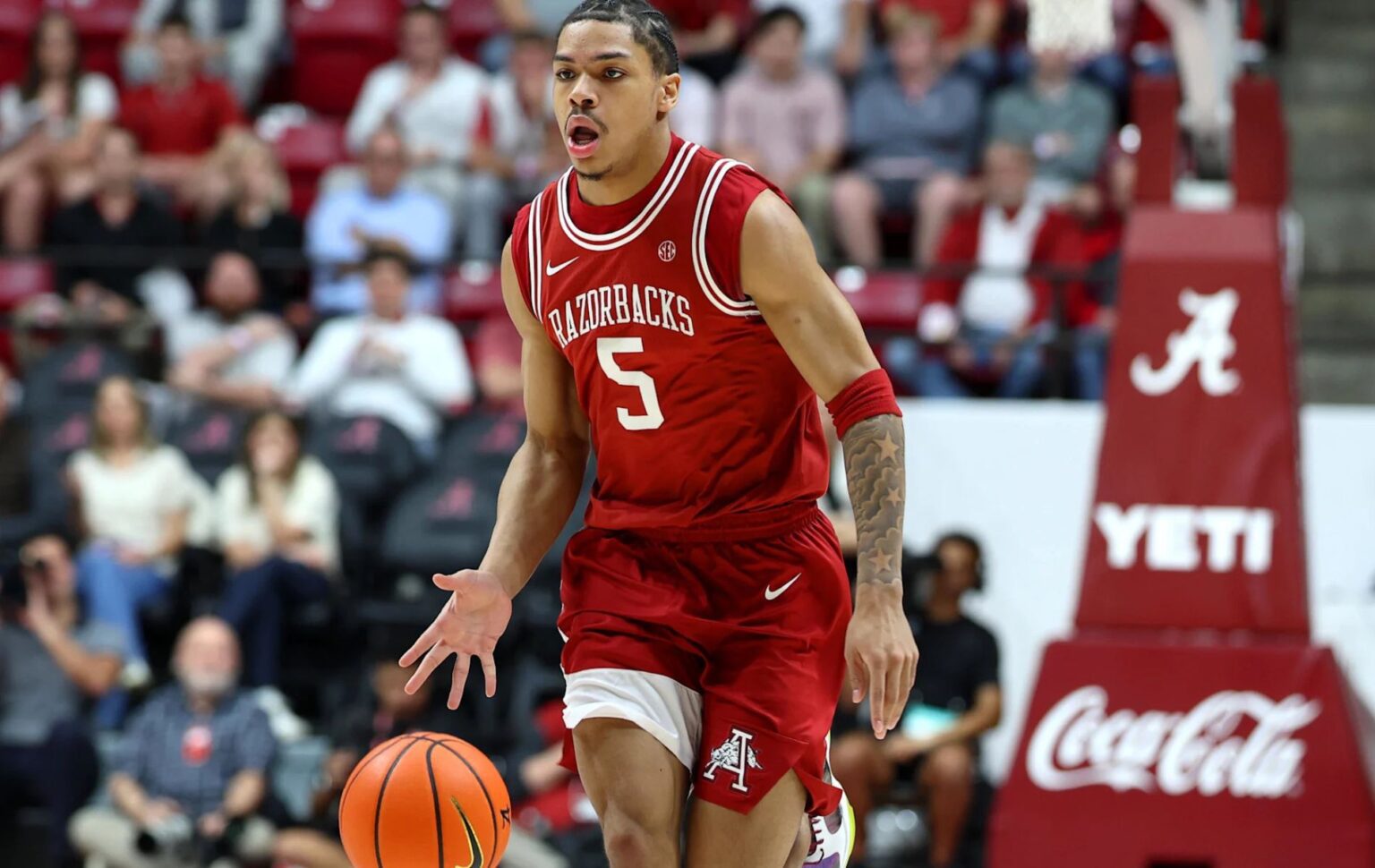
Darius Acuff Jr. should be the pick if he is still on the board. The Kings need a guard who can actually run an offense, not just someone who can get his own points. Acuff checks both boxes.
At Arkansas, he averaged 23.5 points, 3.1 rebounds, and 6.4 assists while shooting 48.4% from the field and 44.0% from three. The advanced numbers back up the production: 60.4% true shooting, 56.1% effective field goal percentage, 29.5% usage, and a 2.97 assist-to-turnover ratio. That is not just empty scoring.
That type of guard would address a major problem. The Kings simply lack an elite creator for the rest of their scorers. DeMar DeRozan can still score, but he is most comfortable in the mid-range. Zach LaVine can attack the rim, but he is not a natural table-setter. Domantas Sabonis can pass from the elbows and run handoffs, but he still needs a guard who can set the tempo. Acuff can be that player.
His pick-and-roll game is the clearest reason he fits. He can turn the corner, pull up if the big drops, hit the roller if help comes, or spray the ball to the corner. Those sound like simple NBA reads, but a lot of young guards cannot make them quickly or consistently. Acuff already showed he can carry a real offensive load without turning every trip into a forced shot.
His shooting would help right away, too. The Kings were last in 3-point makes and attempts, so they badly need guards who are comfortable shooting off the bounce. Acuff made 2.5 threes per game and hit 44.0% from deep. That number may come down in the NBA, but the threat is real. Defenders will not be able to go under every screen without giving him a clean look.
The concern is on defense. Acuff is 6-foot-3 and 186 pounds, with a 6-foot-6 wingspan. He is not undersized to the point where it becomes a major red flag, but he is not a big guard either. His defensive profile is weaker than the other names on this list, including only 0.7 defensive BPM. That is the tradeoff. If the Kings draft him, they will need NBA-ready defenders around him.
Still, at No. 7, this is the swing that makes the most sense. The Kings don’t have a franchise talent. Acuff is the best pure lead-guard bet in this range and one of the highest upside players of the Class.
2. Keaton Wagler
Keaton Wagler is the better size projection. If Acuff is gone, he should get serious consideration because he gives the backcourt a different shape. At 6-foot-6, he brings ball-handling, shooting, and size without needing to be used like a small point guard. That matters for a team that already has too many guards who can be targeted defensively.
At Illinois, Wagler averaged 17.9 points, 5.1 rebounds, and 4.2 assists. His advanced numbers were 59.6% true shooting, 54.1% effective field goal percentage, 25.2% usage, 2.38 assist-to-turnover ratio, 134.1 offensive rating, 8.8 offensive BPM, 3.5 defensive BPM, and 12.3 total BPM. That is one of the most balanced profiles in this draft range.
The appeal is pretty clear. Wagler gives the Kings more size without taking skill off the floor. He can run second-side pick-and-roll, attack closeouts, make the next pass, and shoot off movement. He is not as fast as Acuff or Kingston Flemings, but he plays with good pace for his size. He does not always need to score with speed.
That makes him an interesting fit next to Sabonis. The Kings still use plenty of handoff and elbow actions when Sabonis is healthy. Wagler can come off those actions and punish defenders in a few different ways. If they go under, he can shoot. If they chase over, he can drive. If the help steps up, he can pass. That makes him easier to plug in than a guard who needs a lot of dribbles to feel comfortable.
There is also a defensive case for him. The Kings had a 121.5 defensive rating this season. They cannot keep adding small guards who need to be protected every night. Wagler is not a stopper right now, but his size gives him a better chance to survive NBA matchups. His 3.5 defensive BPM is also a good sign for a player known more for offense.
The main question is whether he is really a lead guard. He may be more of a big combo guard than a full-time offense organizer. That is why he sits behind Acuff. The Kings need a point guard, and Acuff answers that more directly.
But if the front office wants the safer two-way build, Wagler has a strong case. He shoots, passes, rebounds, and gives the lineup more size. That is a valuable package at No. 7.
3. Kingston Flemings
Kingston Flemings is the pressure pick. He brings speed, defense, and downhill force. That is something the Kings lost when Fox left. Flemings is not Fox, but his athletic profile gives the team a path back toward playing faster.
At Houston, Flemings averaged 16.1 points, 4.1 rebounds, 5.2 assists, and 1.5 steals while shooting 47.6% from the field and 38.7% from three. His advanced numbers are very strong: 56.3% true shooting, 26.0% usage, 2.91 assist-to-turnover ratio, 6.6 offensive BPM, 6.0 defensive BPM, and 12.6 total BPM. He also measured with a 40.5-inch max vertical.
The defensive number stands out. The Kings were bad on that end, and Flemings is the best point-of-attack defender in this group. He can pressure the ball, jump passing lanes, and turn stops into transition chances. That matters for a team that needs easier points and cannot rely only on a slow half-court offense.
Flemings also has a real passing feel. He does not drive only to score. He can hit the weak-side shooter, make pocket passes, and push tempo after misses. His 2.91 assist-to-turnover ratio is almost the same as Acuff’s, but he did it with a lower usage rate. That suggests he can be productive without needing to control every possession.
The swing skill is the jumper. Flemings hit 38.7% from three, but he only took 2.9 attempts per game. NBA teams will test whether he is comfortable taking pull-up threes or quick catch-and-shoot looks. If the volume stays low, defenders may go under screens and make his driving lanes tighter.
The other concern is length. Flemings is listed at 6-foot-3, but his wingspan measured only 6-foot-3.5. That is not ideal for a guard who thrives on rim pressure. His athleticism helps, but NBA guards are bigger and stronger.
Even with those concerns, he belongs high on the board. Flemings brings energy, pace, defense, and real guard creation. If the goal is to change the feel of the roster quickly, he may be the best option. He is a little riskier than Wagler, but the two-way burst is real.
4. Mikel Brown Jr.
Mikel Brown Jr. is the best pure shot-maker of this group. He has deep range, a tight handle, and enough size to get his jumper off against length. For a Kings team that finished last in 3-point volume and accuracy, that cannot be ignored.
At Louisville, Brown averaged 18.2 points, 3.3 rebounds, and 4.7 assists. The efficiency was more mixed: 41.0% from the field, 34.4% from three, 57.7% true shooting, and 51.1% effective field goal percentage. His 31.4% usage rate was the highest of the four players listed here, but his assist-to-turnover ratio was only 1.52. That is the biggest difference between him and Acuff. Brown can create shots, but his game management is not at the same level yet.
The upside is easy to see. Brown can shoot behind screens, punish a soft drop, and get hot quickly. His 45-point game against NC State, where he tied a program record with 10 made threes, showed the top end of his scoring ability. The Kings do not have many players who can change a game from three like that.
He also has real guard size. At 6-foot-4 with a 6-foot-7 wingspan, Brown has a better frame than Acuff and Flemings. If his defense improves, he has the tools to guard either backcourt spot. He provides more lineup flexibility than a smaller scoring guard.
The concern is decision-making and shot selection. Brown can settle for difficult jumpers early in the clock. That can look great when he is hot, but the Kings already have enough players who can take hard shots. They need someone who can organize the offense, not just add more tough shot-making. Brown may get there, but he is not the safest bet for that role.
The injuries also matter. He played only 21 games and missed the NCAA Tournament with back issues. That does not make him undraftable, but it has to be part of the evaluation.
Brown should be fourth here, not because he lacks talent, but because the Kings need a more complete guard solution. Acuff runs the team better. Wagler gives more size and balance. Flemings brings speed and defense. Brown is the best scorer, but he may not be the cleanest fit for what this roster needs.
Final Thoughts
The Kings cannot approach this draft like they are one role player away. They went 22-60. They finished 14th in the West. Their offense lacked structure, their defense was near the bottom, and their shooting woes were among the worst in the league. This pick has to bring a lead star, not just a starter.
Acuff is the best point guard bet. He gives the Kings scoring, passing, shooting, and a real path toward building a new offense. Wagler is the best big-guard fit because he adds size, shooting, and balance on both ends. Flemings is the speed-and-defense swing, with enough playmaking to become more than an energy guard. Brown is the shot-making option, but the decision-making and health questions put him fourth.
The Kings need to stop chasing short-term fixes. No. 7 has to be about the next core. If Acuff is there, he should be the pick. If not, Wagler is the next best move.