The Washington Wizards are no longer operating in the margins. After pulling off a blockbuster move to acquire Anthony Davis, the franchise suddenly looks like one of the most intriguing roster constructions in the league. What once resembled a long-term rebuild has shifted into something far more aggressive, with a starting lineup that blends star power, youth, and positional balance, and a bench that quietly runs deep.
On paper, this is the most talented Wizards roster in over a decade.
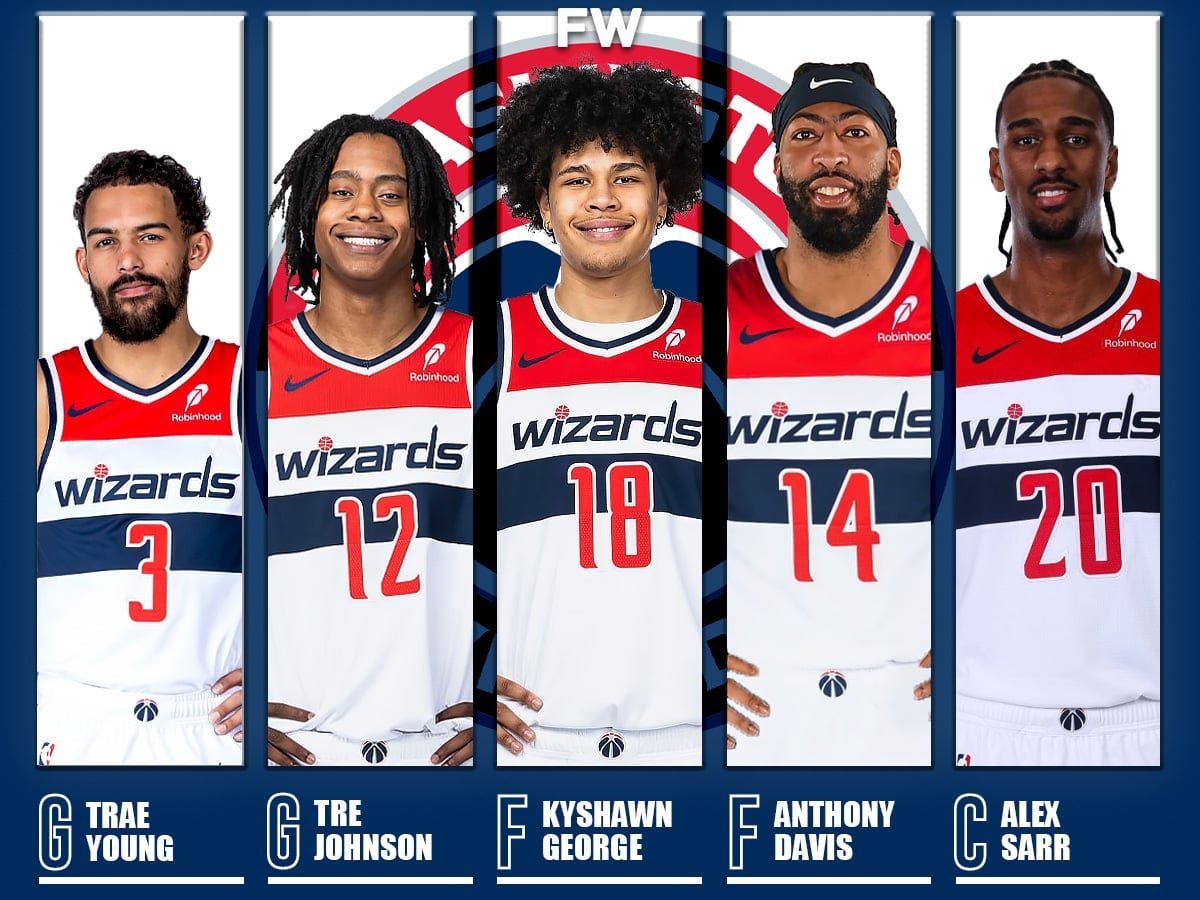
Starters
Point Guard: Trae Young
Shooting Guard: Tre Johnson
Small Forward: Kyshawn George
Power Forward: Anthony Davis
Center: Alex Sarr
Everything starts with Trae Young. When he is on the floor, he is one of the league’s most potent offensive organizers. His ability to bend defenses with range and passing vision immediately elevates every lineup he plays in. Young is averaging 19.3 points and 8.9 assists while shooting 41.5% from the field and 30.5% from three-point range this season.
It is important to note that Young, who arrived in Washington via trade earlier this season, is unlikely to feature in a game for the Wizards this year. Even if he does not suit up, his presence as a franchise-level offensive engine reshapes the team’s identity moving forward.
That spacing becomes far more dangerous when paired with Anthony Davis. Davis is averaging 20.4 points, 11.1 rebounds, 2.8 assists, and 1.6 blocks while shooting 50.6% from the field. In Washington, he no longer needs to carry an offense. Instead, he can focus on dominating defensively, finishing plays, and exploiting mismatches. A Young-Davis pick-and-roll, whenever it debuts, would instantly rank among the most difficult actions to defend in the NBA.
Tre Johnson slides in as the starting shooting guard and represents another critical piece of the rebuild. He is averaging 12.9 points, 2.7 rebounds, and 2.2 assists, showing promise as a scorer who can grow into a secondary creator. Importantly, Johnson does not need to be rushed. Playing next to veterans and high-level talent allows his development to remain steady rather than forced.
Kyshawn George has taken a clear leap in his second season. He is averaging 15.3 points, 5.6 rebounds, and 5.0 assists while shooting 44.5% from the field and 37.6% from three-point range. George’s versatility stands out. He can defend multiple positions, initiate offense when needed, and connect lineups without demanding touches. That type of wing is invaluable on a team blending youth with star power.
Alex Sarr may be the most important structural piece in the lineup. The rookie big is averaging 17.4 points, 7.7 rebounds, 2.8 assists, and 2.1 blocks while shooting 49.6% from the field and 33.3% from three. His ability to protect the rim, switch defensively, and space the floor allows Washington to keep Davis at power forward without sacrificing size. That defensive pairing gives the Wizards a foundation they simply have not had in years.
Things get even more interesting when we head to the bench.
Bench Unit
Bench: Bub Carrington, Jaden Hardy, D’Angelo Russell, Sharife Cooper, Bilal Coulibaly, Jamir Watkins, Justin Champagnie, Will Riley, Anthony Gill, Skal Labissiere, Tristan Vukcevic
Bilal Coulibaly has emerged as the most impactful option off the bench. He is averaging 9.7 points, 4.7 rebounds, and 2.5 assists, providing defensive energy, transition scoring, and positional flexibility. His ability to guard wings and guards makes him a natural fit in staggered lineups.
Cam Whitmore brings scoring punch. He is averaging 9.7 points and 2.3 rebounds, offering instant offense and physicality. While still refining his decision-making, Whitmore’s ability to create shots gives Washington a bench scorer who can swing momentum.
Justin Champagnie has quietly carved out a role as a reliable contributor, averaging 7.2 points while providing effort on the glass and floor spacing. Tristan Vukcevic and Skal Labissiere give the Wizards additional size and shooting options, allowing the coaching staff to mix and match based on matchups.
The depth continues with Bub Carrington, Jamir Watkins, and Sharife Cooper, all of whom provide guard depth and developmental upside. Anthony Gill remains a steady veteran presence who understands spacing, physical play, and rotational discipline.
The key takeaway is optionality. Washington can play big with Davis and Sarr, lean into athletic wing-heavy lineups, or deploy shooting-focused units without sacrificing defensive integrity. Few teams in a rebuilding phase can credibly say that.
The Wizards Can Be A Threat In The East
This roster will still take time to fully coalesce, and wins may not come immediately. Trae Young’s timeline, future trades, and continued development will shape the long-term ceiling. But structurally, the Wizards are no longer a team built solely on future draft equity.
With Anthony Davis anchoring the frontcourt, Alex Sarr emerging as a foundational big, and a bench filled with real contributors, Washington has assembled a roster that looks deep, flexible, and far more competitive than expected. The rebuild is no longer abstract. The pieces are in place.



![Jarred Vanderbilt Yells At JJ Redick; Austin Reaves Holds Him Back As Fight Breaks Out On Lakers Bench [Video]](https://fadeawayworld.net/wp-content/uploads/2026/04/JJ-Redick-Jarred-Vanderbilt-615x410.jpg)