Winning the MVP is already a narrow club. Doing it after falling outside the top 10 in the draft is even rarer. Most MVPs were obvious from the start. They were No. 1 picks, top-five picks, or players every team already saw as future stars before they entered the league.
This list is different. It includes players who were missed, undervalued, drafted in strange historical formats, or taken later than their careers now make believable. Some were not classic draft steals because the old draft system was different, especially with territorial picks and the ABA. Still, none of them entered the NBA through a normal top-10 slot.
From Wilt Chamberlain to Nikola Jokic to Shai, these are the rare MVPs who became much more than their draft position suggested. Some turned into all-time scorers. Some changed how their position was played. Some built championship teams. All of them proved one simple thing: the draft can still miss badly.
1. Wilt Chamberlain
NBA Draft: Territorial selection (Warriors)
MVP Awards: 4 (1960, 1966, 1967, 1968)
Wilt Chamberlain’s case is different because he was not taken with a numbered draft pick. In 1959, the NBA still had territorial picks, which allowed a team to give up its first-round pick and claim a local player before the regular draft started. The Warriors used that rule to get Chamberlain because he was from Philadelphia and became a high school star there.
So he was not “outside the top 10” in the same way as Nikola Jokic, Giannis Antetokounmpo, or Steve Nash. He was a special historical case. Everyone knew he was a huge prospect, but because he entered the league through the territorial system and not the normal draft order, he still fits the broader version of this list.
The numbers are still almost impossible to read like normal basketball history. Chamberlain won four MVPs, two championships, one Finals MVP, Rookie of the Year, and 13 All-Star selections. He also made 10 All-NBA teams, led the league in scoring seven times, led the league in rebounding 11 times, and even led the league in assists in 1967-68 as a center. His career averages were 30.1 points, 22.9 rebounds, and 4.4 assists.
His MVP seasons were absurd. In 1959-60, he had 37.6 points and 27.0 rebounds as a rookie. In 1965-66, he had 33.5 points, 24.6 rebounds, and 5.2 assists. In 1966-67, he changed style, shot 68.3% from the field, and led the 76ers to a championship. In 1967-68, he had 24.3 points, 23.8 rebounds, and 8.6 assists.
There is no modern comparison. Chamberlain was not a draft steal in the normal sense because everyone knew who he was. But he still fits this list because he did not enter the league through a normal top-10 draft slot. As a historical case, he is the biggest exception possible.
2. Moses Malone
NBA Draft: 28th overall pick, ABA Draft (Utah Stars)
MVP Awards: 3 (1979, 1982, 1983)
Moses Malone was not a normal draft story either. He went straight from high school to the ABA and was selected by the Stars with the 28th overall pick in the 1974 ABA Draft. That alone makes him one of the biggest evaluation misses in basketball history, even with the ABA/NBA context being different from today.
Malone became one of the greatest rebounders ever. He won three NBA MVPs, made 12 NBA All-Star teams, added one ABA All-Star selection, made eight All-NBA teams, and led the NBA in rebounding six times. His career totals were 29,580 points and 17,834 rebounds between the ABA and NBA. He was also a champion and Finals MVP with the 76ers in 1983.
His MVP seasons were built on volume, strength, and offensive rebounding. In 1978-79, he had 24.8 points and 17.6 rebounds for the Rockets. In 1981-82, he reached 31.1 points and 14.7 rebounds. In 1982-83, after moving to the 76ers, he had 24.5 points and 15.3 rebounds, then carried that same dominance into the playoffs.
Malone was not flashy. His game was second chances, free throws, deep catches, seals, and physical work. That is what made him great. He turned missed shots into offense better than almost anyone ever. For a player taken 28th in an ABA draft, the final resume is ridiculous.
3. Julius Erving
NBA Draft: 12th overall pick, 1st round (Bucks)
MVP Awards: 1 NBA (1981), 3 ABA (1974, 1975, 1976)
Julius Erving was selected 12th overall by the Bucks in the 1972 NBA Draft, but his career started in the ABA before the merger. That context is important because Erving was already a star before his NBA MVP. He was not some late bloomer. The NBA draft slot just didn’t match the player he became.
Erving won one NBA MVP and three ABA MVPs. He also won one NBA championship, two ABA championships, two ABA Playoffs MVPs, made 11 NBA All-Star teams, five ABA All-Star teams, seven All-NBA teams, and five All-ABA teams. His combined ABA/NBA career averages were 24.2 points, 8.5 rebounds, and 4.2 assists. He finished with 30,026 points.
His 1980-81 NBA MVP season was the proof that the ABA star translated fully. Erving had 24.6 points, 8.0 rebounds, 4.4 assists, 2.1 steals, and 1.8 blocks. He shot 52.1% from the field and carried the 76ers as one of the league’s most complete forwards.
The accolades are all over the place, but the main point is simple. Erving was one of the players who changed what a wing could look like. He had scoring, transition power, defense, shot blocking, and star-level playoff production. A 12th pick becoming a four-time MVP across the ABA and NBA is still insane.
4. Karl Malone
NBA Draft: 13th overall pick, 1st round (Jazz)
MVP Awards: 2 (1997, 1999)
Karl Malone went 13th in the 1985 NBA Draft, and that became one of the best draft steals ever. The Jazz didn’t get a young starter there. They got one of the greatest power forwards in league history and one of the most durable scorers the league has seen.
Malone won two MVPs, made 14 All-Star teams, 14 All-NBA teams, and four All-Defensive teams. He finished his career with 36,928 points, which still ranks third in NBA history. His career averages were 25.0 points, 10.1 rebounds, and 3.6 assists across 1,476 regular-season games.
His first MVP came in 1996-97, when he had 27.4 points, 9.9 rebounds, and 4.5 assists for a 64-win Jazz team. His second came in the 1998-99 lockout season, when he had 23.8 points, 9.4 rebounds, and 4.1 assists. The first season was his stronger MVP case. The second was more about his value on one of the best teams in a shortened year.
The title never came, and that is always part of the Malone discussion. But this list is about MVPs drafted outside the top 10, and Malone is one of the best examples. A 13th pick became a two-time MVP, an all-time scorer, and a top-two player at his position for most of the 1990s.
5. Steve Nash
NBA Draft: 15th overall pick, 1st round (Suns)
MVP Awards: 2 (2005, 2006)
Steve Nash went 15th in the 1996 NBA Draft, and his career took time. He was not a star right away with the Suns. He became an All-Star with the Mavericks, then returned to the Suns and became the engine of one of the best offenses ever.
Nash won back-to-back MVPs in 2005 and 2006. He made eight All-Star teams, seven All-NBA teams, and led the league in assists five times. His career averages were 14.3 points, 3.0 rebounds, and 8.5 assists. The shooting was elite: 49.0% from the field, 42.8% from three, and 90.4% from the line.
The MVP seasons were not huge scoring seasons, but the Suns’ offense ran through him. In 2004-05, Nash had 15.5 points, 3.3 rebounds, and 11.5 assists while shooting 50.2% from the field, 43.1% from three, and 88.7% from the line. In 2005-06, he had 18.8 points, 4.2 rebounds, and 10.5 assists while shooting 51.2% from the field, 43.9% from three, and 92.1% from the line.
The debate around Nash’s MVPs never really stops because he didn’t score like most MVP guards. But the data is the data. The Suns became elite because of his passing, pace, shooting, and decision-making. A 15th pick became a two-time MVP by controlling games without dominating shots.
6. Kobe Bryant
NBA Draft: 13th overall pick, 1st round (Hornets)
MVP Awards: 1 (2008)
Kobe Bryant was selected 13th overall in the 1996 NBA Draft, then moved to the Lakers in the Vlade Divac trade. That pick looks insane now. He became a five-time champion, two-time Finals MVP, 18-time All-Star, 15-time All-NBA player, 12-time All-Defensive player, and the 2008 MVP.
His MVP season came in 2007-08, when he averaged 28.3 points, 6.3 rebounds, 5.4 assists, and 1.8 steals. The Lakers went 57-25, finished first in the West, and reached the NBA Finals. Bryant was still one of the best shot-makers in the league, but he also played through a torn ligament in his right pinkie and still played all 82 games.
The draft part is the main point. Kobe was not picked outside the top 10 because teams didn’t know he had talent. He was picked 13th because high school guards were still risky in 1996. Teams were not fully ready to draft a teenager and hand him a franchise. That mistake changed the league.
Kobe finished his career with 33,643 regular-season points, which still has him inside the top five on the NBA’s all-time scoring list. That is the final proof of how wrong the draft read was. A player taken 13th became one of the greatest scorers ever, won five championships, won the 2008 MVP, and built a resume that most No. 1 picks never get close to. He probably should have won another MVP, but that is another debate.
7. Giannis Antetokounmpo
NBA Draft: 15th overall pick, 1st round (Bucks)
MVP Awards: 2 (2019, 2020)
Giannis Antetokounmpo was drafted 15th in 2013, and the gap between draft-night projection and end product is enormous. He entered the NBA as a long, raw forward. He became a two-time MVP, Defensive Player of the Year, champion, and Finals MVP. That is one of the strongest player-development stories ever.
His first MVP came in 2018-19, when he had 27.7 points, 12.5 rebounds, 5.9 assists, 1.3 steals, and 1.5 blocks. The Bucks won 60 games, and Giannis became the regular season’s most powerful two-way force. His second MVP came in 2019-20, when he had 29.5 points, 13.6 rebounds, 5.6 assists, 1.0 steals, and 1.0 blocks in only 30.4 minutes per game. He also won Defensive Player of the Year that same season.
The peak did not stop with the MVPs. In 2021, Giannis led the Bucks to the championship and won Finals MVP. His Game 6 against the Suns, with 50 points, 14 rebounds, and five blocks, is one of the best closeout games ever. By 2026, he’s earned 10 All-Star selections, nine All-NBA selections, five All-Defensive selections, two MVPs, one DPOY, one Finals MVP, and one championship.
For a 15th pick, that resume is absurd. Giannis was not drafted to be a ready-made star. He became one through body development, usage growth, and rare physical dominance.
8. Nikola Jokic
NBA Draft: 41st overall pick, 2nd round (Nuggets)
MVP Awards: 3 (2021, 2022, 2024)
Nikola Jokic is the biggest draft steal in NBA MVP history. He went 41st overall in the 2014 NBA Draft. That is not just outside the top 10. That is outside the first round completely. No MVP was ever drafted lower in the modern common draft era.
Jokic won MVP in 2021, 2022, and 2024. He also won the 2023 championship and Finals MVP with the Nuggets. This season, he was still on top of the league and made another unanimous All-NBA First Team after putting up 27.7 points, 12.9 rebounds, and 10.7 assists. That gave him a triple-double season from the center position and his sixth First Team All-NBA selection.
His MVP seasons show the same profile in different forms. In 2020-21, he had 26.4 points, 10.8 rebounds, and 8.3 assists. In 2021-22, he had 27.1 points, 13.8 rebounds, and 7.9 assists. In 2023-24, he had 26.4 points, 12.4 rebounds, and 9.0 assists. The scoring was elite, the rebounding was elite, and the passing was historically rare for a big.
The reason Jokic sits so high in this topic is simple. Teams missed because his value did not look normal. He was not explosive, not a vertical athlete, and not a classic rim protector. But he became one of the best offensive players ever because his touch, passing, footwork, size, and decision-making are all elite.
9. Shai Gilgeous-Alexander
NBA Draft: 11th overall pick, 1st round (Hornets)
MVP Awards: 2 (2025, 2026)
Shai Gilgeous-Alexander is the newest name on this list. He was drafted 11th overall by the Hornets in 2018 and moved to the Clippers on draft night. One spot lower, and he would not qualify.
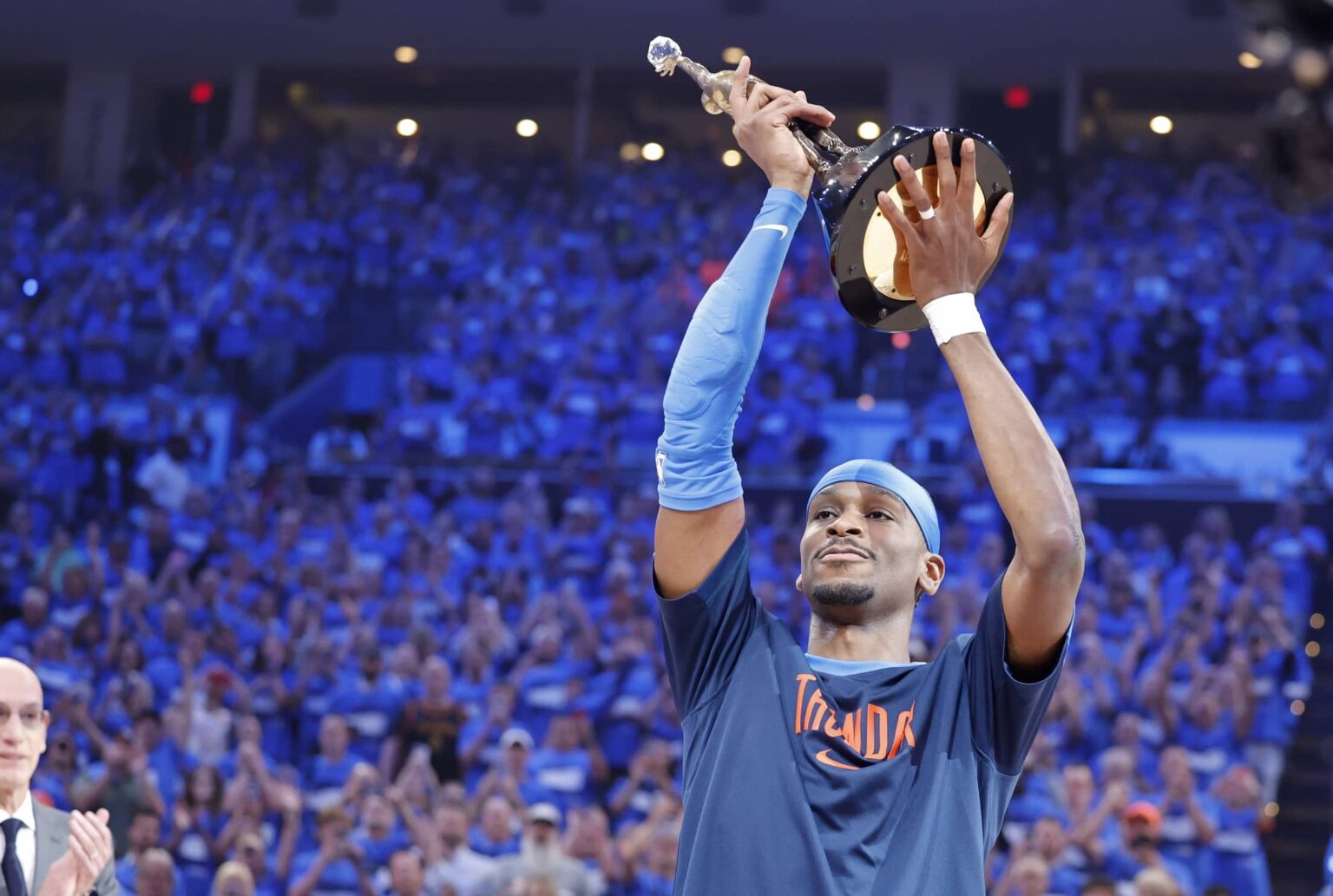
His rise became one of the main stories of the 2020s. The Clippers moved him to the Thunder in the controversial Paul George trade, and his development went from future All-Star to generational talent in a matter of a few seasons. Gilgeous-Alexander won MVP in 2025, then won it again in 2026. As the two-time reigning MVP, he made the 2026 All-NBA First Team unanimously.
The production backed it up. In 2025-26, Gilgeous-Alexander had 31.1 points, 6.6 assists, and 4.3 rebounds while shooting 55.3% from the field. That efficiency for a high-usage guard is the main point. He was not just scoring a lot. He was scoring with control, getting to the line, finishing inside, and keeping the Thunder offense stable.
He has also added team success to the individual numbers. Gilgeous-Alexander was already the 2025 MVP, 2025 Finals MVP, NBA and scoring champion, then followed it with another MVP season. That gives him a resume most 11th picks never come close to building. He is now the first guard since Stephen Curry to win back-to-back MVPs, and he changed how the 2018 draft is remembered.