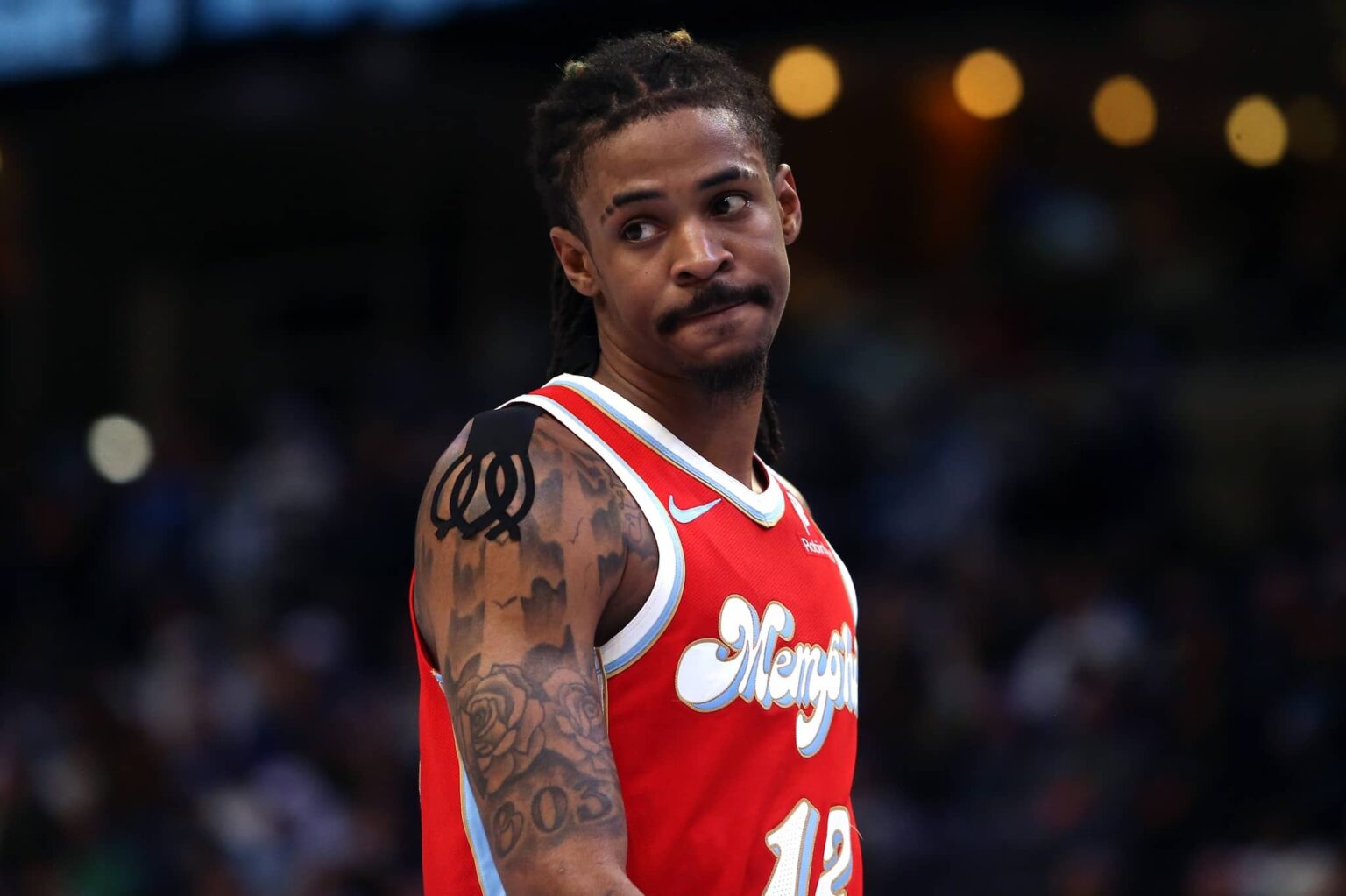
Whispers inside NBA front offices have turned into headlines as league executives publicly questioned the value and reliability of Ja Morant. In a recent report by ESPN (via writers Bobby Marks and Tim MacMahon), one Eastern Conference executive went viral for his blunt assessment of Morant’s current value.
“The combination of pain in the ass, injury prone, not that good anymore and big contract is a bad one,” the executive told ESPN, adding that he would not want Morant on his roster at any salary number.
That verdict arrives just as Morant attempts to recover from a right calf strain that has kept him out since November 15 and added to his growing list of physical setbacks. According to ESPN, he has played in fewer than 40% of the Grizzlies’ games since his back-to-back All-Star seasons because of “three suspensions and a couple dozen injuries,” a combination that has turned availability into one of the central concerns for front offices evaluating him.
Per ESPN-reporting executives, the combination of Morant’s injury history, declining recent performance metrics, disciplinary background, and hefty five-year, $197 million contract adds up to “a bad package” for any prospective suitor.
A Western Conference scout reportedly questioned whether Morant still has the explosiveness that made him a star: “Has Ja already lost his pop? When is the last time he put his chin above the rim?” That skepticism underscores a league-wide concern that his athleticism and physical tools might be eroding.
“Ja has been going down, down, down,” one Western Conference general manager told ESPN, saying he is not sure how much of the decline is tied to motivation versus health and emphasizing that teams “have to be able to look under the hood” with any potential move for him.
Furthermore, some evaluators in the NBA have begun comparing Morant to former athletic guards such as Derrick Rose and John Wall, players whose careers declined sharply after recurring injuries and whose greatest impact years came early. These comparisons suggest that a similar trajectory might be feared for Morant.
This season, Morant’s per-game scoring has dropped significantly compared to his peak years. In 12 games played, he averages 17.9 points, 7.6 assists, and 3.5 rebounds on a shocking 35.9% from the field and 16.7% from deep.
Those scoring numbers come alongside a notable dip in efficiency. Data cited in the article shows that the share of his field-goal attempts within three feet of the basket has declined every year and has “plummeted” this season, with only 15.4% of his shots coming from that range, which is less than half his career norm. This shift in shot selection appears to reflect caution in avoiding physical wear, but also raises questions about his ability to generate elite-level production moving forward.
Availability has been another major issue. Morant has missed a substantial portion of games this season due to injuries and a recent calf strain. According to the report, his limited availability has weighed heavily on front offices evaluating his long-term viability.
According to the same sources, Morant’s trade value in the current market is perceived as weak. Despite interest in turnaround trades involving other stars, such as LaMelo Ball or Trae Young, many executives reportedly view Morant as a risky asset. The prevailing belief is that teams would only consider dealing for him under scenarios of “problem star for problem star,” rather than as a foundational piece.
One Western Conference general manager told ESPN that he’s “not sure about his health,” and questioned whether Morant’s decline is due to lack of motivation or purely physical wear.
What This Means For Memphis’ Wild Season
The Memphis Grizzlies enter the current stretch of the 2025–26 season with a 9–13 record, placing them ninth in the Western Conference after a three-game winning streak, broken on Tuesday by San Antonio. The team remains below .500 after multiple disruptions to its rotation, including injuries across the roster and Ja Morant’s continued inconsistency in availability.
Memphis built its roster around Morant, and his five-year, $197 million contract shapes almost every decision the front office makes. When he isn’t available, the team feels it immediately. His absences have disrupted rotations, forced role players to take on expanded duties, and limited the Grizzlies’ ability to establish any real continuity on the floor. Their current 9–13 record reflects how difficult it has been to stay competitive in the West without consistent production from their lead guard.
The team’s flexibility is also limited. With such a large portion of the cap tied to Morant, Memphis has fewer options to reshape the roster or pursue major additions during the season. His reduced availability and declining efficiency add another layer of uncertainty, leaving the organization closely dependent on how quickly he recovers and whether his performance stabilizes. For now, the direction of the Grizzlies remains closely linked to Morant’s health and his ability to return to the level that once defined the franchise.
Despite the heavy criticism, not every voice in the ESPN story wrote Morant off completely. Some executives argued that his playoff résumé and competitive edge still separate him from the other guards in the trio and that a different environment could help reset his career.
One Western Conference executive told ESPN that Morant is “the one who can maybe be saved” if he reaches a point where he has to prove himself again for his next contract, while another described acquiring him as “a gamble” but expressed belief that he “will be fine at his next stop”, with the warning that Memphis “is going to have to move Ja” at some point.