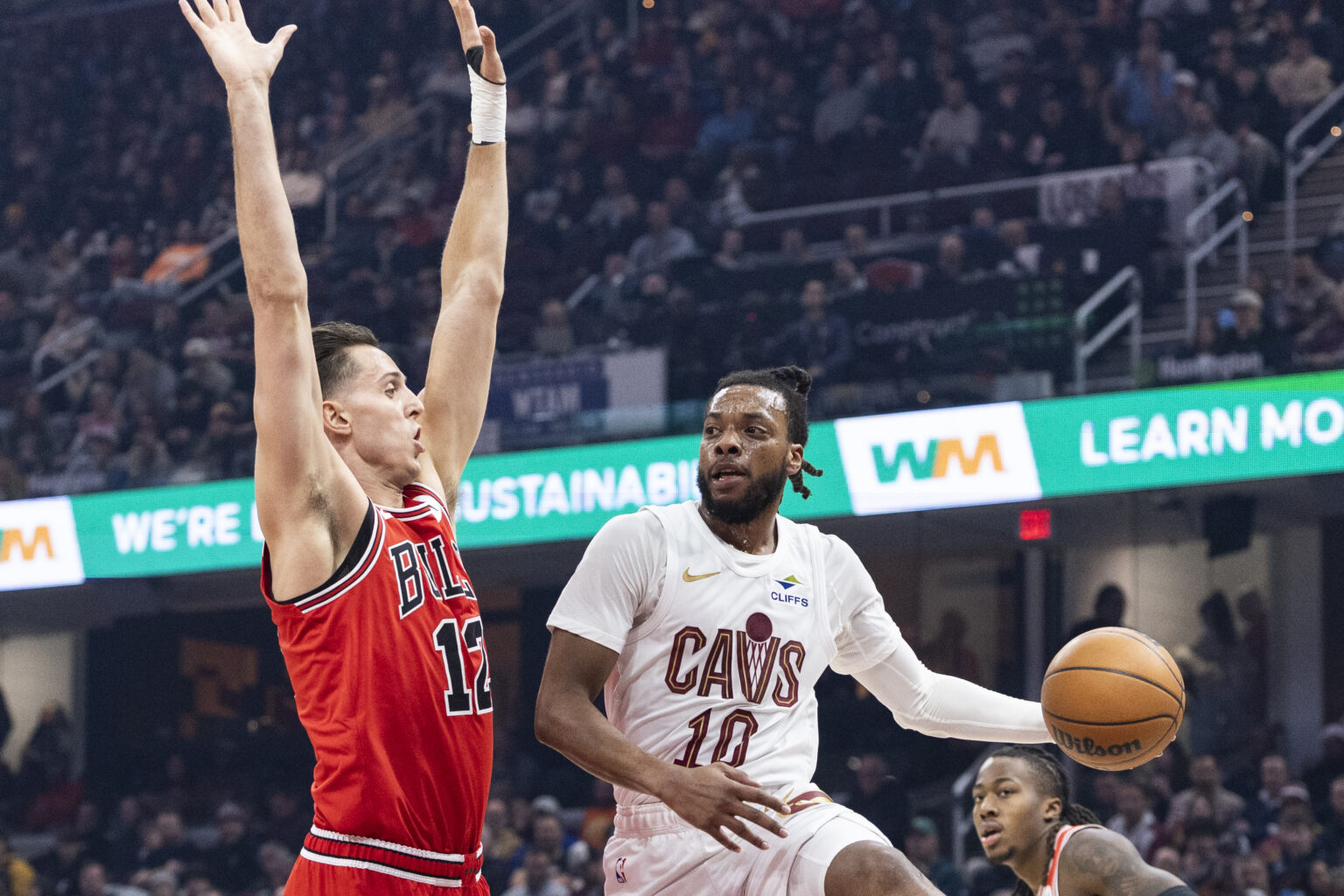
Friday night felt like another step backward for the Cleveland Cavaliers. Despite a monster scoring night from Darius Garland, Cleveland couldn’t sustain momentum, couldn’t get stops when it mattered, and ultimately faded in a 136-125 loss to the Chicago Bulls – a game that exposed how fragile the Cavs still look without their stars fully intact.
This wasn’t a loss caused by one bad stretch or a hot opponent shooting out of their mind. It was a familiar pattern. Cleveland has now dropped three straight games and four of its last five, including five of the last six at home, and the issues that surfaced against Chicago reflect deeper concerns that have followed this team all season.
Defense Continues To Vanish Late In Games
For three quarters, Cleveland at least competed. Then the fourth quarter arrived, and the structure collapsed again. With the score tied at 115, the Bulls closed the game on a decisive 17-8 run, shooting 7-of-10 during that stretch while Cleveland managed just three field goals. Nikola Vucevic alone scored 11 of his 24 points in the fourth quarter, repeatedly getting to his spots without much resistance.
Overall, Chicago shot 52 percent from the field and scored 136 points despite committing only 12 turnovers. Cleveland managed just one block as a team compared to Chicago’s five, and the Cavs struggled to contest shots at the rim once fatigue set in. This has become a theme – when games tighten late, Cleveland’s defensive communication slips, rotations slow, and opponents find clean looks far too easily.
Darius Garland Is Trying To Carry A Load
Darius Garland was brilliant individually, finishing with a season-high 35 points on 13-of-27 shooting, knocking down six threes, and adding eight assists. With Donovan Mitchell sidelined due to illness, Garland shouldered the offense from the opening tip and kept Cleveland afloat through sheer shot-making.
But the downside was just as clear. Garland had to take 27 shots to get those 35 points, and the Cavs simply don’t have enough secondary creation right now to ease that burden. When Chicago trapped or forced the ball out of his hands late, Cleveland’s offense stalled. Garland finished with four turnovers, and the team as a whole committed 15, leading to 21 Chicago points. This version of the Cavs asks too much of Garland, night after night.
The Supporting Cast Isn’t Providing Enough Two-Way Play
Beyond Garland, Cleveland struggled to find consistent offense. Jarrett Allen was efficient (14 points on 6-of-9 shooting with 12 rebounds), but his touches came in spurts rather than as a steady pressure point. Dean Wade was largely invisible offensively, scoring just two points in 28 minutes. Jaylon Tyson had nine points but turned the ball over five times, neutralizing much of his positive play.
Off the bench, the production was scattered. Nae’Qwan Tomlin scored 15 points but needed 14 shots to get there. De’Andre Hunter finished with 11 points but was a -13 in his 26 minutes. Cleveland’s bench scored 49 points, but it didn’t translate to control, spacing, or defensive stability – the kind of contributions that actually change games.
Transition Defense and Turnovers Are Too Costly
Chicago didn’t beat Cleveland with flashy offense – it beat them by capitalizing on mistakes. The Bulls scored 20 fast-break points compared to Cleveland’s seven, consistently turning live-ball turnovers into easy baskets. Josh Giddey and Tre Jones combined for 13 assists, pushing the pace whenever Cleveland’s offense bogged down.
Cleveland’s 15 turnovers might not seem overwhelming on paper, but the timing was brutal. Several came during momentum swings or late-clock situations, and Chicago made the Cavs pay by converting those miscues into 14 points. When a team struggles to score efficiently in the half-court, giving up transition chances becomes a backbreaker, and that’s exactly what happened again.
The Margin for Error Is Thin Without Mitchell And Mobley
Missing Donovan Mitchell and Evan Mobley isn’t an excuse, but it highlights how little cushion Cleveland has. Even with Garland playing one of his best games of the season, the Cavs couldn’t overcome defensive lapses, uneven bench minutes, and poor late-game execution. Chicago had seven players score in double figures; Cleveland had four.
The Cavs actually won points in the paint (62-58) and nearly matched Chicago on the glass (46-48), but those small edges didn’t matter because Cleveland lost control everywhere else. They were outscored, out-paced, and out-executed when the game tightened. That’s a troubling sign for a team trying to stay afloat while waiting for its stars to return.