Game 1 was a reality check for the Los Angeles Lakers. The Oklahoma City Thunder came out sharper, faster, and far more cohesive, cruising to a 108-90 win while controlling 79% of the game and building a lead that stretched to 21 points.
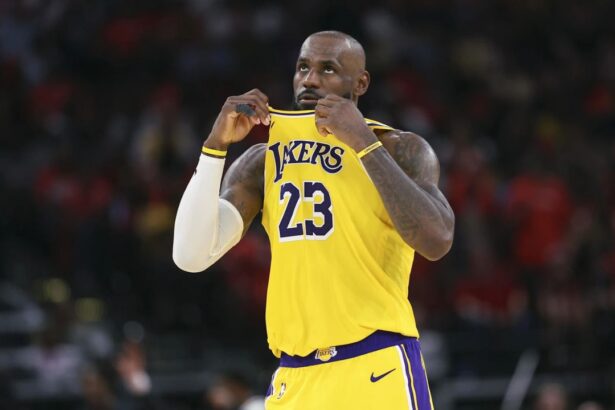
From the opening quarter, this felt like one team dictating terms and the other scrambling to keep up. Despite an efficient 27-point night on 12-17 shooting from LeBron James, the Lakers never found sustained rhythm.
Poor shooting from the backcourt, turnover issues, and OKC’s defensive activity turned this into a one-sided affair. Meanwhile, the Thunder showcased their true power and sent a clear message that this series might not be as close as some expected.
1. OKC’s Efficiency Was On Another Level
The Thunder outclassed the Lakers in shot quality and execution. OKC shot 49.4% from the field compared to the Lakers’ 41.7%, but the real separation came from beyond the arc: 43.3% (13-30) for the Thunder versus 33.3% (10-30) for Los Angeles.
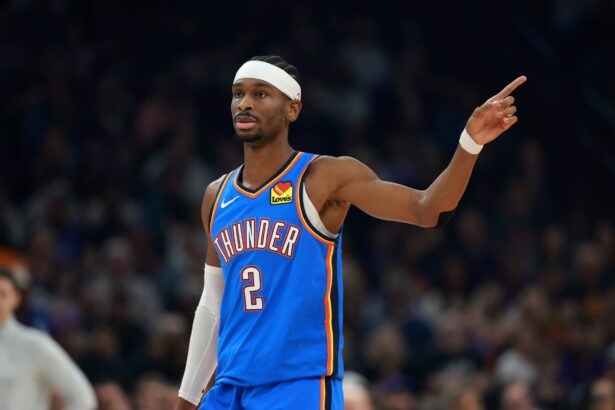
What made it more impressive is how balanced the scoring was. Chet Holmgren led the way with 24 points on 9-17 shooting, while Shai Gilgeous-Alexander added 18 points and 6 assists, controlling the pace even while committing 7 turnovers.
Add in 18 points from Ajay Mitchell and 12 off the bench from Jared McCain (4-5 from three), and suddenly the Lakers were dealing with waves of efficient offense. This wasn’t a case of one star going nuclear; this was a system clicking.
OKC generated 29 assists on 42 made field goals, constantly moving the ball and finding the best shot. The Lakers, by comparison, had 26 assists but on fewer makes and far less offensive flow.
2. Lakers’ Backcourt Completely Disappeared
You’re not beating a team like OKC when your guards can’t score, and that’s exactly what happened. Austin Reaves had a brutal night: 8 points on 3-16 shooting, 0-5 from three, along with 4 turnovers.
It was one of those games where nothing looked comfortable; pull-ups, drives, even open looks just weren’t falling. Marcus Smart wasn’t much better offensively, finishing with 12 points on 4-15 shooting, though he did contribute 7 assists and 4 steals.
Still, the inefficiency hurt. When your starting backcourt combines to shoot 7-31 (22.5%), the offense is going to stall no matter how well your star plays.
Even the bench didn’t provide relief. Luke Kennard scored 7 points but shot just 1-4 from the field, and no other guard stepped up. The result? A stagnant offense that couldn’t capitalize on LeBron’s efficiency.
3. Thunder’s Frontcourt Dominated Inside
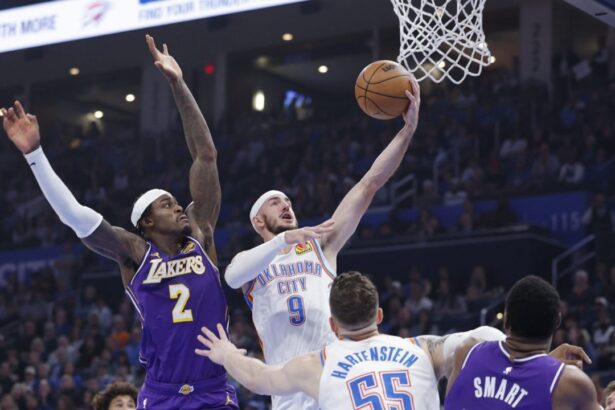
While the Lakers weren’t terrible inside, OKC simply controlled the paint more effectively. The Thunder outscored the Lakers 48-40 in the paint and outrebounded them 44-40, but the impact went deeper than raw numbers.
Chet Holmgren was a two-way force, finishing with 24 points, 12 rebounds, and 3 blocks, altering shots all night. Alongside him, Isaiah Hartenstein quietly posted 8 points, 9 rebounds, and 4 assists, anchoring the interior with physicality and smart passing.
Meanwhile, Deandre Ayton had a solid stat line, 10 points and 11 rebounds, but didn’t impose himself offensively. The Lakers had 11 offensive rebounds, yet struggled to convert them into meaningful second-chance scoring. OKC, on the other hand, made their interior touches count.
4. Game Control: OKC Controlled From Start To Finish
The most telling stat of the night might be this: the Thunder led for 79% of the game, while the Lakers led for just 15%. Even when the Lakers made small pushes, they never truly threatened.
OKC responded quickly every time, whether through a timely three, a forced turnover, or a defensive stop. The Thunder also forced 18 Lakers turnovers, turning them into 20 points, compared to just 16 points off turnovers for the Lakers.
Add in OKC’s edge in fast-break points (14-11) and their ability to consistently get quality looks, and it’s clear this game was played on their terms. The Lakers were reacting all night instead of initiating, and against a confident team like OKC, that’s a losing formula.