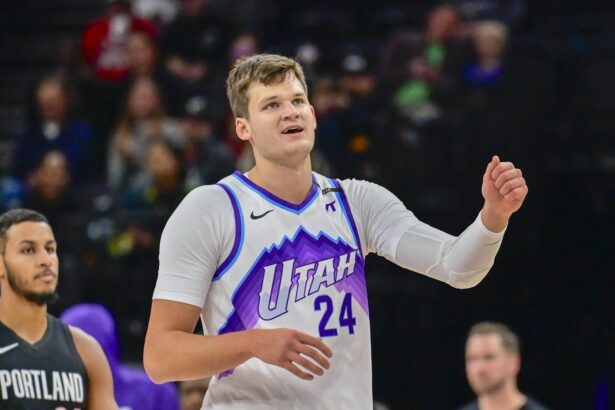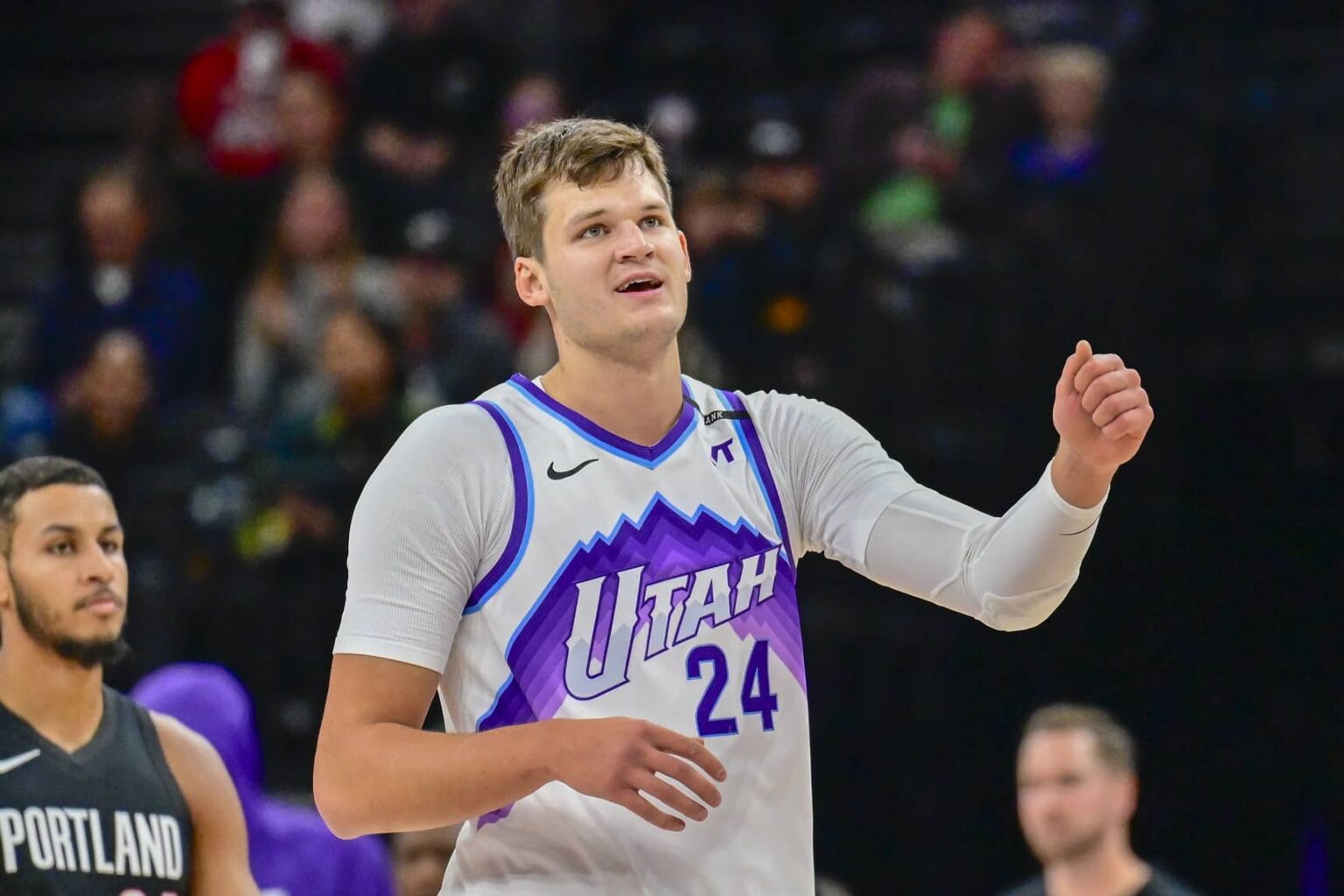
Walker Kessler may finally become available after years of teams trying to trade for him.
According to Sam Amick of The Athletic, Kessler is at odds with the Jazz over two things: the team didn’t offer him an extension last summer, and he isn’t happy with how they are handling his restricted free agency now. Amick added that Kessler is seriously thinking about continuing his career outside Utah.
This isn’t a player with no market. Amick reported that the Lakers, Pacers, Hawks, Wizards, Raptors, and Knicks have all made significant pushes for Kessler in the past. That list makes sense. He is 24, protects the rim, rebounds, finishes almost everything inside, and doesn’t need the ball to help an offense.
Kessler only played five games this season after suffering a torn labrum in his left shoulder, but he was playing very well before the injury. He averaged 14.4 points, 10.8 rebounds, 3.0 assists, 1.4 steals, and 1.8 blocks while shooting 70.3% from the field. The sample was small, but his value didn’t disappear because of one injury.
The Jazz can still match any offer sheet because Kessler is a restricted free agent. He could also accept his $14.6 million qualifying offer and become an unrestricted free agent in 2027, or push for a sign-and-trade this summer. The Jazz still control the situation, but keeping an unhappy player on a one-year deal wouldn’t be ideal either.
Nothing says the Jazz are definitely trading him yet. Still, this is the first real opening teams have had in some time. If the team decides the relationship has become too difficult, these six teams should be back on the phone very fast.
6. Indiana Pacers
Walker Kessler would fit the Pacers’ style in a basic basketball sense. Tyrese Haliburton needs centers who screen, run, catch lobs, and finish fast possessions. Kessler can do all of that while also protecting the rim behind an aggressive perimeter defense. The problem is that the Pacers already spent real assets to solve this exact position.
Ivica Zubac arrived during the season and gave them 14.1 points and 10.6 rebounds on 59.8% from the field across his full year. He will make $19.6 million in 2026-27 and $21.0 million in 2027-28. That is a very good contract for a starting center who rebounds, creates second chances, and doesn’t need many touches. The Pacers didn’t trade for Zubac just to replace him a few months later.
There is also the money. Kessler is reportedly looking for around $30.0 million per season in restricted free agency. Paying close to $50.0 million combined for two traditional centers wouldn’t make much sense, especially when neither one is a reliable three-point shooter. Playing them together would make the offense smaller around the perimeter because both defenders could stay close to the paint.
The Pacers also don’t project to have cap space. Spotrac lists more than $212.0 million in total allocations before final offseason decisions, with major money committed to Haliburton, Pascal Siakam, Zubac, Andrew Nembhard, and Aaron Nesmith. They couldn’t simply hand Kessler an offer sheet. A sign-and-trade would be needed, and receiving a signed-and-traded player would hard-cap them at the first apron.
That probably means Zubac would need to leave in the same deal or in another trade. At that point, the Pacers would be sending out a good center on a cheaper contract to pay more for a younger center coming off shoulder surgery. Kessler may have more long-term defensive upside, but the difference isn’t large enough to justify all those steps.
Indiana made more sense as a Kessler landing spot before the Zubac trade. Now the position is filled, the payroll is already heavy, and the team has bigger needs on the wing. Kessler would still look good with Haliburton, but this is easily the weakest destination of the six.
5. Washington Wizards
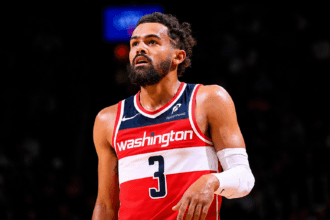
The Wizards could create a very easy offensive role for Kessler. Trae Young has always been one of the NBA’s best lob passers, and Kessler wouldn’t need plays called for him. He could screen, roll, attack the offensive glass, and wait for Young to pull the opposing center away from the basket.
He would also help cover some of Young’s defensive problems. Kessler can stay near the rim and erase drives when guards get through the first line. That part sounds good. The issue is that the Wizards already have a very expensive and crowded frontcourt.
Anthony Davis will make $58.5 million next season. Alex Sarr is at $12.4 million and remains one of the main young pieces on the roster. Davis can play power forward, but his best position is still center. Sarr can move outside more than Kessler, but asking three big men to share minutes would make the rotation strange very fast.
The money is also difficult after the Wizards added Davis and Young. Young has a $49.0 million player option, and Spotrac projects around $225.6 million in total allocations. The franchise no longer has the giant cap-space number it projected before those trades. A Kessler move would probably need to happen through a sign-and-trade, which means the Wizards would have to get below the first apron and remain there.
That isn’t impossible, but it would require another trade. The Wizards would probably need to send out one of their medium-sized contracts and may still need to move more salary. The Jazz would also want young value or draft capital, not only veterans used to complete the numbers.
The basketball timeline isn’t perfect either. Kessler is young enough to grow with Sarr, but Davis and Young were added to make the Wizards competitive now. Spending more assets on another center wouldn’t solve the lack of wing depth, shooting, or perimeter defense around them.
Kessler could become a very strong pick-and-roll partner for Young, and the defensive fit is easy to understand. Still, the Wizards would be using more money and assets at the position where they already have Davis and Sarr. It looks interesting on the court, but the full roster idea doesn’t really connect.
4. Atlanta Hawks
The Hawks have a more natural reason to chase Kessler. They need stronger rim protection and defensive rebounding, and Kessler could give them a real center behind a perimeter group led by Dyson Daniels. Putting one of the best point-of-attack defenders in front of a seven-footer would make getting to the rim very difficult.
Kessler would also work with Jalen Johnson. Johnson can grab a rebound and start the offense himself, while Kessler runs directly toward the basket. That could create easy points without asking either player to stand around and shoot. The Hawks would become bigger and more physical, which they still need against the top teams in the East.
The question is what happens with Onyeka Okongwu. He averaged 15.2 points, 7.6 rebounds, and 3.1 assists this season, and he has improved as a passer and outside shooter. Okongwu will make $16.1 million next season and is under contract through 2027-28. He is also more comfortable switching onto guards than Kessler.
Keeping both would be expensive and may create another bad spacing situation. Kessler is the better rim protector, but Okongwu does more things away from the basket. The Jazz would probably ask for Okongwu in a sign-and-trade because his salary helps the numbers and gives them another starting-level center.
The Hawks’ cap situation can change a lot depending on options, guarantees, and free-agent holds. They could create meaningful room by making several aggressive decisions, but they could also remain over the cap with their current group. Jalen Johnson is at $30.0 million, Dyson Daniels starts his new deal at $25.0 million, and Jonathan Kuminga is listed at $24.3 million.
A direct offer sheet would require the Hawks to remove several cap holds and possibly move another contract. A sign-and-trade built around Okongwu, a young player, and draft compensation is more realistic. Still, paying extra assets to move from Okongwu to Kessler may not change the team enough.
This landing spot has real defensive potential. Daniels, Johnson, and Kessler could become one of the biggest defensive groups in the conference. Kessler would also receive a full starting role instead of sharing minutes with an older center. The Hawks rank fourth because the fit is good, but Okongwu’s contract and development make the move more of a choice than a real need.
3. Toronto Raptors
Walker Kessler would give the Raptors a younger defensive center for the Scottie Barnes timeline. He could protect the rim, control the defensive glass, and finish passes from Barnes or Immanuel Quickley. The Raptors already have size across the roster, and Kessler would make that identity even stronger.
The main problem is Jakob Poeltl. He will make $19.5 million next season after picking up his player option, and his extension keeps him under contract through 2029-30. The new money begins in 2027-28 at $27.3 million, then rises again over the final two seasons. The Raptors have already made a serious long-term investment in him.
Poeltl is still a useful center. He screens, passes, finishes inside, and understands where to stand on both sides. Kessler would give them more shot blocking and a younger body, but the offensive role would be very similar. Keeping both wouldn’t be a good use of more than $40.0 million at center.
The Raptors don’t project to have cap space either. Scottie Barnes, Brandon Ingram, Immanuel Quickley, RJ Barrett, and Poeltl already take up most of the payroll. They would need a sign-and-trade, and Poeltl would almost have to be part of the outgoing salary.
The Jazz may not want a 30-year-old center with three extra seasons coming after 2026-27. That could force a third team into the trade. The Raptors would send Poeltl somewhere else, that team would send value or salary to the Jazz, and Kessler would land with the Raptors. It is possible, but it isn’t a simple two-team move.
The offensive fit also needs some thought. Barnes and Barrett are strongest when they get downhill. Kessler doesn’t pull centers away from the basket, so the paint could become crowded. The Raptors would need enough shooting from Quickley, Ingram, and their wings to keep the floor open.
Still, Kessler could raise the defensive level immediately. He is younger than Poeltl, fits the timeline better, and gives the Raptors a stronger answer against elite interior scorers. This is a real landing spot if the front office wants to change the center position before Poeltl’s extension becomes harder to move.
The Raptors rank third because the basketball idea makes sense. The contract mechanics are the real problem. They can’t add Kessler without first deciding what to do with a center they already paid.
2. New York Knicks
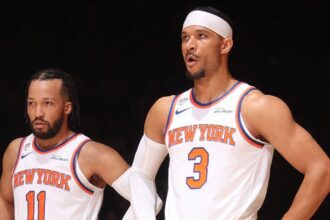
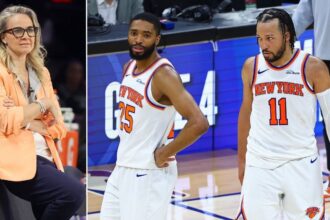
The Knicks may be the best pure basketball fit on the list. Karl-Anthony Towns spends a lot of possessions outside the paint, so Kessler could stay closer to the basket without destroying the spacing. Towns pulls the opposing center away, Kessler screens for Jalen Brunson, and the Knicks still have a major lob and offensive-rebounding threat.
Kessler would also protect Towns defensively. Towns wouldn’t need to handle the hardest center matchup every night or become the main rim protector. Kessler could guard the basket while OG Anunoby and Mikal Bridges pressure the ball. That group would be huge and very difficult to score against inside.
Mitchell Robinson already played this role during the championship run. He averaged 8.8 rebounds and gave the Knicks extra possessions, but his injury history remains a concern. Robinson is now an unrestricted free agent, and ESPN projected a deal around three years and $39.0 million. Kessler would be younger, but he would also be much more expensive.
The cap situation is the big issue. Towns will make $57.1 million, Anunoby is at $42.5 million, and Brunson is at $37.7 million. Spotrac lists almost $259.0 million in total allocations before final decisions. The Knicks don’t have cap space and can’t send Kessler an offer sheet.
A sign-and-trade would hard-cap them at the $209.0 million first apron. That means they couldn’t only exchange Robinson for Kessler and continue with the same roster. They would have to remove a lot more salary, possibly breaking up part of the championship rotation.
A double sign-and-trade involving Robinson could become one part of the structure, but it wouldn’t solve everything. The Knicks would also need the Jazz to value Robinson or find a third team. Their limited first-round pick collection makes the offer harder because Utah won’t move Kessler only to help the defending champions.
This is why the Knicks rank second instead of first. On the court, the fit may be perfect. Kessler could play with Towns, replace Robinson, and give Brunson an elite lob target. Financially, it is very hard to build without moving an important player.
The Knicks should still call because championship teams can’t ignore a 24-year-old center with this defensive profile. Still, this landing spot is much more realistic on a basketball board than inside an actual trade machine.
1. Los Angeles Lakers
The Lakers have the best mix of basketball fit and a real financial path.
Walker Kessler next to Luka Doncic is the easiest idea on the list. Doncic can force two defenders toward him, wait for the center to step up, and throw the ball above the rim. Kessler wouldn’t need post touches or isolation plays. His points would come from screens, rolls, cuts, offensive rebounds, and simple finishes.
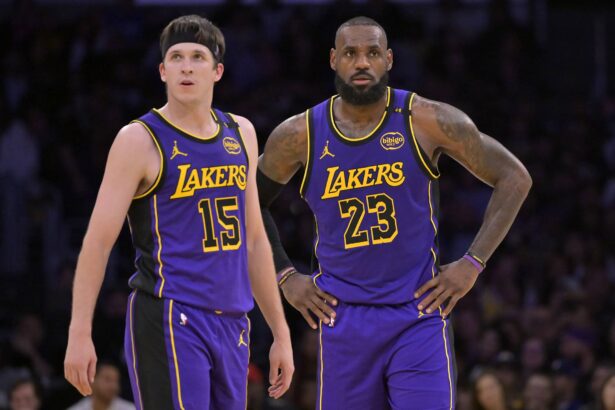
The defensive need is also obvious. Doncic and Austin Reaves can create an elite offense, but the Lakers need more protection behind them. Kessler could stay close to the basket, challenge shots, and reduce how often the wings need to leave shooters to help inside.
Deandre Ayton gave the Lakers 12.5 points and 8.0 rebounds while shooting 67.1% from the field. He has an $8.1 million player option for next season. If he accepts it, the Lakers could keep him as a second center or move him later. His decision changes the available space, but it doesn’t remove the Kessler option.
The Lakers can project anywhere from $50.3 million to $61.4 million in cap room depending on the decisions made by Ayton and Marcus Smart. Those numbers include the $20.9 million cap hold for Reaves but require the Lakers to renounce LeBron James and most of their other free agents.
That gives them a route the other five teams don’t really have. The Lakers could sign Kessler to an offer sheet using cap space, then go above the cap to re-sign Reaves through Bird rights. They wouldn’t need Utah’s help to create the contract.
The Jazz could still match, and most reports suggest they are ready to do that. An offer sheet would also lock up part of the Lakers’ cap room while Utah decides, which could cost them other free agents. That is the risk of chasing a restricted player.
A sign-and-trade may become the better route if Kessler makes it very clear that he wants to leave. The Lakers could offer draft compensation and use their cap room to absorb his new contract without sending back equal salary. That gives the Jazz a reason to cooperate instead of losing control of the situation later.
Nothing is guaranteed, but the Lakers have the star fit, the starting role, and the financial flexibility. Kessler would receive easy shots from Doncic and become the main defensive center from day one. Among the six reported suitors, this is the one that makes the most sense from every side.