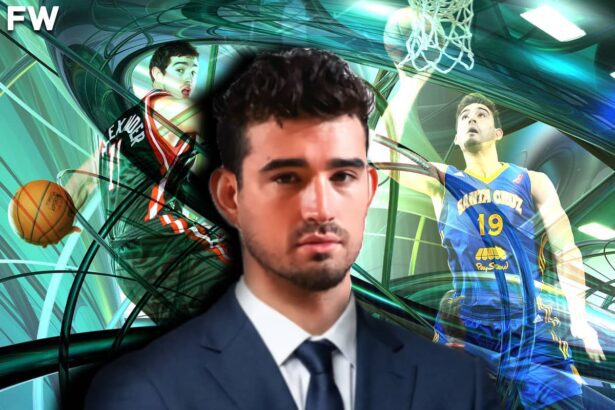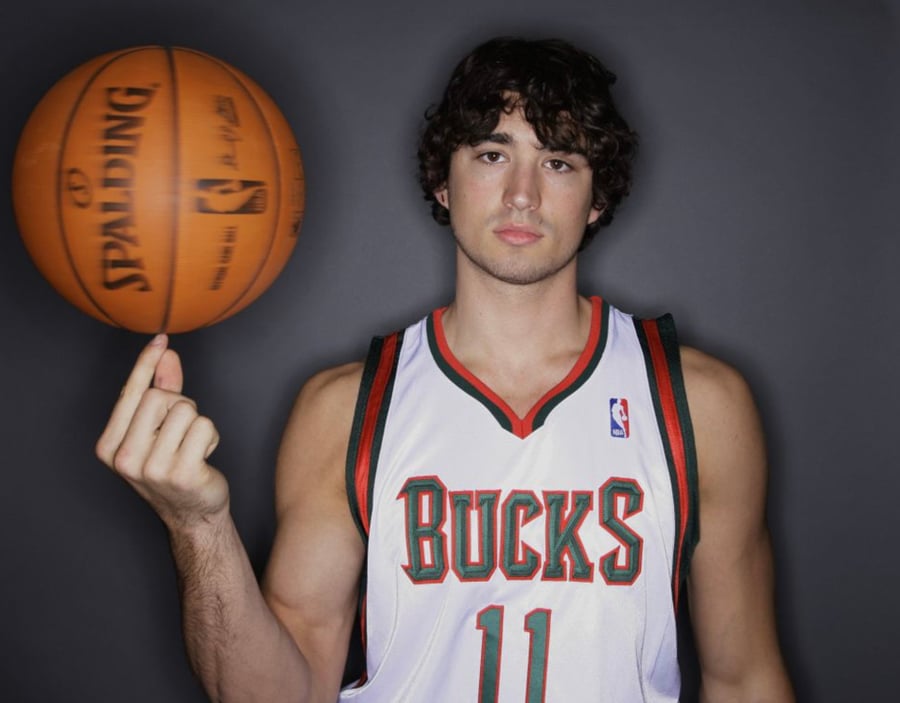
When former Milwaukee Bucks lottery pick Joe Alexander speaks about his journey to the NBA, he does not credit raw talent or fortunate breaks. Instead, he points to something far more uncomfortable: extreme social isolation and what he openly calls delusion.
Alexander, selected eighth overall in the 2008 NBA Draft by the Milwaukee Bucks, recently went viral on Instagram, describing how he intentionally cut himself off from outside influences between the ages of 13 and 21. According to him, that isolation was not accidental.
“I played in the NBA, and what really got me there was ferocious social isolation. There’s no other way I could have made it.”
“From the age of 13 to 21, I lived in a total bubble. No one could touch my mission, my focus, and most importantly, my subconscious mind. I had to do that because I wasn’t the most talented kid. I was skinny. Uncoordinated. I didn’t have polished ball skills. Coming out of high school, I didn’t have a single college scholarship. Four years later, I was an NBA lottery pick.”
“How?”
“I strategized for the long run. I worked relentlessly on my jump shot, ball handling, and athleticism, but underneath all of that, I focused on something else. The number one asset you need if you want to conquer your industry is delusion.”
“And the only way to manufacture that asset is through extreme social isolation.”
“When you’re a teenager, your brain is still developing. You’re impressionable. It only takes one well-placed sentence from someone who loves you to disrupt your belief system. They might mean well. They might even be more successful than you. But the NBA dream is irrational. It defies logic. If you spend too much time around rational people, their rationality chips away at your delusion.”
“I understood that early.”
“Every day when I planned my workouts, improving my skills was secondary. The first question I asked myself was: how do I stay away from people? How do I isolate enough to protect the belief system I need?”
“I needed my delusions to grow unchecked. I needed them to warp my thinking.”
“The first delusion was an extreme belief that I could make it. That if I outworked everyone on earth, I could get to the NBA. There was no evidence to support that. I wasn’t even projected to play college basketball. The idea that I would make the NBA was irrational. But I protected that belief through isolation.”
“The second delusion was that basketball was the only thing that mattered. That the NBA was the only acceptable outcome. That if I failed, my life would be miserable.”
“Now, objectively, those beliefs aren’t true. But at 16, 17, 18 years old, you cannot allow yourself to question them. You can’t even whisper doubt. You can’t spend time with people who gently suggest backup plans. Even if they never say it directly, their worldview seeps into you.”
“And once that happens, the edge softens. The urgency fades. The obsession weakens.”
“For me, isolation wasn’t about being antisocial. It was about protecting the one irrational belief that had any chance of turning into reality. I had no margin for doubt. So I built a bubble around my mind. That bubble became my advantage.”
The first delusion he cultivated was an unshakable belief that he could outwork everyone on earth and reach the NBA, despite no objective evidence supporting it. The second was the idea that basketball was the only acceptable outcome, that failure would render life meaningless. He now admits those beliefs were extreme and not entirely rational, but he insists that questioning them at 16 or 17 would have softened his edge.
That psychological framing fits with Alexander’s other viral reflections about the brutality of professional sports. He has previously described pro athletes as essentially injured all the time, arguing that chronic pain and obsessive dedication rewire the brain. In his telling, ruthless competitiveness is less about loving the game and more about survival after years of physical and mental strain.
Alexander’s NBA career itself was brief. He played two seasons in the league, splitting time between Milwaukee and the Chicago Bulls. Across 67 games, he averaged 4.2 points and 1.1 rebounds in limited minutes. By conventional standards, he did not become a franchise cornerstone.
However, his professional journey lasted 15 years across multiple countries, including Israel, Italy, Turkey, France, South Korea, and Iran. He competed for respected clubs such as Maccabi Tel Aviv and Hapoel Jerusalem before retiring in 2023.
In today’s NBA, where load management, mental health conversations, and player empowerment are central themes, Alexander’s perspective feels almost like a relic from a harsher era. Yet his story underscores a timeless truth: reaching the highest level often demands not only skill, but a willingness to live inside an obsession that borders on irrational.
For Alexander, that bubble became his advantage. Whether it was healthy is a different debate entirely.