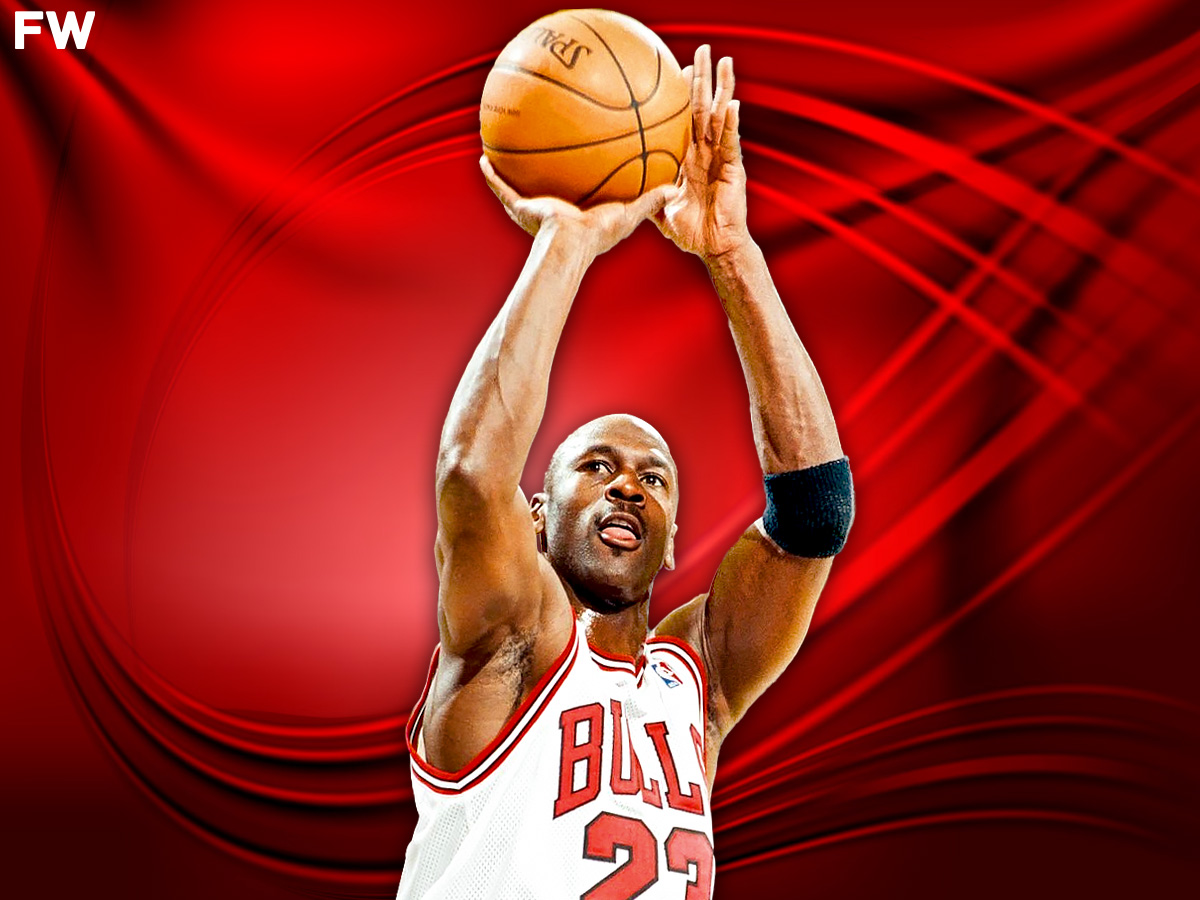
Debates about Michael Jordan’s legacy rarely slow down, and one of the more persistent arguments centers on his three-point shooting. For years, many fans have claimed that Jordan could have been a great three-point shooter if he had simply chosen to focus on it. Recently, sports analyst Nick Wright challenged that idea during an episode of the What’s Wright? podcast, arguing that the numbers tell a very different story.
Wright believes the notion that Jordan intentionally avoided becoming a strong three-point shooter is largely a myth. According to him, Jordan did attempt threes during his career, and the results show that long-range shooting was simply the one area of his game that was not elite.
“People pretend that the one weakness in Michael’s game, three-point shooting, was a weakness by choice. Like, if he wanted to be good at it, he would have been good at it. As if he was Shaq and just never shot them.”
“But in reality, there was a brief stretch of time when Jordan was actually a good three-point shooter. Because of that, he shot a lot of them for the era. And that period was when the league moved the three-point line in.”
“As soon as they moved the line back out, he went from shooting 37% on four attempts per game, which was a lot for the mid-nineties, to 23% on about one and a half attempts per game. Then, after he had three years of retirement, seeing that guys were shooting more and more threes and his athleticism was not what it once was, he came back and was a nice, crisp 19% three-point shooter again. He might be the greatest player of all time. There is a strong argument for that.”
“But the idea that he simply chose to be bad at something, rather than it being the one thing he was not great at, is nonsense. People point out that he took over 1,700 threes in his career and that his career percentage, 32.7%, does not actually look awful. That is fine.”
“But if you remove the years where they moved the line in, the picture changes. In the seasons with the shortened line, Jordan shot 39% from three. In the seasons with the regular line, he shot 29%. We do not have to make things up. I am not going to sit here and say, if LeBron really wanted to, he would be a 90% free-throw shooter.”
Jordan’s career numbers appear respectable at first glance. He finished his career shooting 32.7% from beyond the arc, making 581 of 1,778 attempts. Yet Wright pointed out that this number becomes misleading once context is added, particularly the seasons when the NBA temporarily shortened the three-point line.
Michael Jordan’s 3-point shooting percentage year by year:
– 1984–85: 17.3%
– 1985–86: 16.7%
– 1986–87: 18.2%
– 1987–88: 13.2%
– 1988–89: 27.6%
– 1989–90: 37.6%
– 1990–91: 31.2%
– 1991–92: 27.0%
– 1992–93: 35.2%
– 1994–95: 50.0%
– 1995–96: 42.7%
– 1996–97: 37.4%
– 1997–98: 23.8%
– 2001–02: 18.9%
– 2002–03: 29.1%
Jordan’s career numbers appear respectable at first glance. He finished his career shooting 32.7% from beyond the arc, making 581 of 1,778 attempts. Yet Wright pointed out that this number becomes misleading once context is added, particularly the seasons when the NBA temporarily shortened the three-point line.
From 1994 through 1997, the league moved the line closer, reducing the distance from 23 feet 9 inches to 22 feet in an effort to increase scoring. During that stretch, Jordan’s percentages surged.
In the 1994–95 season, he shot 50.0% from three on 1.9 attempts per game. The following year, during the Chicago Bulls’ historic 72-win season, he shot 42.7% on 3.2 attempts per game. In 1996–97, he shot 37.4% while taking 3.6 attempts per game.
Across those three seasons with the shortened line, Jordan made 238 of 589 three-point attempts, a remarkable 40.4%. However, Wright noted that those numbers drop sharply once the line returns to its original distance.
Outside of the shortened line era, Jordan’s career three-point shooting was far less impressive. His best season from the normal distance came in 1992–93, when he shot 35.2% on 2.9 attempts per game. Many other seasons were far lower.
Early in his career, he shot just 17.3% in 1984–85, 16.7% in 1985–86, and 18.2% in 1986–87. Even during his later years with the Washington Wizards, his numbers remained modest, shooting 18.9% in 2001–02 and 29.1% in his final season.
When the shortened line years are removed entirely, Jordan’s career percentage drops to 28.8 percent, a figure Wright believes better reflects his true shooting ability from long range. Wright’s broader point is not to diminish Jordan’s legacy. The six-time champion and five-time MVP remains widely considered one of the greatest players in NBA history. Instead, Wright argues that acknowledging a small weakness does not take away from Jordan’s greatness.