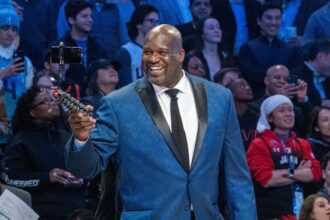
Shaquille O’Neal spent years bulldozing through defenses, using every bit of his 7-foot-1, 325-pound frame to impose his will on the league. He averaged 27.2 points, 12.5 rebounds, and 2.8 blocks in 295 games for the Orlando Magic, nearly dragging the franchise to a championship in 1995 all by himself.
When he joined the Los Angeles Lakers in 1996, he linked up with a rising Kobe Bryant, and the two eventually built one of the most dominant runs in NBA history. The breakthrough arrived in 2000 when they swept the Indiana Pacers in the Finals, with Shaq averaging 38 points and claiming Finals MVP honors.
Plenty of people wondered if they could sustain that level, but the Lakers came right back in 2001 and knocked off the Philadelphia 76ers, with Shaq once again at the center of everything. They completed the three-peat in 2002 by taking down the New Jersey Nets, even as questions about Bryant’s growing role lingered in the background.
Phil Jackson’s system kept the titles coming, but Shaquille O’Neal recently opened up about which championship carried the most weight for him during an appearance on expediTIously with Tip T.I. Harris.
“The first one was like a f**k you. Now, now what you going to say? But, knowing them, and this is a true story, we come back to LA, Orlando, with the kids. I’m watching ESPN. Here they go challenging me again. Oh, Kobe and Shaq, they won. Can they do it again? Now got to leave my kids, go train hard in the summer. I’m going show these mo**erfu**ers again. You win number two now. Now I got two. I might even retire on you mo**erfu**ers.”
“So, now you go back after the second summer, and they f**king challenge you again. So, now I got to win three in a row. So, I win three in a row, and they start creating the internal stuff with the Mamba. Now things don’t go well. Mamba starting to rise up. And I always tell people he did what he’s supposed to do.”
“So, the fact that I got traded was cool. To answer your question, my most rewarding one was in Miami because now, after you win three, I’m starting to get older and now they’re saying, ‘Okay, you got three, but we don’t care about that. You can’t do it again.’ Can you do it without the youngster?”
By the summer of 2004, things had unraveled. After a disappointing Finals loss to the Detroit Pistons, where Bryant took shots over Shaq instead of feeding the big man, Lakers owner Dr. Jerry Buss shipped Shaquille O’Neal to the Miami Heat in exchange for Lamar Odom and role players.
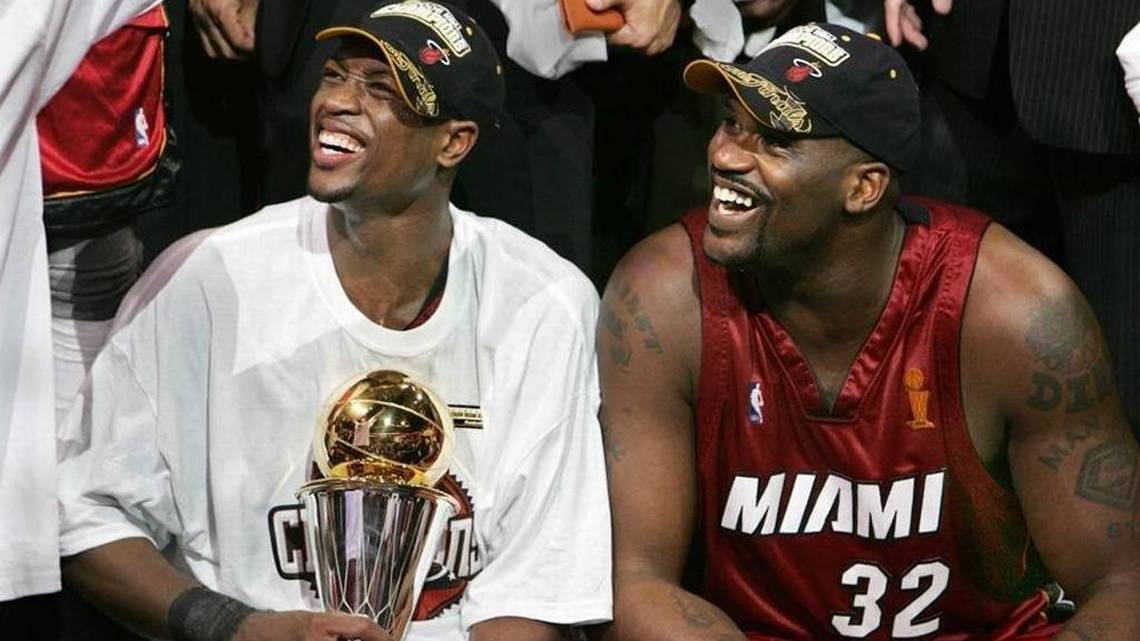
O’Neal found himself alongside Pat Riley and a young Dwyane Wade, who was quickly proving himself as a fearless scorer with ice in his veins.
“The reason why I chose Miami because when I saw [Dwayne] Wade play, I was like, ‘That kid right there is going to beat somebody.’ And I know he needed somebody like me next to him. So, when I got to Miami, the first thing I said, ‘This your team. I don’t want them trying to say Shaq’s coming out. Your team, you the man. You the godfather. I’mma back you up.”
“I’mma show you the dos and the don’ts. He was a great listener. He was a great leader. And because I didn’t have my best finals in that Dallas series, but he just exploded like I knew he could. So, the fact that I won that fourth one with him was cool.”
At 34 years old, Shaq was not the same force he had been in his prime. His body had taken a beating over the years, injuries piled up, and maintaining his conditioning became more of a challenge.
But he did not need to be the centerpiece anymore. Wade stepped up without hesitation, and Shaq welcomed the change. He focused on doing the dirty work, boxing out, setting screens, controlling the paint, while Wade sliced through defenses and created chaos.
The dynamic worked beautifully. Wade would draw defenders and kick it to Shaq for easy finishes, or Shaq would occupy help defenders and let Wade attack open lanes. Winning that 2006 championship carried a different kind of meaning, though Mark Cuban thinks differently.
It proved he could win outside Los Angeles, without the drama, and it showed the league he could still be a champion on someone else’s team.