After ranking the 2026 point guards, the next position that will shape team building is shooting guard. This group is simpler to evaluate: teams are paying for shot-making and two-way reliability, not just “ball-handling.” The top tier is still tied to options and re-sign decisions, so the list can change quickly once those dates hit. Underneath it, the market is mostly rotation scorers competing for mid-level money.
This top 10 will prioritize three things: shot creation that holds up late in games, shooting that creates spacing without needing the ball, and defense that is playable in the postseason.
10. Kentavious Caldwell-Pope
2026-27 Contract Status: $21.6 million (Player Option)
Kentavious Caldwell-Pope is a very specific free agency case: high-value role player, but only at the right number. With the Grizzlies this season, Caldwell-Pope is putting up 8.4 points, 2.5 rebounds, and 2.7 assists, shooting 41.0% from the field. The efficiency is tied to his role. He is a spacing wing-guard, not a creator. He takes the hard assignments, runs the floor, hits open threes when the offense generates them, and keeps lineups stable.
The contract leverage is the twist. He has a $21.6 million player option for 2026-27, which is a massive number for a player whose value is defense and complementary shooting. At that price, opting in is the obvious move unless he has a rare scenario where a contender offers real multi-year money with a bigger role. Most teams would rather pay the mid-level for this archetype than $21.6 million.
His market value is still real, though. Every contender wants a guard who can fight over screens, switch when needed, and not crater spacing. The issue is how the number forces the decision: he is more likely to be a trade piece as an expiring contract than a true free agent target.
What I think happens: he opts in, then the Grizzlies explore trades if they want to rebalance salary and add creation. The teams that would bite are the same teams that always chase this archetype, Nuggets, Lakers, Heat, and Bucks, especially if they can treat him as a finishing piece rather than a core salary.
9. Bennedict Mathurin
2026-27 Contract Status: Restricted Free Agent
Bennedict Mathurin belongs among the highlighted shooting guards because the baseline is already a real NBA scorer with playoff-sized physical tools. For the Clippers in 2025-26, Mathurin is averaging 18.4 points, 5.5 rebounds, and 2.5 assists, shooting 43.2% from the field. That production has also popped in high-usage moments, including a 38-point game that signaled he can carry offense for stretches against real competition.
His contract situation points to restricted free agency in 2026, which matters because it limits the odds of him truly “hitting” the market without the Clippers having control. The Pacers moved him as they were unwilling to extend him, but the Clippers will have the rights to match any offer.
Mathurin’s pitch is simple: wing scoring with strength. He can attack closeouts, get to the line, and punish smaller guards. He is not only a catch-and-shoot player, which raises his value compared to most complementary shooting guards. The swing skill is decision-making: when he is forced into crowd reads, does the offense stall, or does he keep the ball moving quickly enough to stay efficient. Defensively, teams will want him to be more consistent, but the frame gives him a chance to be playable in switch-heavy postseason schemes.
What I think happens: the Clippers keep him on a five-year, $90 million deal. Unless they decide he is too expensive relative to their other commitments, matching an offer sheet is the clean outcome because shot creation at his age is hard to replace. If another team forces it, the most logical bidders are cap-space teams that need a primary or secondary scorer on the wing: Nets, Jazz, and Wizards.
8. Jaden Ivey
2026-27 Contract Status: Restricted Free Agent
Jaden Ivey is a projection play more than a finished product, and his 2026 value will be framed by health and role. He is now with the Bulls, and his 2025-26 line is modest: 8.5 points, 2.5 rebounds, and 1.8 assists in 18.1 minutes, shooting 44.5% from the field, 37.3% from three, and 80.9% at the line. He has been sidelined with left knee soreness, which will matter in negotiations because availability is part of the pricing.
Contractually, this is not an open-market free agent case. Ivey is coming off his rookie-scale structure and is expected to be a restricted free agent in the 2026 offseason, meaning the Bulls can match offers. That matching power usually compresses the market unless a team is willing to overpay or build an offer sheet with an aggressive structure.
The appeal is clear: straight-line burst, transition pressure, and enough shooting development that defenses cannot ignore him. The concern is consistency in half-court reads and whether he can defend well enough to close playoff games at shooting guard. Teams will look at him as a pace-and-pressure guard who needs a clean developmental environment and a defined usage lane.
What I think happens: the Bulls try to retain him at a number that reflects upside without paying like he is already a top starter. A four-year, $80.0 million deal (about $20.0 million per year) could work with a Team Option in the last season.
The most plausible external bidders are teams with cap room that can afford to be patient and want athletic guard creation: Pelicans, Nets, Jazz, and Pacers. If the market stays conservative because of the RFA dynamics, a short bridge deal in Chicago is also realistic.
7. C.J. McCollum
2026-27 Contract Status: Unrestricted Free Agent
C.J. McCollum is one of the cleaner “floor-raiser” guards in this class because the scoring baseline remains reliable. Traded to the Hawks in the Trae Young deal, McCollum is averaging 18.8 points, 3.4 rebounds, and 3.6 assists, shooting 45.5% from the field and 38.8% from three. He is not a pure point guard, but he is a credible secondary handler who can run pick-and-roll, get to pull-ups, and punish second units.
The contract setup makes him a true 2026 free agent. His $30.3 million deal runs out after 2025-26, which is why he projects as an unrestricted free agent and why teams will view him as a plug-and-play scoring add, not a long-term core swing. That shapes the bidder pool: contenders looking for a third scorer and teams trying to reach respectability without committing to a long rebuild.
On-court, the playoff question is always the same. McCollum can win you games with shot-making, but he is also the type teams try to target defensively, so roster context matters. If he is your primary creator, you are probably capped. If he is your third option with a strong defensive infrastructure behind him, he can tilt a series with two hot shooting nights.
What I think happens: he ends up on a short, high-salary deal that reflects his age and immediate value, likely one-plus-one or two years worth over $40.0 million. The Hawks could keep him if the roster fit works and they want continuity, but the more logical fits are contenders that need perimeter scoring and can protect him defensively: Raptors, Heat, Magic, and Blazers. If a cap-space team swings, it would be a team trying to speed-run competence with veteran scoring, but that usually comes with a shorter term.
6. Anfernee Simons
2026-27 Contract Status: Unrestricted Free Agent
Anfernee Simons is the upside swing in this group because the age curve still favors him, and the skill is straightforward: pull-up shooting, deep-range volume, and scoring bursts that bend coverage. Now with the Bulls, Simons is at 14.3 points, 2.5 rebounds, and 2.4 assists, shooting 44.0% from the field. The most important number for his market is the three-point profile: ESPN’s splits list him at 38.7% from three on meaningful volume.
The contract piece is clean. His current deal expires after 2025-26, pushing him into unrestricted free agency in 2026. That matters because teams do not need a trade to acquire him. They just need money and a role.
His evaluation is role-dependent. Simons can run pick-and-roll, but he is best when he is not asked to be the full-time organizer. The ideal usage is “secondary engine”: play next to a bigger initiator, get downhill off advantage, and punish drop coverage with pull-ups. Defensively, teams will still have to scheme, so he fits better on rosters that already have size and point-of-attack resistance.
What I think happens: he gets paid by a team that wants shot creation and is comfortable building the guard rotation around offense first. 4 years, $92.0 million deal, over $22 million per season. That is actually a realistic number.
The Bulls keeping him is possible if they see him as part of their long-term scoring base, but the more interesting fits are teams that need a high-volume shooter next to a primary star: Magic, Hawks, Lakers, and Heat. If he closes the season healthy and hot from three, he will have a real mid-tier bidding war.
5. Quentin Grimes
2026-27 Contract Status: Unrestricted Free Agent
Quentin Grimes is the cleanest “role that wins” wing-guard in this tier because he checks two boxes teams pay for: competent on-ball defense and functional offense that does not require heavy usage. With the 76ers in 2025-26, Grimes is averaging 12.8 points, 3.6 rebounds, and 3.6 assists, shooting 44.3% from the field, 35.0% from three, and 84.7% at the line. That’s a starter-quality line for a player whose job is often to stabilize lineups rather than headline them.
His contract situation is unusually clear. He signed a one-year, $8.7 million qualifying offer to return to the 76ers, a structure that gives him an inherent no-trade clause and sets him up to become an unrestricted free agent in the summer of 2026. In other words: he will actually be available.
The on-court fit is wide. Grimes can play next to a primary ball-handler, take tough guard assignments, and knock down enough threes to keep spacing intact. The playmaking bump this season (3.6 assists) also helps, because it suggests he can do more than stand in the corner. The limitation is that he is not a primary creator, so teams expecting him to replace a lead guard will be disappointed.
What I think happens: he gets a three-year, $45.0 million deal to come back to the 76ers, who traded Jared McCain for cap space to resign him. If not, the most natural fits are teams that prioritize defense and need reliable spacing around stars: Lakers, Nuggets, Bucks, Heat, and Warriors. If the 76ers want continuity, they will have to pay market price, because this is the rare case where “available” is real.
4. Zach LaVine
2026-27 Contract Status: $48.9 million (Player Option)
Zach LaVine’s 2026 outlook is mostly about health and leverage, not production. Before the season-ending right-hand surgery, LaVine gave the Kings efficient, high-end shot-making: 19.2 points, 2.8 rebounds, and 2.3 assists in 39 games, with 47.9% from the field, 39.0% from three on 6.5 attempts, and 88.0% at the line.
That profile still matters. Even in a down year, LaVine’s shooting gravity is real. He can score off the catch, he can punish switching with pull-ups, and he’s still one of the cleaner “get a bucket without breaking the offense” guards when the spacing is competent. The issue is durability and timeline: the Kings shut him down, and the market will price the risk, especially at the top of the salary scale.
Contract-wise, the lane looks narrow. Sam Amick reported LaVine intends to pick up his $48.9 million player option for 2026-27. That is the rational play coming off surgery, because it locks in elite money and pushes any long-term decision to 2027, when he can re-enter the market with a full healthy season on the résumé.
What I think happens: he opts in, then the Kings revisit trade conversations once he’s back on the floor and showing the same shooting volume. That is when the league can justify the number. The teams that make the most sense are the ones that already have size and defense and need scoring punch without changing the entire scheme: Lakers, Pistons, Heat, and Rockets. The talent is still there. The path is just delayed by the contract and the medical file.
3. Norman Powell
2026-27 Contract Status: Unrestricted Free Agent
Norman Powell is the biggest “production vs. price” problem in this shooting guard group, in the best way. He has played like a top-tier scorer all season for the Heat: 22.9 points, 3.6 rebounds, and 2.6 assists per game, with 47.6% from the field and 39.2% from three on 7.3 attempts.
That is not empty volume. It is a high-leverage offense, shot-making off movement, off the dribble, and at the foul line, with a role that scales next to other creators.
Contract-wise, this is straightforward. Powell is in the final year of his contract and projects as an unrestricted free agent in 2026. Given his age, the market will be about term as much as dollars. Teams will pay for this level of scoring, but they will be cautious about going deep into multiple seasons at 33 years old.
Powell’s selling point is clarity: he is a ready-made scoring wing for a contender. He does not need the offense built around him to get 20-plus. He fits next to stars, he can carry bench minutes, and he punishes teams that over-help. Defensively, he is not a stopper, but he competes, and he is not unplayable if the roster has enough size.
What I think happens: the Heat try to keep him on a two-year deal, maybe over $25 million per season, because replacing 22.9 points per game on 39.2% from three is not realistic without cap space. If he reaches the open market, the teams that make the most sense are contenders willing to pay for scoring and accept the defensive trade-offs: Lakers, Bucks, Nuggets, and Warriors. He is one of the few guards in this class who can change a playoff offense on Day 1.
2. James Harden
2026-27 Contract Status: $42.3 million (Player Option)
James Harden is still producing like a No. 1 offense initiator, even at 36. This season, Harden is posting 24.6 points, 4.8 rebounds, and 8.2 assists per game, with 42.6% from the field and a 60.4% true shooting mark. The volume is unchanged: he’s still living in pick-and-roll, still forcing rotations, still getting to the line, and still creating clean threes for teammates with timing and manipulation.
He also has a recent proof point that matters for 2026: teams can plug him into a playoff roster and get an immediate offensive lift. The Cavaliers’ post-deadline stretch has already shown the basic formula, better half-court organization, and more free throws, with Harden stabilizing non-star lineups.
The contract is the whole story. Harden’s deal is structured with a 2026-27 player option around $42.3 million, which gives him control over whether he stays on a one-year, premium salary track or looks for a longer commitment. At his age, the market typically splits: contenders prefer short money; rebuilding teams rarely pay for this archetype unless it’s tied to a broader plan.
What I think happens: he declines the option only if there is a clear two-year or three-year offer from the Cavs to resign if the postseason is not a failure. If not, he opts in, because $42.3 million is hard to replace. The most plausible landing spots if he actually gets loose are teams that need a real half-court organizer and have a win-now mandate: Lakers, Heat, or Magic. The Cavaliers’ re-signing him on a two-year, around $65 million deal is still the most likely outcome after trading away their young star, Darius Garland, for him.
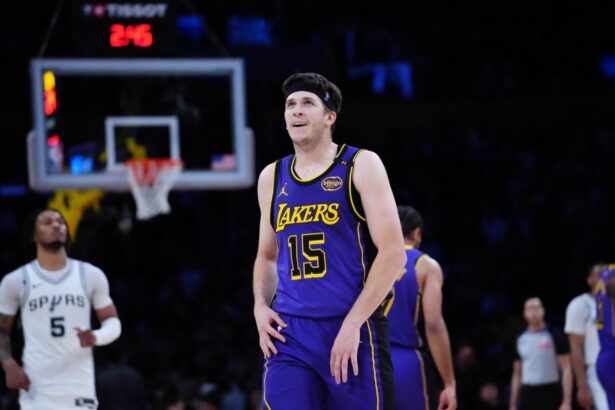
1. Austin Reaves
2026-27 Contract Status: $14.9 million (Player Option)
Austin Reaves has played himself into the top tier of this shooting guard class because the production now looks like a lead guard’s workload with wing size. For the Lakers in 2025-26, Reaves is at 25.2 points, 5.1 rebounds, and 5.7 assists per game, shooting 50.9% from the field. He is also at 37.1% from three, which keeps his scoring portable across roster builds.
The contract is straightforward and creates the 2026 decision point. Reaves’ deal includes a 2026-27 player option, with multiple sources expecting him to decline it. Given the level of production, that deal is below market for a 25-point scorer who can also initiate offense, so the assumption around the league is that he will look for a new deal over $30.0 million annually.
On-court, the value is two-part. First, he can run offense: pick-and-roll reads, live-dribble passing, and late-clock shot creation. Second, he fits next to stars because he does not need the ball every trip to be effective. That combination is what pushes him above most of the “good starter” wing-guard tier. He is not a pure stopper defensively, but at his size, he is less matchup-limited than smaller scoring guards.
What I think happens: he opts out, and the Lakers prioritize keeping him, even if it means a larger annual number in a three-year framework, because replacing that level of on-ball creation without cap space is nearly impossible. If he actually reaches the market, the teams that make the most sense are the ones that need a second creator next to a franchise star: Magic, Spurs, Nets, and Heat.