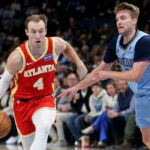
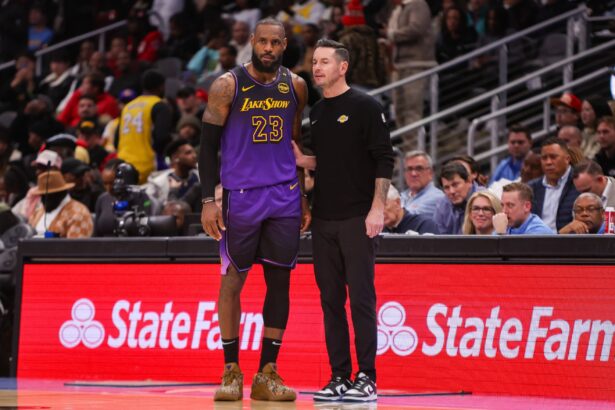
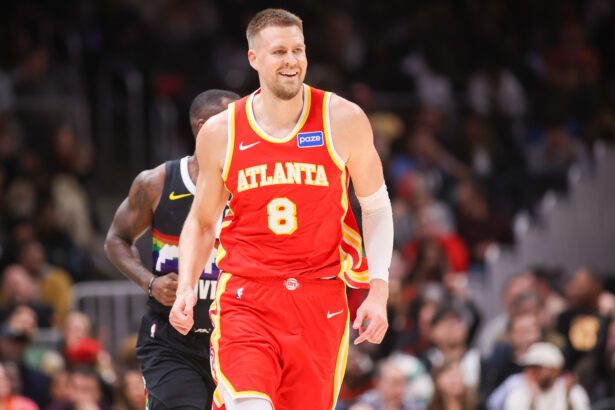
The Lakers finally hit the wire, but it was a small swing. They agreed to send Gabe Vincent and a 2032 second-round pick to the Hawks for Luke Kennard, per Shams Charania.
That move helps the shooting math right now, but it does not change the two questions that have hung over this roster for weeks: can the Lakers find a long-term frontcourt starter, and can they add another playoff-caliber wing who defends and hits open threes?
Lakers’ insider Jovan Buha basically laid it out in plain terms on deadline day:
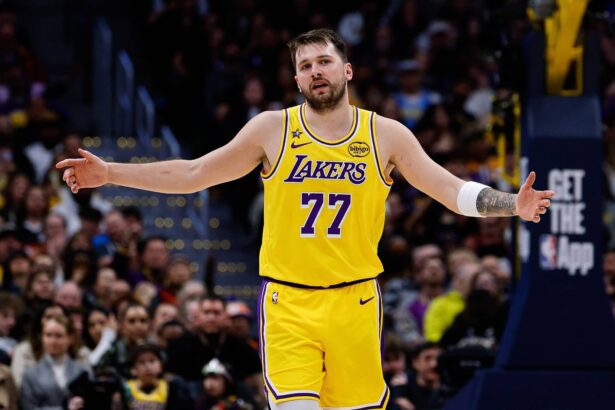
“I believe there should be two objectives for the Lakers at the 2026 trade deadline. Objective number one is acquiring a long-term starter next to Luka Doncic and Austin Reaves, likely a frontcourt starter, be it a center or a 3 and D wing. I think that would be a success of a deadline.”
The timing is tight. With fewer than four hours left before the 3 p.m. ET deadline, the Lakers are 30-19 and sitting in the West pack where one clean upgrade can matter more than a splashy name.
The Kennard add reads like a floor-raising tweak. The next move, if it comes, has to be the one that actually fits the Luka Doncic and Austin Reaves build: size you can trust, or a real 3-and-D wing who stays on the floor when the matchups get ugly.
A Big Move For The Nets Centerpiece
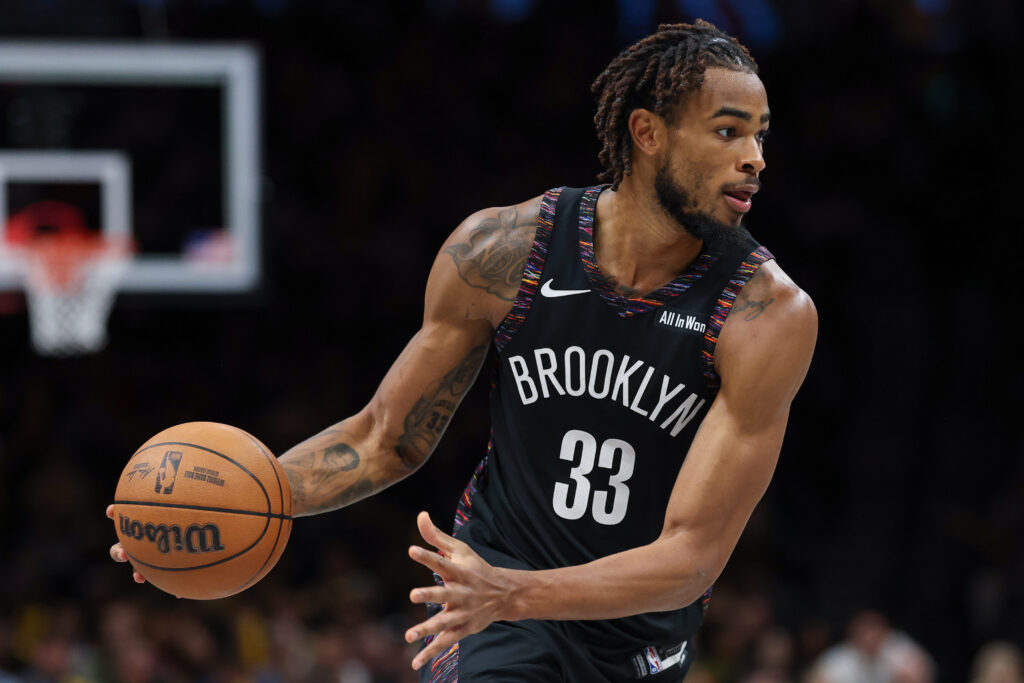
Los Angeles Lakers Receive: Nic Claxton
Brooklyn Nets Receive: Rui Hachimura, Dalton Knecht, Adou Thiero, Jaxson Hayes
If the Nets are actually willing to move Nic Claxton, this is the kind of structure that makes sense for both sides: a contender buying a long-term defensive center, and a rebuilding team turning one expensive starter into multiple bites at the apple.
The Nets are 13-36 and buried in the East standings, so the argument for converting present value into younger pieces is pretty straightforward.
On the court, Nic Claxton fits exactly what the Lakers are missing around Luka Doncic and Austin Reaves: a switch-capable five who cleans up mistakes and does not need touches to matter.
Claxton is averaging 12.2 points, 7.3 rebounds, and 4.0 assists on 57.8% from the field, which is basically ideal “low-usage, high-impact” production for a team that already has creators.
He is also on a long contract, not a rental. Claxton is making $25.4 million in 2025-26, and he is signed through 2027-28, with a structure that declines over the later years.
The Lakers’ outgoing package tells you why this would appeal to the Nets beyond just “more bodies.” Rui Hachimura is the money piece: he’s on an expiring $18.3 million deal, which gives the Nets a clean way to open over $20 million in room next season by letting it come off the books.
Hachimura is also a solid rotation forward right now, averaging 11.9 points and 3.5 rebounds on 50.1% shooting. Jaxson Hayes is another expiring contract (and functional depth), on $3.4 million while averaging 6.4 points and 3.8 rebounds.
The youth angle is Dalton Knecht and Adou Thiero. Knecht is on a cheap rookie-scale number ($4.0 million in 2025-26) and has averaged 4.6 points in a smaller role, but the selling point for the Nets would be development runway, not his current usage.
Adou Thiero is even more of a project flyer at $1.3 million, and the kind of second-round swing rebuilding teams should be collecting. There has also been some ClutchPoints reporting that Knecht has pushed for a change of scenery, but that claim is not something that has been consistently backed by top league reporters, so treat it as noise unless it gets confirmed.
As for the rumor lane on Claxton, the basic framing has been consistent: teams looking for a center have checked in, and the Nets’ leverage is that Claxton is not expiring.
HoopsHype Michael Scotto reported interest from multiple teams in that market. If the Lakers are serious about finding a long-term starter at center, Claxton is one of the few names who checks the “age, defense, contract” boxes without forcing you into a pure rental.
Landing Their Dream Target In The End
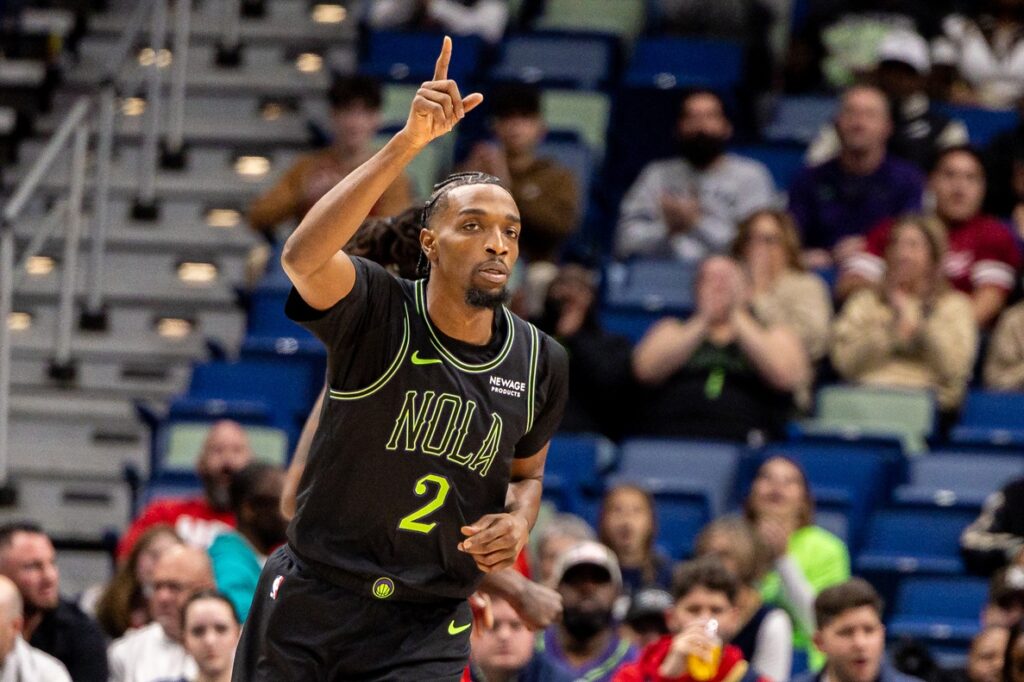
Los Angeles Lakers Receive: Herb Jones
New Orleans Pelicans Receive: Jarred Vanderbilt, Maxi Kleber, 2032 first-round pick
This is the kind of deal the Lakers only make if they’re serious about building a playoff-proof defense around Luka Doncic and Austin Reaves. Herb Jones is one of the rare wings who can guard up a position, survive quick guards, and still function offensively without needing plays called for him.
That archetype almost never hits the market, which is why the reporting around him has been so firm. In early January, Chris Haynes said the Pelicans were telling teams Jones wasn’t available.
At this point, though, the Pelicans should be open anyway. You can’t be 13-39, 14th in the West, and treat everyone like they’re untouchable. If you’re the worst team in the conference, the smart play is to sell into scarcity, especially when the player you’re selling is valuable enough to bring back a real pick plus multiple contracts you can flip later. That’s not “giving up.” That’s finally acting like the record matters.
Jones’ current production is modest, but the value is in the job description. He is averaging 9.3 points, 3.6 rebounds, and 2.5 assists this season, and he’s still a defense-first wing that teams trust in big minutes.
Contract-wise, he’s not a rental: he’s making $13.9 million this season, with future salary on the books (including $14.9 million next year, then a jump that reflects his upcoming 3-year extension). That matters for the Lakers, because they’re not just chasing “help” for two months, they’re chasing a long-term starter.
On the Pelicans’ side, Jarred Vanderbilt and Maxi Kleber are about money control and optionality. Vanderbilt is at $11.6 million this season and under contract beyond it, with a player option later in the deal. He’s also still the same type of player teams talk themselves into: physical, switchable, rebounding-forward, even if the stat line is small (Vanderbilt is at 4.9 points and 5.0 rebounds).
Maxi Kleber is the opposite: $11.0 million and expiring, basically clean cap relief, and a tradable number. His on-court role is minimal right now (1.9 points, 1.7 rebounds), but that’s not why he’s in the deal.
The real selling point for the Pelicans is the 2032 first-round pick. That’s the long-view chip: far enough out that it can hold real upside, and clean enough to be rerouted later if the Pelicans want to accelerate again. From the Lakers’ angle, it’s the price of getting the exact type of 3-and-D wing every contender wants, and almost nobody can pry loose.