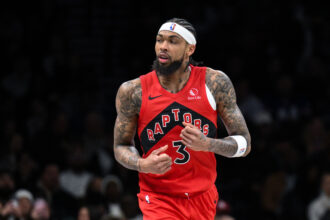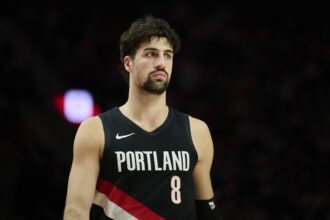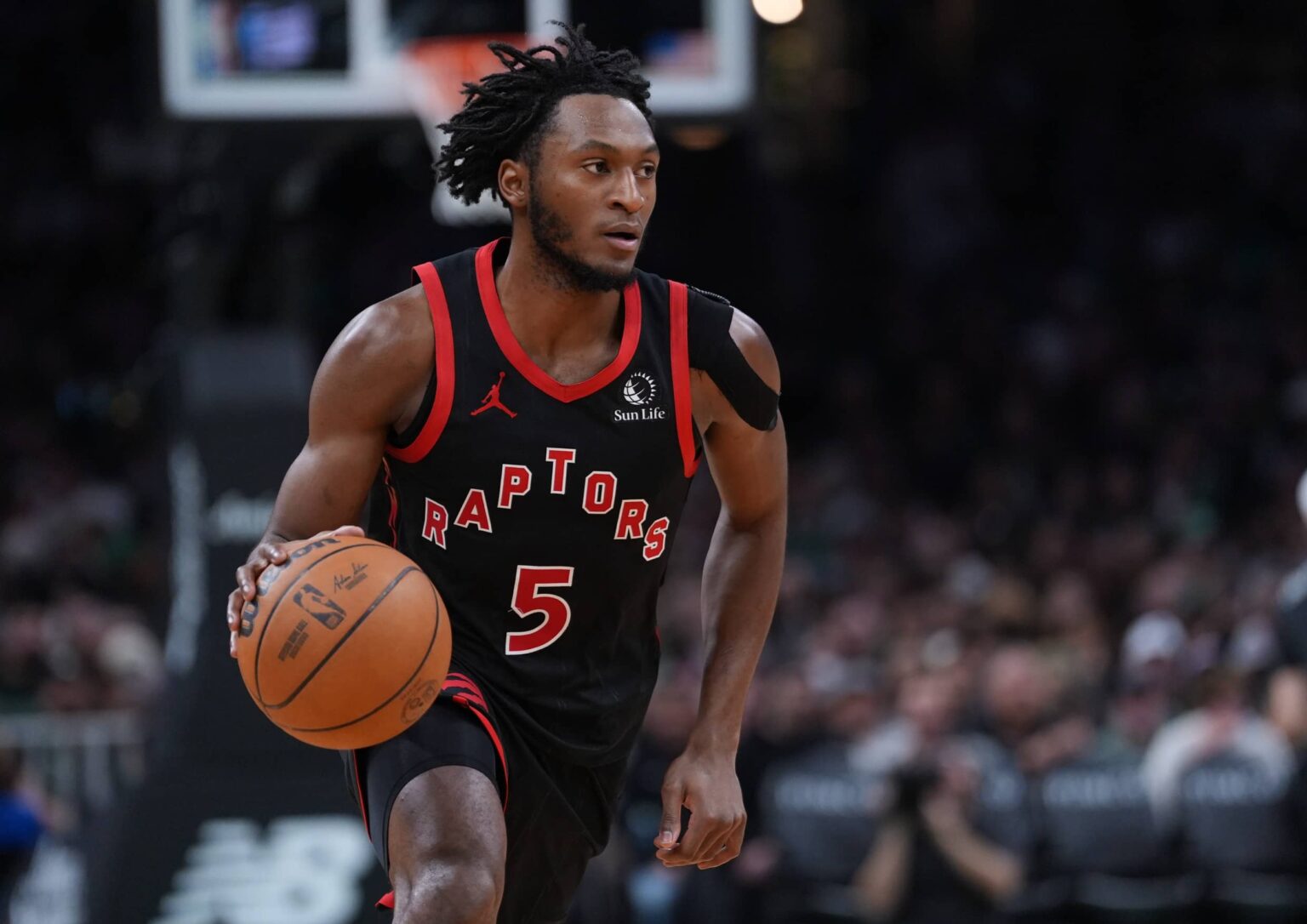
The Toronto Raptors are good, like actually good. They sit at 25-19, fourth in the East, and they’ve built a real identity on that end of the floor. But this is the part where “good” starts to feel like a trap.
The problem is the exact one that shows up every single postseason. Shot-making gets tight, pace slows, and you need one steady adult in the backcourt who can run the game, guard the other team’s best guy, and not melt when the first punch lands.
That’s why the Raptors showing deadline urgency makes sense. ESPN’s Tim Bontemps and Brian Windhorst reported the Raptors have been on the phones gauging trade value for players, including RJ Barrett and Immanuel Quickley. That is the “we like this team, but we don’t love the ceiling” signal.
So here’s the swing. Not a half-measure. Not a “maybe he helps.” A proven champion guard who raises the floor immediately and gives this group a playoff heartbeat.
The Trade
Toronto Raptors Receive: Jrue Holiday, Duop Reath, 2027 second-round pick via Hawks (Raptors hold swap rights)
Portland Trail Blazers Receive: Immanuel Quickley, Jonathan Mogbo, 2027 first-round pick (Raptors)
Jrue Holiday is set to make $32.4 million in 2025-26, while Duop Reath checks in at $2.2 million. Immanuel Quickley is at $32.5 million, and Jonathan Mogbo is at $1.9 million for the season.
So yeah, the math actually behaves for once. The Raptors would be sending out roughly $34.5 million (Immanuel Quickley + Jonathan Mogbo) and bringing back roughly $34.6 million (Jrue Holiday + Duop Reath). That’s basically a straight swap in cap terms, which is huge because it means this deal lives in the real world, not in the “cool idea, impossible numbers” fantasy land.
And since the money isn’t the obstacle, the conversation gets fun fast: what Jrue Holiday does to the Raptors on the court is the whole point of swinging big here.
Why It Makes Sense For The Raptors
This deal is a playoff play, and it’s an identity play.
Right now, Quickley gives you juice, but he also gives you nights where you’re begging for stability. He’s at 16.3 points, 4.2 rebounds, and 6.1 assists, but the shooting has been rocky, 42.4% from the field and 34.6% from three. That’s not trash, but it’s not “I trust this in a seven-game grinder” either.
Holiday gives you the exact opposite vibe. He doesn’t sprint into bad shots, he doesn’t play scared, and he doesn’t get hunted without consequences. This season, he’s at 15.1 points, 5.0 rebounds, and 7.1 assists, with 43.6% from the field and 34.9% from three. Those numbers look similar on paper, but the game impact isn’t similar at all.
Holiday makes your offense calmer without making it slower.
The Raptors already rack up 29.4 assists per game. Holiday fits that, because he loves the extra pass, and he knows when to keep it simple. He turns sets into advantages, not chaos. You don’t need him to be a 25-point scorer. You need him to keep the car on the road when the game gets weird.
And the Raptors absolutely get weird sometimes, mostly because their spacing sits in a rough place. They shoot 33.6% from three as a team. That’s the kind of number that turns “nice regular-season offense” into “brick festival” when defenses load up in May. Holiday doesn’t fix spacing alone, but he adds a veteran decision-maker who punishes bad rotations and forces defenses to guard the entire possession.
Now, the real reason you do this. Defense.
The Raptors allow 112.2 points per game, and they’ve defended like a serious team for months. Holiday turns that from serious to nasty. He still plays like a guy who expects to win every possession. He fights over screens, he tags rollers, and he communicates like a coach on the floor.
That matters because the Raptors want to be the team that drags you into discomfort. They already protect the ball well at 13.8 turnovers per game. Add Holiday and you get even more control, more “you’re not getting free points,” more “earn it.”
The other underrated part: leadership.
You can call it corny, but playoff basketball is basically a stress test. Holiday has been through it, and he’s won at the highest level. That shows up in late-game possessions where most teams start playing hot potato. The Raptors need a steady closer who doesn’t panic when the crowd gets loud and the whistle gets tight.
Now, what about the “sweeteners”?
Reath is a throw-in big who keeps your rotation from falling apart on a random Tuesday. He’s at 2.8 points and 1.0 rebounds in limited minutes, so you don’t trade for him expecting fireworks. You trade for him because big depth matters, and you can never have too many usable bodies with Jakob Poeltl’s recurrent back injuries.
And the second-rounder is a nice little bonus, because this deal already costs you a first. Getting a second back softens the pain.
Bottom line: Holiday gives the Raptors a playoff brain and a playoff backbone. If you believe this core can win two rounds, you do this yesterday.
Why It Makes Sense For The Trail Blazers
This is the part where people get confused because they only think in one direction.
“Why would the Trail Blazers move Holiday?”
Because timing matters.
The Trail Blazers sit at 22-22, and they’ve been competitive, but they also live in that awkward zone where every decision matters. If the front office decides the real goal is building the next great version of the roster, not chasing the Play-In like it’s a trophy, then flipping a veteran guard for a younger starter and a first-round pick is exactly how you do it.
Quickley is the centerpiece for them with Damian Lillard and Scoot Henderson both out this season. He’s 26, he can run an offense, and he already produces starter-level numbers: 16.3 points, 6.1 assists, 4.2 rebounds. He isn’t perfect, but he fits a modern backcourt, and he can grow with the timeline.
Also, his contract matches the reality of team-building. He makes $32.5 million right now. That’s not cheap, but it’s the going rate for a lead guard. And if the Trail Blazers believe he’s better when he gets consistent pick-and-roll reps and consistent shot diet, they’re buying a real player, not a mystery box.
Then you add the first-round pick.
That’s the real win. Picks are oxygen. A 2027 first gives the Trail Blazers flexibility to either draft, trade for a bigger star later, or package assets to move up. Every front office wants optionality. This deal gives it.
And Mogbo is the type of cheap rotation swing you take all day.
His role shrank this season, but he still gives you a toolsy forward/center archetype. In his limited minutes, he’s at 1.5 points and 1.3 rebounds, which looks tiny because the minutes are tiny. Last season, he played real minutes and put up 6.2 points, 4.9 rebounds, and 2.3 assists. That’s the profile of a useful developmental big man who can pass, defend, and survive.
For the Trail Blazers, that’s a good bet at a cheap number.
And if you want the clean cap logic, it’s simple. Holiday is at $32.4 million. Moving that contract while bringing back a similar salary plus a first is the kind of move that keeps you flexible without falling off a cliff.
One more thing.
Holiday has dealt with injuries this season and barely played 16 games out of 44 so far. If the Trail Blazers worry about availability stacking up, they might prefer cashing in now, instead of waiting until the market cools.
This is how smart teams operate. They sell the veteran at a moment where the buyer feels urgency, and they walk away with the long-term prize.
The Risk
For the Raptors, the risk is obvious.
They give up a first-round pick and a 26-year-old lead guard. That can age badly if Holiday slows down fast or if the offense loses too much shot creation. And if the Raptors don’t make noise in the playoffs, people will scream about the first like it’s a felony.
There’s also the fit question.
Holiday stabilizes everything, but he isn’t a “bailout scorer” in the way a pure bucket-getter is. If the Raptors already struggle from three at 33.6%, they still need other guys to hit shots when defenses load up. Holiday helps you get better looks, but he can’t make the shots for you.
For the Trail Blazers, the risk is different.
Quickley can run hot and cold. If you’re betting on him as a long-term lead, you’re stacking him over a guy like Henderson, who you drafted 2nd overall. Plus, you’re moving a veteran tone-setter. Sometimes a locker room needs that guy, especially for young guards.
But if you’re being real, teams don’t win big by playing scared. They win by picking a direction and going hard.
Final Thoughts
I love this for the Raptors, and I don’t even think it’s complicated.
They’re 25-19, they defend like a playoff team, and they clearly feel enough urgency to explore the market. If you’re in that spot, you don’t nickel-and-dime your way through February. You go get the proven champion guard who makes every possession cleaner and every matchup uglier.
Holiday isn’t a flashy headline. He’s the kind of addition that makes your stars better, makes your role guys calmer, and makes your defense meaner.
Quickley is a good player. But Holiday is a playoff weapon, and the Raptors need a playoff weapon more than they need another regular-season heater.
If the Raptors want to stop being “nice” and start being dangerous, this is the trade.