The Kings finished 22-60 and 14th in the Western Conference, and it is fair to call them one of the biggest disappointments of the season. This was a team that hoped its veteran core could stay competitive, but instead it missed even the Play-In picture and now enters the summer with very little clarity.
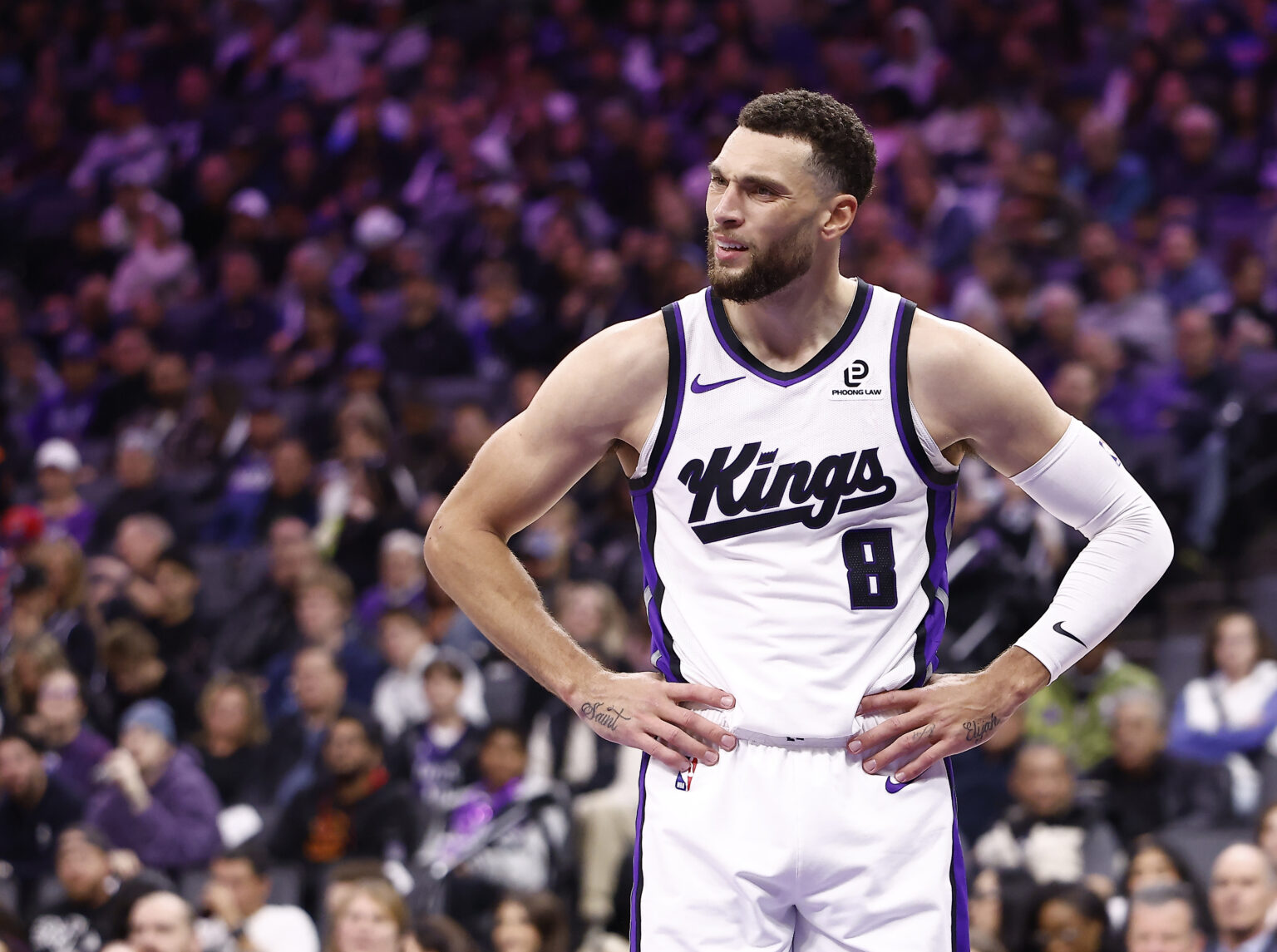
In that context, one of the biggest questions on the roster is Zach LaVine’s 2026-27 player option, which is worth $48.930 million, or basically $49.0 million. If he picks it up, the Kings will be locked into one more expensive year with a roster that does not look close to contending.
The hard truth is that LaVine did not play like a $49.0 million player this season. In 39 games, he averaged 19.2 points, 2.8 rebounds, and 2.3 assists while shooting 47.9% from the field and 39.0% from three. Those are still solid scoring numbers, but they are not enough to justify that kind of salary, especially after he underwent season-ending surgery on his right hand in February. That injury ended an already uneven season and added even more doubt around his value going into the offseason.
Still, LaVine did not fully shut the door on free agency. In his exit interview, he said:
“I will go back and look at the best course of action and ask what is most important to me right now.”
The safest bet is still that he takes the money, especially because no team is likely to offer anything close to that figure on the open market. But if LaVine decides that leaving a sinking situation matters more than one last huge payday, he would immediately become an interesting option for win-now teams in need of scoring. Here are five potential landing spots.
1. Sacramento Kings
The first landing spot is the one nobody wants to talk about because it feels too simple. But it makes real sense. If Zach LaVine declines the $48.9 million player option, the Kings could still be the cleanest solution for both sides. He would not be getting that kind of money again on the open market, still.
A path could be an opt-out followed by a new deal with the Kings at a lower yearly number. Something like two years at $60.0 million or three years at $90.0 million would cut the immediate cap hit and give LaVine more long-term security. That kind of move would only make sense if he values stability and role more than squeezing every last dollar out of one season. On paper, the Kings still need his scoring. This team was bad almost everywhere that mattered. It finished 22-60, 14th in the West, with a -9.58 net rating, 111.0 points per game, and 121.0 points allowed per game. That is not a small tweak away from contention. That is a broken team.
The asset picture is not hopeless, but it is not strong enough to scare anyone, either. The Kings still control their own 2026 first-round pick and most of their future firsts, while also holding a protected Spurs first in 2027. But there is no obvious young cornerstone on the current roster that screams future All-Star. Keegan Murray still has real value, and Devin Carter and Maxime Raynaud are interesting, but this is not a roster with a blue-chip youth wave ready to save it. That is why the draft lottery matters so much for them. The Kings entered the tiebreaker zone with the Jazz for the fourth-worst record, giving them an 11.5% chance at the No. 1 pick if they stay fourth.
That is also why keeping LaVine on a smaller contract could help. Right now, the Kings are old, expensive, and stuck in the middle of two bad ideas. They are not good enough to win now, but they also are not loaded with premium trade chips that make a fast rebuild easy. The Kings were the fourth-oldest team in the league this season, and LaVine, Domantas Sabonis, De’Andre Hunter, and Malik Monk already account for 74% of the team’s guaranteed salary next year.
2. Chicago Bulls
The Bulls were stuck in the middle again, then fell below even that. They finished 31-51 and 12th in the East, which is a bad place to be for a team that has spent years trying to stay competitive without ever looking dangerous. The Jaden Ivey gamble also ended fast, with the Bulls waiving him for conduct detrimental to the team. That leaves another opening in the guard rotation, and it makes the idea of adding a proven scorer look more logical than it did a few weeks ago.
That is why a Zach LaVine reunion is at least worth thinking about. Josh Giddey gave the Bulls real creation this season, averaging 17.0 points, 8.3 rebounds, and 9.1 assists in 54 games, while Matas Buzelis made a real jump with 16.3 points, 5.8 rebounds, and 1.5 blocks across 77 games. Put LaVine next to Giddey, keep Buzelis on the wing, and suddenly the Bulls would have a much better perimeter core than they had for most of this season. It would not fix everything, but it would raise the ceiling of the offense right away.
It also helps that LaVine’s best years came with the Bulls. In 416 games with the franchise, he averaged 24.2 points, 4.7 rebounds, and 4.3 assists, and he made two All-Star teams. That is real history, not fake nostalgia. He knows the market, the organization knows his game, and there is at least some basketball logic in bringing him back if the price is right. The key is that it cannot be anything close to the $49.0 million option number. This only makes sense if the contract drops into the under-$30.0 million-per-year range, maybe on a two- or three-year deal.
The Bulls do not have a star on LaVine’s level right now, even if he is no longer a top option on a contender. Giddey and Buzelis are real building blocks, but this team still needs more shot-making and more offensive pressure if it wants to get back into the playoff mix instead of living in lottery range. A return would be risky, and it would not be popular with everyone, but compared to what the Bulls have looked like lately, this could still be one of their cleaner bets.
3. Los Angeles Clippers
This one only works if the Clippers decide they are not fully rebuilding, even after all the changes. They already made two huge swings by trading James Harden for Darius Garland and sending Ivica Zubac to the Pacers for Bennedict Mathurin, Isaiah Jackson, two first-round picks, and a second-round pick. Norman Powell was also moved to the Heat last summer. So this is not the same veteran group anymore. It is a much more unstable roster, one that finished 42-40 and ninth in the West and now sits somewhere between trying to stay relevant and trying to reset for the future.
That is where Zach LaVine starts to make some sense. Garland gives the Clippers a younger lead guard, but Mathurin is heading into restricted free agency and is not a sure long-term answer yet. LaVine could step into the scoring role Powell used to fill, while giving Kawhi Leonard another proven perimeter shot creator next to Garland. He is not a clean replacement for Powell because he needs the ball more, but the talent upgrade could still be real if the price drops enough. On a deal below $25.0 million per season, LaVine would be a much easier bet than he is at $49.0 million.
The bigger issue is Kawhi. He is still on the books for $50.3 million in 2026-27, and that is the final guaranteed season of his current contract before free agency. That means the Clippers are walking into a year with real uncertainty. If they look bad early, the whole thing could flip fast, and they might end up trading Leonard at the deadline. Kawhi has not publicly asked out, but there’s a potential trade demand if the team is not competitive. So it is not hard to see the pressure here. If the Clippers are not competitive, the questions about Kawhi’s future will only get louder.
So LaVine is less of a long-term solution here and more of a bridge. He could help keep the Clippers dangerous enough to matter through the first half of the season, which might be all they need while they figure out whether this Garland-Kawhi version has any real ceiling. If it works, they stay in the playoff mix. If it does not, then the deadline could become the point where everything changes anyway. That is why this fit is interesting. It is not safe, but for one year, it could buy the Clippers time.
4. Washington Wizards
The Wizards are probably the strangest fit on this list, but that is also why they are interesting. They just finished 17-65, the worst record in the league, yet they also spent the last few months acting like a team that does not want to stay in a slow rebuild forever. They traded for Trae Young in January and then for Anthony Davis at the February deadline, so the front office has already made it clear that it wants bigger names around its young core instead of waiting three or four more years.
The Anthony Davis part is where this gets complicated. There is still a clear uncertainty around the long-term plan on Davis’ side. This week, during his exit interview, he joked saying, “Yeah, I’m under contract. I love my money,” when asked about next season with the team, as he wants to hear their plan to compete before making any bigger long-term commitment. That sounds like a star who is not forcing his way out today, but also not blindly sold on the future.
That is why Zach LaVine makes some sense here. He would not guarantee anything, and this still would be a weird roster, but a Young-Davis-LaVine trio at least looks serious on paper. LaVine averaged 19.2 points and shot 39.0% from three. Davis, despite another injury-hit year, still put up 20.4 points, 11.1 rebounds, 2.8 assists, and 1.7 blocks in 20 games. The Wizards also badly need more real offense after finishing 29th on offense and 29th on defense. And if they want Davis to believe this is turning into a competitive team instead of another dead-end stop, adding one more proven scorer could help.
The problem is money and logic. The Wizards no longer project to have cap space after bringing in Young and Davis, so this is not a clean free-agency move unless more salary goes out first. Still, if LaVine’s market collapses and his price drops below $25.0 million per year on a short deal, this becomes easier to picture. It would not make the Wizards a title team, but it might make them respectable enough to keep Davis engaged instead of letting the whole thing get awkward only a few months after they traded for him.
5. Detroit Pistons
The Pistons may be the cleanest basketball fit on this list. They just went 60-22 and finished as the No. 1 seed in the East, so this would finally give Zach LaVine a real winning situation instead of another messy roster project. That part matters. LaVine has played only one playoff series in his career, a four-game loss with the Bulls in 2022, so there is a real argument that this stage of his career should be about joining a serious team, not just chasing the biggest number possible again.
There is also a real roster need here. The Pistons were excellent this season, but they did not build that record with huge three-point volume. They attempted 30.9 threes per game, which was the second-lowest mark in the league, and they shot 35.6% from deep, which ranked tied for 17th. So even though they won a lot, the spacing still is not overwhelming. LaVine, even in a down year, still shot 39.0% from three. Put that kind of shooter next to Cade Cunningham, and the offense gets a different layer right away.
The key is role. LaVine probably would not arrive here as a star-level starter who gets to dominate the ball. That would miss the point. On the Pistons, he would make more sense as a lower-usage veteran scorer, someone who can juice second units, punish teams that load up on Cunningham, and close games when more shot-making is needed. He is not a strong defender, and this team already has its identity, so the Pistons should be thinking about him as a luxury scorer, not as a player to reshape the whole roster around. That is why a deal around $20.0 million per year, maybe $40.0 million over two seasons, feels much more reasonable than anything close to his current option number.
And from LaVine’s side, the appeal is obvious. He would go from one of the league’s worst teams to the top seed in the East, with less pressure, cleaner looks, and a better chance to matter in big games. The Pistons do not need him to be the old Bulls version of LaVine. They would just need him to hit shots, add spacing, and give them one more proven scorer for a playoff run. For a player who has barely tasted postseason basketball, that could be enough to make the Pistons one of the smartest bets on the board.