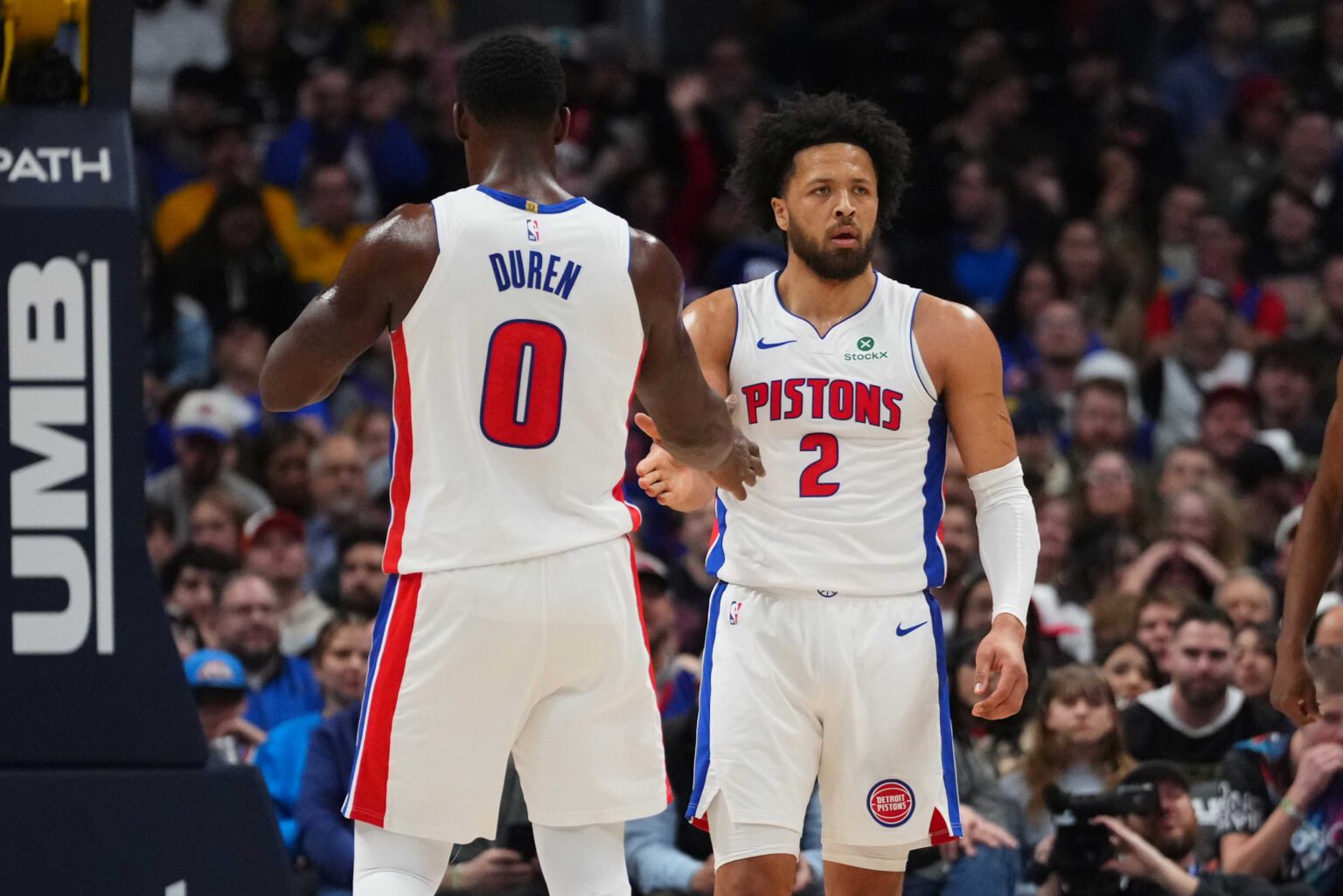
The Pistons enter the stretch run as the league’s No. 1 team. They hit the post-All-Star slate with a 42-13 record, sitting ahead of the Thunder at the top of the overall standings. That matters for this series, because the draft is not being judged through a rebuilding lens anymore. The standard is now championship-level maintenance: identifying players who can survive high-leverage minutes, or at a minimum, holding enough value to become real trade currency.
Cade Cunningham is the headline reason the Pistons are here. Cunningham has forced his way into the MVP conversation with a season that blends volume creation with control, and he just dropped 42 points, 13 assists, and eight rebounds in a statement win that kept the Pistons on top of the league. When the best player is operating at that level, the draft becomes less forgiving. A first-round miss is no longer “developmental.” It is an opportunity cost on a roster that is trying to win right now.
This is the same audit we just did with the Lakers, Warriors, Bulls, and Kings. Same categories, same framing: what the Pistons actually received in a Pistons uniform, how long it lasted, and whether the pick produced real on-court impact or real asset value.
2016 NBA Draft
Henry Ellenson – 18th Pick
Stats: 3.8 PTS, 2.2 REB, 0.5 AST, 0.0 BLK, 0.1 STL, 36.4% FG, 32.3% 3PT
Henry Ellenson was a spacing big project. The appeal was straightforward: size, touch, and the idea that he could eventually function as a bench forward who pulls a defender out of the paint and keeps lineups offensively viable. For a mid-first pick, the baseline expectation is not stardom. It is a playable rotation outcome within the rookie contract window.
That outcome never materialized with the Pistons. Ellenson played 59 total games, and the minutes never stabilized into a role the staff could trust. The efficiency did not earn him a real offensive niche, and he did not provide the defensive value a frontcourt player needs to stay on the floor when games tighten. The result was a player who remained developmental without producing a usable rotation baseline.
The ending was definitive. The Pistons placed him on waivers on February 9, 2019, closing the chapter without a meaningful on-court return from the pick.
Rating: Bust
2017 NBA Draft
Luke Kennard – 12th Pick
Stats: 9.8 PTS, 2.8 REB, 2.1 AST, 0.5 STL, 0.2 BLK, 44.1% FG, 40.2% 3PT
Luke Kennard was drafted as a clean floor-raiser: shooting, spacing, and enough feel to play on or off the ball without breaking an offense. For the Pistons, the appeal was simple. A mid-lottery guard who can shoot at volume is supposed to become a stable starter or a long-term top-six piece.
He got close, but the timeline never stabilized. Kennard’s third season was the clearest glimpse of the pick working, when he jumped to 15.8 points and 4.1 assists per game in 28 games before knee issues ended his year. Even then, it was a small sample, and the Pistons never reached the point where he became a dependable pillar you build around.
The exit tells you how the organization ultimately valued him. In November 2020, the Pistons moved him in a three-team deal that sent him to the Clippers. A mid-lottery pick becoming a trade piece is not automatically a failure, but in this exercise, the question is what the Pistons actually banked. They got a high-level shooter; they did not get a long-term core answer, and the relationship ended before the second contract ever became a Pistons problem.
Rating: Good
2018 NBA Draft
No First-Round Pick
The Pistons did not make a first-round selection in 2018 because that pick was already owed out in the Blake Griffin trade. The pick landed at No. 12, and the Clippers used it to draft Miles Bridges, then immediately traded Bridges to the Hornets as part of the Shai Gilgeous-Alexander trade.
Rating: N/A
2019 NBA Draft
Sekou Doumbouya – 15th Pick
Stats: 5.6 PTS, 2.8 REB, 0.7 AST, 0.5 STL, 0.2 BLK, 38.3% FG, 25.0% 3PT
The Pistons were betting on age, length, and physical upside with Sekou Doumbouya, accepting that the early production would be messy if the long-term outcome was a two-way forward. That can be a defensible approach at No. 15, but it requires visible development traction inside the rookie contract.
The on-court return never reached a stable rotation baseline. As a rookie, he averaged 6.4 points and 3.1 rebounds in 38 games on 39.0% from the field and 28.6% from three. In his second season, the minutes and efficiency slid again, with 5.1 points per game on 37.9% shooting and 22.6% from three. The profile stayed raw without producing a bankable skill that demanded a role.
The Pistons moved on quickly. In September 2021, he was traded to the Nets as part of a salary-driven deal, closing the Pistons chapter without a meaningful on-court payoff for a mid-first investment. For this series, that is the definition of a miss: a first-round pick who never becomes reliable in the rotation and exits before turning into real Pistons value.
Rating: Bust
2020 NBA Draft
Killian Hayes – 7th Pick
Stats: 8.1 PTS, 2.9 REB, 5.2 AST, 0.3 BLK, 1.0 STL, 38.6% FG, 27.7% 3PT
Killian Hayes was supposed to be a long-term lead-guard: size, passing, defensive activity, and the idea that the jumper would become passable enough for the rest to play. For the Pistons, that archetype mattered because they needed a primary organizer, not just another scorer.
The issue is that the offensive baseline never stabilized. Hayes’ career Pistons shooting profile stayed inefficient, and the lack of rim pressure made it hard to build functional spacing around him. The playmaking was real in short stretches, but it never converted into reliable on-court value because defenses could consistently ignore him as a scoring threat.
The ending was definitive. The Pistons waived him in February 2024, closing the book before a second contract and without meaningful asset return. That is a miss at No. 7.
Rating: Bust
Isaiah Stewart – 16th Pick
Stats: 8.8 PTS, 6.8 REB, 1.3 AST, 1.2 BLK, 0.4 STL, 51.2% FG, 34.1% 3PT
Isaiah Stewart was the opposite of a mystery pick. Stewart was physical, functional, and competitive every night, the type of big man who gives a team a floor: screens, rebounds, rim contests, and enough effort to anchor lineups that are otherwise unstable.
For the Pistons, that baseline became real value. Stewart has been a long-term rotation big with real defensive utility, and his career line shows the broader point: he has stayed playable across multiple roster iterations and has added just enough shooting credibility to avoid being a pure non-shooter.
He is not a star outcome for a first-round pick, but a mid-first turning into a durable, two-way rotation piece is a clear win. The Pistons got actual years of use, not a short flash.
Rating: Good
Saddiq Bey – 19th Pick
Stats: 14.5 PTS, 4.9 REB, 2.0 AST, 0.2 BLK, 0.9 STL, 40.0% FG, 35.7% 3PT
A straightforward wing with size, strength, and volume threes, Saddiq Bey did what the Pistons needed early in the timeline, which was to take real shots, carry real minutes, and provide spacing gravity even when the roster was not good.
The efficiency was never clean, but the value was obvious: he was a legitimate volume shooter for a young team that needed someone willing to take difficult attempts without the offense collapsing. That matters when you’re evaluating what the Pistons actually received, not what the pick “should” have been.
The Pistons cashed him out in February 2023 in the multi-team deal that sent him to the Hawks. That trade timing is part of the grade: he produced real minutes and held enough league value to be moved in a deadline transaction.
Rating: Good
2021 NBA Draft
Cade Cunningham – 1st Pick
Stats: 22.7 PTS, 5.4 REB, 7.8 AST, 0.6 BLK, 1.1 STL, 44.9% FG, 33.8% 3PT
Cade Cunningham is the franchise-altering hit. Cunningham gave the Pistons a true primary: size at the point of attack, manipulation as a passer, and the ability to create quality shots late in possessions without the offense devolving into chaos.
The production is not theoretical anymore. Cunningham’s Pistons career line is already elite for a lead guard, and in 2025-26, he has pushed into the MVP tier by carrying both volume and control on a team sitting at the top of the league.
This is the highest outcome for a No. 1 pick in this format: a player who changes the franchise’s ceiling in his own uniform, on a winning timeline, with skills that translate to playoff basketball.
Rating: Great
2022 NBA Draft
Jaden Ivey – 5th Pick
Stats: 14.9 PTS, 3.5 REB, 4.0 AST, 0.2 BLK, 0.8 STL, 44.1% FG, 34.3% 3PT
Jaden Ivey was drafted as a speed-and-pressure guard who could bend defenses. Ivey showed enough as a Pistons player to look like a long-term backcourt piece next to Cade Cunningham: downhill burst, transition value, and improving shot confidence.
The problem in this evaluation is that the Pistons never reached the stable “this is our guard for the next five years” phase with him. Injuries interrupted the development curve, and then the timeline changed. Ivey is now with the Bulls after a recent acquisition from the Pistons, which closes the chapter before the pick could fully mature into either a core outcome or a long-term asset hold.
That does not automatically mean the selection was a failure, but it does mean the Pistons did not get the full intended return in their own uniform. The pick produced a real NBA player, but the story ends early.
Rating: Good
Jalen Duren – 13th Pick
Stats: 12.6 PTS, 10.3 REB, 2.0 AST, 1.1 BLK, 0.7 STL, 64.8% FG, 0.0% 3PT
Jalen Duren was acquired as a draft-night investment in a traditional advantage: size, rebounding, rim finishing, and physicality that show up every game. Duren’s value is not subtle. He is a possession player who can swing the math with boards and paint touches.
The Pistons got a real starting center trajectory quickly. Duren’s career line is already double-double caliber, and the efficiency at the rim is exactly what you want from a young big who doesn’t need plays called for him to score.
The key context is that he was not just “picked.” The Pistons traded into the slot on draft night to get him, which makes the evaluation even cleaner: they paid to target him, and he became a foundational piece of the current roster.
Rating: Good
2023 NBA Draft
Ausar Thompson – 5th Pick
Stats: 9.8 PTS, 5.8 REB, 2.2 AST, 0.8 BLK, 1.0 STL, 49.0% FG, 23.0% 3PT
Ausar Thompson was seen as a two-way wing solution, not a long-term project. The Pistons took him because the defensive tools were supposed to translate immediately: point-of-attack pressure, event creation, and the ability to guard up a position without being physically overwhelmed. The offense was always the swing, but the baseline pitch was simple. If he defends at a high level, he plays.
That baseline has held. Thompson has carved out real minutes on a team with championship-level expectations, and the defensive impact has shown up in ways that matter for a contender, not just a rebuilding roster. The Pistons are 36-13 with him in the lineup this season, which is the cleanest “on-court value” signal you can ask for without getting into film. He is not a scorer, and the shooting is still a problem, but he influences possessions.
The risk is also clear. The three-point number forces the Pistons into spacing compromises, and that becomes a bigger problem in playoff environments where teams are willing to ignore non-shooters and load up on Cunningham. If the shot stays broken, Thompson has to be elite on defense to justify closing minutes. If the shot becomes even league-average, the pick becomes one of the best role-building outcomes in this era of Pistons basketball.
Rating: Good
2024 NBA Draft
Ron Holland II – 5th Pick
Stats: 7.1 PTS, 3.3 REB, 1.2 AST, 0.3 BLK, 0.9 STL, 44.6% FG, 23.4% 3PT
Ron Holland II was drafted as an energy forward who could live in the margins: transition, cutting, offensive rebounds, and defensive activity. The Pistons did not need another high-usage scorer. They needed a young wing-forward who could survive next to Cunningham and eventually win minutes through effort and physicality.
The early return is mixed, but not empty. Holland has played real games; the minutes have increased in his second season, and the production has moved with it. He is at 8.1 points and 4.3 rebounds in 20.7 minutes this season, which at least shows he can function in a rotation role. The efficiency and the shot are the issue. A 23.0% career three-point mark is a spacing problem for a wing-forward, and it limits the lineups where he fits cleanly.
This is still a development pick in practice, even if the draft slot was top-five. If the jumper never becomes credible, Holland’s ceiling is capped as a regular-season energy piece. If it improves, the physical profile makes sense as a long-term rotation forward on a good team.
Rating: Too Early
2025 NBA Draft
No First-Round Pick
The Pistons did not make a first-round selection in 2025. Their first pick in that draft was No. 37, where they selected Chaz Lanier, which is a second-round outcome and outside the first-round grading for this series.
Rating: N/A
Final Thoughts
The Pistons’ last 10 years of first-round picks split cleanly into two eras: the misses that extended the wilderness, and the hits that built the current league-best standard. The early part of the timeline is the warning sign. Henry Ellenson did not become an NBA rotation piece. Sekou Doumbouya did not develop into a dependable wing. Killian Hayes was a top-10 bet that never found an offensive baseline. Those are not “bad luck” outcomes. They are first-round investments that produced minimal Pistons value relative to the slot and runway.
The second era is why the Pistons are where they are now. Cade Cunningham is the one true “great” in this span, the franchise-altering outcome that resets the organization’s ceiling. That is the entire point of the No. 1 pick, and the Pistons got it. Around him, the Pistons hit repeatedly in the “good” range. Luke Kennard gave real shooting value before being moved. Saddiq Bey produced real minutes and real usage as a young wing, then held enough value to be moved in a meaningful deal. Isaiah Stewart became a durable rotation big with defensive utility. Jaden Duren became a foundational starting center, the type of pick that stabilizes a roster even when the offense runs elsewhere.
The more recent first-round decisions look like clear maintenance moves for a team trying to win. Ausar Thompson has already justified his slot through defense, physicality, and lineup impact, even with the shooting still limiting his ceiling. That is a “good” outcome because the player is already part of winning basketball. Jaden Ivey is the complicated one. The pick produced an NBA-level guard with real downhill pressure, but the Pistons did not keep the full arc long enough for it to become a settled Pistons outcome. In this framework, it still grades as “good” because the player was real and the asset held value, even if the chapter ended early.