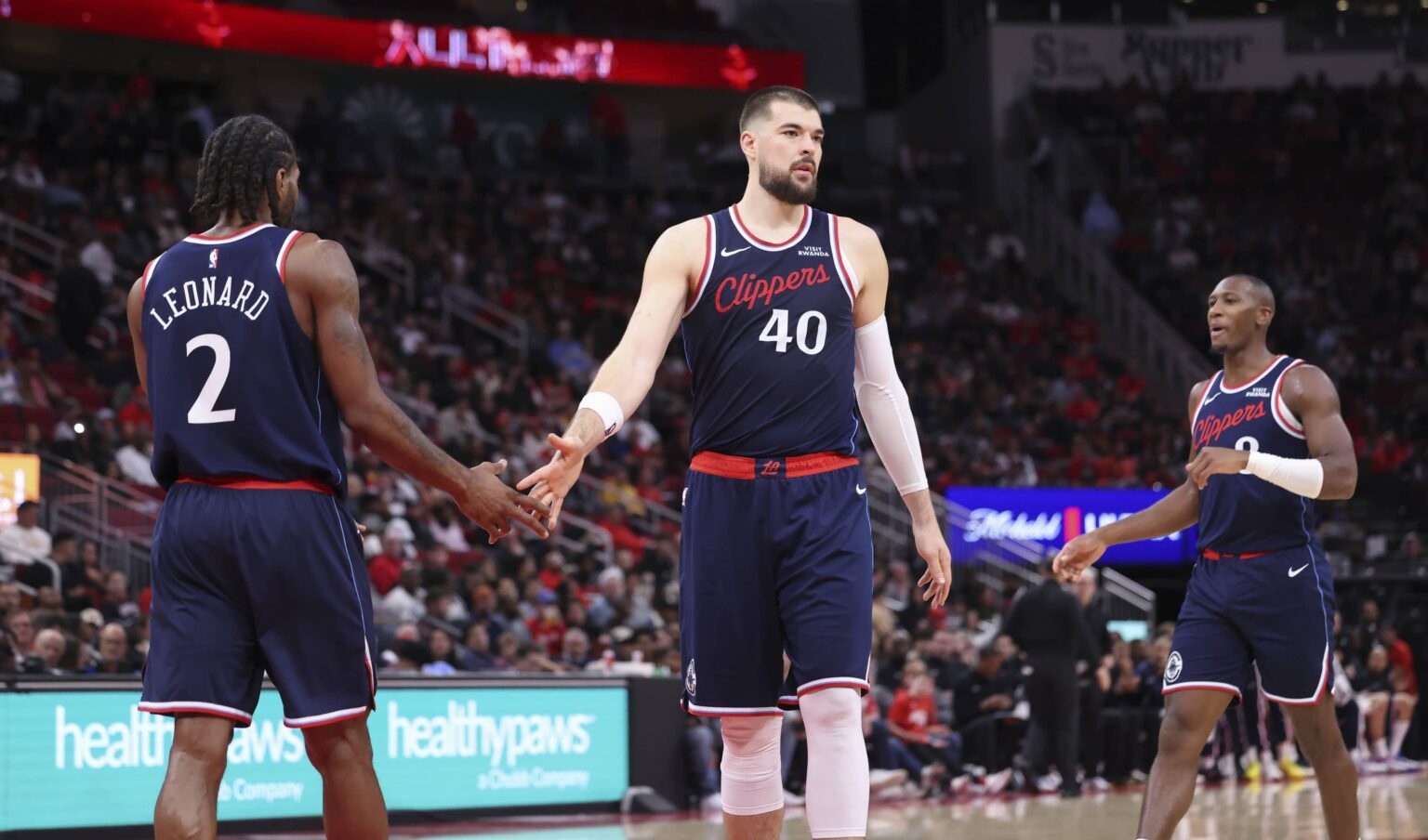
Ivica Zubac learned one of the NBA’s harshest lessons the hard way, and it had nothing to do with pick-and-roll coverage or guarding elite scorers. It came the moment he opened his bank app and realized his first big paycheck had been sliced nearly in half.
Speaking candidly on X&O’s CHAT podcast about his early NBA days, Ivica Zubac recalled the shock of requesting a $250,000 advance on his rookie contract and seeing just $105,000 hit his account.
(Translated from Croatian)
“At first, when you come to the NBA, you think you’re rich overnight. But you’re actually not. Then you see how it really works. Half of what you see is gone, especially in California. That first summer I signed, I was coming to LA. I had a little money left from Mega, some cash, but not enough.”
“Now you have to find an apartment. Teams don’t pay rent here, in Europe they do. You have to buy a car. The team doesn’t give you one. Every apartment you rent is unfurnished. You have to buy everything. I had no money, so I called my US agent asking what I should do. He said we could request an advance on my contract. That’s what they usually do with rookies.”
“So we asked for some money. I requested $250,000. He put in the request, and a few days later he called. He told me, “The money should have been deposited. Check your account.”’I log in and it says 105. I’m like, how 105? We said 250. I call him. Where’s the money? He goes, ‘Welcome to California.'”
“He said those are taxes. He got the full report. It listed all the special taxes I had. Federal, state, even special taxes. Health care, pension, everything. All that. From 250 to 105. That was the first shock.”
“Then you’re in the NBA and suddenly you’ve got a million relatives. Everyone’s got their own ideas. Everyone thinks you’re rich overnight, but on a rookie deal, you live paycheck to paycheck.”
“You’ve got so many expenses. My rookie contract was $1 million the first year. Cut that in half with expenses. And California costs are huge. The standard is high. There’s nothing left. You still have to pay your agent. You’re basically in the red.”
The irony is that Zubac had already experienced financial instability before reaching the NBA. As a teenager in Europe, he dealt with delayed payments and club financial problems, once being told to send back money he had just received so he could complete a transfer. He thought the NBA would mean security.
Instead, it delivered a different kind of lesson. Money comes fast, but it leaves just as fast if you are not prepared.
When Zubac first entered the league with the Los Angeles Lakers, he was hit by several layers of taxation at once. Federal income tax for top earners sits at 37%. California adds a state income tax that climbs as high as 13.3 percent, the highest in the United States. On top of that, NBA players are subject to ‘jock taxes,’ meaning they pay state and local taxes in every city they play road games.
There are also mandatory deductions for league escrow, pension contributions, and health care. Before an agent ever takes a cut, an NBA player in California typically brings home only about 45 to 55% of his gross salary.
Now fast forward to the present. Zubac is no longer a rookie trying to survive in Los Angeles. He is an established center entering the prime of his career with the Indiana Pacers, and the difference in take-home pay is massive purely because of geography.
Indiana’s tax structure is far more favorable. The state has a flat income tax of roughly 3%, and local taxes in Indianapolis add around 2%. Combined with federal tax and jock taxes, NBA players in Indiana typically take home about 50 to 60% of their salary before agent fees. That five to ten percent swing may not sound huge, but over multi-year contracts, it translates into millions of dollars.
Zubac is set to earn $18.9 million this season, $20.3 million next season, and $21.7 million the year after. If he were still playing in California, using a conservative estimate of a 50% take-home before agent fees, his net income would look roughly like this. From $18.9 million, he would take home about $9.45 million. From $20.3 million, around $10.15 million. From $21.7 million, roughly $10.85 million.
In Indiana, assuming a slightly better 55% take-home before agent fees, the numbers jump. From $18.9 million, Zubac would keep about $10.4 million. From $20.3 million, roughly $11.2 million. From $21.7 million, close to $11.9 million.
That difference adds up fast. Over just these three seasons, Zubac stands to take home roughly $3 million to $4 million more by playing in Indiana instead of California, even before accounting for the lower cost of living.
Still, that first paycheck remains unforgettable.
From $250,000 to $105,000 in a few clicks. For Zubac, it was the moment the NBA stopped being a dream and started being real.