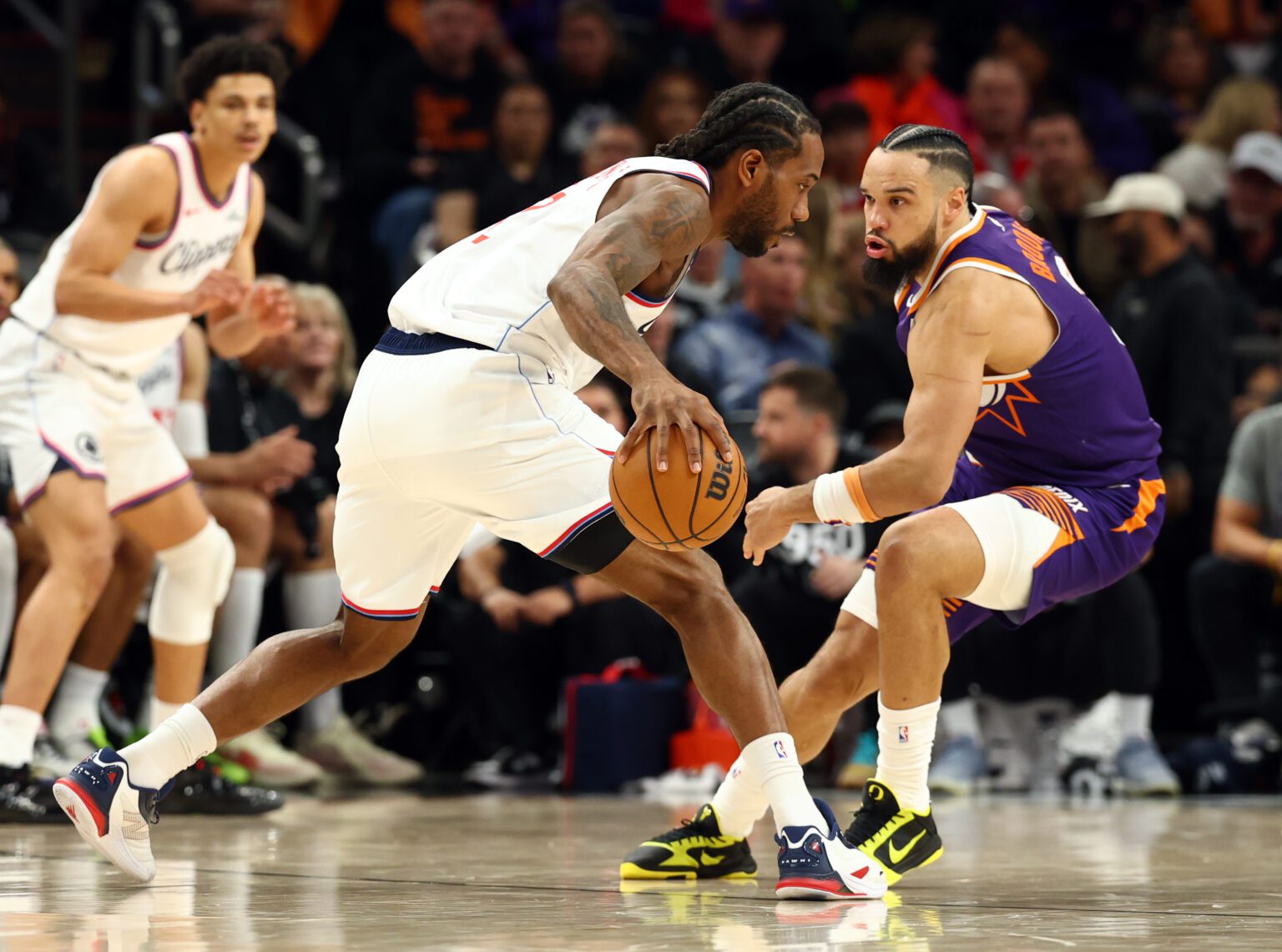
The Clippers overwhelmed the Suns in every area that usually decides games: size, efficiency, and physicality. From the opening quarter on, Los Angeles controlled the paint, owned the glass, and never let Phoenix’s perimeter shooting fully flip the script.
By the time it was over, the Clippers had cruised to a 117-93 victory that pushed them closer to the .500 mark and sent a clear message about the identity they’re leaning into.
This wasn’t a hot-shooting fluke. It was a methodical dismantling built on interior dominance and balanced scoring. Even with a few sloppy stretches offensively, the Clippers’ control of the boards and shot quality made sure the Suns never truly threatened after the first half.
1. The Paint Belonged Entirely to the Clippers
Los Angeles pounded Phoenix inside all night, outscoring them 64-18 in the paint – a staggering difference that shaped the entire game. Ivica Zubac was the anchor, finishing with 14 points on a perfect 5-of-5 shooting night while pulling down 20 rebounds, including 3 offensive boards. Phoenix simply didn’t have the size or strength to keep him from carving out deep position.
It wasn’t just Zubac. John Collins added 16 points and 9 rebounds, Kawhi Leonard attacked mismatches on his way to 25 points, and the Clippers as a team shot 51.8% from the field (43-of-83). When a team scores that efficiently inside, it forces the defense to collapse, and that opened up rhythm shots everywhere else.
2. Rebounding Gap Was Game-Ending
The rebounding stats looked like a bomb was dropped on the Clippers’ 63, Suns’ 35. That’s an astonishing +28 rebounding margin and the differential resulted in controlling the tempo and volume of shots. Los Angeles snatched 15 offensive boards, which translated to numerous second-chance opportunities. This eventually prolonged the time Phoenix had to spend on defense.
Zubac’s 20 boards were the most, and Nicolas Batum added 8, Collins 9, and even guards like Kris Dunn had 5. On the contrary, Phoenix was unable to finish defensive possessions and the Clippers were allowed to reset and attack again. It’s tough to win when you’re giving up almost two possessions for every one you take.
3. Kawhi Set the Tone Early
Calm and steady wins the race. Kawhi Leonard, the embodiment of a calm storm, scored 25 points and contributed with 8 rebounds and 5 assists in 30 minutes of play. He shot 9-20 and made 6 of 10 free throws. When the smaller defenders from the Suns tried to push him, he’d back them down and facilitate when help came.
Leonard’s impact was felt in other areas. He was more of a scoring presence and he guided the team when the Clippers were unorganized, and loose with the ball, finishing the game with 17 turnovers. He made key baskets that Phoenix was unable to convert in key moments. Whenever the Suns were about to score, Kawhi made buckets that silenced their momentum and responded with a smart pass.
4. Bench Unit Blew It Open
The bench unit of the Clippers not only kept the lead, but they also expanded it. Jordan Miller continued to shine, scoring 20 points (7-of-12) with 3-of-4 from 3 in 24 minutes and finishing with a solid +18. Bogdan Bogdanovic contributed with 6 points and a game-best +25 in 14 minutes. Brook Lopez also helped out with 8 points and a block.
That group helped the Clippers maintain offensive flow even with the starters being able to take a breather. The Los Angeles Clippers had a total of 25 assists and the ball movement from the second unit made the Phoenix Suns defend with quick rotations and adjustments. On the other hand, the Suns’ bench was unable to provide consistent offensive pressure, which gave the Clippers the allowed margin to stretch the score to a blowout.
5. Suns Lived From Three And Died By Everything Else
The Phoenix Suns had a solid offensive performance and shot 41.3% from three (19-of-46) which was the only area where they had success offensively. As a team, they shot 33.3% overall (31-of-93) and only 18 points in the paint. The Suns missed out on rebounds, there were not a lot of free throws, and the Clippers defense was not attacked.
The Suns lost the game because they had a lack of depth offensively even with productive games from Grayson Allen (23 points) and Dillon Brooks (22 points). They were out-assisting Los Angeles 25-21, out-rebounded by almost 30 and allowed the Clippers to hold the lead for 83% of the game. When the jump shots were not falling, there was no other offensive gameplan and the Suns lost the game.