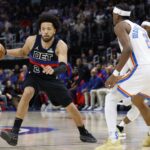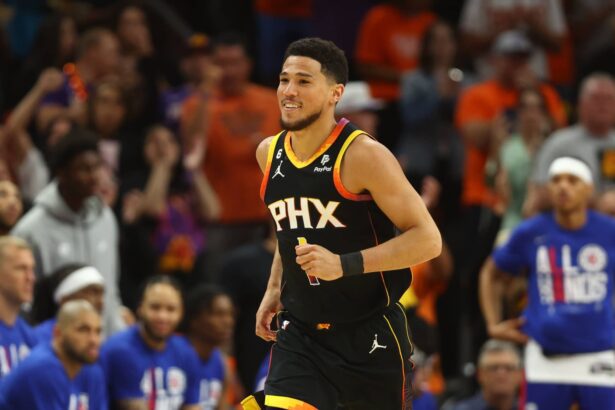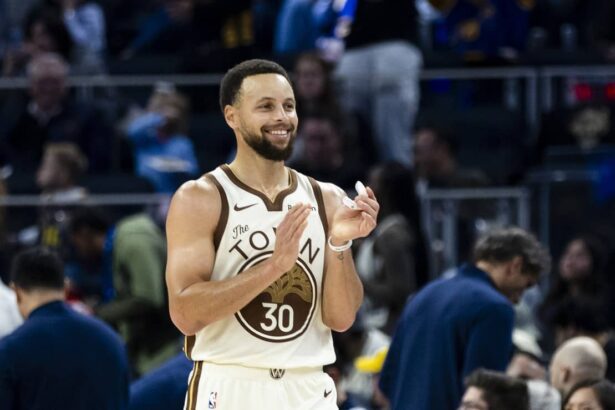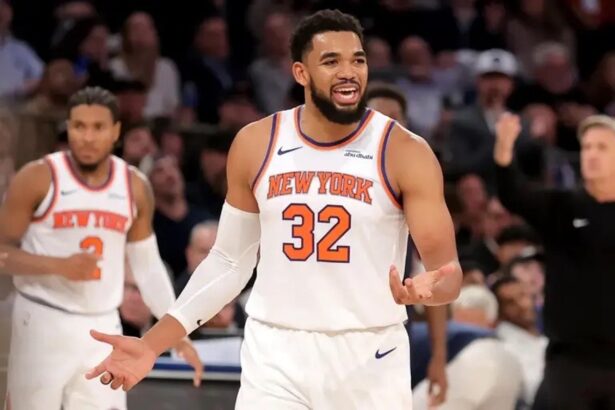
For years, the narrative around Luka Doncic has been simple. An elite offensive engine but a major defensive liability. That label, however, might be increasingly outdated.
The 2025–26 season has quietly produced a different statistical profile. Luka currently holds a 115.3 defensive rating. The Los Angeles Lakers struggled defensively as a unit, hovering near 116.6. Context matters. Team defense shapes individual ratings. Yet Luka’s advanced metrics show consistent activity and involvement across multiple impact categories.
The comparisons are revealing.
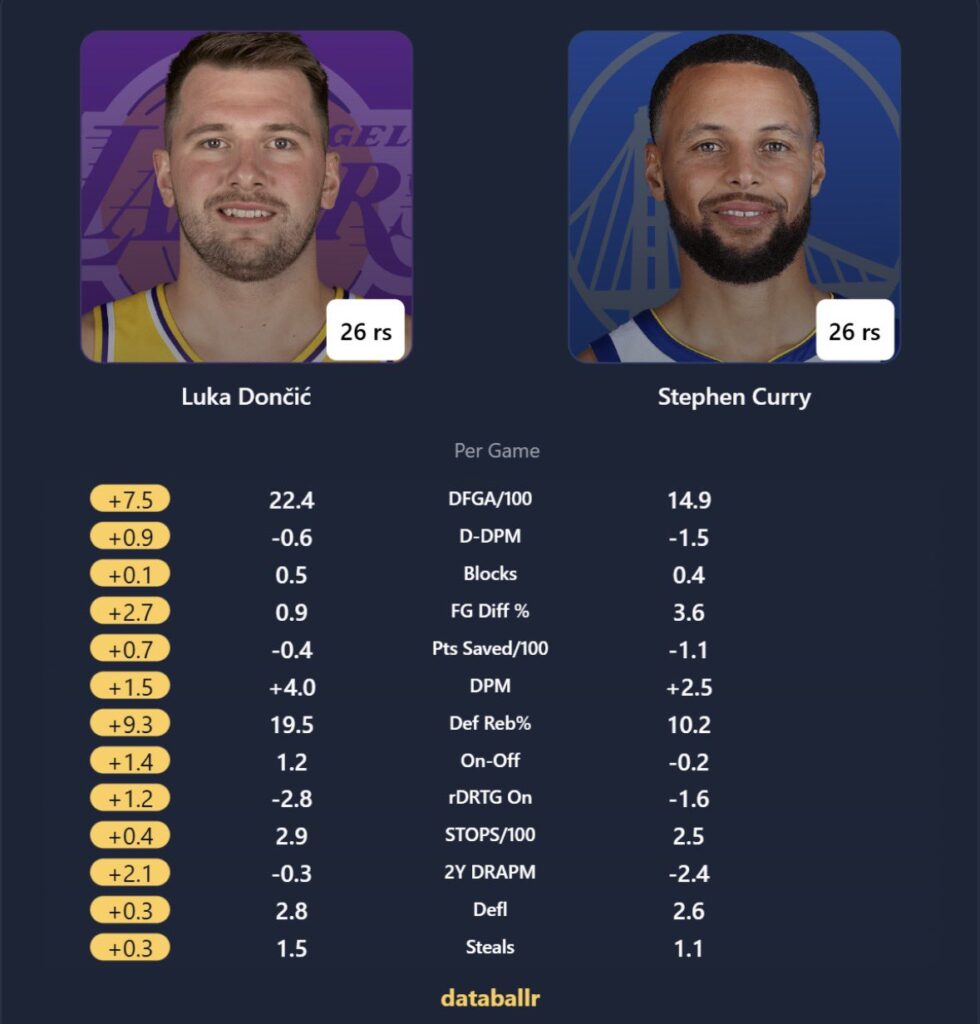
When comparing Luka Doncic and Stephen Curry defensively, the gap begins with sheer involvement. Luka contests far more shots per 100 possessions at 22.4 compared to Curry’s 14.9, a difference of 7.5 attempts. That is not marginal usage but a major structural role difference. Luka is absorbing primary defensive actions far more frequently, while Curry often functions within a team scheme that protects him from high volume on ball assignments. The impact models reflect separation as well.
Luka’s Defensive Estimated Plus Minus sits at -0.6 compared to Curry’s -1.5, showing Luka grades significantly closer to neutral. On the glass, the difference becomes massive. Luka’s defensive rebound percentage is 19.5 versus Curry’s 10.2, nearly double, meaning Luka is ending possessions at a much higher rate.
Luka also produces more stops per 100 possessions at 2.9 compared to 2.5, and holds a slight edge in blocks at 0.5 versus 0.4. When total impact is measured, Luka’s overall DPM stands at+4.0 while Curry’s sits at +2.5. Even if Curry remains a strong team defender in structure, Luka’s contest volume, rebounding dominance, and possession-ending activity create a broader statistical footprint.
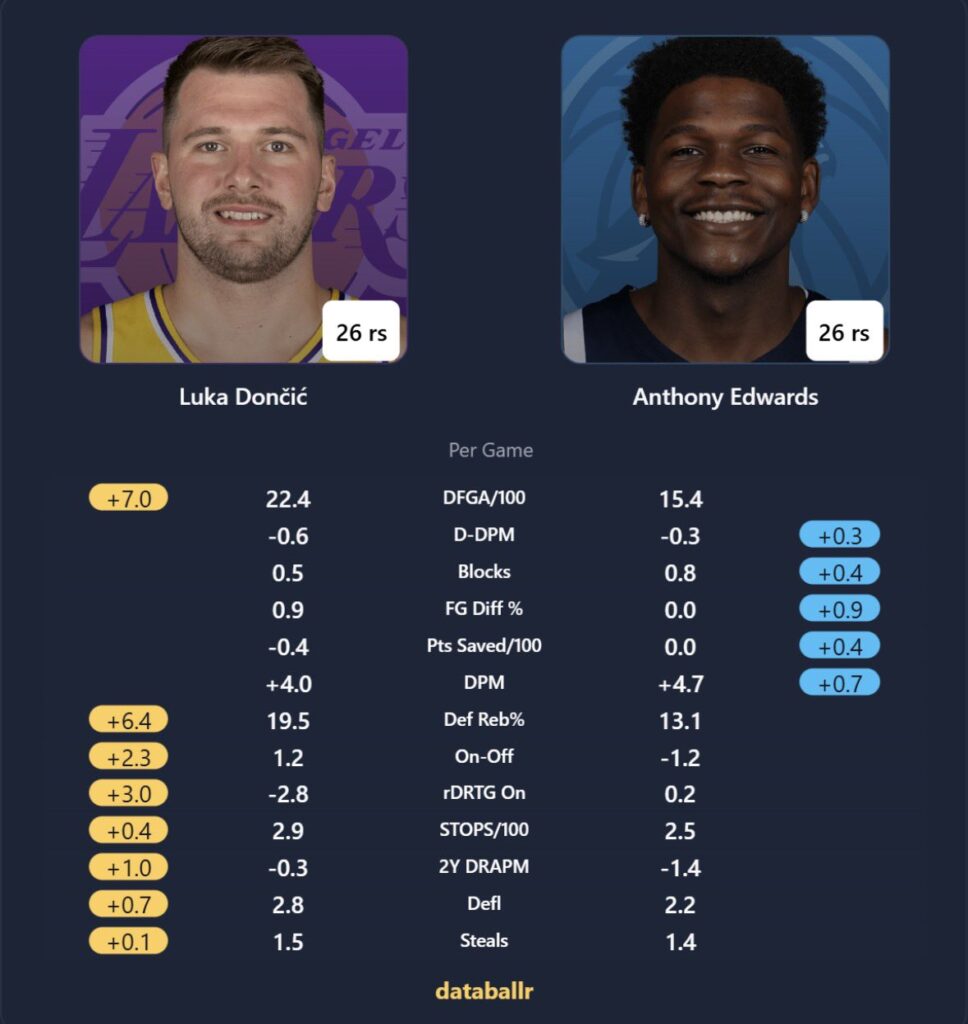
The Anthony Edwards comparison is the closest statistically. Luka contests 22.4 field goal attempts per 100 possessions compared to Edwards’ 15.4, maintaining a strong involvement edge. Luka also dominates the glass with a defensive rebound percentage of 19.5 compared to Edwards’ 13.1. Stops per 100 possessions slightly favor Luka at 2.9 versus 2.5, and deflections lean Luka at 2.8 compared to 2.2. Steals are nearly identical, with Luka at 1.5 and Edwards at 1.4.
Where Edwards gains ground is in impact grading and efficiency suppression. Edwards posts a stronger Defensive Estimated Plus Minus at -0.3 compared to Luka’s -0.6 and holds a slightly higher overall DPM at +4.7 versus +4.0. Field goal differential percentage and points saved per 100 also tilt toward Edwards, indicating slightly stronger pure containment metrics.
Even so, Luka’s superiority in contest volume, rebounding dominance, and possession ending activity gives him a compelling statistical case built on defensive event accumulation rather than isolated efficiency control.
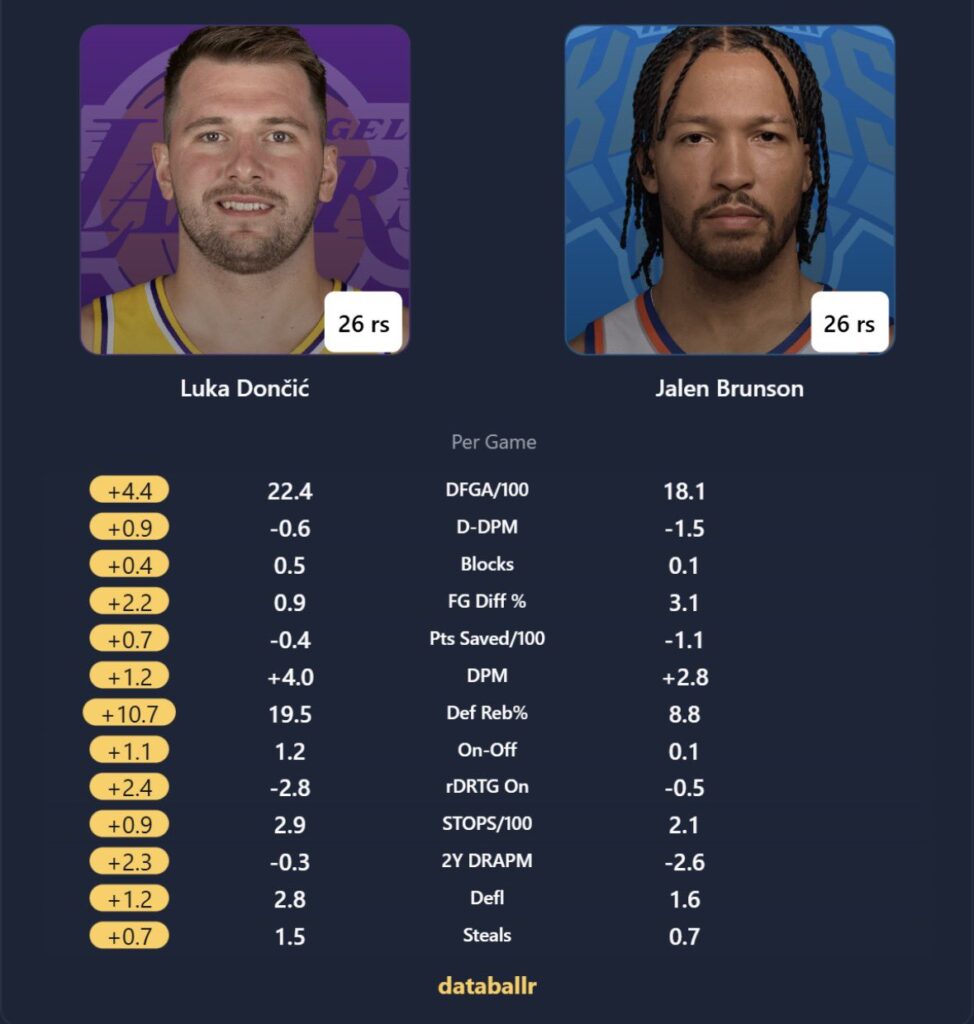
Against Jalen Brunson, the separation expands across nearly every measurable category. Luka contests 22.4 field goal attempts per 100 possessions compared to Brunson’s 18.1, indicating higher defensive involvement.
The Defensive Estimated Plus Minus again favors Luka at -0.6 versus Brunson’s -1.5, suggesting Brunson grades as a more significant negative in defensive impact models. The size difference shows up dramatically in rim protection and rebounding. Luka averages 0.5 blocks compared to Brunson’s 0.1, providing at least some vertical deterrence.
The defensive rebound percentage gap is enormous, with Luka at 19.5 and Brunson at 8.8, meaning Luka rebounds like a forward while Brunson rebounds like a small guard. Luka also produces more stops per 100 possessions at 2.9 compared to Brunson’s 2.1 and nearly doubles him in steals at 1.5 versus 0.7.
Overall, DPM further supports Luka’s superiority, with Luka at +4.0 and Brunson at +2.8. Across contest volume, rebounding control, disruption, and impact models, Luka’s defensive statistical profile is clearly stronger.
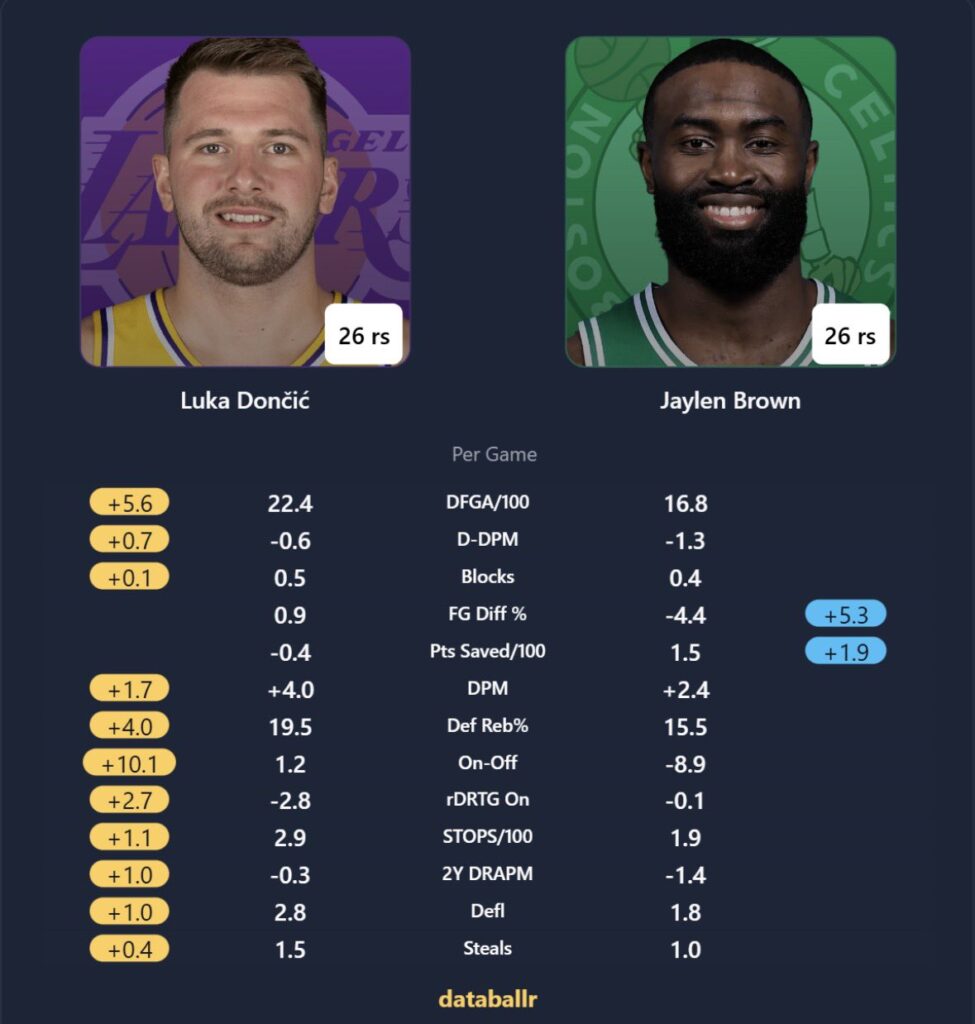
The Luka Doncic versus Jaylen Brown comparison is more nuanced because Brown carries a strong defensive reputation. Yet the volume metrics reveal interesting contrasts. Luka contests 22.4 field goal attempts per 100 possessions compared to Brown’s 16.8, indicating greater direct involvement. Defensive Estimated Plus Minus again favors Luka at -0.6 versus Brown’s -1.3.
On the glass, Luka leads with a defensive rebound percentage of 19.5 compared to Brown’s 15.5, though Brown remains solid in that category. The most notable separation appears in stops per 100 possessions, where Luka posts 2.9 compared to Brown’s 1.9, and in deflections, where Luka averages 2.8 compared to Brown’s 1.8.
Brown’s advantage emerges in efficiency suppression metrics such as field goal differential percentage and points saved per 100, where he grades stronger in pure matchup containment. Even so, when focusing on activity level, possession ending plays, and total involvement, Luka’s defensive footprint appears broader in raw event creation.
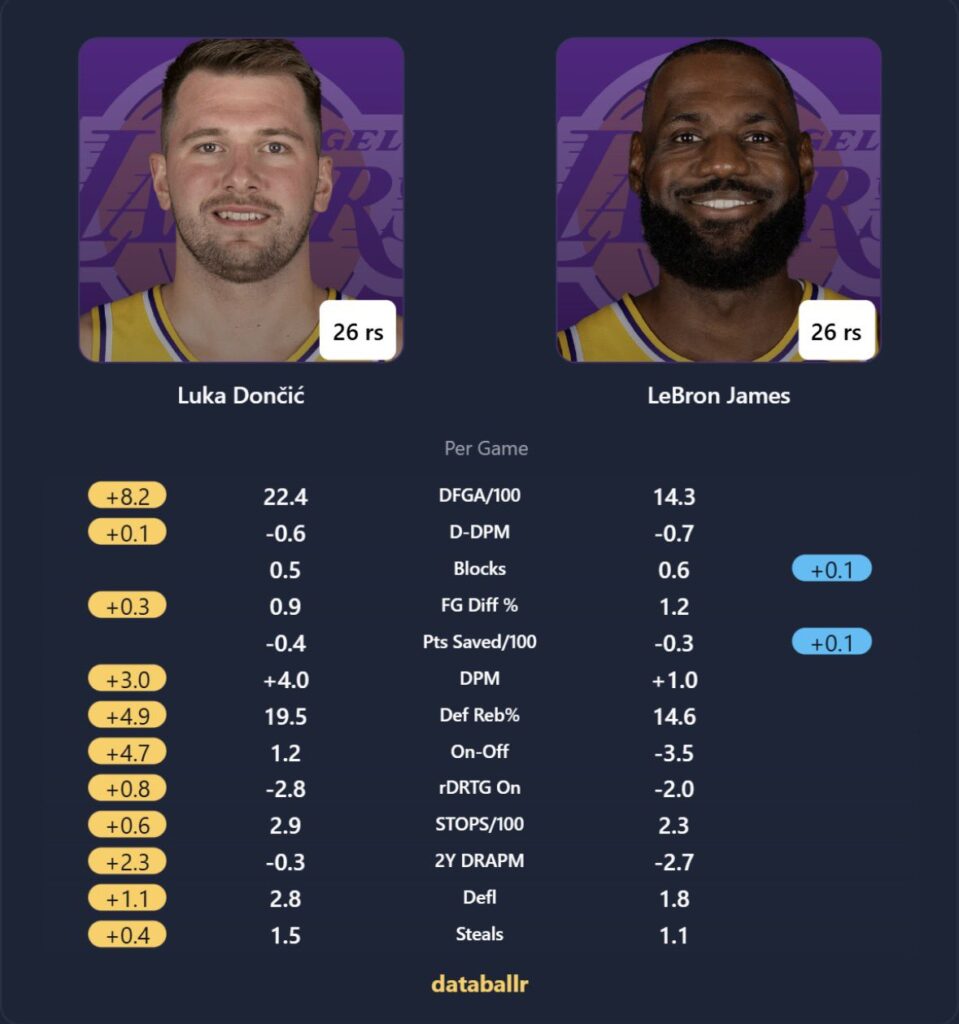
When placed next to LeBron James at this stage of their careers, Luka’s statistical involvement once again stands out. Luka contests 22.4 field goal attempts per 100 possessions compared to LeBron’s 14.3, reflecting a major difference in engagement. Their Defensive Estimated Plus Minus figures are nearly identical, with Luka at -0.6 and LeBron at -0.7, showing neither grades as elite, but Luka slightly edges him.
On defensive rebounding, Luka holds a clear advantage at 19.5% compared to LeBron’s 14.6%. Luka also generates more stops per 100 possessions at 2.9 versus 2.3 and produces more deflections at 2.8 compared to 1.8. The overall DPM gap is substantial, with Luka at +4.0 and LeBron at +1.0, reflecting a larger two-way impact footprint.
While LeBron’s historical defensive peak remains unquestioned, the present data suggests Luka’s current defensive volume metrics exceed his across most measurable areas.
Critics often cite team defensive struggles when Luka is on the floor. The Lakers allow 14.0 points off turnovers, 12.0 fast break points, 10.3 second chance points, and 38.0 paint points with Luka logging heavy minutes. Yet he also leads the team in playing time. Those numbers reflect lineup combinations and overall roster construction as much as individual defense. LeBron ranks close behind in those same categories, and Austin Reaves follows. The defensive shortcomings are systemic, not isolated to Luka.
What stands out in the advanced data is Luka’s activity. He contests more shots than most guards, rebounds at an elite rate for his position, and produces stops and deflections at high frequency. Defensive plus minus models no longer show him as a severe negative. Instead, they paint a picture of a player who may lack lateral burst but compensates with anticipation, positioning, and strength.
No one is saying Luka cannot be better defensively. He absolutely can. He can move more quickly laterally, make smarter decisions when gambling for steals, cut down on unnecessary reach-in, and improve transition effort. There are clear areas where a more consistent motor would elevate him to another tier. The ceiling is higher than what we currently see.
And to be clear, no one is definitively calling him a better defender than Jaylen Brown or Anthony Edwards. The advanced numbers may show advantages in certain volume and possession ending metrics, but Brown and Edwards are widely viewed as more complete perimeter stoppers. They move better laterally and guard tougher assignments consistently. Film still matters.
However, the numbers do strongly suggest he has been better defensively than Stephen Curry and Jalen Brunson this season. Those two rarely receive heavy defensive criticism despite grading out similarly or worse in several impact metrics. Luka, meanwhile, carries the defensive liability label almost by default.
Context also amplifies everything.
He is now in Los Angeles with the Lakers and positioned as the new face of the league. Luka leads the NBA in jersey sales and was the most voted player during All-Star voting. The spotlight is enormous.
On top of that, his constant dialogue with referees and visible frustration during games turn some fans off. The complaining narrative feeds into the defensive narrative. When effort is questioned emotionally, it bleeds into how people interpret the numbers.
So yes, Luka can improve. Yes, he has defensive limitations. But the data does not support the extreme version of the criticism. He is not an elite defender or a lockdown wing. Yet statistically, he is far from the defensive disaster many portray him to be.