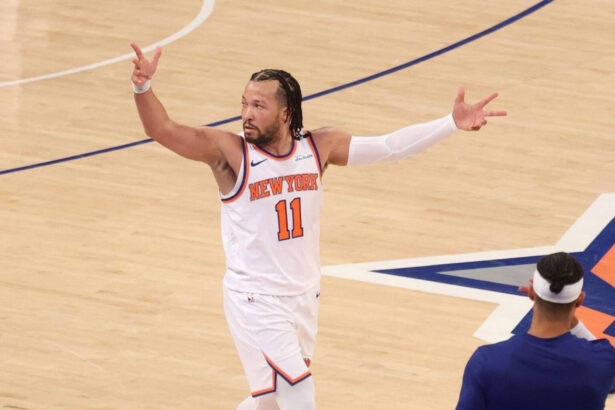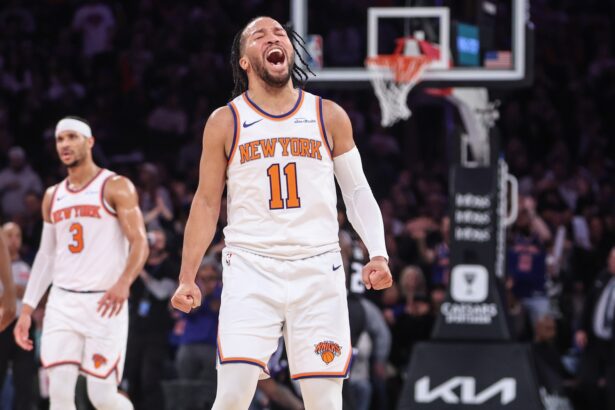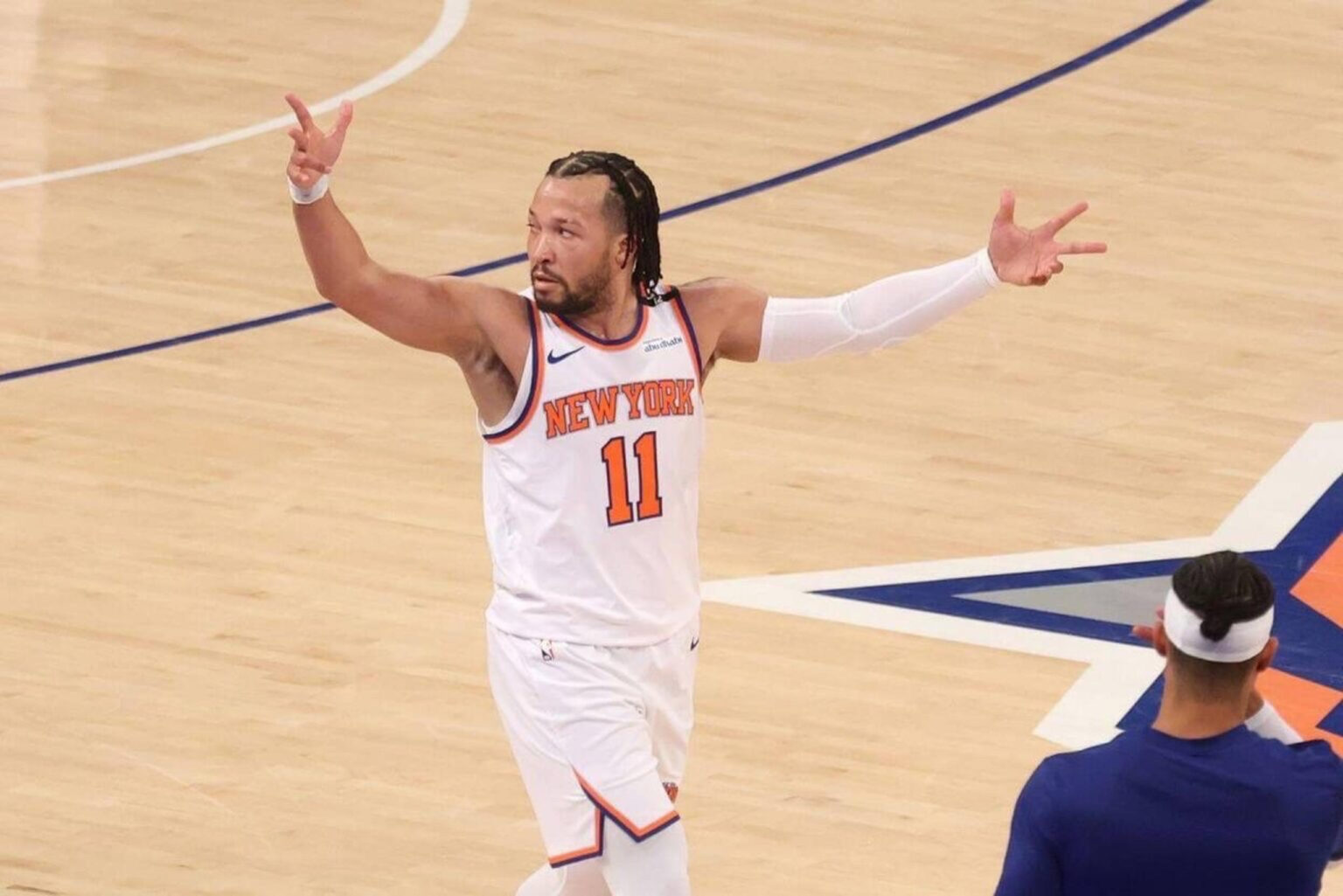
Becky Hammon’s old Jalen Brunson take is aging in a very interesting way now. In December 2023, she said the Knicks couldn’t win a championship with Brunson as their best player because he was too small. The exact idea was simple: if your first option is a small guard, the ceiling is not high enough.
Now the Knicks are two wins away from the title. They lead the Spurs 2-0 in the 2026 NBA Finals, and Games 3 and 4 are at MSG. Jalen Brunson is not only the face of the team. He is also right there in the Finals MVP race with Karl-Anthony Towns. If Brunson puts together two strong games at home and the Knicks finish the job, he could win the award and kill that whole criticism in the strongest way possible.
That would also put him in a very small group. Finals MVP is usually an award for bigger wings, dominant forwards, or elite big men. Small guards don’t win it often because playoff defenses can target size, force switches, and make every possession more physical. That is why players like Stephen Curry, Isiah Thomas, Tony Parker, and Chauncey Billups stand out so much.
Brunson is listed at 6’2”, so if he wins Finals MVP, he would become one of the shortest players ever to do it. He wouldn’t just be winning a title. He would be joining a rare list of guards and smaller wings who proved size wasn’t enough to stop them on the biggest stage.
Here are the 10 shortest NBA players who have won Finals MVP.
10. John Havlicek – 6’5”
Finals Stats: 26.4 PPG, 7.7 RPG, 4.7 APG, 1.9 SPG, 0.0 BPG, 42.9% FG, N/A 3P%
John Havlicek was not small like Brunson, Curry, or Isiah Thomas, but 6’5” is still short for a Finals MVP winner. Once the list goes below 6’6”, many historic names are already gone, including Michael Jordan, Kobe Bryant, and Shai Gilgeous-Alexander. That is why Havlicek still fits this group.
He won Finals MVP in 1974 after the Celtics beat the Bucks in seven games. Havlicek was the main perimeter scorer, a heavy-minute player, and the best offensive option for the Celtics in a very physical series.
The numbers show how much he had to carry. Havlicek put up 26.4 points, 7.7 rebounds, and 4.7 assists per game while playing 47.1 minutes per game. That is almost the whole game every night. He also added 1.9 steals per game, which was important in a slower era where every extra possession had more value. His shooting was not elite at 42.9% from the field, but the volume and difficulty were huge.
The biggest part is that this came against a Bucks team with Kareem Abdul-Jabbar and Oscar Robertson. Kareem was still a monster, and the Bucks had championship experience from 1971. Havlicek had to work through long possessions, hard defense, and a series that reached Game 7 on the road.
Havlicek also had major late-series moments. He scored 36 points in Game 6, even though the Celtics lost in double overtime, then came back in Game 7 with 16 points, 9 rebounds, and 6 assists in a 102-87 win. That final line wasn’t his biggest scoring game, but the Celtics didn’t need him to force everything.
For a 6’5” wing, Havlicek was ahead of his time. He could score, pass, defend, rebound, and run forever. He wasn’t a small guard like others, but he is still part of the short Finals MVP group because most winners are bigger than him. His 1974 run was about workload, stamina, and all-around value.
9. Dwyane Wade – 6’4”
Finals Stats: 34.7 PPG, 7.8 RPG, 3.8 APG, 2.7 SPG, 1.0 BPG, 46.8% FG, 27.3% 3P
Dwyane Wade’s 2006 Finals run is one of the strongest guard scoring series ever. He was 24 years old, in his third season, and still gave the Heat 34.7 points per game against the Mavericks. He also added 7.8 rebounds, 3.8 assists, 2.7 steals, and 1.0 blocks, so the production was not only scoring. He was creating rim pressure, getting to the free-throw line, rebounding from the guard spot, and forcing turnovers.
The Heat lost the first two games of the series, with Wade scoring 28 points in Game 1 and 23 points in Game 2. After that, he took over the series. He had 42 points, 13 rebounds, and 2 steals in Game 3, then 36 points in Game 4, then 43 points, 4 rebounds, 4 assists, and 3 steals in Game 5. In Game 6, he finished it with 36 points, 10 rebounds, 5 assists, 4 steals, and 3 blocks.
The free throws were a huge part of the series. Wade attempted 97 free throws in six games, which is 16.2 per game, and made 75 of them. That volume shows how much pressure he put on the Mavericks’ defense. He was not living on jumpers. He was attacking the paint, drawing contact, and forcing the defense to react every trip.
His shooting split was 46.8% from the field and 27.3% from three. The three-point number was not important to his value. His whole game was built on drives, mid-range shots, transition attacks, and foul pressure. For a 6’4” guard to control a Finals like that, with that much scoring and physical pressure, is still rare.
8. Dennis Johnson – 6’4”
Finals Stats: 22.6 PPG, 6.0 RPG, 6.0 APG, 1.8 SPG, 2.2 BPG, 45.9% FG, N/A 3P%
Dennis Johnson won Finals MVP in 1979 after the SuperSonics beat the Bullets in five games. His line was strong across the board: 22.6 points, 6.0 rebounds, 6.0 assists, 1.8 steals, and 2.2 blocks per game. For a 6’4” guard, the block number is the standout stat. He had 11 blocks in five games, which is crazy production for a backcourt player.
Johnson played 44.8 minutes per game in the series. That tells the whole role. He was not a scorer who was hidden on defense, and he was not only a defensive guard with limited offense. He had to handle a heavy two-way workload almost every night. He averaged 19.6 field-goal attempts per game and shot 45.9% from the field, which was solid for that shot diet and era.
His game-by-game scoring was very steady, too. Johnson had 23 points, 20 points, 17 points, 32 points, and 21 points in the five games. Game 4 was his biggest scoring game, with 32 points, 10 rebounds, 3 assists, and 4 blocks in 48 minutes. The SuperSonics won 114-112 in overtime and took a 3-1 series lead.
The three-point line didn’t exist yet, so there is no 3P% for this series. That also makes the scoring different to judge. Johnson had to get his points from twos and free throws, while also playing heavy defensive minutes. At 6’4”, that kind of two-way Finals MVP profile is still one of the most unusual ones on this list.
7. Jerry West – 6’3”
Finals Stats: 37.9 PPG, 4.7 RPG, 7.4 APG, N/A SPG, N/A BPG, 49.0% FG, N/A 3P%
The 1969 Finals MVP vote was almost all about the stat sheet. The Lakers lost the series in seven games, but Jerry West had numbers that were too big to ignore: 37.9 points, 4.7 rebounds, and 7.4 assists per game on 49.0% from the field. For a 6’3” guard, with no three-point line, that scoring level was absurd.
West scored 53 points in Game 1, 41 points in Game 2, 24 points in Game 3, 40 points in Game 4, 39 points in Game 5, 26 points in Game 6, and 42 points in Game 7. That is four 40-point games in one Finals series. He also had at least 7 assists in five of the seven games, so he wasn’t only taking shots. He was also creating a big part of the Lakers’ offense.
The Game 7 line is still one of the strongest losing efforts in Finals history. West finished with 42 points, 13 rebounds, and 12 assists in a 108-106 loss. The Lakers had Wilt Chamberlain and Elgin Baylor, but West was the main offensive player in the series. His shot volume, efficiency, and passing load were all high.
The Celtics won the title, but West became the only player ever to win Finals MVP on the losing team. The award was created that year, and his production made the decision difficult to avoid. He had 265 total points and 52 assists in seven games. At 6’3”, that is one of the biggest Finals workloads ever for a smaller guard.
6. Jo Jo White – 6’3”
Finals Stats: 21.7 PPG, 4.3 RPG, 5.8 APG, 1.5 SPG, 0.0 BPG, 43.9% FG, N/A 3P%
The 1976 Finals were a heavy-minute guard series for Jo Jo White. He played 46.5 minutes per game, took 17.8 shots per game, and gave the Celtics 21.7 points and 5.8 assists per night. The numbers were not flashy like Jerry West, but the workload was huge and steady.
White’s scoring by game was 22, 11, 25, 27, 33, and 15 points. He had three games with at least 25 points and two games with at least 9 assists. He also shot 87.8% from the free-throw line, which helped in close games.
Game 5 was the key part of his Finals MVP case. White played 60 minutes in the triple-overtime win over the Suns and finished with 33 points, 6 rebounds, 9 assists, and 2 steals. He shot 15-of-29 from the field. The Celtics won 128-126 and took a 3-2 series lead.
The Celtics closed the series in Game 6, and White finished as their leading scorer in the Finals. He wasn’t the biggest player on the floor, and he wasn’t the most physically dominant player in the series like John Havlicek or Dave Cowens. But at 6’3”, he gave the Celtics scoring, ball control, free-throw shooting, and huge minutes. That was enough for the award.
5. Joe Dumars – 6’3”
Finals Stats: 27.3 PPG, 1.8 RPG, 6.0 APG, 0.5 SPG, 0.3 BPG, 57.6% FG, 0.0% 3P
Joe Dumars had the best scoring series of his career at the perfect time. The Pistons swept the Lakers in the 1989 NBA Finals, and Dumars led the series with 27.3 points per game. He also had 6.0 assists per game and shot 57.6% from the field, so this was not only volume. It was efficient half-court scoring from a 6’3” guard.
His game log was simple and strong: 22 points and 7 assists in Game 1, 33 points and 6 assists in Game 2, 31 points and 5 assists in Game 3, then 23 points and 6 assists in Game 4. He scored at least 22 points in every game and had at least 5 assists in every game. He finished the series with 109 points, 24 assists, and only 7 turnovers.
Dumars did almost all of his damage inside the arc and at the line. He went 38-of-66 from the field and 33-of-38 from the free-throw line. He attempted only two threes in the whole series and missed both.
The Lakers were hurt, with Byron Scott out and Magic Johnson limited by a hamstring injury, but Dumars still did exactly what the Pistons needed. Isiah Thomas was the bigger name, but Dumars was the best offensive guard in that series.
4. Chauncey Billups – 6’3”
Finals Stats: 21.0 PPG, 3.2 RPG, 5.2 APG, 1.2 SPG, 0.0 BPG, 50.9% FG, 47.1% 3P
Chauncey Billups didn’t need a huge scoring average to control the 2004 Finals. The Pistons beat the Lakers in five games, and Billups gave them 21.0 points and 5.2 assists per game on 50.9% from the field and 47.1% from three. His true shooting was 69.6%, which is the number that explains the series better.
Billups scored 22 points in Game 1, 27 points in Game 2, 19 points in Game 3, 23 points in Game 4, and 14 points in Game 5. He had four games with at least 19 points and shot 8-of-17 from three for the series. He also went 39-of-42 from the free-throw line, good for 92.9%. The Lakers didn’t have a good answer for his pull-up shooting and control in pick-and-roll situations.
His Game 2 line came in the only Pistons loss of the series: 27 points, 4 rebounds, and 9 assists in 47 minutes. After that, the Pistons won three straight games and held the Lakers to 68, 80, and 87 points. Billups wasn’t the only reason for that defense, but his offense gave the Pistons enough structure in a slow series.
The Pistons lacked a clear superstar. That made Billups’ role different from most Finals MVP winners. He was not carrying 30 shots per game, but he was the guard who organized the offense, got to the line, hit threes, and punished the Lakers when they helped too much. At 6’3”, he won the award with control and efficiency, not raw volume.
3. Stephen Curry – 6’2”
Finals Stats: 31.2 PPG, 6.0 RPG, 5.0 APG, 2.0 SPG, 0.2 BPG, 48.2% FG, 43.7% 3P
Stephen Curry’s 2022 Finals were the final answer to the only missing part of his resume. The Warriors beat the Celtics in six games, and Curry was clearly the best offensive player in the series. He gave them 31.2 points per game on 48.2% from the field and 43.7% from three, with 5.0 assists and 2.0 steals per game.
The game log was strong almost all the way. Curry had 34 points in Game 1, 29 in Game 2, 31 in Game 3, 43 in Game 4, 16 in Game 5, and 34 in Game 6. Game 5 was the only bad shooting night, as he went 0-of-9 from three. The Warriors still won that game 104-94, then Curry answered with 34 points in the title-clinching Game 6.
The biggest game was Game 4. The Warriors were down 2-1 in the series, and Curry had 43 points, 10 rebounds, and 4 assists in a 107-97 win. He shot 14-of-26 from the field and 7-of-14 from three. That game changed the series. Without it, the Warriors go down 3-1. With it, the series became 2-2, and the Warriors won the next two.
Curry made 31 threes in six games, which is 5.2 per game. The Celtics had size, switching, and strong perimeter defense, but they still couldn’t take away his off-ball movement, pull-up shooting, and late-clock shot-making. At 6’2”, he won Finals MVP by being the best scorer in the series.
2. Tony Parker – 6’2”
Finals Stats: 24.5 PPG, 5.0 RPG, 3.3 APG, 0.8 SPG, 0.0 BPG, 56.8% FG, 57.1% 3P
Tony Parker’s 2007 Finals were short, direct, and efficient. The Spurs swept the Cavaliers in four games, and Parker was the top scorer in the series at 24.5 points per game. He also gave them 5.0 rebounds and 3.3 assists while shooting 56.8% from the field. For a 6’2” guard, the paint scoring was the main point.
Parker scored 27 points in Game 1, 30 in Game 2, 17 in Game 3, and 24 in Game 4. He shot 39-of-73 from the field in the series. The Cavaliers had LeBron James, but their team defense didn’t have the speed to keep Parker out of the lane. He got to his spots early in the clock and finished well around the rim.
The three-point number was also strong, but it came on low volume. Parker shot 4-of-7 from three, good for 57.1%. That wasn’t the base of his game. His Finals MVP case came from drives, floaters, pull-ups, and constant pressure on the Cavaliers’ guards. He didn’t need to dominate the ball like a 35-point scorer because the Spurs had Tim Duncan and Manu Ginobili there.
Game 4 closed the series, and Parker had 24 points, 7 rebounds, and 1 assist in an 83-82 win. The score shows the type of series it was. It wasn’t high scoring, and every easy basket had value. Parker’s speed gave the Spurs the best perimeter advantage, and that was enough for him to become one of the shortest Finals MVP winners ever.
1. Isiah Thomas – 6’1”
Finals Stats: 27.6 PPG, 5.2 RPG, 7.0 APG, 1.6 SPG, 0.4 BPG, 54.2% FG, 68.8% 3P
Isiah Thomas is the shortest Finals MVP in NBA history. The Pistons beat the Blazers in five games in the 1990 NBA Finals, and Thomas led the series with 27.6 points and 7.0 assists per game. He also added 5.2 rebounds and 1.6 steals while shooting 54.2% from the field. For a 6’1” guard, that is a very high scoring and efficiency combo in the Finals.
Thomas had 33 points, 7 rebounds, and 6 assists in Game 1. He followed with 23 points, 7 rebounds, and 11 assists in Game 2. In Game 3, he had 21 points, 5 rebounds, and 8 assists. Then he scored 32 points in Game 4 and 29 points in Game 5. He scored at least 21 points in every game and had at least 5 assists in every game.
The shooting was the big stat. Thomas went 52-of-96 from the field and 11-of-16 from three. That is 54.2% FG and 68.8% 3P. The three-point volume was not modern volume, but 11 makes in five games was still important in 1990. He also went 23-of-31 from the line. The full series was 138 points, 35 assists, 26 rebounds, 8 steals, and 2 blocks.
The Pistons had a strong team, with Joe Dumars, Bill Laimbeer, Dennis Rodman, Mark Aguirre, and Vinnie Johnson around him. But Thomas was the first option in this Finals. He was the best scorer, the main passer, and the guard who controlled the pace. At 6’1”, he is still the clearest example for this article: a small guard being the best player in the Finals and winning the award.
Jalen Brunson Could Join This Group
Jalen Brunson is not there yet, but the path is real now. The Knicks lead the Spurs 2-0 in the 2026 NBA Finals, and Games 3 and 4 are at MSG. Through two games, Brunson is at 25.0 points, 4.0 rebounds, and 4.0 assists per game. That is not a huge Finals line compared with some names on this list, but the award race is still close enough because the Knicks are winning and Brunson has the ball late.
The height part is the bigger story. Brunson is listed at 6’2”. That would put him in the same height group as Stephen Curry and Tony Parker, and only behind Isiah Thomas at 6’1” among the shortest Finals MVP winners. If Brunson wins it, the list of 6’2” or shorter winners would be only Thomas, Curry, Parker, and him.
For a guard his size, that is the real test. Small first options usually get attacked by size and length in the Finals. If Brunson finishes this series as the best Knicks player and wins Finals MVP, the “too small” criticism loses its weight.