The Knicks are not one win away from ending the series. They are three wins away. That distinction is important. A 39-point Game 1 win does not guarantee a sweep. It does, however, create a clear question: Do the 76ers have enough counters to make this series competitive against a title favorite?
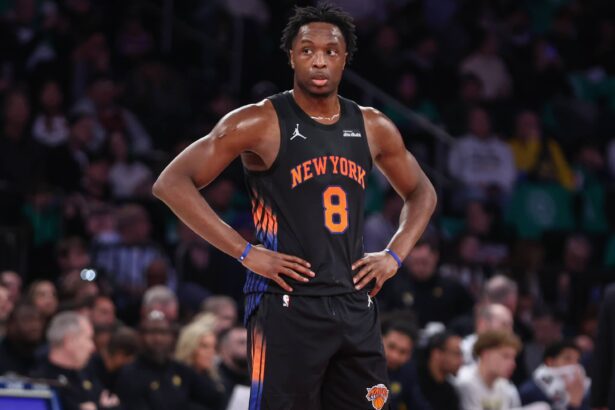
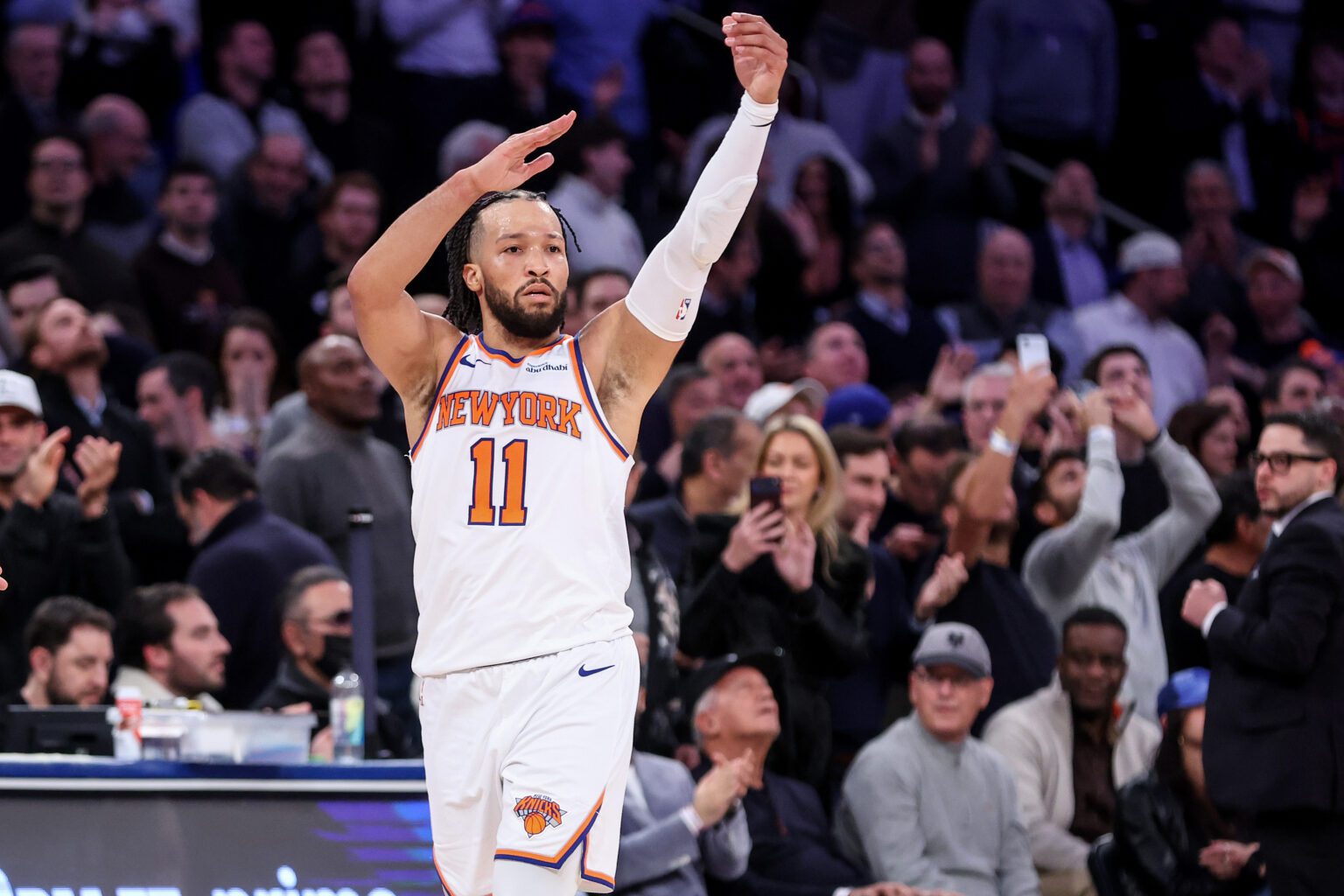
Game 1 gave a harsh first answer. The Knicks beat the 76ers 137-98 in Game 1 of the Eastern Conference semifinals, taking a 1-0 series lead and extending one of the most dominant playoff stretches in recent league history. They shot 63.1% from the field, 51.4% from three, and led by as many as 40. Jalen Brunson scored 35 points in 31 minutes, including 27 in the first half. OG Anunoby scored 18, while Karl-Anthony Towns and Mikal Bridges each had 17. The 76ers received 17 points from Paul George, 14 from Joel Embiid, and 13 from Tyrese Maxey. That was not enough to stay close.
The result continued a larger pattern. The Knicks closed the first round against the Hawks with a 140-89 win in Game 6, then opened this series with another blowout. They became just the second team in NBA history to end one series and begin another with consecutive wins by at least 30 points, joining the 1986 Celtics. They also became the first team in NBA history to win three straight playoff games by at least 25 points.
That is why the sweep question is legitimate. It is not only about one hot shooting night. Through seven playoff games, the Knicks have outscored opponents by 20.6 points per game, which would be the best point differential in playoff history if sustained. The Knicks entered this point with the second-ranked offense and third-ranked defense in the playoffs. That profile translates better than a single shooting run.
The Game 1 Gap Was Not Normal
The first number that explains Game 1 is 74.4%. That was the Knicks’ effective field goal percentage, the third-highest single-game mark in NBA playoff history. This was not an ordinary efficient game. It was a structural collapse from the 76ers’ defense. The Knicks scored 137 points on 98 possessions, which is roughly 139.8 points per 100 possessions.
The shot-making was extreme, but the shot quality was also strong. The Knicks went 53-for-84 from the field and 19-for-37 from three. Their 63.1% field goal rate set a franchise playoff record, and their 51.4% mark from three was also their best playoff 3-point rate in a game with at least 30 attempts. Those numbers came with 34 assists on 53 makes, a 64.2% assist rate. The offense was not built only on Brunson’s isolation. The ball moved, the defense rotated, and the Knicks created repeated advantages on half-court sets.
The 76ers were not only outshot. They were outorganized. They finished with 15 assists on 30 made field goals. They also had 19 turnovers, compared to 14 for the Knicks. The 76ers had a turnover rate near 17.8%, while the Knicks were closer to 13.3%. In a game where the Knicks were already shooting at a historic level, the 76ers could not afford to give away the ball in that way.
The rebounding also favored the Knicks. They won the total glass 48-38 and had a 31-20 edge in defensive rebounds. Both teams had eight offensive rebounds, but the 76ers missed 43 shots from the field while the Knicks missed only 31. That made the Knicks’ defensive rebounding more important. They limited second chances, finished stops, and kept the game from turning into a free-throw-and-rebound grind, which is one of the few ways the 76ers could have slowed the pace.
The quarter-by-quarter score also shows how early the game broke. The Knicks won the first quarter 33-25, then won the second 41-26. They led 74-51 at halftime. By the end of the third quarter, it was 109-78. The 76ers’ starters were already finished before the fourth quarter had any competitive meaning. The 76ers basically waved the white flag with 5:19 left in the third quarter, when George joined Maxey and Embiid on the bench.
That is the first sweep indicator. The Knicks did not need heavy fourth-quarter minutes from their main players. Brunson played 30 minutes. Anunoby played 30. Bridges played 26. Josh Hart played 25. Towns played 20. The Knicks got a playoff blowout while controlling workload. In a series where the 76ers are coming off a seven-game first round, that has real value.
The 76ers can argue that the shooting will regress. That is fair. The Knicks are unlikely to shoot 63.1% from the field and 51.4% from three every game. But the problem is not only the final percentage. The problem is how easily they got there. The Knicks scored six straight times from the same Brunson-Mitchell Robinson action in the first quarter, producing 14 points. Later, they scored on their final 10 possessions of the second quarter, with Brunson scoring the final 11 points of that half.
That type of repetition is worse than a hot hand. A hot hand can cool. A repeated action that creates points every time forces a full defensive reconsideration. The 76ers tried different defenders, different coverages, and even zone. None of it stopped the Brunson action. That is why Game 1 looked less like variance and more like a matchup problem.
The 76ers Still Do Not Have A Brunson Answer
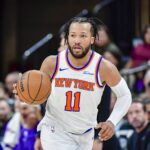
Jalen Brunson is the central problem. He averaged 26.0 points, 3.3 rebounds, and 6.8 assists in the regular season, shooting 46.7% from the field and 36.9% from three. That already made him one of the league’s most stable half-court guards. In Game 1, he was not only stable. He was ruthless. He scored 35 points on 12-for-18 shooting, 3-for-6 from three, and 8-for-8 at the line. His true shooting rate was 81.3%, his most efficient playoff game among his 30-point performances.
The 76ers tried to change the matchup. They used VJ Edgecombe early, then Kelly Oubre Jr., then George, then Quentin Grimes. They also switched, blitzed, and showed zone. The result did not change. Brunson kept turning the same basic action into different answers. That is the hardest part of defending him. He does not need the defense to make the same mistake twice. He only needs one small angle.
The first-quarter stretch showed the full menu. Brunson hit Robinson on a lob. He used a handoff to get to a short jumper. He beat Oubre to the rim. He rejected a screen and created a stepback against George. He beat Embiid’s blitz and hit a pull-up three. Then he found Miles McBride in the strong-side corner when Maxey gave too much space. Six trips, six scores, 14 points. The 76ers saw almost every version of the same problem in a few minutes.
That is why Embiid’s defensive role is such a concern. The Knicks will keep forcing him into space. If he plays drop, Brunson can step into pull-ups or snake into the paint. If he comes high, Brunson can turn the corner, reject the screen, or move the ball to the next shooter. If the 76ers switch, Brunson can attack the big. If they blitz, the short-roll and weak-side spacing become available. The 76ers do not have an easy coverage because Brunson is comfortable against all of them.
Robinson also changed the series in a specific way. His box score was small: two points, four rebounds, and one assist in 11 minutes. But his screens created many of the early problems. The only thing that briefly slowed the Knicks’ offense was the 76ers intentionally fouling him late in the first quarter. Robinson went 0-for-4 from the line, but once he came out, the Knicks resumed their scoring rhythm.
That creates a decision for the 76ers. If they use intentional fouls on Robinson, they can stop a specific offensive action, but they also put themselves in a strange rhythm and risk early bonus situations. If they do not, Brunson has a direct path into the core of their defense. Neither option is ideal. It is one reason a sweep is possible: the 76ers may need a defensive adjustment that creates a different offensive problem.
The Knicks also have too many secondary release points. Anunoby shot 7-for-8 and made both of his threes. Bridges shot 7-for-10 and made 3 of 5 from three. Towns shot 7-for-11 and made 3 of 5 from three. Those three combined to shoot 21-for-29 from the field and 8-for-12 from deep. That means the 76ers could not load up on Brunson without allowing efficient shots elsewhere.
Towns’ role is important because he is not only a spacer. He had 17 points, six rebounds, six assists, and two blocks in 20 minutes. His passing from the frontcourt gives the Knicks another way to punish rotations. If the 76ers send extra help toward Brunson, Towns can move the ball quickly. If they stay home, he can shoot over the top or attack a late closeout.
The 76ers’ best path is to make Brunson a passer without allowing automatic threes. That requires better screen navigation, more physical ball pressure, and sharper low-man rotations. But Game 1 showed how difficult that is. The Knicks generated paint touches, corner threes, above-the-break threes, and short-roll reads from the same base actions. One adjustment will not solve every problem.
The 76ers’ Stars Were Not Close To Their Level
The 76ers cannot survive this series if Embiid and Maxey produce like secondary options. Embiid averaged 26.9 points, 7.7 rebounds, and 3.9 assists during the regular season, shooting 48.9% from the field and 85.4% at the line. Maxey averaged 28.3 points, 4.1 rebounds, and 7.5 assists. Together, they are supposed to carry the 76ers’ shot creation. In Game 1, they combined for 27 points.
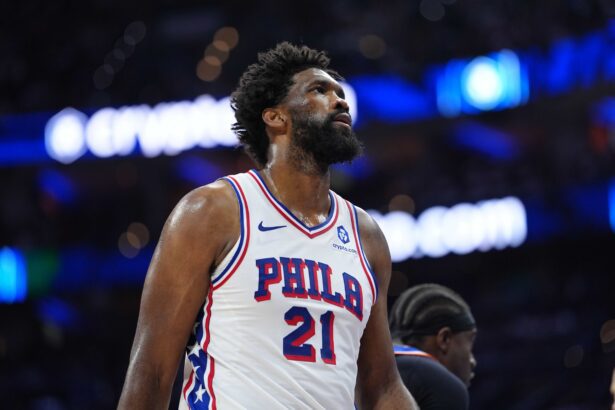
Embiid finished with 14 points, four rebounds, and one assist in 24 minutes. He shot 3-for-11 from the field, 0-for-2 from three, and had a minus-24. His free throws kept his scoring line from looking worse, as he went 8-for-9 there. But the field-goal profile was poor. His effective field goal rate was 27.3%. His true shooting rate was 48.1%, well below his regular-season mark of 60.5%.
The larger issue was control. Embiid did not tilt the game. He did not force the Knicks to foul their bigs into serious trouble. He did not punish switches enough to slow the Knicks’ small-ball comfort. He did not create enough passing pressure. A one-assist night from Embiid means the Knicks were not forced into repeated emergency rotations. That is a defensive victory for the Knicks.
Maxey was also limited. He had 13 points, three rebounds, two assists, and four turnovers in 26 minutes. He shot 3-for-9 from the field, 0-for-3 from three, and 7-for-7 at the line. His free throws kept his efficiency alive, but the overall control was poor. A two-assist, four-turnover game from Maxey is not enough against a defense that can guard multiple positions and turn mistakes into immediate pressure.
The 76ers’ starting lineup was heavily beaten. George was minus-26. Embiid was minus-24. Maxey was minus-28. Oubre was minus-25. Edgecombe was minus-15. The five starters combined for a minus-118 in the box score. That does not mean all five played equally poorly, but it shows the main group never stabilized the game.
George was the best of the main three. He scored 17 points on 6-for-11 shooting and went 4-for-6 from three. But he had only three rebounds and three assists, and the 76ers still lost his minutes by 26. George making shots is useful. It is not enough if Embiid and Maxey are not creating normal offensive pressure.
The team-level free throws also require context. The 76ers went 27-for-34 at the line. That is a large edge over the Knicks, who went 12-for-17. Normally, that type of free-throw gap gives the 76ers a path to survive a poor shooting game. It did not matter because they were crushed everywhere else: field goals, three-point volume, assists, rebounds, turnovers and defensive efficiency.
This is one reason a sweep can happen. The 76ers already had one major statistical advantage in Game 1 and still lost by 39. They made 15 more free throws than the Knicks. They still scored only 98 points. They need more than regression. They need Embiid to regain dominance, Maxey to collapse the defense, and George to keep hitting threes, all while fixing a defense that allowed 137 points in 98 possessions.
Fatigue is also part of the picture. The 76ers had only one full day off after beating the Celtics in Game 7 to complete a comeback from a 3-1 deficit. That was the franchise’s first such comeback. The Knicks, meanwhile, ended their first-round series with a 51-point Game 6 win over the Hawks and entered Game 1 with more rest and less late-game stress.
That should not be used as an excuse for a 39-point loss. But it affects the sweep conversation. If the 76ers are still trying to recover physically while the Knicks are playing short minutes in blowouts, the gap can grow. Game 2 becomes more important because the 76ers cannot afford another long night chasing Brunson screens, closing to shooters and asking Embiid to defend in space.
The Sweep Case Is Not Automatic Yet
The sweep case starts with the Knicks’ two-way form. They have won four straight playoff games by a combined 135 points. They allowed fewer than 100 points for the fourth straight game in Game 1. They have scored efficiently and defended without needing Brunson to play extreme minutes. That is a strong combination. Blowouts can be misleading, but repeated blowouts with elite offense and defense are more difficult to dismiss.
The second part is matchup pressure. The 76ers need Embiid to protect the rim, defend pick-and-roll, score efficiently, draw fouls, and pass out of help. That is a large workload, especially against a Knicks team that can involve him on almost every defensive possession. If Embiid is not moving well enough to contain Brunson’s actions and still dominate on offense, the 76ers’ ceiling drops quickly.
The third part is the Knicks’ lineup balance. Brunson is the main creator. Towns stretches the floor and passes. Bridges and Anunoby give size, shooting, and defensive flexibility. Hart rebounds, cuts, and pushes tempo. Robinson gives screening and rim pressure. McBride and Tyler Kolek supplied bench shooting and passing in Game 1, combining for 16 points and six assists. That gives the Knicks more ways to win than the 76ers had in the opener.
The 76ers still have counters. The first is using Embiid closer to the elbows and nail, where he can pass before the Knicks load up. The second is involving Maxey earlier in drag screens and early offense, before the Knicks set their shell. The third is making Brunson defend more often, preferably through George, Maxey, or Oubre’s actions. The fourth is testing Robinson at the free-throw line again if his screening becomes too damaging.
They also need more from the non-stars. Edgecombe had 12 points, but he shot 5-for-11 and was minus-15. Oubre had 12 points and five rebounds. Grimes had five points in 24 minutes. Andre Drummond scored zero in nine minutes. The 76ers do not need every role player to win his matchup, but they cannot have a night where George is the only high-efficiency starter and the bench fails to change the game.
The danger for the 76ers is that many of their corrections are connected. If they send more help at Brunson, Towns, Anunoby, and Bridges get better looks. If they stay home on shooters, Brunson keeps playing in space. If Embiid steps higher, the rim is exposed. If he sits lower, Brunson walks into rhythm shots. If they play smaller, the Knicks can punish the glass. If they play bigger, the offense can slow down.
That does not mean the series is over. The 76ers are not a normal No. 7 seed. They beat the Celtics after trailing 3-1. They have Embiid, Maxey, and George. They can shoot better, defend with more urgency, and make Game 2 much closer.
Still, the Knicks are in a sweep position because Game 1 exposed more than one problem. It exposed the 76ers’ pick-and-roll defense, their inability to contain Brunson, their dependence on free throws, their star inefficiency, their possession mistakes and their fatigue disadvantage. One adjustment can reduce one of those issues. It cannot erase all of them.
The most realistic answer is this: the Knicks are not guaranteed to sweep, but they are absolutely positioned to do it. Game 1 was not only a blowout. It was a tactical report. The Knicks found repeatable offense, defended the 76ers’ best players below their normal level, and preserved their own starters’ legs. If Game 2 follows the same basic shape, the series may not return to full tension.