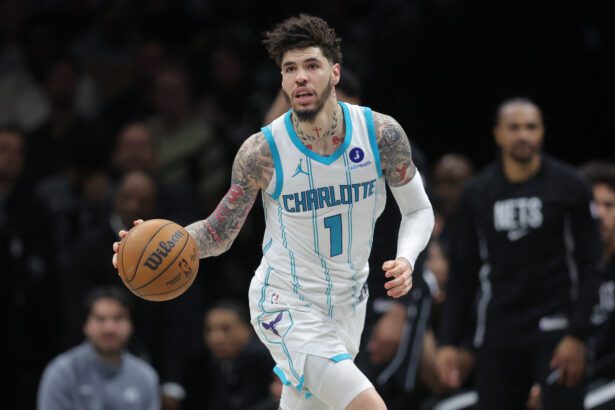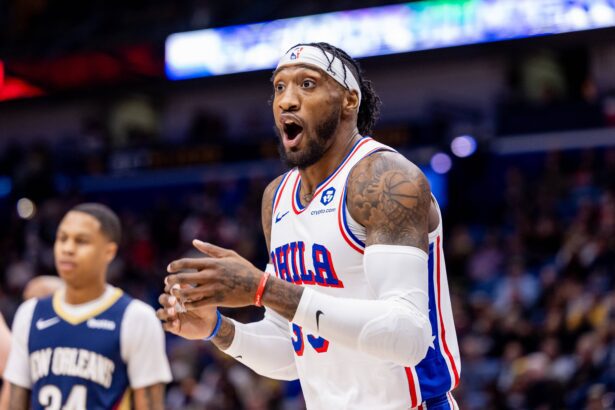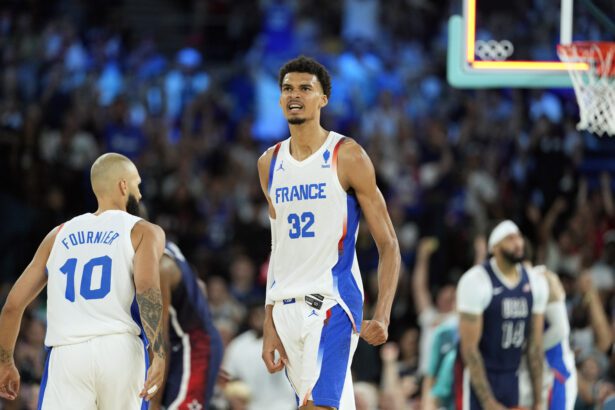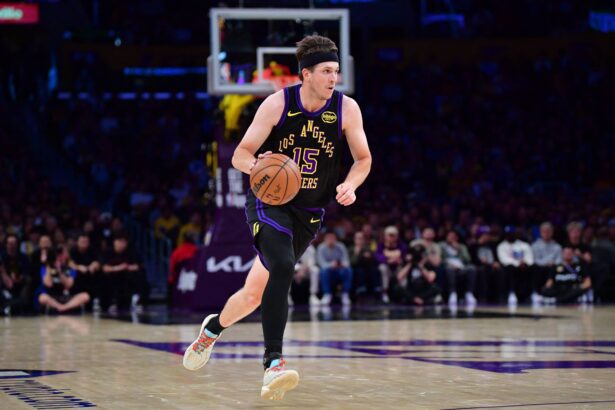
The Oklahoma City Thunder have started the season almost perfectly as a team can. At 24-1 through their first 25 games, they’ve matched the early pace of the legendary 73-win Golden State Warriors, and suddenly a comparison that once felt ridiculous is starting to sound strangely reasonable.
Oklahoma City is overwhelming teams on both ends, ranking second in scoring (123.6 PPG), first in points allowed (106.2), and holding a ridiculous +17.2 net rating. This isn’t a fake early-season run; this is the profile of an all-time squad powered by reigning MVP Shai Gilgeous-Alexander, a dominant rim-protector in Chet Holmgren, and a healthy Jalen Williams, and one of the deepest, most disciplined benches in the league.
Naturally, that raises the question fans can’t help but debate: how would this Thunder team stack up against the 2015-16 Warriors, the gold standard for regular-season dominance? If these two eras met in a best-of-seven, who actually walks away?
Starting Lineup
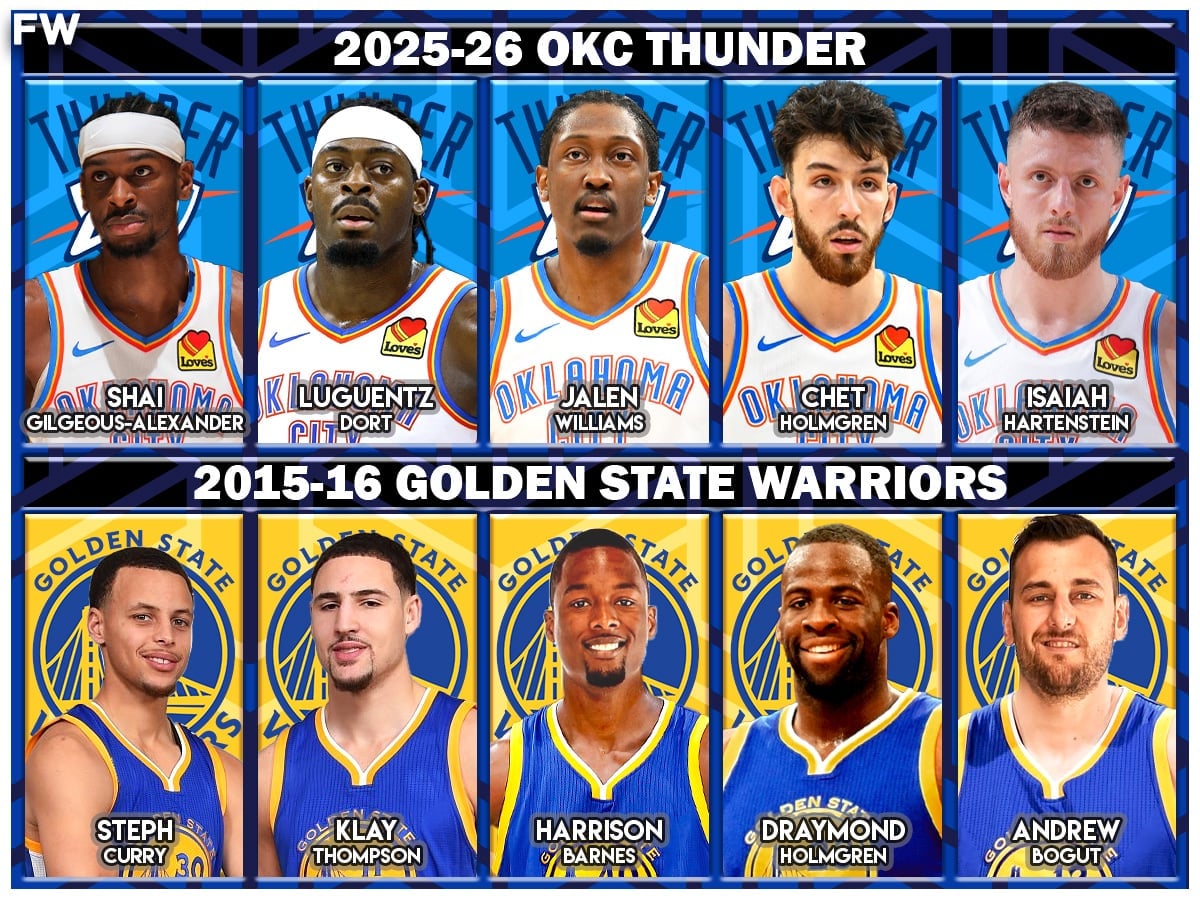
Oklahoma City Thunder: Shai Gilgeous-Alexander, Luguentz Dort, Jalen Williams, Chet Holmgren, Isaiah Hartenstein
Golden State Warriors: Stephen Curry, Klay Thompson, Harrison Barnes, Draymond Green, Andrew Bogut
Oklahoma City is near-perfection on both ends. SGA is an offensive superstar, Jalen Williams is an elite co-star, and Chet Holmgren is a bona fide DPOY candidate. That is one heck of a Big Three.
Add in Isaiah Hartenstein’s screening, rebounding, and physicality plus Luguentz Dort’s bulldog perimeter defense, and OKC rolls out a starting five with length, versatility, and almost no weak link.
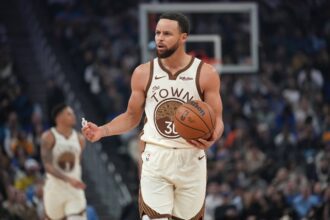
Golden State’s starters don’t need much introduction. Stephen Curry is the most dangerous off-ball mover in NBA history, bending defenses in ways that no scheme truly solves. Prime Klay Thompson gives this group a second elite shooter who spaces the floor to absurd levels.
Draymond Green is key defensively, as he matches what Chet brings in terms of defensive IQ although he brings more toughness and leadership. Barnes is a two-way forward with excellent athleticism, and Andrew Bogut is a natural rim-protector and powerful big down low.
The Thunder have to hold the edge in the starting lineup thanks to their versatility and two-way balance. Simply, OKC has more ways to generate offense and disrupt Golden State’s sets.
The Warriors counter with historic shooting and elite chemistry, but their lineup has more defensive pressure points and less shot creation outside Curry. OKC simply brings more athleticism, length, and matchup flexibility, giving them the advantage.
Advantage: 2025-26 Oklahoma City Thunder
Key Bench Players
Oklahoma City Thunder: Alex Caruso, Isaiah Joe, Aaron Wiggins, Cason Wallace, Ajay Mitchell, Jaylin Williams, Ousmane Dieng
Golden State Warriors: Shaun Livingston, Leandro Barbosa, Ian Clark, Brandon Rush, Andre Iguodala, Festus Ezeli, Marreese Speights
The Thunder bring wave after wave of activity when they go to the bench. Alex Caruso is a defensive nightmare who can guard three positions and steady the offense.
Isaiah Joe and Aaron Wiggins bring instant spacing and energy, while Cason Wallace supplies point-of-attack defense and mistake-free offense.
Jaylin Williams adds frontcourt toughness and playmaking, and Ousmane Dieng plus Ajay Mitchell give OKC developmental depth with size and skill. This bench is deep, disciplined, and custom-built to maintain leads while the stars rest.
Golden State’s 2015-16 bench was one of the most impactful second units in league history. Shaun Livingston gives them a calm, mismatch-hunting midrange assassin, while Leandro Barbosa brings lightning-in-a-bottle scoring bursts.
Andre Iguodala is the crown jewel here, a Finals MVP-caliber defender who can run the offense and close games. Festus Ezeli and Marreese Speights supply size, rebounding, and scoring punch, while Ian Clark and Brandon Rush offer clean 3-and-D minutes. This bench has veteran composure and championship instincts.
Overall, Golden State owns the bench advantage because their second unit is loaded with playoff-tested veterans who know exactly how to impact high-stakes games. Iguodala, Livingston, and Barbosa give the Warriors dependable scoring, composure, and defensive versatility, while Speights and Ezeli provide frontcourt stability.
OKC’s bench is deeper in raw numbers and more energetic, but experience and reliability tilt this category toward the Warriors.
Advantage: 2015-16 Golden State Warriors
Mark Daigneault vs. Steve Kerr
Mark Daigneault is adaptable, positive, and great at making adjustments. As he gains exposure on the NBA sidelines, he knows his players inside and out and is easily one of the best tacticians in the game today. Of course, a player’s coach goes a long way in keeping the team active and hungry in their bid to become a dynasty.
Meanwhile, Steve Kerr offers a different type of coach. He has revolutionized the NBA with his in-game management, kickstarting the “Death Lineup” featuring Andre Iguodala that has become the standard in the league today. Every team plays “small” now, with pace, space, and shooting the core of what we see every day.
In terms of who has the edge, it has to be Steve Kerr. It won’t be a landslide coaching advantage, but Kerr is the winner here. He has the Warriors system operating to perfection and every player knows his role. The Thunder became who they are because of the Warriors and how they play, so the they get the advantage.
Advantage: 2015-16 Golden State Warriors
2025-26 OKC Thunder Advantages
OKC’s biggest edges are length, athleticism, and defense. They can switch across nearly every position, crowd passing lanes, and throw multiple physical defenders at Curry and Thompson.
Offensively, they have more on-ball creation than Golden State, and their rim protection with Holmgren and Hartenstein is a major difference-maker. They also have the deeper bench top-to-bottom, giving them fresher legs and more consistent scoring throughout a series.
2015-16 Golden State Warriors Advantages
Golden State carries advantages rooted in skill precision. Their shooting is unlike anything the Thunder have faced; one miscommunication and Curry or Thompson can rip a game open.
Their offense is more complex, their chemistry is fully established, and they have championship-level execution in late-game moments. Kerr, Draymond, and Iguodala also form an elite problem-solving trio that thrives in high-pressure playoff scenarios.
Who Wins In A Best-Of-7 Series?
Golden State lands the first punch in Game 1 by leaning on pure experience. Stephen Curry hits six threes on his way to 34 points and 8 assists, while Klay Thompson chips in 22 with a late corner three that kills OKC’s final push. The Thunder look sharp early – SGA goes for 29 points, Chet Holmgren adds 18 points and 4 blocks – but the Warriors’ ball movement and poise in the fourth quarter give them the edge. Draymond quarterbacks the defense, and Golden State takes a 1-0 lead on the road.
Oklahoma City comes out angry. SGA completely controls the night with 33 points, 10 assists, and 4 steals, while Jalen Williams slices the Warriors for 24 on 10-of-15 shooting. Holmgren dominates the paint, holding Golden State to just 36% inside the arc. Curry still manages 28, but OKC’s length swallows the Warriors’ motion offense. Isaiah Joe and Aaron Wiggins spark a 14-2 second-quarter run, and the Thunder even the series heading to Chase Center.
Curry reminds everyone why this conversation exists in the first place. He detonates for 45 points, including a ridiculous 17-point burst in the third quarter that turns the arena into a volcano. Draymond adds 11 assists and clamps down on OKC’s cutters. SGA puts up 31, and Chet chips in 19, but the Thunder can’t match the avalanche of shot-making. Golden State survives the early OKC run and leans on its crowd to take a 2-1 series lead.
This time, it’s the rookie unicorn who dominates. Holmgren delivers 26 points, 14 rebounds, and 5 blocks, outplaying Bogut and Ezeli on both ends. He erases multiple layups, triggers transition, and hits two massive threes to silence a Golden State surge. SGA adds 27, and Caruso throws in elite defensive minutes on Curry late, helping OKC close the door. Curry finishes with 32, but the Thunder’s physicality wins out. The series heads back to Oklahoma City tied 2-2.
SGA delivers his biggest punch of the series. He drops 38 points, including 15 in the fourth, and completely controls crunch time. Jalen Williams adds 21, and OKC shoots 55% overall. Golden State keeps pace behind Curry’s 30 and Klay’s 20, but late turnovers doom them – Dort’s pressure on Thompson leads to a huge transition bucket, and OKC protects home court. The Thunder take a 3-2 series lead and sit one win from knocking off the 73-win legends.
Back in the Bay, the Warriors lean on their championship DNA. The game is choppy, physical, and tight throughout, but Andre Iguodala turns back the clock with 17 points, elite defense, and two crucial steals in the fourth. Curry puts up 31, Draymond adds 10 rebounds and 9 assists, and the Warriors’ defense stiffens late. OKC gets 28 from SGA, but their shooting cools off – Joe, Wiggins, and Wallace combine to go just 3-for-15 from deep. Golden State grinds out a must-win and sends the battle to an epic Game 7.
The finale is a heavyweight fight from the opening tip. Curry hits three early threes and finishes with 36, Thompson adds 19, and Draymond impacts everything defensively. But OKC’s athleticism and depth finally tilt the game. Holmgren delivers 25 points, 13 rebounds, and 4 blocks, including a massive swat on a Curry layup with two minutes left. SGA closes the night with 34 points and 7 assists, repeatedly hitting tough midrange jumpers to keep OKC ahead. Caruso forces a key turnover on Livingston in the final minute, and Jalen Williams seals it with a transition dunk. The Thunder outlast the Warriors and survive a legendary series.
Final Result: 2025-26 Oklahoma City Thunder vs. 2015-16 Golden State Warriors 4-3
Finals MVP: Shai Gilgeous-Alexander