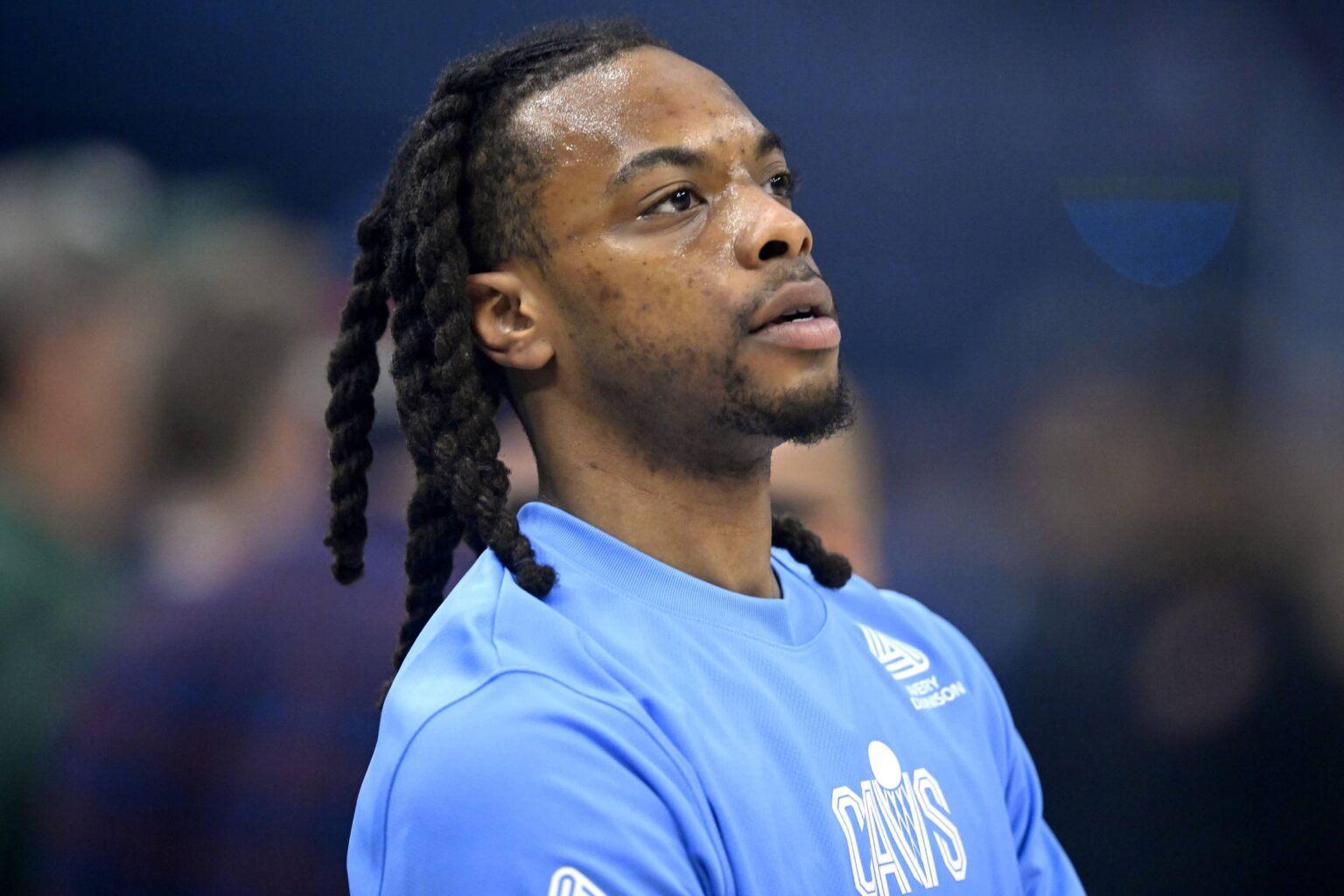
The Cleveland Cavaliers are supposed to be entering their prime, not answering awkward questions about whether their All-Star point guard even fits their future.
Darius Garland is back on the floor after toe surgery, but he still does not look like himself. This season, he is sitting at 14.0 points, 3.0 rebounds, and 6.2 assists per game on 35.3% from the field and 32.1% from three, a massive drop from last year’s elite efficiency.
The Cavaliers are 14-11 and just eighth in the Eastern Conference, carried mostly by Donovan Mitchell playing at an MVP level and Evan Mobley anchoring the defense. For a team that finished first in the East last season, that is a clear step back.
All of that is exactly why Garland’s name keeps popping up in trade chatter again. Brian Windhorst recently reported that the Cavaliers are at least listening to offers for Garland and are more open-minded than in past years, due to looming second-round apron restrictions and a very expensive core. Jake Fischer has echoed that idea, noting that while away is not close, Garland is no longer treated as completely untouchable.
Other reports have stressed that the Cavaliers are not aggressively shopping him, only taking calls, but that nuance does not change the bottom line. When a 25-year-old guard on a five-year, $197 million deal suddenly shifts from franchise cornerstone to “we will hear you out,” the rest of the league notices.
So the question now is not whether Garland is talented. It is which teams are realistic landing spots if the Cavaliers decide the fit and the money no longer make sense.
1. Orlando Magic
Proposed Trade Details
Orlando Magic Receive: Darius Garland
Cleveland Cavaliers Receive: Jalen Suggs, 2026 first-round pick (WAS rights to swap)
The Orlando Magic are 14-10 and sitting fifth in the Eastern Conference, with a profile that already looks like a legit playoff team. They score 117.8 points per game, sit 12th in offensive rating at 116.5, and 6th in defensive rating at 112.3, so the base is already there for something serious.
The Magic have size, length, and a star-level hub in Paolo Banchero, plus Franz Wagner playing at an All-Star level before his ankle injury. What they still lack in big moments is a true half-court organizer at guard. Garland fills exactly that gap, a pick-and-roll creator who can bend defenses, get Banchero easier looks, and keep the offense from stalling late in games.
Jalen Suggs is the reason this kind of offer feels realistic instead of laughable. This season, he is averaging 14.6 points, 3.8 rebounds, and 4.7 assists on 45.5% from the field, with his usual chaos on defense. He fights over every screen, guards the best perimeter player, and has clearly become the emotional tone setter of the Magic. Sending him out would hurt the locker room and the defense, but it also reflects how the front office might view his long-term ceiling. Suggs looks more like an elite two-way role player than a primary initiator. Garland gives the Magic a higher offensive ceiling and lets Suggs’ responsibilities be replaced by a committee with the rest of their long, versatile wings.
The single 2026 first-round pick is where the Cavs’ side of this starts to make sense. They get just one pick due to Suggs playing better than Garland and being less injury-prone right now, so the Magic can afford to move it without destroying their future flexibility. From Cleveland’s perspective, they get a cheaper, younger guard who fits cleanly next to Donovan Mitchell or a future star, plus another asset to play with later.
For the Magic, it is a calculated gamble. They trade their culture guard and a compromised first for a buy-low shot at a 25-year-old All-Star-level creator. If Garland shakes off the toe issues and gets back to his old form, this is the kind of move that can push the Magic into the top tier of the East.
2. Toronto Raptors
Proposed Trade Details
Toronto Raptors Receive: Darius Garland
Cleveland Cavaliers Receive: Immanuel Quickley, Ochai Agbaji, 2029 first-round pick (via TOR)
The Toronto Raptors are 15-10, sitting in the top four of the Eastern Conference and right in the middle of a surprise rise built around Scottie Barnes, Brandon Ingram, and a defense that has tightened up over the past month.
Immanuel Quickley has been huge for that turnaround, averaging 16.5 points, 4.2 rebounds, and 6.2 assists on 47.0% from the field this season while running more pick-and-roll and closing a lot of games as the primary guard. Trading him is not painless, but it is the sort of consolidation move you make if you believe Garland can still be an All-Star-level engine. For the Raptors, swapping Quickley for Garland is basically betting that a bigger creator with a deeper passing bag will raise their playoff ceiling around Barnes and Ingram.
For the Cavaliers, this version of a Garland move is quietly pretty clean. They are barely clinging to the eighth seed, living almost entirely off Donovan Mitchell playing the best basketball of his career at 30.5 points per game and elite efficiency. Garland’s season shows how far off his usual standard he has been while dealing with toe issues.
Quickley gives the Cavs a different type of point guard. He is more of a scoring guard than a pure table setter, comfortable spotting up, relocating, and attacking closeouts, which makes him a better off-ball partner for a ball-dominant star like Mitchell, who wants the rock in his hands as often as possible. Quickley can still run second units and pick on bench lineups, but he does not need the same usage Garland does to be effective.
Agbaji is the extra piece that makes the package feel complete for the Cavs. His box score this year is modest at 3.5 points and 1.9 rebounds, but he is a classic three-and-D wing who can defend up a position, hit open threes, and fill minutes on the perimeter without demanding touches.
Adding him to a rotation that already features Max Strus and De’Andre Hunter gives the Cavs more lineup versatility, especially in playoff series where they need fresh bodies to throw at big wings. The 2029 first-round pick is the long-term upside play, a chip the front office can either use in the draft or flip in a future deal. For the Raptors, the risk is obvious.
They would be giving up a thriving starting guard, a useful wing, and a distant first for a player who has not looked like himself this season. The upside is just as clear. If Garland regains his All-Star form, the Raptors walk away with a legitimate offensive star to pair with Barnes and Ingram and suddenly look a lot more dangerous in May.
3. Houston Rockets
Proposed Trade Detail
Houston Rockets Receive: Darius Garland
Cleveland Cavaliers Receive: Fred VanVleet, Reed Sheppard, Jeff Green, Josh Okogie
The Houston Rockets are sitting at 15 wins and 6 losses, first in the Southwest Division and fourth in the West, so they are firmly in contender territory even without a real traditional point guard on the floor. Fred VanVleet tore his ACL during a team minicamp in September and is widely expected to miss most if not all of this season, which leaves a giant hole in Ime Udoka’s backcourt.
Reed Sheppard has been fantastic as a stopgap, giving the Rockets 13.0 points and 3.3 assists per night, on 47.7% from the field and 44.6 from three. Still, as good as Sheppard is, nobody really believes his upside is the same as a former All-Star lead guard.
That is where Darius Garland becomes really tempting. Garland is only 25 and already has two All-Star appearances on his résumé, yet he is stuck in a weird year for the Cavs. For the Rockets, this is a classic buy-low swing. Put a healthy Garland next to Kevin Durant, Alperen Sengun, and Amen Thompson, and you suddenly have a long-term answer at point guard who can run pick and roll, organize the half-court, and still space the floor. To me, that is a far better fit than another James Harden reunion we recently broke down for the Rockets.
From a roster and cap standpoint, shipping out VanVleet, Sheppard, Jeff Green, and Josh Okogie consolidates four rotation slots into one star-level guard. It also clears enough room to eventually add one or two standard contracts, so you can imagine the Rockets taking fliers on names like Ben Simmons, Chris Paul, or Malik Beasley if they hit the market, while still keeping Amen Thompson and Tari Eason as their core wing defenders.
Amen is already averaging 17.4 points, 7.0 rebounds, and 5.1 assists with All-Defensive-level impact, and Eason was at 11.5 points and 5.2 rebounds before his oblique strain. I like this a lot for the Rockets: they cash in injured money and depth for a young star whose value is depressed, and if Garland gets back to his usual level, that backcourt plus Durant turns Houston into a real nightmare for the rest of the West.
4. Sacramento Kings
Proposed Trade Details
Sacramento Kings Receive: Darius Garland
Cleveland Cavaliers Receive: Malik Monk, Dennis Schroder, Devin Carter, Keon Ellis, 2027 first-round pick (SAC), 2031 first-round pick (via MIN)
The Sacramento Kings are 6–18 and sitting 13th in the Western Conference, a long way from the beam-team vibe they had a couple of years ago. With DeMar DeRozan and Zach LaVine carrying a lot of the scoring load and Domantas Sabonis still out injured, the Kings badly need a long-term lead guard who can actually run the show. Russell Westbrook is giving them energy, but at his age, he is a short-term stopgap, not the future of the position.
In previous breakdowns, we looked at cheaper point guard options for the Kings. This version is the exact opposite. This is the big swing that tries to solve the position in one move.
Garland would walk into Sacramento as the clear offensive organizer. Even in a down year, he is still a gifted pick-and-roll creator who can shoot off the dribble and pass out of tight windows. At twenty-five years old, he fits the same competitive timeline as Sabonis and LaVine and gives the Kings a guard who can actually control the game in the clutch.
A Garland-Sabonis two-man game surrounded by LaVine spacing the floor has real potential. It also gives the Kings a closing lineup that finally has a true point guard, not just scorers trying to make something happen late in games. Compared to another stopgap or a bargain bin option, this is the move that says the Kings want a real star at the position.
For the Cavaliers, this package is about depth and flexibility. Monk is averaging 13.3 points, 1.9 rebounds, and 2.4 assists while shooting 43.8% from the field and 39.6% from three, which gives the Cavs an instant microwave scorer off the bench. Schroder adds a different look at point guard with 12.4 points, 3.7 rebounds, and 6.0 assists per game, even if the 39.6% from the field is not pretty. Carter and Ellis are rotation fliers. Ellis brings a three-and-D profile, while Carter is a developmental guard who at least defends and competes, even if his shot has not come around yet.
Add two future firsts on top, and the Cavs suddenly have ammo for another trade or a softer landing if they need to retool around Donovan Mitchell. For the Kings, it is simple. They give up depth and picks for a shot at a real franchise point guard. If Garland hits, this is the kind of overpay that no one cares about in a couple of years.