Jonathan Kuminga didn’t waste a single second.
On Thursday, January 15, 2026, the exact first day his contract finally lets him get dealt, Kuminga reportedly told the Warriors he wants out. The timing is the whole point here; the trade deadline is February 5, so this thing just went from awkward to loud, fast.
And honestly, you can see how it got here. Kuminga has played only 18 games this season, and he’s been stapled to the bench for 13 straight. That’s not a “find your rhythm” situation, that’s a divorce waiting to happen.
He’s at 11.8 points, 6.2 rebounds, and 2.6 assists a night on 43.1% from the field, and the three-point number has been rough (27.6%).
The wild part is the Warriors aren’t even free-falling. They’re 22-19 and sitting 8th in the West, basically living in that stressful Play-In neighborhood where every move feels like it has to be a “win-now” upgrade.
So now the league’s about to do the thing it always does: connect the dots, leak the shortlists, and start tossing Kuminga into every roster like he’s a plug-and-play cheat code. He’s on the kind of deal that teams love to trade for because it stays flexible, and multiple teams have already been sniffing around.
That’s where this gets fun. Here are the five trade paths that actually make sense, not fantasy stuff, real hoops logic, real incentives, real “yeah, I could see that” energy.
1. The Kings Hit The Panic Button And Land Kuminga
Golden State Warriors Receive: Malik Monk, Keon Ellis, 2026 first-round pick (top-10 protected)
Sacramento Kings Receive: Jonathan Kuminga
This one basically writes itself because the groundwork is already out there. The Kings have been circling Kuminga for months, and the reporting has been consistent that the Kings stayed interested even as the situation dragged on. There’s even been chatter that Kings GM Scott Perry reached out to Warriors GM Mike Dunleavy Jr. as the eligibility date approached.
The holdup, every time, has been Malik Monk’s money. Multiple reports have framed Monk’s contract as the sticking point for the Warriors, who don’t want to lock themselves into long-term salary that messes with flexibility. The Warriors have been looking to bring back expiring contracts in return for Kuminga, per ESPN reporting. That’s why this version matters. If the Kings are going to ask the Warriors to swallow Monk anyway, they have to pay the “annoyance tax,” and that comes in the form of a real first-rounder with real downside.
And the downside is very real right now. The Kings have been a mess, sitting 14th in the West at 11-30, which turns that 2026 pick into something the Warriors can actually dream on. If the Kings keep spiraling, even a top-10 protection doesn’t completely kill the value, because the rollover to 2027 still keeps the Warriors in position to get a meaningful asset.
Contract-wise, this is clean and it matches what both sides have been dancing around. Kuminga is on $22.5 million this season. Monk makes $18.8 million in 2025-26, and he’s under contract with a player option down the line, which is exactly why the Warriors have hesitated. Keon Ellis is the extra value piece, a cheap contract at $2.3 million in 2025-26 that helps the Warriors justify the whole thing beyond “we took Monk because you begged us to.”
From the Warriors’ side, you’re basically turning a situation that’s already gone public into two rotation guards and a pick that could actually matter. Monk gives them instant creation and bench scoring, the kind of downhill pressure they’ve begged for when games get ugly. Ellis gives them a plug-and-play wing defender on a bargain deal, which is exactly the type of player good teams steal in trades when the other side panics.
For the Kings, this is the offseason story coming home to roost. They’ve flirted with a pivot toward a rebuild, and the overall direction has looked shaky for a while. Now they’re 14th, the vibes are weird, and the easiest way to sell “we’re not dead” is to grab a 23-year-old forward with real upside and let him run. Kuminga also reportedly had interest in Sacramento during his restricted free agency, so the fit isn’t random, it’s been on the board.
If the Kings are willing to attach the pick, the Warriors should do this fast. That’s the difference between a messy breakup and a clean win.
2. The Nets Get Their Young Core Swing For A Big Time Scorer
Golden State Warriors Receive: Michael Porter Jr.
Brooklyn Nets Receive: Jonathan Kuminga, Moses Moody, Al Horford, 2027 first-round pick swap
This is the funniest kind of trade idea because the biggest “report” attached to it is basically a denial, and that denial is exactly why it stays interesting.
Shams Charania wrote on ESPN today that the Warriors have not talked to the Nets in more than a month and have never shown real interest in trading for Michael Porter Jr.
Cool, that’s the public posture. Now look at the roster math and tell me it does not at least tempt them if things get ugly. The Warriors are trying to win right now, and Porter is one of the cleanest “add points without wrecking your spacing” players you can plug next to a star guard. The issue is not fit, it’s money, and it’s whether they want to commit to a big number for a wing who needs touches.
Porter is having a monster year. He’s at 25.7 points, 7.5 rebounds, and 3.3 assists per game, shooting 48.6% from the field. That’s not “nice third option” production, that’s legit high-end scoring output. And stylistically, he’s the exact type of shooter the Warriors love, movement threes, quick trigger, punishes help, forces rotations, opens cuts.
The Nets are sitting at 11-27, and the recent slide has been brutal, five straight losses and eight losses in nine games. When a team looks like that, it starts making sense to turn a high-usage scorer into multiple bites at the apple.
This package gives them that. Kuminga becomes the upside swing they can actually build around on the wing. Moses Moody gives them another young perimeter piece under control. Al Horford is basically the “make the math work” vet, plus he can still stabilize a locker room that would be leaning young.
Now the Warriors’ side. If they ever did warm up to Porter Jr., the basketball part is easy. He gives them size that actually scores, he makes defenses pay for collapsing, and he adds a scorer who does not need to dribble the air out of the ball. In a playoff game, that matters. A lot. The risk is also obvious: the contract is heavy, and once you take it on, you’re married to it.
Porter makes $38.3 million this season, and he’s also at $40.8 million in 2026-27. That is the whole conversation. If the Warriors do this, they are saying “we’re done messing around, we’re buying points.”
And the Nets sweeten it with the swap because they need to justify moving their best scorer. If I’m the Nets, I’m not doing this without that swap, because the output is the sacrifice. But if the swap is real, this is the type of aggressive gamble that can actually change a season fast.
3. The Bulls Flip An Expiring Big And The Warriors Fix Their Center Problem
Golden State Warriors Receive: Nikola Vucevic, Julian Phillips, 2028 second-round pick, 2029 second-round pick
Chicago Bulls Receive: Jonathan Kuminga
This is the kind of deadline deal that starts with one simple truth: the Warriors have reportedly looked for expiring contracts in any Kuminga talks. And that’s exactly what makes Nikola Vucevic a sneaky, realistic target, even if the Warriors haven’t been painted as a “dying to get him” team in past cycles.
On the Bulls’ side, the smoke is real. Jake Fischer has said Vucevic’s trade market has more “enhanced appeal” than in prior years. And it’s not hard to see why. He’s having a legitimately strong season at 16.9 points, 9.2 rebounds, and 3.7 assists per game on 50.3% from the field, and he’s also hitting 38.0% from three.
That’s a modern big who can score, space, pass, and punish switches. He also just delivered a walk-off bucket, the go-ahead layup with four seconds left to beat the Jazz, and has three game-winners this season.
Now connect it to Kuminga. The Bulls have been tied to him recently, with Jake Fischer noting prior Bulls interest and Joe Cowley reporting the team is still evaluating whether to make a real run at him. This framework fits both lanes at once: the Bulls get their young swing, the Warriors get the exact type of expiring they’ve been hinting at.
The contracts line up clean. Vucevic is on an expiring deal worth $21.4 million this season. Phillips is basically the extra flyer, and he’s cheap at $2.2 million. The two second-rounders are the sweetener that makes it feel like the Warriors didn’t just swap a talented wing for a rental.
Basketball-wise, I love the fit for the Warriors. Vucevic gives them a real pick-and-pop big who drags rim protectors out of the paint, plus he can run those high-post actions and handoffs that keep their offense moving when teams switch everything. He’s also a calming offensive hub for bench units, which matters a ton in playoff-style games where possessions get tight.
For the Bulls, Kuminga makes sense because they need a forward with real upside and real juice, not another safe “solid rotation” piece. He can be the athletic wing they actually prioritize, get featured reps, and grow into a bigger role without the constant “win-now” pressure breathing down his neck.
If the Warriors want the cleanest version of their reported expiring-contract plan, this is it.
4. The Warriors Skip Davis And Get A Real Center And A Bench Bucket
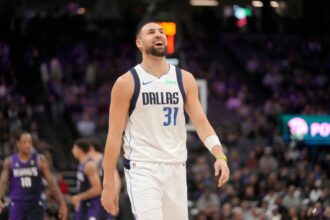
Golden State Warriors Receive: Daniel Gafford, Jaden Hardy, 2030 second-round pick (via 76ers)
Dallas Mavericks Receive: Jonathan Kuminga
If you want the cleanest “rumor-to-reality” bridge for this one, it’s simple: the Mavericks have been listed as a real Kuminga trade lane since the moment his eligibility date hit, and the idea keeps popping up because the Warriors need a center and the Mavs have extra bigs.
And let’s be honest, the Anthony Davis dream is the kind of thing fans yell into the void. In the real world, any Davis construction basically forces you to talk about Draymond Green, and that’s just not happening.
So if the Warriors want help at center without detonating their identity, Daniel Gafford is the practical answer. There’s even been reporting that ties Gafford directly to the Warriors’ center shopping list, with Chris Haynes linked to that exact target group.
Gafford solves an immediate problem: he’s a real rim runner who finishes everything, and this season he’s hitting 62.3% from the field while giving you 7.9 points, 6.4 rebounds, and 1.4 blocks in about 21 minutes a night. That’s not a “let him cook” player, it’s a “set a screen, dive hard, erase stuff at the rim” player.
On the Warriors, that fits like a glove. He gives them vertical spacing, makes life easier for their shooters, and actually punishes teams for switching small. Defensively, he lets them play more honest coverages because he can protect the rim without five helpers collapsing every possession.
Then comes the sneaky part: Jaden Hardy. The Warriors don’t just need a big, they need another creator. Podz is a smart organizer off the bench, but asking him to be a true scoring ball-handler every night is a lot. Hardy gives you the microwave points and some on-ball juice, and he’s at 6.4 points per game this season while hitting 38.9% from three. That’s the kind of bench piece who can swing a second quarter when the offense gets stuck, and it keeps Podziemski in his best role, the table-setter who keeps the unit steady.
Now the money, because it matters here. Daniel Gafford makes $14.4 million in 2025-26, and Jaden Hardy makes $6.0 million, so the Warriors aren’t taking on some backbreaking mega-salary just to get off Kuminga, they’re paying for real rotation value at two spots they actually need.
That kind of money is digestible for what it provides, a real rim-running center who changes their paint game and a bench scorer who can handle reps, and it keeps them away from the massive long-term wing contracts that would choke future flexibility.
For the Mavs, this is about upside and timeline. Kuminga becomes the athletic forward swing who can grow into a bigger usage role, and they get to sell their fanbase a real “new core” piece without pretending this roster is one tiny tweak away. They also avoid the awkward part of trying to juggle too many bigs at once, while still keeping their long-term ceiling flexible.
If the Warriors want to turn the Kuminga situation into immediate, functional help, this is one of the cleanest ways to do it.
5. The Lakers Pay The “Expiring Tax” For A Potential Starter
Golden State Warriors Receive: Gabe Vincent, Maxi Kleber, Dalton Knecht
Los Angeles Lakers Receive: Jonathan Kuminga, De’Anthony Melton
This one has been sitting in the rumor blender for a minute, and the reporting has basically lined up the logic in big neon letters. The Lakers have been linked to Kuminga as a real “monitoring” situation, with multiple outlets noting they’ve kept tabs on him as the deadline picture sharpened.
With the Warriors looking for expiring deals in return, this Lakers framework actually feels clean. It doesn’t ask the Warriors to adopt some scary long-term contract they don’t want, it hands them flexibility and a rookie-scale shooter they can develop.
The expiring part is the hook. Gabe Vincent makes $11.5 million, and Maxi Kleber makes $11.0 million. If the Warriors want to keep their books light and pivot again later, those are the kind of contracts you can live with. They also help the Warriors keep their options open for the summer, which matters if they want to take another swing without locking themselves into a multi-year cap prison.
Then you add the sweetener: Dalton Knecht. He makes $4.0 million in 2025-26 on his rookie scale deal. And the Lakers have already shown you, with zero subtlety, how they view him when they’re chasing an upgrade.
Knecht was the headline young piece in that Mark Williams trade package that got agreed to, then later rescinded. That doesn’t mean they hate him, itor means they’re willing to use him as the shiny asset when they’re trying to level up, and he keeps popping back up in deadline chatter as the guy other teams ask for.
For the Warriors specifically, Knecht is the type of shooter who can actually pop in their environment. They run stuff, they move bodies, they create those quick-hit looks, and a confident trigger guy becomes way more valuable when the system keeps feeding him clean windows. If you’re trading a talented wing, you want at least one piece who can realistically outperform his contract. That’s the case here.
From the Lakers’ side, the sell is simple: Kuminga gives them the athletic wing swing they’ve been missing, and they can talk themselves into the “new role, new leash” version of him. They also clear expiring money while consolidating into one higher-upside piece, which is usually how these deadline pushes work.
Final Thoughts
This whole Kuminga situation didn’t explode out of nowhere, it just finally ran out of places to hide.
The Warriors tried to sell the “development curve” story for two years, but the minute his role stopped being stable, the tension started stacking up. You could feel it in the way his minutes yanked up and down, the way every good stretch turned into a mini debate instead of a real runway, and the way the conversation shifted from “future piece” to “trade chip” without anyone saying it out loud. Once that happens, it’s basically over, because a young guy can live with mistakes, he can’t live with uncertainty.
And then the offseason turned everything into a pressure cooker. The contract stuff got loud, the league started treating him like he was available, and every report was basically code for “this is headed toward a divorce.” When you hit the first day he’s eligible to be moved and the demand comes immediately, that’s not emotion, that’s planning. That’s a player telling you he doesn’t believe the role will ever match the talent.
Now the Warriors have the worst kind of problem, it’s not just about value, it’s about control. If they wait, the market smells desperation. If they rush, they risk taking the wrong package just to make the noise stop. That’s why these trades all revolve around the same theme, expiring money, flexibility, and pieces that actually fit, because the Warriors can’t afford to take a deal that traps them while also losing a young asset for pennies.
The ugly truth is this: it went to hell because both sides wanted different versions of the same story. Kuminga wanted a bigger stage and a real leash. The Warriors wanted him to be patient while they kept chasing wins. Those timelines don’t coexist forever, and once they crash, it’s messy.
At this point, it’s not about whether the breakup happens. It’s about whether the Warriors can flip the chaos into something that helps them right now, and whether Kuminga lands somewhere that finally lets him be more than a guy waiting for permission.